General
Are Appraisals Public Record? What to Know
September 29, 2026
14 min read
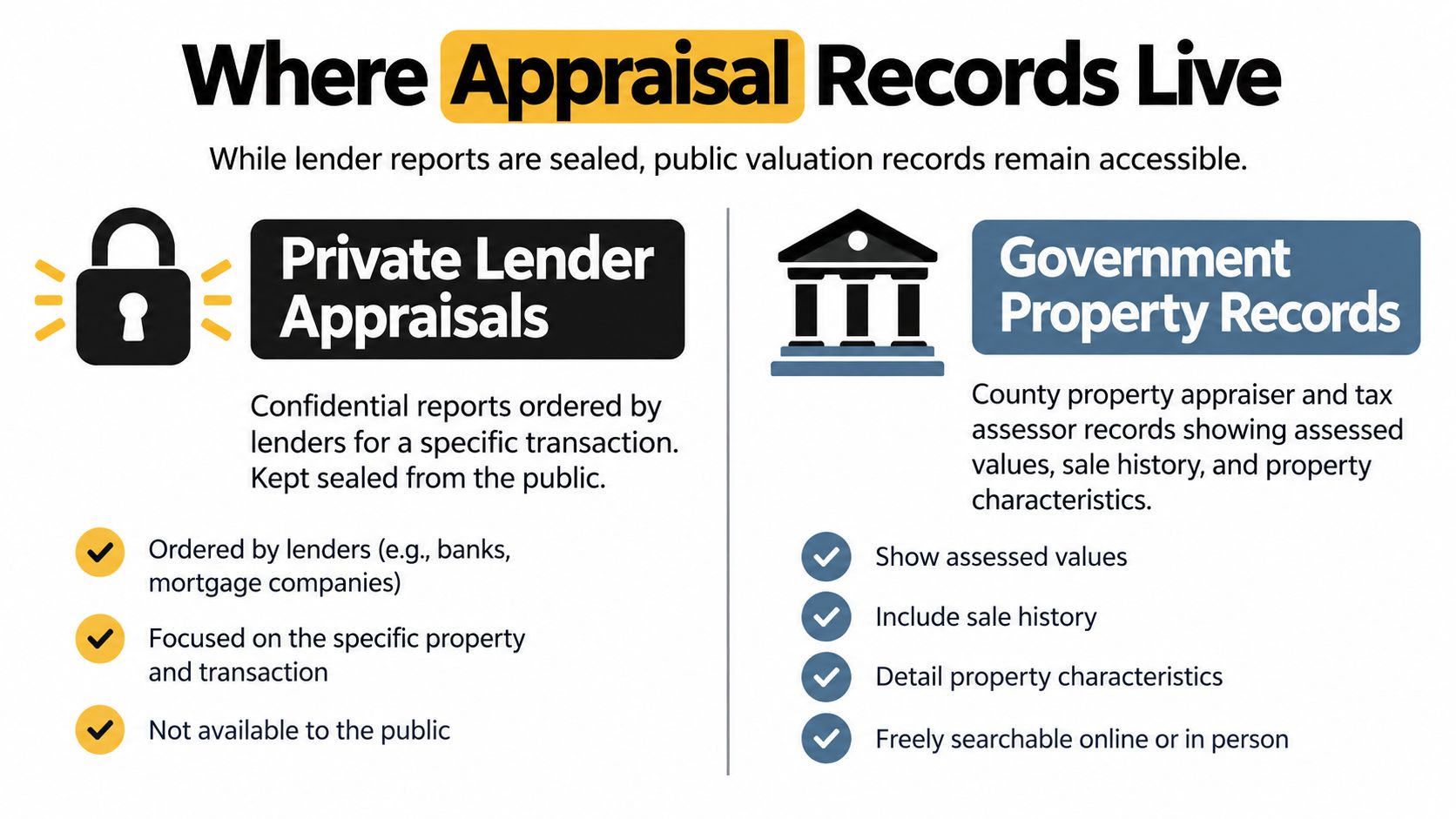
Private mortgage appraisals are generally confidential and aren't public record. Government-commissioned tax assessments and property appraiser records are generally public, although access can depend on the agency, state law, and whether a legal trigger has occurred.
You're looking at a property, trying to decide whether the seller's price is defensible, and someone tells you an appraisal already exists. The natural next question is, “Can I pull it?” Usually, you can't download the lender's report. You can, however, assemble a useful valuation picture from public records without seeing that report at all.
That distinction matters in acquisitions. Investors often waste time searching county websites for a private bank appraisal that was never required to be published. At the same time, they may overlook the public data that reveals a parcel's sales history, assessed value, land characteristics, building details, and other signals that influence underwriting.
The Short Answer on Appraisal Confidentiality
When people ask are appraisals public record, they're usually combining two different documents. A private lender appraisal is prepared for a specific financing assignment, while a government assessment or property appraiser record is maintained for public administration and taxation. The first is generally restricted. The second is often searchable.
A private appraisal typically follows the lending transaction. A bank, mortgage lender, or another authorized client orders the report to evaluate collateral for a purchase or refinance. The report isn't designed as a public valuation certificate, and it normally won't appear in a county's online property search.
Government records serve a different purpose. A county tax assessor or property appraiser may publish parcel information, assessed values, property characteristics, and sales history through a public portal. Those records aren't substitutes for a lender's market-value analysis, but they can give an investor enough context to screen a deal, identify comparable sales, and spot inconsistencies in the seller's assumptions.
Practical rule: First identify who ordered the appraisal and why. The same word, “appraisal,” can describe a confidential lending report or a government-held valuation record with very different access rules.
Separate the document before searching
Use this sequence before making a records request:
- Identify the client. Was the assignment ordered by a lender, a private party, or a government agency?
- Identify the purpose. Lending, taxation, acquisition, condemnation, and litigation can create different access outcomes.
- Identify the custodian. A bank or appraiser may hold a private report, while a county office or court may hold government records.
- Check for a trigger. A government appraisal may become public after a court filing, condemnation proceeding, or completed purchase agreement under applicable law.
That process is more productive than assuming every valuation tied to a property belongs in the public file. It also mirrors the distinction investors already make when researching whether deeds are public record. Ownership documents and valuation reports don't automatically share the same access rules.
The practical conclusion is straightforward. Don't plan an acquisition around obtaining a neighbor's lender appraisal. Plan it around verifiable public records, relevant comparable sales, property inspection, and a clearly documented valuation method.
Why Private Lender Appraisals Stay Confidential
A private lender appraisal is confidential because the appraiser is completing an assignment for an identified client, not publishing a market report for general inspection. Under USPAP-style confidentiality rules, the appraiser may disclose assignment results to the client, people authorized by the client, or third parties authorized by law. The general rule is described in this guidance on appraisal confidentiality.
That rule changes the answer for nearly every person outside the transaction. A curious neighbor can't normally request the report from the appraiser. A competing investor can't obtain it from a county portal. A seller may not automatically receive every version of a report just because the property is theirs, since access depends on the assignment relationship and applicable law.
Who may receive the report
The permitted audience usually centers on the assignment:
- The client: The party that engaged the appraiser receives the assignment results.
- Authorized recipients: The client can authorize other people or organizations to receive the report.
- Legally authorized third parties: A statute, court order, or another legal authority can create access that wouldn't exist through an ordinary public-record request.
- Other transaction participants: Their access isn't automatic. It depends on authorization, lender procedures, and the legal setting.
This is why a buyer may know that an appraisal was completed without having unrestricted access to the underlying report. A lender could share information within the financing process, but that doesn't convert the report into a publicly searchable document.
Confidential doesn't mean invisible
Confidentiality protects the assignment results. It doesn't erase every public fact connected to the property. The county may still publish a transfer, an assessed value, building characteristics, or other parcel-level information under its own disclosure rules. Someone reviewing those records might infer how a property compares with nearby transactions, but they still haven't obtained the lender's analysis.
That distinction protects both privacy and underwriting integrity. A lender's appraisal may include the appraiser's selection and reconciliation of comparable sales, analysis of condition, and professional judgment about marketability. Public records generally expose underlying facts in separate formats, not the appraiser's complete reasoning.
A public sale record can tell you that a transaction happened. It doesn't necessarily tell you why an appraiser considered that transaction comparable or how the appraiser reconciled differences.
For acquisitions, the failed approach is treating a private report as the missing piece that will solve every valuation question. Even if you could see it, the report was prepared for a particular assignment date, purpose, and client. A disciplined investor instead uses public data to build an independent estimate and treats any lender feedback obtained through the transaction as additional context, not a substitute for underwriting.
Accessing Government Property Appraiser Records
Government-held property records are the practical alternative when the lender report is unavailable. County property appraiser and tax assessor offices commonly make parcel-level information available through online portals, in-person offices, or records-request processes. The exact fields vary by jurisdiction, but public access may include sales history, land and building characteristics, assessed values, and related parcel information.
Some offices also publish records with protected information removed or redacted. Public access therefore isn't always an all-or-nothing question. A portal may expose useful property data while withholding an owner detail or another protected field, and the actual private appraisal report may remain confidential.
What to collect from a county portal
A basic property-record review should capture more than the current assessed value. Pull the parcel identifier, recorded transfers, reported building size and characteristics, land information, assessment history where available, and nearby sale records. Then compare those fields with the listing, inspection notes, photographs, and any documents supplied by the seller.
A useful review asks:
- Does the physical description match? Public square footage, room counts, condition descriptions, and improvement details can be incomplete or inconsistent.
- Do the sales make sense as comparables? A nearby sale may still belong to a different competitive market, property type, or condition segment.
- What does the assessment represent? An assessed value may serve a tax function rather than equal current market value.
- What remains hidden? The portal may show property facts without showing the private appraiser's comparable selection or final reconciliation.
The public-record property search workflow is useful for organizing this process, especially when you're reviewing multiple parcels rather than one potential purchase.
Public data is a proxy, not a verdict
Public records work well for screening and verification. They can expose an outdated listing description, reveal a prior transfer, or help you identify nearby properties that deserve deeper review. They don't eliminate the need to inspect the subject, validate condition, and confirm that the selected sales compete for the same buyer.
The strongest workflow treats records as evidence assembled from multiple sources. A county record is one input. Listing history, photographs, contractor opinions, zoning information, and direct market knowledge may change the conclusion. Investors should also preserve the date of each lookup because public records can be updated, corrected, redacted, or displayed differently over time.
A practical workaround isn't trying to reconstruct a confidential report word for word. It's building an auditable valuation file from the information you can lawfully access, then documenting where uncertainty remains.
Trigger Events That Make Appraisals Public
Confidentiality can change when a government entity commissioned the appraisal. Government acquisition work may be protected initially, then become public after a defined procedural event. That means the right question isn't only “is the appraisal public?” It's also “what happened after the appraisal was prepared?”
Minnesota provides a clear example. Appraised values prepared for government land acquisition are classified as confidential or nonpublic, but the status changes when the material is submitted in court, used in condemnation proceedings, or after a purchase-sale agreement is reached. The relevant Minnesota statute on appraisal records describes those access conditions.
The events that change access
For a government-commissioned appraisal, monitor the transaction for:
- A court submission. Once valuation material is filed in a judicial proceeding, it may become available through the court record, subject to the applicable rules.
- A condemnation proceeding. Eminent-domain litigation can move appraisal information from an internal acquisition file into a contested public process.
- A completed purchase-sale agreement. In the Minnesota example, reaching that milestone changes the confidentiality status of the appraised value.
- State-specific open-record rules. Other jurisdictions may use different triggers, exemptions, custodians, or redaction practices.
The timing creates a meaningful advantage for investors tracking public projects. A valuation that was unavailable during early negotiations may become accessible later, but waiting for disclosure can also mean missing the commercial opportunity. Public availability doesn't guarantee that the record is easy to locate, complete, or useful for a current private acquisition.
Read the legal setting, not just the document title
A file labeled “appraisal” doesn't tell you enough. Determine whether a public agency prepared it for land acquisition, whether litigation exists, and which office or court maintains the record. Then check the relevant state statute, agency notice, or clerk's filing system before assuming that a request will succeed.
County assessment databases are a separate category. Open-record frameworks can make county appraisal and assessment information broadly searchable in states such as Texas, Alabama, and Georgia, but that doesn't mean a private mortgage report has entered the same system.
Timing matters: A government appraisal may be confidential during negotiations and accessible after a defined legal milestone. Treat access as a status that can change, not as a permanent label.
For deal-making, record timing should influence diligence planning. If a public acquisition could affect a target area, save the currently available parcel and assessment data, track agency actions, and revisit the file after a possible trigger. Don't represent an anticipated disclosure as a confirmed valuation source.
How Investors Calculate ARV Without Private Reports
A fix-and-flip investor doesn't need a lender's confidential report to form an initial After Repair Value, or ARV. The investor needs a defensible set of comparable sales, a realistic view of the subject's finished condition, and a method for separating evidence from assumptions.
Start with the subject property, not the highest sale nearby. Record its location, property type, size, layout, lot, age, current condition, and the improvements planned after renovation. Public records can help establish basic parcel facts, but they should be checked against the property itself because recorded fields may not capture remodeling, deferred maintenance, additions, or functional problems.
Build the comp set around buyer competition
The nearest sale isn't automatically the best comp. A useful comp should compete with the renovated subject for the same buyer, which means reviewing neighborhood position, property type, size, layout, condition, and the features buyers pay attention to.
A practical comp review can follow this order:
- Define the competitive area. Start with the subject's likely buyer pool and expand only when local evidence supports it.
- Filter for finished condition. If ARV assumes a renovated home, prioritize sales that resemble the planned finish rather than distressed or untouched properties.
- Review the sale context. Investigate whether the transaction appears ordinary, unusual, heavily marketed, or affected by a special condition.
- Adjust for meaningful differences. A garage, extra bath, superior location, layout problem, or lot difference may matter more than a superficial distance match.
- Reconcile a range. Don't force a single sale to carry the entire conclusion.
Use automation, then apply judgment
A public-data platform can accelerate the mechanical work by pulling parcel facts, identifying candidate sales, weighting distance and recency, and presenting adjustment breakdowns. PropLab, for example, uses public records, tax data, and market signals to produce ARV, rehab estimates, maximum offer price calculations, risk indicators, and shareable reports without requiring MLS access.
That automation helps with speed and consistency, but it doesn't make inspection unnecessary. A system may flag a likely comparable, while an acquisitions manager recognizes that the property sits on a noisier road, has an inferior floor plan, or needs a level of renovation the record doesn't show. Those observations belong in the underwriting file.
Turn ARV into an offer decision
Once the comp analysis supports an ARV range, estimate repairs from the actual scope, add carrying and transaction assumptions, and apply the required margin. The result should be a documented offer ceiling, not a number selected because a confidential appraisal might support it.
The failed shortcut is asking an automated tool, or a public record, to provide certainty without verifying inputs. A reliable process uses automation to reduce search time, then checks the subject, comps, condition, and market context before submitting an offer. For a fuller framework, review how to calculate ARV and adapt the method to your investment strategy.
Building a Data-Driven Acquisition Strategy
The strongest acquisition teams stop treating private appraisals as the foundation of their pipeline. They use public records to find and verify opportunities, comparable-sale analysis to establish a market-supported range, and property-level diligence to test whether the projected finished value is realistic.
That approach has a clear division of labor. Public portals supply searchable facts. Automated analysis organizes those facts and surfaces relevant sales. Human review handles condition, competitive-market judgment, unusual transaction circumstances, and the questions no database can answer from a parcel number alone.
A repeatable operating rhythm
Use a property file that preserves the reasoning behind each decision:
- At intake, save the parcel record, sales history, listing details, and the date retrieved.
- During comping, record why each comparable was selected and identify differences that require review.
- During rehab underwriting, tie each repair assumption to visible conditions, contractor input, or a stated allowance.
- Before offering, calculate the maximum price from the ARV conclusion, repair scope, costs, and target margin.
- Before funding, give partners a concise report that separates verified facts from estimates and unresolved risks.
This system works because it doesn't depend on a document you probably can't obtain. It also gives lenders and partners something more useful than a vague statement that “an appraisal exists.” They can review the inputs, challenge the assumptions, and understand how the offer was formed.
The public-versus-private distinction should guide your expectations. A county record can support discovery and analysis, but it isn't a private lender's opinion. A government appraisal may become available after a legal trigger, but it still requires context. Good acquisitions practice combines accessible evidence with professional judgment instead of confusing visibility with validity.
PropLab helps investors turn public records, tax data, and market signals into ARV estimates, rehab assumptions, MAO calculations, risk indicators, and shareable underwriting reports without relying on a private lender appraisal. Visit PropLab to analyze properties and build a more defensible acquisition workflow.
Tags
About the Author
P
PropLab Team
Real Estate Analysis Experts
The PropLab team consists of experienced real estate investors, data scientists, and software engineers dedicated to helping investors make smarter decisions with AI-powered analysis tools.
Free tool
Pull comps for any address
Comparable sales with adjustments, ready to defend in front of a seller or a lender.