General
Flipping Houses Software: Tools, Features, and How to Choose
September 28, 2026
17 min read

You've got a property under contract, a lender waiting for numbers, and three different ARVs sitting in three different spreadsheets. One uses a wide radius, another leans on renovated listings that don't match the subject, and the third omits the repair scope entirely. By the time you reconcile them, another buyer has already submitted an offer.
That's the practical reason flipping houses software matters. The right platform doesn't just produce a fast profit number. It connects lead research, defensible comps, rehab assumptions, offer limits, lender reporting, and project tracking in one workflow. The wrong platform gives you a polished calculation built on weak evidence.
Why Flipping Houses Software Now Matters More Than Ever
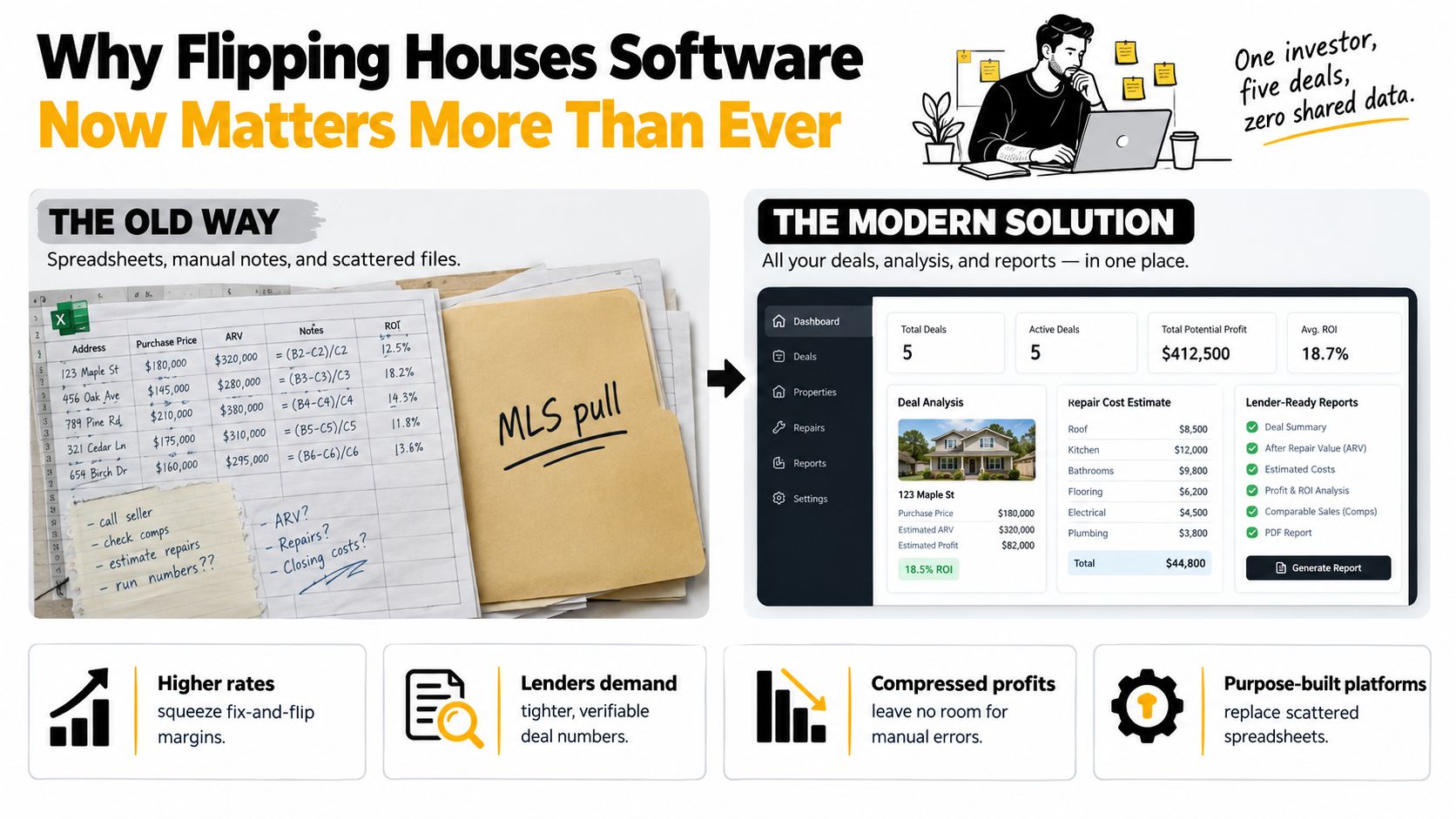
The fix-and-flip business has become less forgiving. ATTOM's 2025 data recorded about 297,000 flipped single-family homes and condominiums, down 3.9% from 2024, while flips represented 7.4% of home sales and produced an average gross profit of $65,981. The same coverage noted that volume had exceeded 407,000 homes in 2022 before declining as profitability tightened. CNBC's coverage of the ATTOM data makes the operating lesson clear: investors have less room for a bad purchase price, an optimistic ARV, or an uncontrolled hold period.
Financing conditions add pressure. The Burns + Kiavi Fix and Flip Housing Market Index, based on a quarterly survey of about 275 active flippers nationwide, fell from 63 in Q1 2026 to 59 in Q2 2026, marking a second consecutive quarterly decline. Industry coverage connected that softer sentiment with higher mortgage rates, which can affect deal flow, comparable-sales activity, and confidence in underwriting. Kiavi's Q2 2026 FFMI coverage shows why market-cycle signals belong beside property-level analysis.
The operating shift
Spreadsheets and manual MLS searches still have a place. They're useful for reviewing assumptions and developing market judgment. They're poor at keeping a team aligned when lead data, comp notes, rehab pricing, lender documents, and project costs live in separate systems.
Platforms such as PropStream, DealMachine, REI/Hubble, FlipperForce, and DealDash by HouseCanary approach the problem from different directions. Some begin with distressed-property data and acquisition workflows. Others focus on valuation, rehab management, or institutional reporting. Tools such as AI workflows for real estate investment fit into this broader shift toward faster, more structured underwriting.
A lender increasingly wants to see the reasoning behind your ARV, not just the final figure. Your report should identify the comparable sales, explain meaningful adjustments, show the rehab budget by category, and calculate a maximum offer that can survive a slower sale or higher carrying cost.
Operating rule: Speed wins the opportunity, but defensible numbers decide whether you should buy it.
The central tension is simple. Fast analysis without explainable valuation creates fast losses. Defensible analysis without workflow speed causes you to lose viable deals. Your software should solve both problems.
The Core Jobs Flipping Houses Software Must Do
A credible platform should handle five connected jobs. Treat them as a chain, not as an attractive list of unrelated features.
Lead discovery starts the process
The first job is finding properties that deserve review. Lead-generation tools pull public records, ownership data, equity indicators, liens, absentee-owner information, delinquency signals, and other indicators of potential motivation. Driving-for-dollars platforms add field observations, while list-stacking tools help acquisitions teams prioritize records that match several signals.
That is where PropStream and DealMachine generally stand out. Their advantage is pipeline creation, not automatic certainty that a property is a deal. A lead is only a research candidate until the valuation and inspection support it.
ARV needs adjusted comparable sales
The second job is estimating After Repair Value, or ARV. A useful comp engine should rank comparable sales by relevance and expose the logic behind the ranking. It should account for property type, size, condition, finished quality, location, sale recency, and unusual transactions.
Automated comps can perform well in homogeneous, high-transaction neighborhoods. They can be materially wrong where housing stock varies, recent sales are sparse, or distressed activity distorts the dataset. An independent review of real-estate comps software warns that even a 5–10% valuation error can jeopardize a tight-margin deal. New Silver's analysis of automated real-estate comps supports an essential requirement: choose a tool that shows confidence ranges, adjustment logic, and weighting factors, not merely one AVM-style number.
Rehab estimates must resemble real work
A rehab estimator should convert condition assumptions into a line-item scope. It needs categories such as demolition, roofing, mechanical systems, electrical, plumbing, kitchens, bathrooms, flooring, paint, exterior work, permits, and cleanup. A single “light,” “medium,” or “heavy” renovation label isn't enough for a contractor, lender, or partner.
Directional estimates help you screen opportunities. They don't replace a site visit, contractor input, or market-specific pricing.
Offer reports connect analysis to financing
The fourth job is producing a lender-ready report. That report should make the path from ARV to offer price easy to audit:
- Valuation evidence: Show selected comps, relevant adjustments, dates, distances, and outlier treatment.
- Project assumptions: Separate acquisition, repairs, financing, holding, selling, and contingency costs.
- Offer logic: Display the maximum allowable offer and the profit or risk assumptions behind it.
- Collaboration: Allow a partner or lender to review the same version through an export, PDF, or share link.
A fast calculation that can't be explained will slow the transaction later.
Post-close tracking completes the loop
The final job is execution. Track committed costs, paid invoices, change orders, draw requests, schedule items, sale preparation, and final performance against the original underwriting. That historical record improves future estimates because you can compare planned costs with actual costs by neighborhood, property type, contractor, and scope.
| Core Job | Typical Strongest Tool Category | Common Weakness |
|---|---|---|
| Distressed-lead discovery | Lead databases and driving-for-dollars platforms | Motivation signals don't prove deal quality |
| ARV and comps | Automated valuation and comparable-sales platforms | Sparse or mismatched comps can distort results |
| Rehab estimating | Rehab calculators and project-management tools | Directional costs may not reflect contractor bids |
| Lender reporting | Underwriting and offer-report platforms | Some reports hide methodology or adjustment logic |
| Project cost tracking | Construction and portfolio-management software | Acquisition tools may be weak after closing |
Integration decides whether the system fits your business. Check support for CRM sync, QuickBooks, Google Sheets, Zapier, contractor portals, and accounting platforms before signing up. A platform that creates good numbers but forces duplicate data entry can still slow your team.
The Leading Flipping Houses Software Compared
There isn't one universal winner. The strongest choice depends on where your workflow breaks first.
| Platform | ARV/Comps | Rehab Estimating | Offer Report | Pricing Tier | Best For |
|---|---|---|---|---|---|
| PropStream | Broad property data and comp research | Basic to moderate underwriting support | Useful for deal analysis, often needs review | Mid-market | Solo investors and acquisition teams |
| DealMachine | Lead data, driving-for-dollars, and comp workflows | Directional estimates | Practical offer workflow | Mid-market with add-ons | Field-focused wholesalers and flippers |
| REI/Hubble | Pipeline-centered, with connected deal analysis | Workflow dependent | CRM-oriented documentation | Mid-market | Teams needing follow-up discipline |
| FlipperForce | Strong rehab and project tracking | Detailed renovation management | Better for internal control than formal valuation defense | Mid-market | Rehab-heavy operators |
| DealWorthIt | Deal structuring and investment analysis | Useful scenario modeling | Stronger for structured decisions than raw lead generation | Mid-market | Investors comparing strategies |
| DealDash by HouseCanary | Advanced valuation and comp reporting | Less focused on construction execution | Institutional-grade reporting | Premium | Lenders, funds, and serious acquisition teams |
PropStream
PropStream is the best value for a solo flipper who already knows how to review comps. It combines property research, list building, comparable-sales access, and deal analysis in one familiar environment. It's especially useful when your bottleneck is identifying owners and properties rather than managing a large construction portfolio.
Its weakness is that speed can encourage shallow review. Treat its ARV as a starting point, then inspect the selected sales and confirm whether the finished quality truly matches your intended product. PropStream also leans toward acquisition intelligence, so teams needing detailed rehab execution may pair it with dedicated project software.
DealMachine
DealMachine makes sense for operators who generate leads in the field. Driving-for-dollars, skip tracing, property notes, and offer workflows can move a street observation into an acquisition conversation quickly.
The limitation is valuation depth. Its rehab estimate should be treated as directional, not as a contractor-ready bid. It's a strong front-end system for finding and contacting prospects, but it needs a disciplined comp review before you rely on the number.
REI/Hubble
REI/Hubble, formerly associated with REI BlackBook, is built around pipeline management and follow-up. It's a fit for wholesalers and acquisition teams that lose opportunities because leads aren't contacted, categorized, or advanced consistently.
It's less compelling as a standalone valuation authority. If the platform organizes your pipeline but doesn't provide the comp confidence and adjustment transparency your lender expects, use it as the CRM layer rather than the final underwriting layer.
FlipperForce and DealWorthIt
FlipperForce is the more natural choice for rehab-heavy operators. It helps turn an approved project into a controlled construction workflow, with budget tracking and project visibility that acquisition-first tools often lack.
DealWorthIt is more useful when you're comparing deal structures, financing assumptions, or exit strategies. Neither should be selected solely because it produces a quick ARV. The more complex your renovation, the more important it becomes to connect the initial estimate with actual costs and changes.
DealDash by HouseCanary
HouseCanary has the strongest valuation orientation in this group. DealDash is designed for users who need more than a quick comp pull, especially lenders, funds, and acquisition teams that need a report another decision-maker can audit.
That strength comes with a tradeoff. Premium valuation analytics won't manage every contractor, material purchase, or draw request for you. It's also more software than a low-volume solo operator needs.
For a broader framework on evaluating analysis platforms, this comparison of AI house-flipping analysis software is useful, but run every recommendation through your own deals and lender requirements.
Matching Software to Investor Type and Deal Volume
Choose software by the job you perform repeatedly, not by the length of a feature page. A wholesaler needs rapid lead qualification and follow-up. A rehabber needs cost control. A lender needs valuation evidence that survives scrutiny.
| Investor Type | Typical Volume | Best-Fit Tools | Why It Fits |
|---|---|---|---|
| Solo flipper | Under 5 deals per year | PropStream, DealWorthIt, budget analysis tools | Keeps research affordable and manageable |
| Part-time wholesaler | Several contracts monthly | DealMachine, PropStream, REI/Hubble | Prioritizes lead capture, contact, and pipeline movement |
| Full-time rehabber | Multiple active projects | FlipperForce, DealMachine, DealWorthIt | Connects acquisition analysis with renovation execution |
| Junior acquirer at a fund | Several simultaneous reviews | HouseCanary, PropStream Pro, REI/Hubble | Supports repeatable underwriting and team collaboration |
| Hard-money underwriting analyst | Loan pipeline across property types | HouseCanary, HouseCanary-powered analytics, PropStream Pro | Emphasizes defensible ARV and formal reports |
| Rental portfolio buyer | Ongoing acquisitions and operations | Stessa, Baselane, plus a dedicated comp tool | Adds portfolio accounting and property-level reporting |
Wholesale-first operators
If you win deals through list stacking, driving routes, and rapid contact, PropStream or DealMachine should be on your shortlist. REI/Hubble is valuable when your main failure is inconsistent follow-up rather than weak lead volume.
Don't force a wholesale CRM to become your valuation system. Once a property moves from “possible lead” to “offer candidate,” send it through a comp workflow that exposes adjustments and confidence.
Rehab-heavy flippers
Operators running active renovations need a clean handoff from acquisition to construction. DealMachine can work for a field-led operation, while DealWorthIt helps structure the deal and FlipperForce provides stronger project oversight.
The key question is whether you can compare your original budget with actual costs without rebuilding the analysis manually. If you can't, the software isn't teaching your business anything.
Funds and lenders
Small funds and hard-money shops should prioritize report defensibility, user permissions, standardized review, and exportable documentation. HouseCanary is the obvious premium candidate for valuation-heavy work. PropStream Pro may fit teams that need broad property research alongside underwriting.
Stessa and Baselane are more relevant for rental portfolio accounting than for primary flip valuation. They can complement an underwriting platform, but they shouldn't be mistaken for a full acquisition-to-sale system.
Selection rule: Build a shortlist of two or three tools for your exact workflow before comparing feature counts.
Pricing, Integrations, and Real Cost of Ownership
A low subscription price can be misleading. Your real bill includes data access, skip tracing, county coverage, seats, exports, integrations, and the time your team spends moving information between systems.
PropStream starts around $99 per month, but skip fees, county data fees, and a required $29.50 monthly access fee can push the practical cost above $150. DealMachine runs around $99 per month, with driving routes and list-stacking add-ons that can move actual spending toward $200–300 monthly. Real-estate software pricing comparisons also highlight the industry's shift toward collaboration artifacts such as PDFs, share links, and team workflows.
| Tool | Base Price | Key Add-On Fees | Notable Integrations |
|---|---|---|---|
| PropStream | Starts around $99/month | Skip tracing, county data, $29.50 access fee | Podio, Zapier, CRM workflows |
| DealMachine | Around $99/month | Driving routes, list stacking, contact data | CRM and automation connections |
| REI/Hubble | Commonly mid-market | Plan and seat dependent | CRM and follow-up workflows |
| FlipperForce | Commonly $99–199/month | Usually feature or seat dependent | Project and contractor workflows |
| HouseCanary | Roughly $250–500/month | Reports and API usage | Argyle, Plaid, lending LOS systems |
| Rehab Valuator | Starts near $49/month | Plan dependent | Spreadsheet-oriented workflows |
| Stessa | Portfolio software tier | Plan dependent | QuickBooks and accounting workflows |
| Baselane | Portfolio software tier | Plan dependent | QuickBooks and Xero |
Calculate the economic threshold
If your operation closes under $500,000 in annual profit, keeping software spending below $1,500 per year is a sensible discipline. Investors above $1 million in annual profit may justify $5,000–15,000 per year when the platform produces measurable velocity gains. Those thresholds come from the provided industry guidance, not a universal accounting rule, so compare them with your own margins and staffing costs.
The right calculation is:
subscription + data and skip fees + team seats + MLS fees + integration costs + internal admin time
Check the exit path
Ask for data-export rights before you import your entire pipeline. Confirm whether you can export contacts, notes, comp records, budgets, reports, and project history in a usable format. Vendor lock-in becomes expensive when a team outgrows a single-user tool or changes its CRM.
Integrations matter most at handoff points. QuickBooks and Xero connections support accounting workflows through platforms such as Stessa and Baselane. PropStream and DealMachine can connect with CRMs, Podio, and Zapier. HouseCanary's connections to lending systems matter when underwriting must move into a formal loan process.
Red Flags, Accuracy Limits, and Smart Verification Habits
No software can see through a wall, judge workmanship from a listing photo, or know whether buyers in a small neighborhood will accept your finish level. The danger starts when a platform presents uncertain output with false precision.
Watch for four warning signs:
- Retail-only comps: The model excludes distressed sales and uses polished renovated properties that exceed your planned finish quality.
- Static rehab numbers: The estimator produces nearly identical budgets across markets, property sizes, and condition levels.
- Stale sales: The tool uses older comps without explaining market-time adjustments.
- Opaque reports: The offer sheet gives you a number but no methodology note, adjustment trail, or confidence signal.
HouseCanary's valuation logic is more rigorous than a basic calculator, but it still can't fully capture condition and quality adjustments. PropStream is fast, but an optimistic output in B and C neighborhoods can create an inflated offer ceiling. DealMachine's renovation estimate is useful for screening, not for replacing a contractor's scope.
A strong verification habit is to compare software output with direct MLS review and your own market knowledge. For off-market deals without MLS access, demand transparent data inputs, distance and recency weighting, adjustment breakdowns, and confidence scoring. This guide to data-quality assessment is useful when you're auditing the reliability of the records behind a model.
Never approve an offer because the interface looks precise. Approve it because you can defend the inputs.
Track performance after the sale. Record the submitted ARV, actual sale result, projected rehab, final rehab, hold period, and reasons for variance. If your tool repeatedly misses in one neighborhood or property type, adjust the process or replace the tool. A software score is only useful when it improves your decisions.
How to Pick the Right Flipping Houses Software
Don't choose from a brochure. Run a 10-day, three-deal stress test using the same properties across every platform you're considering. Use one MLS-listed flip, one off-market wholesale target, and one rental-grade fixer, then compare the output with your manual underwriting and actual contractor input.
Score each platform on five practical criteria:
- Valuation defensibility: Can you identify why each comp was selected and how the model adjusted it?
- Workflow speed: Can you move from address to reviewable offer without duplicate entry?
- Useful integrations: Does it connect with the CRM, accounting system, spreadsheet, or lender workflow you already use?
- Cost per seat: What will the full team pay after data fees, add-ons, and exports?
- Exit flexibility: Can you export the records if your operation changes?
The stress test should expose weaknesses quickly. Compare the ARV with your own manual comp set. Compare the rehab output with contractor bids. Send the offer report to a hard-money lender and ask whether the assumptions are clear enough to underwrite. Don't judge a tool by how attractive the dashboard looks.
For renovation decisions, your valuation should also reflect the work buyers can see and pay for. If your project includes kitchens, bathrooms, or other upgrades that materially affect resale appeal, use a practical resource on how to raise your home's value before selling alongside local sales evidence. A prettier finish doesn't automatically justify a higher ARV unless comparable buyers have paid for that quality.
Solo operators should favor low-cost, single-user tools with transparent exports. Teams managing 20 or more projects need role-based access, project management, standardized reports, and draw-request automation. Don't pay for institutional analytics if your business can't use the reporting, and don't expect a basic lead database to manage a complex rehab portfolio.
PropLab combines ARV analysis, rehab estimates, MAO calculations, confidence scoring, adjustment breakdowns, and lender-ready reports in one workflow, with a free tier and paid plans for expanded use. If you want to test valuation speed and defensibility on your own deals, visit PropLab and run your next property through the platform before you make the offer.
Tags
About the Author
P
PropLab Team
Real Estate Analysis Experts
The PropLab team consists of experienced real estate investors, data scientists, and software engineers dedicated to helping investors make smarter decisions with AI-powered analysis tools.
Free tool
Stop guessing rehab costs
Get a line-item renovation estimate from the property details — no contractor walkthrough needed.