General
Profit Margin Analysis: A Real Estate Guide for 2026
September 25, 2026
13 min read
You've found a property that looks like a winner. The neighborhood is improving, comparable sales support the resale price, and the seller's asking price leaves room for renovation. Then the contractor revises the estimate, the permit takes longer than expected, and the projected profit starts disappearing before the first wall comes down.
That's why profit margin analysis matters in real estate. It isn't just a formula for confirming that a deal looks attractive. It's a risk filter that tells you how much room remains after repairs, financing, holding, selling, and the other costs that turn a promising property into a weak investment.
Why Profit Margins Decide Your Investment Success
An investor can fall in love with a property long before the numbers deserve that commitment. A low purchase price, a favorable location, or a dramatic renovation concept can create the feeling that profit is already waiting. But the relevant question isn't whether the property could sell for more after improvements. It's whether the spread between total project cost and resale value is wide enough to absorb mistakes.
Suppose your first pass shows a comfortable difference between the expected After Repair Value, or ARV, and the proposed purchase price. That difference can shrink quickly once you include demolition, permit work, material waste, financing, insurance, utilities, taxes, closing costs, and the time required to sell. A property with attractive headline potential can leave you with a margin too thin to survive an ordinary setback.

The spread is not the profit
The spread is only the starting point. Your actual profit is what remains after every required dollar has been assigned to the project. That distinction separates disciplined investors from buyers who justify an offer with an optimistic resale price.
A useful way to audit the difference is to ask why profits don't match revenue in other businesses. The same principle applies to a flip, where the resale proceeds are revenue and the full project budget determines what you retain. This explanation of why profits don't match revenue is useful because it reinforces a point investors often overlook: a strong top line can conceal weak economics underneath.
Practical rule: Don't ask whether a deal can make money. Ask whether the margin remains acceptable after your least convenient reasonable assumptions.
Profit margin analysis gives you that answer before you write a check. It forces you to define your target return, calculate the maximum price you can pay, and reject deals that depend on everything going perfectly. In real estate, the math isn't pessimism. It's your first layer of protection against overpaying.
Core Concepts of Real Estate Margin Analysis
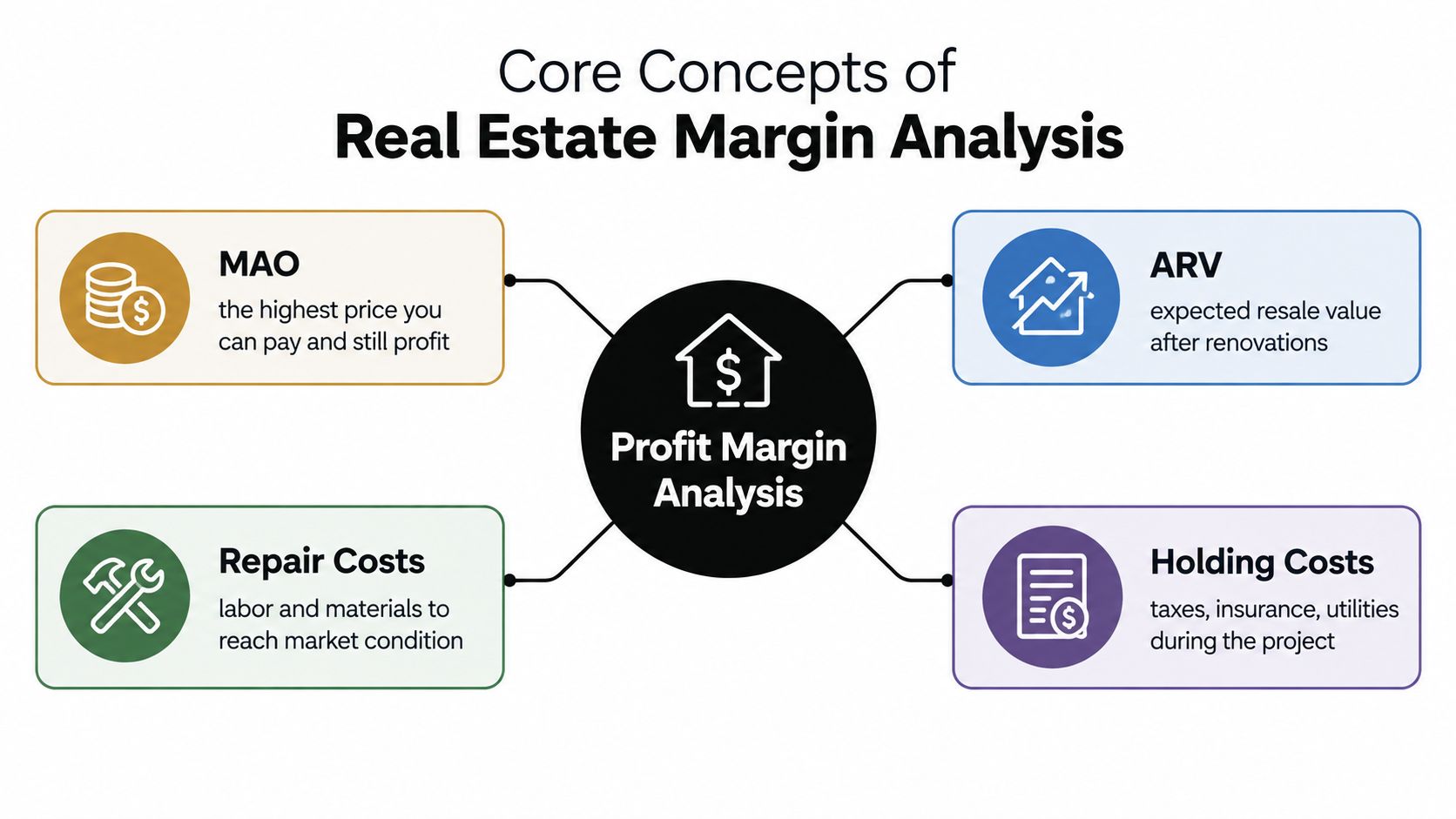
Start with four terms that belong in every acquisition conversation: ARV, repairs, holding costs, and Maximum Allowable Offer, or MAO. ARV is your estimate of the property's resale value after the work is complete. Repairs cover the labor and materials required to reach the intended market condition. Holding costs include the expenses of owning the property during renovation and sale.
MAO is the highest price you can pay while still preserving the profit you require. A practical structure is:
MAO = ARV − repairs − holding costs − selling and financing costs − target profit
Some investors use the 70% rule as a quick screening shortcut. In simplified form, it treats the purchase price, repairs, and desired margin as a portion of ARV. It can help eliminate obviously weak opportunities, but it shouldn't replace a property-specific budget. Taxes, financing terms, local closing costs, project duration, and the property's condition can make a rule-of-thumb estimate misleading.
Use the margin stack, not one headline number
For broader financial analysis, use a layered ratio stack:
- Gross margin:
(revenue − cost of goods sold) / revenue, showing what remains after direct costs. - Operating margin:
operating income / revenue, isolating core business efficiency before interest and taxes. - Net margin:
net income / revenue, showing what remains after all expenses.
Real estate underwriting adapts this logic rather than copying a company income statement. The property-level equivalent is to separate resale value from direct renovation costs, operating and carrying expenses, financing, selling costs, and the final profit. That separation shows whether the deal is losing value through construction, overhead, financing, or an unrealistic resale assumption.
Keep cost categories consistent across every property you review. Missing direct costs, misclassifying overhead, inconsistent categories, and mismatched timing can distort the result. A practical reference on Snyp cost control measures can help when you're building a repeatable system for tracking expenses instead of relying on scattered spreadsheet notes.
Calculating MAO and Identifying Hidden Costs
A deal can show an attractive resale value and still fail before closing. The reliable starting point is a defensible ARV, not the seller's asking price. Review comparable properties that match the subject's location, size, layout, condition, and buyer appeal. Adjust for meaningful differences instead of choosing the highest sale and treating it as the expected result.
Build the calculation in layers
Use this sequence:
- Estimate ARV. Select comparable sales that reflect the finished property you plan to deliver. The renovation scope and the comparable set should describe the same product.
- Subtract the full rehabilitation budget. Include structural work, systems, finishes, labor, design, permits, inspections, hauling, and cleanup. Add a contingency that reflects the property's uncertainty. Do not bury risk in a vague “miscellaneous” line.
- Deduct your required profit. Set the target before negotiating. The purchase price must support the investment objective, rather than leaving profit as whatever remains.
- Reserve transaction and carrying costs. Include acquisition closing costs, loan costs, interest, taxes, insurance, utilities, maintenance, listing expenses, commissions, seller concessions, and ownership costs through closing.
- Treat the balance as your MAO. If the seller wants more, the property does not meet your required margin at that price.
The hidden costs often matter more than the visible renovation line. Contractor estimates may cover labor and major materials while excluding permit fees, engineering, waste removal, temporary protection, appliance installation, landscaping, or inspection corrections. A delayed project adds interest, taxes, insurance, utilities, and other carrying expenses even when the construction budget stays unchanged.
A low repair estimate doesn't create margin. It creates exposure.
Make every assumption traceable
Create a separate line for each cost category and record how you estimated it. Use contractor bids where possible, confirm permit requirements with the local authority, and distinguish known costs from assumptions. If a figure depends on an uncertain condition, label it and test the deal with a less favorable input.
Tools can reduce mechanical work. PropLab estimates ARV values within 3-5% of actual sales and provides instant Max Offer Price calculations derived from ARV minus repairs with built-in profit margins, according to PropLab's published product information. Treat the output as a screening aid, then verify the comparable sales, renovation scope, and local conditions yourself.
For a deeper explanation, review how maximum offer price is determined. The final decision remains with the investor. A fast calculation is only as reliable as the assumptions entered into it.
Real-World Deal Example and Profit Breakdown
Consider a hypothetical fix-and-flip with an estimated ARV of $300,000. The investor expects to acquire the property for $150,000, spend $60,000 on rehabilitation, and incur $20,000 in holding, financing, and selling costs. The projected profit is therefore $70,000, calculated as $300,000 minus total costs of $230,000.
The projected profit margin on resale revenue is 23.33%, calculated as $70,000 divided by $300,000. That margin looks meaningful, but it only holds if the ARV and budget are credible.
| Cost Category | Amount | % of Total |
|---|---|---|
| Acquisition | $150,000 | 65.22% |
| Repairs | $60,000 | 26.09% |
| Holding, financing, and selling costs | $20,000 | 8.70% |
| Total investment cost | $230,000 | 100% |
| Projected profit | $70,000 | Not a cost |
Read the structure, not only the result
The repair budget consumes a substantial share of total investment cost. That makes scope accuracy critical. If the investor underestimates the work, the error doesn't affect a minor line item. It directly reduces the profit that justified the acquisition.
The same applies to ARV. A resale estimate based on superior finishes, a better layout, or a more desirable condition than the selected comparables can make the margin look stronger than the finished product will support. The underwriting must connect the renovation scope to evidence from the market.
A proper deal review would also separate the broad cost categories into detailed lines. Acquisition may include inspections and closing charges. Repairs may include permits, labor, materials, and waste. Holding and selling costs may include loan charges, taxes, insurance, utilities, marketing, commissions, and final closing expenses.
The example demonstrates the workflow, not a guaranteed outcome. A disciplined investor would preserve the margin by reducing the MAO if the budget becomes less certain or the comps fail to support the assumed resale condition. Profit margin analysis works when it changes the offer, not when it merely confirms a price you already want to pay.
Sensitivity Testing for Market Uncertainty
A deal that works under one forecast may fail under a modest change in a key assumption. Sensitivity testing exposes that weakness before your capital is committed. Rather than producing one polished projection, build alternative cases for resale value, repair costs, and project duration.
Test the variables that can move the result
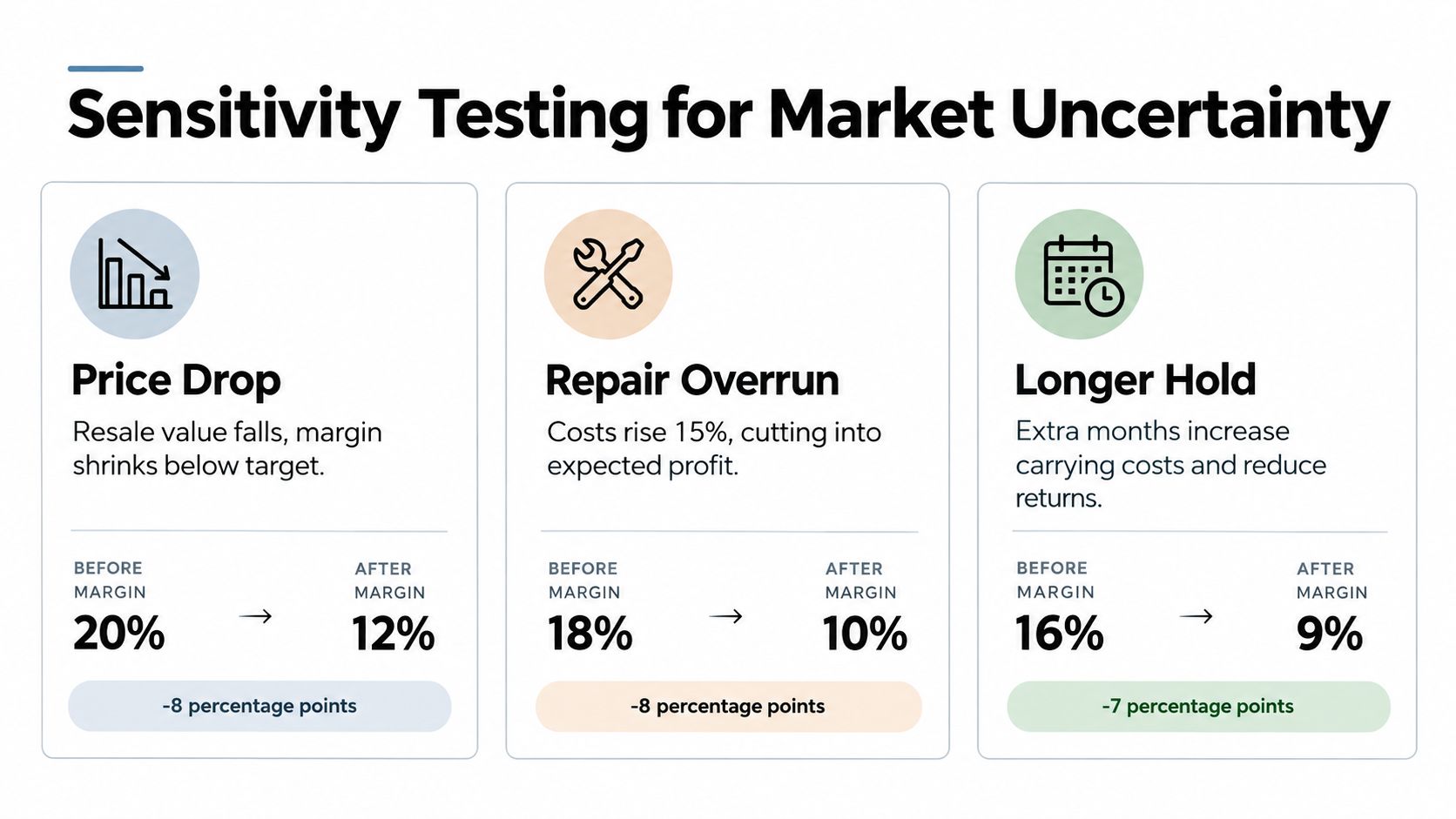
Use three direct stress tests:
- Price reduction: Lower the expected resale value and recalculate profit. This tests whether your comps provide genuine support or whether the deal depends on the most favorable sale.
- Repair overrun: Increase the renovation budget by 15%, then measure the effect on profit and margin. This scenario is specifically useful when the inspection was limited or the scope includes older systems.
- Longer hold: Extend the project timeline and add the resulting carrying costs. A delayed permit, slow contractor schedule, or longer listing period can erode returns without changing the purchase price.
The right response isn't always to reject the property. You might reduce the offer, simplify the scope, improve the contractor controls, or require stronger evidence for the ARV. What matters is knowing which lever causes the deal to fall below your threshold.
A deal is safer when its acceptable outcome doesn't depend on the best-case scenario.
Compare outcomes side by side
Create a small scenario grid with the base case, downside ARV, higher repairs, and longer hold. Record total cost, projected profit, and profit margin for each version. The comparison tells you whether risk is concentrated in one assumption or spread across several.
For uncertain estimates, confidence ranges can make the analysis more honest than a single precise point estimate. This guide to confidence intervals offers useful context for thinking about valuation uncertainty. Use that uncertainty to set the offer, not to decorate the report.
Margin durability matters because price gains may be temporary. Research cited by Bain says many firms matched or exceeded input cost inflation through price increases in 2025, while global corporate margin expectations were reported to have contracted by an estimated 64 basis points in 2025. The broader lesson applies to real estate: a favorable headline margin can reverse when market conditions, buyer demand, or competitive pricing changes. Bain's pricing and commercial excellence analysis provides that context.
Pre-Offer Checklist to Protect Your Margin
Before submitting an offer, challenge the assumptions that support your MAO. The strongest underwriting process is usually less about complicated formulas and more about refusing to leave critical questions unanswered.
Verify the resale thesis
- Review comparable sales: Confirm that the properties reflect the same location, finished condition, layout, and buyer profile.
- Match scope to comps: Don't underwrite luxury finishes while relying on ordinary renovated sales, or assume a basic renovation will achieve premium pricing.
- Check the marketability: Consider access, parking, floor plan, lot characteristics, and features that buyers in the area value.
- Test the exit: Estimate selling costs and ask whether the expected listing strategy fits local demand.
Inspect the cost base
- Walk the property carefully: Look for foundation, roof, electrical, plumbing, HVAC, moisture, structural, and environmental concerns.
- Confirm permits: Verify which work requires permits, inspections, engineering, or zoning approval before assigning a start date.
- Obtain trade input: Use contractor estimates that describe scope, materials, labor, exclusions, and timing.
- Separate known and unknown costs: Mark uncertain items instead of burying them in a generic contingency.
- Budget the hold: Include financing, taxes, insurance, utilities, maintenance, and the possibility of a delayed sale.
Finally, compare your calculated MAO with the seller's expectation without adjusting your math to make the deal fit. If the numbers don't support your required margin, walk away or renegotiate. The cost of losing one property is usually easier to absorb than the cost of buying an underwritten disappointment.
Streamlining Analysis with Smart Tools
Manual underwriting remains useful for understanding a deal, but it becomes fragile when you copy figures between spreadsheets, switch between comp sources, and update repair assumptions in separate tabs. A repeatable workflow should keep valuation, scope, holding costs, selling expenses, and profit targets connected.
The best setup combines automation with human review. A tool can organize public records, surface comparable sales, calculate scenarios, and produce a report. It can't inspect a foundation, validate a contractor's scope, or know whether a buyer will reject the finished layout. Those judgments still require local knowledge and direct diligence.
Automate repetition, not responsibility
A practical workflow looks like this:
- Capture the property address, condition, intended scope, and exit strategy.
- Pull and review relevant comparable sales.
- Estimate ARV and record the reasoning behind the selection.
- Add repair, holding, financing, selling, and acquisition costs.
- Calculate MAO against the required profit.
- Run downside scenarios before contacting the seller.
- Export a clear report that partners, lenders, and acquisition staff can audit.
PropLab is one option for this workflow. It estimates ARV, helps estimate rehab costs, calculates an MAO using ARV, repairs, holding costs, selling costs, and desired profit, and produces offer-ready reports. Its public-record and market-signal approach doesn't require MLS access, and its outputs include comp details, adjustment breakdowns, confidence scoring, red flags, and condition indicators according to the provided product information.
For a broader tool comparison, review real estate analysis tools for 2026. The useful question isn't whether software can eliminate underwriting. It's whether the workflow helps you review more opportunities without lowering the standard applied to each one.
Profit margin analysis should end with a decision, not just a percentage. If the margin survives realistic cost and market tests, the MAO gives you a clear negotiating limit. If it doesn't, the analysis has still done its job by keeping you from paying for potential that the numbers can't protect.
PropLab brings ARV estimation, rehab budgeting, MAO calculation, risk indicators, and offer-ready reporting into one underwriting workflow. Visit PropLab to evaluate potential deals faster, stress-test your assumptions, and make offers that preserve the margin you need.
About the Author
P
PropLab Team
Real Estate Analysis Experts
The PropLab team consists of experienced real estate investors, data scientists, and software engineers dedicated to helping investors make smarter decisions with AI-powered analysis tools.
Free tool
Get the ARV of any property in 30 seconds
Skip the spreadsheet. Enter an address and get an after-repair value backed by real comps.
