General
Real Estate Appraisal Comps: A Practical Guide
September 23, 2026
16 min read
“Use three closed sales from the last 90 days within one mile.” That advice is easy to remember, but it can produce a fragile valuation when the local market has too few transactions, prices are moving quickly, or the available sales differ materially from the subject property. Recent industry coverage reports that appraisers have been missing about 30% of the normal number of sales, leaving fewer usable comparisons and increasing the risk that closed-sale data reflects yesterday's market rather than today's buyer demand (Appraisal Today).
Professional real estate appraisal comps analysis is not a search for three convenient addresses. It's a process of selecting evidence, adjusting for meaningful differences, weighting the strongest signals, and documenting why the conclusion deserves trust. That distinction matters to a fix-and-flip investor calculating After Repair Value, a wholesaler setting a maximum offer, and a lender deciding whether the collateral supports the loan.
Why the Simple Comp Rules No Longer Hold
The familiar shortcut has a useful purpose. Recent, nearby, closed sales can provide a clean picture of what buyers paid for properties that competed with the subject. The problem starts when investors treat the shortcut as a rule that overrides judgment.
A one-mile search can cross a school boundary, a highway, a flood zone, or a neighborhood with a different housing stock. A recent closing can also be a poor match if it has a different condition level, lot configuration, view, floor plan, or buyer motivation. In a thin market, forcing that sale into the analysis doesn't create precision. It hides uncertainty behind a precise-looking number.
The evidence from appraisal practice supports a broader view of comp selection. The Enterprises require only three comparable sales, yet an FHFA analysis of appraisals connected to Enterprise-backed mortgages found that more than two-thirds of appraisals from 2013 through 2021 included five or more comparables (FHFA). The share declined from 76% in 2013 to 59% in 2021, a 17-percentage-point decrease, but the pattern still shows that many appraisers use a wider pool than the minimum.
Practical rule: Three sales may satisfy a minimum expectation. They don't automatically provide a defensible valuation.
What breaks in a thin market
Closed sales record negotiated outcomes from earlier decisions. The property may have gone under contract weeks before closing, and the buyer may have negotiated under conditions that no longer exist. When transaction volume falls, that time lag becomes more consequential because each sale carries more influence.
Investors often make a second mistake here. They expand the radius until they find higher prices that support the renovation plan, without proving that buyers see the distant neighborhood as a substitute. A better response is to widen the evidence carefully, then explain the tradeoff between recency, similarity, and location.
The rules taught in real estate school remain useful starting points. They're insufficient for underwriting a specialized renovation or defending a lender file when the obvious comp pool is shallow. A credible conclusion may require older but highly similar sales, newer but less similar sales, pending contracts, active competition, and documented market-condition reasoning.
How Appraisers Select Comparable Sales
Appraisers don't select comps by distance alone. The sales comparison approach starts with properties that are similar in legal, physical, and locational characteristics, then adjusts material differences before reconciling the results into a value opinion. The Appraisal Institute's professional guidance and FHFA materials both emphasize the importance of accounting for factors such as location, size, condition, concessions, and buyer or seller motivations.
Start with a search, then apply judgment
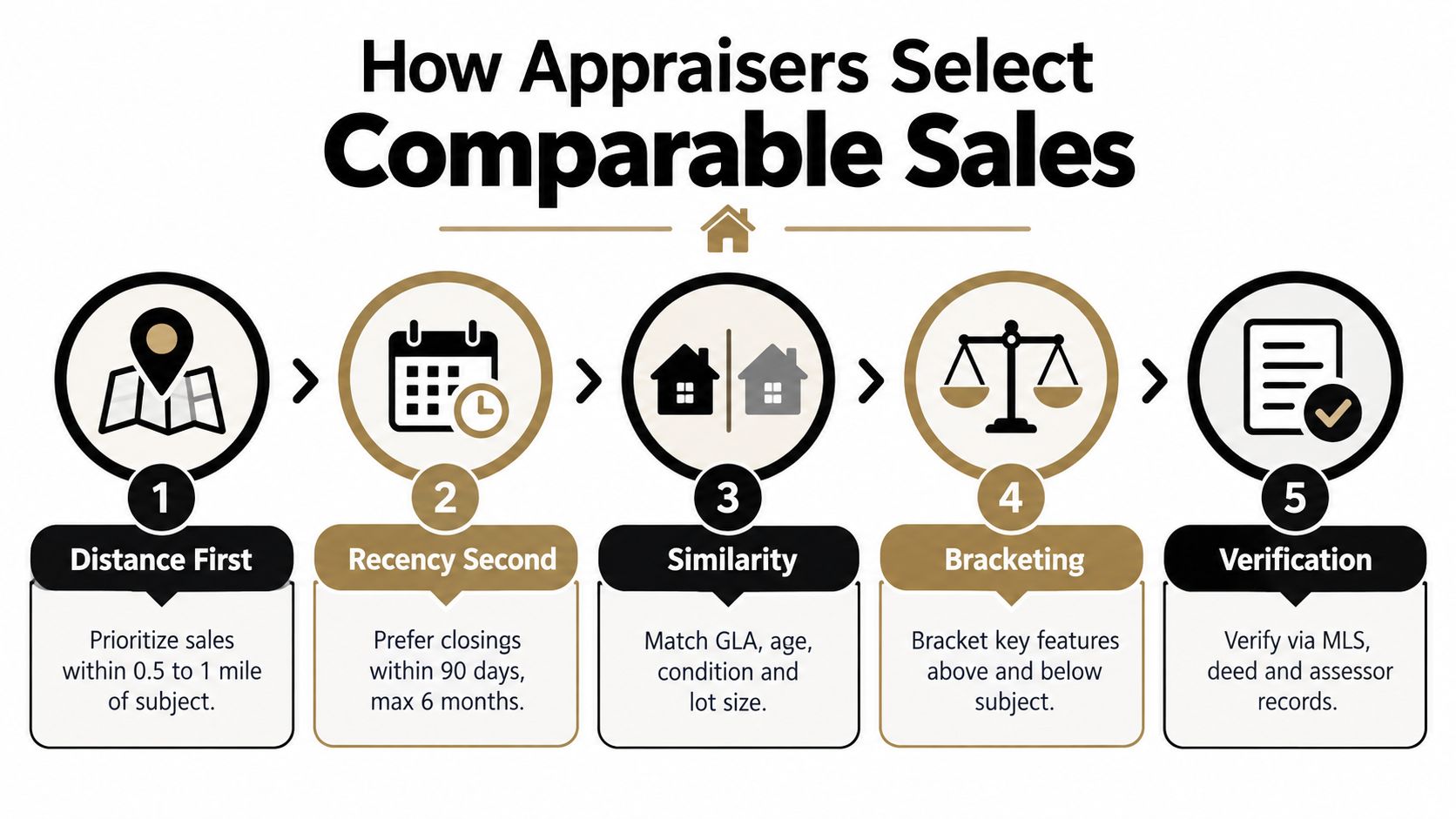
A practical hierarchy looks like this:
- Distance first: Begin close to the subject, using a map rather than relying blindly on ZIP codes or broad MLS areas. Nearby sales reveal the local buyer pool, but proximity only earns a comp a place in the candidate set.
- Recency second: Prefer recent transactions when they're comparable. If the only recent sale has a major mismatch, an older local sale may be more informative than a newer distant one.
- Similarity third: Compare gross living area, age, design, lot size, condition, room count, garage, views, zoning, and functional layout.
- Bracket the subject: Include sales that are superior and inferior on important features. Bracketing helps prevent the analysis from relying only on optimistic or pessimistic evidence.
- Verify the transaction: Confirm the sale price, concessions, financing context, condition, and physical facts through MLS records, deeds, assessor data, and other reliable documentation.
Consider a subject with a standard suburban lot and a renovated interior. The closest sale may appear ideal until the assessor record shows a lot that's 40% larger and a site with a superior view. That property may command a meaningful premium unrelated to the subject's renovation. An appraiser could reject it as the primary indicator and reach two miles away for a sale with a smaller lot, similar layout, and comparable condition.
Weighting begins during selection
A comp doesn't need to match every feature perfectly. It needs to be useful after its differences can be explained and adjusted. A nearby sale with a materially different site may receive less weight than a slightly farther sale that matches the subject's size, condition, and buyer appeal.
For investors gathering market evidence, automated collection can help build a candidate pool, but it shouldn't replace verification. Tools such as home listing scrapers can help locate public listing information for initial research, while the final comp file still needs transaction-level checking.
The selection decision should answer a simple question: Would a reasonable buyer have considered this property a substitute for the subject? If the answer is weak, the sale may still provide market context, but it shouldn't carry the same weight as a credible substitute.
Adjusting Comps and Calculating ARV Step by Step
Raw sale prices aren't interchangeable. Adjust each comp toward the subject, not the other way around. If Comp 1 has a larger garage, subtract the garage contribution from its sale price to estimate what it might have sold for with the subject's garage configuration. If the comp is inferior, add the supported difference.
The table below uses an illustrative example. The dollar adjustments are teaching assumptions, not verified market facts, so a real file should support each line with paired sales, contractor evidence, or another defensible method.
Worked Example: Adjusting Three Comps to ARV
| Line Item | Comp 1 | Comp 2 | Comp 3 |
|---|---|---|---|
| Raw closed price | $410,000 | $425,000 | $395,000 |
| Gross living area adjustment | -$8,000 | +$5,000 | +$12,000 |
| Garage adjustment | -$10,000 | $0 | +$10,000 |
| Bath adjustment | $0 | -$7,000 | +$7,000 |
| Condition adjustment | +$15,000 | -$5,000 | +$20,000 |
| Concession adjustment | +$4,000 | $0 | +$3,000 |
| Adjusted price | $411,000 | $418,000 | $447,000 |
| Illustrative weighting | 40% | 35% | 25% |
| Weighted contribution | $164,400 | $146,300 | $111,750 |
The indicated ARV from this example is $422,450, calculated by multiplying each adjusted price by its assigned weight and adding the results. Comp 1 receives the greatest weight because it may be the strongest combination of location, condition, and physical similarity. Comp 3 receives less weight despite its higher adjusted result because its starting property may require more interpretation.
For a complete underwriting file, each adjustment needs a reason. A gross-living-area adjustment might come from paired sales with similar condition and location. A concession adjustment should reflect the value of the credit when the credit affected the effective transaction price. A condition adjustment should distinguish cosmetic work from structural repairs or functional obsolescence.
From ARV to maximum allowable offer
The 70% rule is a heuristic, not a lending standard or a substitute for a full budget. Applied mechanically to the illustrative ARV, the gross ceiling would be:
$422,450 × 70% = $295,715
That figure still isn't the offer. A more complete MAO calculation subtracts renovation costs, financing and holding costs, resale expenses, closing costs, contingency, and the investor's required profit. If the renovation budget is $65,000, holding and financing are $22,000, resale friction is $25,000, and the required profit is $45,000, the illustrative MAO becomes:
$422,450 − $65,000 − $22,000 − $25,000 − $45,000 = $265,450
That result is below the 70% ceiling, which is exactly why the shortcut should be treated as a screening tool. You can find a fuller framework for calculating ARV, but the core discipline remains the same: calculate the value range first, then test whether the deal survives an adverse rehab or resale assumption.
Finally, run two sanity checks. The ARV per square foot should sit within a credible range established by the adjusted comps, and the offer should leave enough room for the renovation to run over budget without destroying the investment thesis.
What to Do When Comps Are Scarce or Stale
A representative thin-market deal involves a 1,400-square-foot ranch in a transitioning neighborhood with only two closed sales in the trailing six months. Both sales are older and inferior to the subject. Rejecting them without replacement leaves no evidence. Accepting their raw prices without adjustment treats stale information as current.
The first step is to identify what each sale can still tell you. One might establish the lower end of the local range. The other might reveal how buyers value the basic ranch layout, even if its condition is inferior. Then add pending contracts, listings under contract, current competing listings, and expired listings to understand direction and buyer behavior.
Active listings don't prove value because sellers can ask for prices buyers won't pay. Pending transactions offer stronger directional evidence because a buyer has agreed to a price, although the final terms and concessions may remain unknown. Expired listings can show where the market rejected a price, but they require careful interpretation because marketing quality and seller decisions also affect the outcome.
A triangulation matrix
| Data Source | Reliability Weight | Use in ARV Build-Up |
|---|---|---|
| Verified closed sale | High | Primary price evidence after physical and transaction adjustments |
| Pending contract | Moderate to high | Directional evidence of current buyer demand, subject to verification |
| Active listing | Moderate to low | Competitive context and ceiling test, not proof of achieved value |
| Expired listing | Low to moderate | Evidence of rejected pricing or marketing resistance |
| Contractor scope and renovation photos | Contextual | Supports condition analysis and explains the subject's finished appeal |
| Broader market indicators | Contextual | Helps test whether local movement appears rising, stable, or declining |
A time adjustment is defensible only when supported by observed market movement. Compare similar sales across periods, separate seasonal effects from genuine shifts, and explain why the adjustment applies to this property segment. A lender's desk reviewer is more likely to accept a supported extrapolation than an unsupported claim that the market has risen.
Thin-market discipline: When closed sales are scarce, add evidence layers. Don't turn uncertain evidence into false precision.
The file should contain a map, property cards, assessor records, listing histories, pending details where available, photos, repair scope, and a written explanation of every adjustment. In disclosure-limited markets, research the implications of missing sale details with resources covering non-disclosure states, then label assumptions clearly instead of presenting them as verified facts.
Common Mistakes and Red Flags in Comp Analysis
Most comp errors don't come from arithmetic. They come from allowing one attractive fact, usually proximity or price, to dominate the analysis.
The recurring failures
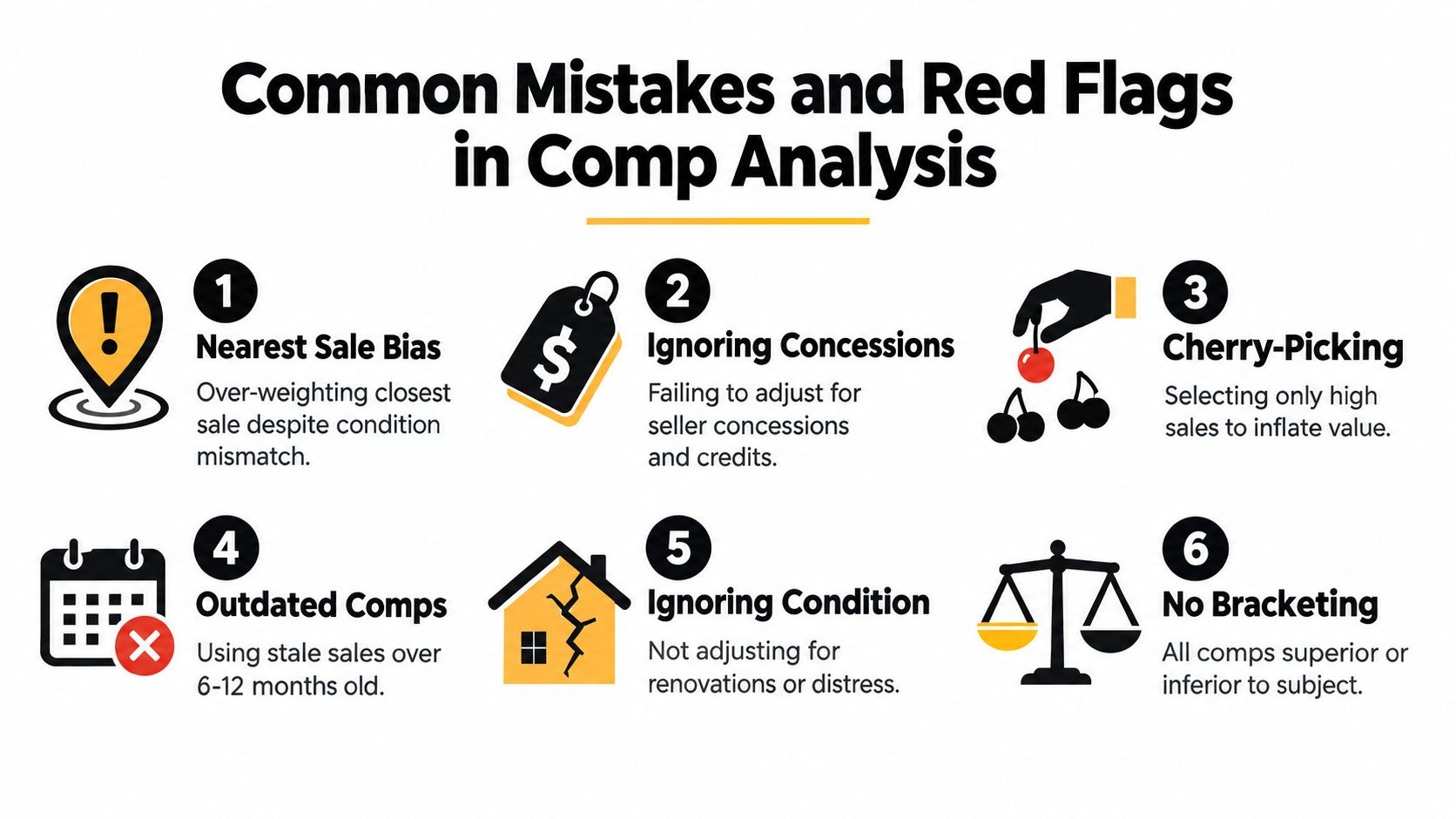
- Nearest-sale bias: An investor chooses the closest closing despite a major condition, lot, or view mismatch. Correct it by ranking similarity before assigning weight.
- Concession blindness: The gross price looks strong, but the seller provided credits that reduced the effective price. Correct it by verifying concessions and adjusting the comp when they influenced the transaction.
- Cherry-picking: Only high sales appear in the valuation file. Correct it by retaining rejected candidates and documenting why each one was excluded.
- Stale-comp dependence: An old closing carries the analysis without a market-condition adjustment. Correct it by comparing it with current pending and competitive evidence.
- Condition omission: “Updated” gets treated as equivalent to a full renovation. Correct it by separating finishes, systems, deferred maintenance, and functional layout.
- No bracketing: Every selected comp is superior, or every selected comp is inferior. Correct it by seeking evidence on both sides of the subject's key characteristics.
Concessions need their own investigation
Concessions are among the easiest ways to overstate value. A buyer may have paid a high gross price while receiving a credit for closing costs, repairs, rate assistance, or other expenses. If the credit helped produce the agreed price, comparing that gross figure directly with a comp that had no concession can inflate the indicated value.
The correction requires more than reading the headline sale price. Review the settlement statement or other transaction documentation when available, inspect MLS remarks and amendments, and ask the listing or buyer's agent to clarify credits. In lender work, the appraiser may have access to disclosures that an investor doesn't, so the investor should mark unknown concessions as a risk rather than assuming none existed.
Location and view premiums also create double-counting problems. If a superior location already explains part of the comp's price difference, don't add a second adjustment for the same advantage under a separate label. The same caution applies to condition and renovation quality. A remodeled kitchen, new systems, and functional floor plan may overlap in the buyer's response, so paired evidence should guide the total adjustment.
A Repeatable Comps Workflow for Investors and Lenders
A reliable workflow begins with records, not optimism. Run the same process on every subject, preserve rejected candidates, and separate verified facts from assumptions.
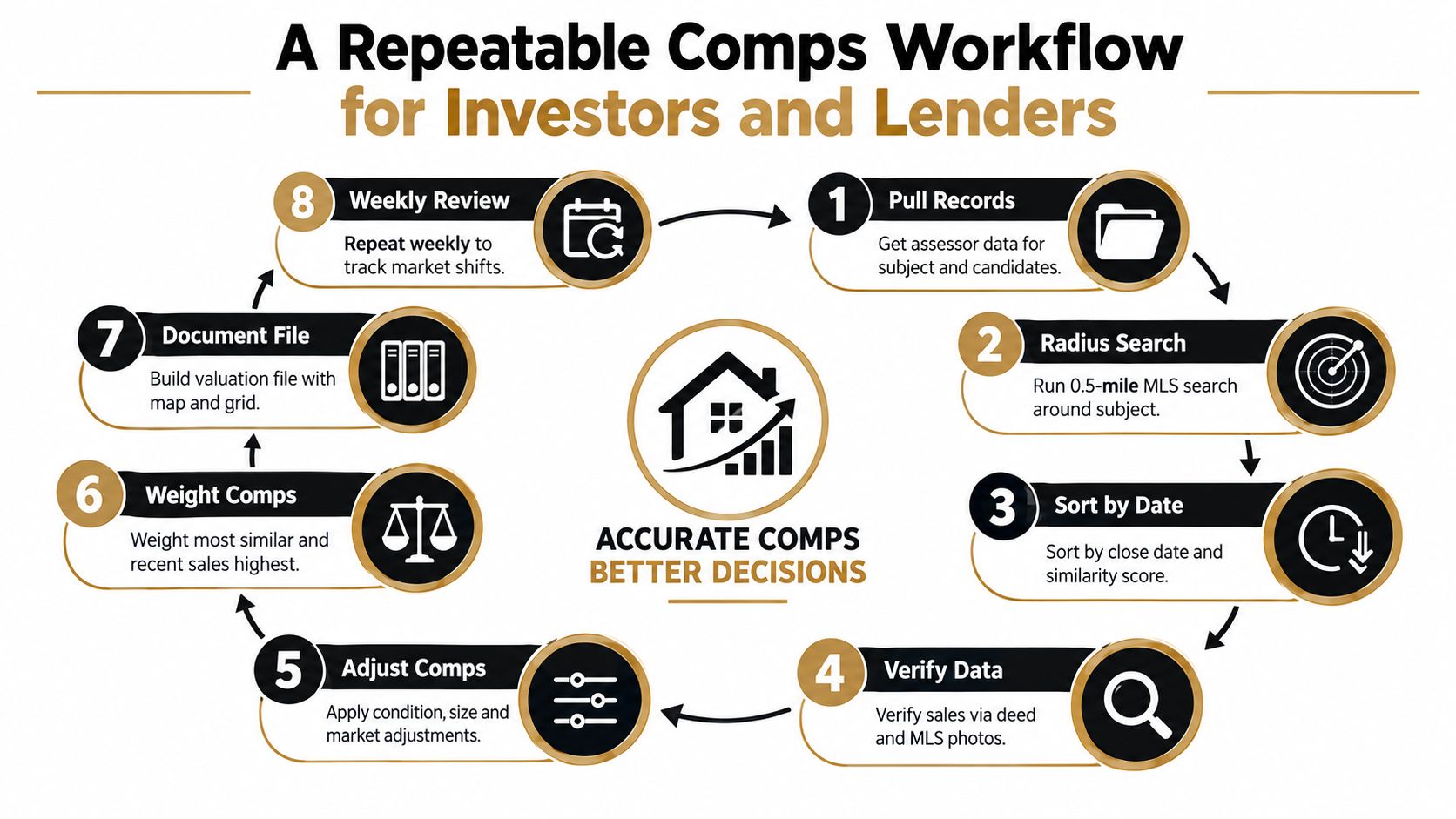
- Pull records: Get assessor data for the subject and candidates, including size, lot, year, use, and recorded sale information.
- Run a radius search: Start with a map-based search near the subject, then expand only when the local pool fails to provide substitutes.
- Sort candidates: Rank by close date, physical similarity, location, condition, and transaction quality.
- Verify the sale: Check deed records, MLS photographs, listing history, financing notes, and concession disclosures where available.
- Build the grid: Put the subject and each candidate side by side. List every material difference before assigning a dollar adjustment.
- Apply adjustments: Support size, condition, garage, bath, location, and time adjustments with paired evidence or documented market analysis.
- Weight the evidence: Give the greatest influence to the most similar and reliable sales, not automatically to the nearest or highest sale.
- Document and review: Save the map, grid, sources, assumptions, rejected sales, value range, and MAO. Revisit the file as new market evidence appears.
Compress speed, not control
An investor can compress the first pass by using public-record search and a standardized spreadsheet. A lender underwriter may require deeper verification, additional documentation, and a second review, but neither audience should skip the adjustment grid or reconciliation narrative.
Suppose an investor analyzes a subject on acquisition day and identifies a narrow ARV range from two strong local sales plus one older, adjusted sale. A lender reviews the same subject later, adds a newly pending competitor, verifies concessions, and confirms the renovation scope. The files may use different levels of detail, but a disciplined process should cause both parties to converge on the same general ARV band, or clearly explain why they don't.
The workflow also benefits from visual review. Plot each sale on a map, compare photos in a consistent order, and chart adjusted prices rather than raw prices. A candidate that looks persuasive in a spreadsheet may become an obvious outlier once its location or condition is visible.
For teams processing repeated deals, consistency matters more than a single clever comp. A saved template can require the analyst to answer why each comp was chosen, what adjustment was made, how that adjustment was supported, and why the final weight differs across sales.
Turning Appraisal Comps Into Defensible Decisions
A comp file should do more than produce an ARV. It should let a partner, lender, or auditor understand the decision without reconstructing the analyst's thought process.
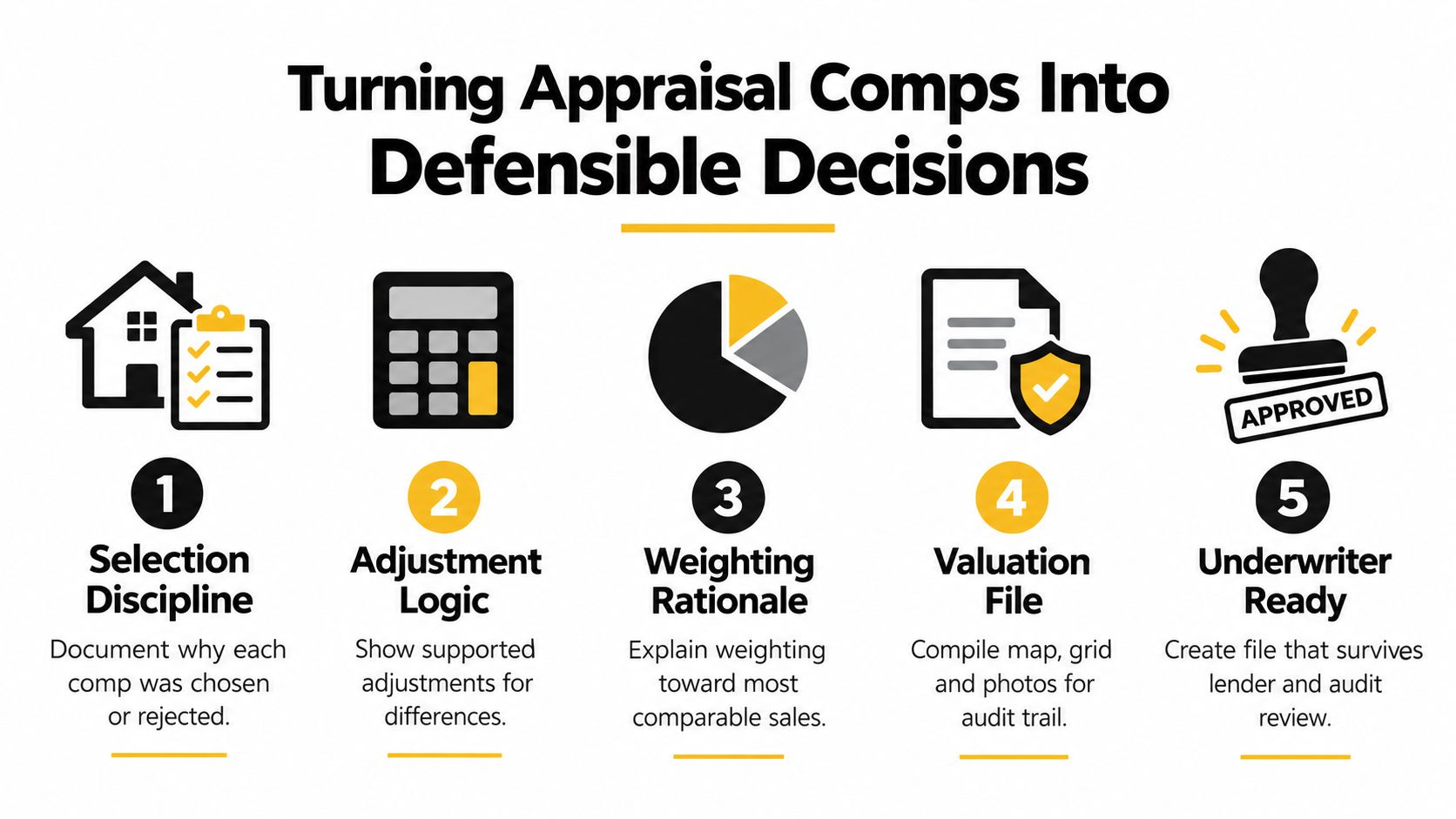
The defensibility standard rests on four habits:
- Verify closed sales: Preserve the source and transaction details for every primary comp.
- Date the adjustments: Show the amount, reason, and supporting evidence for each material difference.
- Layer thin-market evidence: Use pending and listed properties to clarify current direction when closed sales are stale, while labeling their lower reliability.
- Explain reconciliation: State why one comp receives more weight than another and how the final range was chosen.
A useful file can answer five questions quickly: What was selected? What was rejected? What changed between each comp and the subject? Why does the weighting make sense? What would invalidate the conclusion? A documented confidence rating scale can help teams communicate uncertainty without pretending that every valuation has the same evidence quality.
Treat real estate appraisal comps as a defensibility discipline, not a data-pull task. The strongest ARV is the one supported by verified transactions, transparent adjustments, sensible weighting, and a written reconciliation that survives challenge.
PropLab helps investors and lenders identify relevant comparable sales, apply distance and recency weighting, account for property differences, and produce ARV and MAO analysis without requiring MLS access. Use PropLab to build a documented comp file for your next deal, then share the resulting report with your partner or lender before you commit capital.
Tags
About the Author
P
PropLab Team
Real Estate Analysis Experts
The PropLab team consists of experienced real estate investors, data scientists, and software engineers dedicated to helping investors make smarter decisions with AI-powered analysis tools.
Free tool
Pull comps for any address
Comparable sales with adjustments, ready to defend in front of a seller or a lender.
