General
Real Estate Comparables Template Guide
September 30, 2026
19 min read

You're looking at a property that seems easy to price. The subject has the right bedroom count, the square footage appears close, and several nearby homes sold for prices that seem to support the seller's asking price. Then you discover that the strongest sale was fully renovated, closed under different financing conditions, and sits on a quieter street. Another sale is older than you assumed, while a third has no reliable record of its renovation history.
That's how an apparently attractive acquisition turns into an overpayment. A real estate comparables template should prevent that outcome by forcing every valuation input into an evidence trail, from the transaction source to the adjustment rationale and confidence of the final conclusion.
Why Your Comps Template Dictates Deal Profitability
A junior analyst often starts with the map. They pull nearby sales, sort by distance, and copy the address, sale price, bedrooms, bathrooms, and square footage into a spreadsheet. The result looks organized, but it can still be economically useless. A clean table of bad evidence gives a false sense of precision.
The problem usually appears when the analyst compares a renovated property with a dated subject and treats the price gap as a simple square-footage difference. The buyer then bases the offer on an optimistic ARV, underestimates the work needed to reach that finish level, and leaves no room for an unexpected condition issue. The spreadsheet didn't cause the loss. The spreadsheet failed to expose the assumptions that caused it.
The template is an audit trail
A working comps file should answer five questions for every sale:
- What sold: Record the property identity, sale type, contract date, closing date, and reported price.
- Who verified it: Name the MLS record, public record, broker confirmation, deed source, or other evidence used.
- How comparable it is: Compare location, legal use, layout, gross living area, site, quality, and condition.
- What differs: Record each adjustment rather than hiding differences in a final opinion.
- How much confidence it deserves: Flag missing information, unusual terms, and unresolved contradictions.
This is the difference between a comp list and an underwriting workflow. A comp list helps someone browse. An auditable template helps an acquisitions manager decide whether the evidence supports a profitable offer.
The sales comparison approach depends on multiple market-derived observations, not one convenient sale. Professional guidance emphasizes comparable, recent, verifiable, arm's-length transactions and consistency with local market practice, which is why the template should capture the effective date of the analysis and the history behind the selected sales. Fannie Mae's comparable-sales guidance provides the relevant framework for treating the comp set as time-bounded evidence rather than a collection of nearby addresses.
Underwriting rule: If you can't explain why a sale is substitutable for the subject, it isn't a comp yet. It's only a lead.
A defensible ARV gives you a foundation for the rest of the deal. Rehab scope, financing, holding costs, selling costs, and the required profit can all be modeled more intelligently when the exit value reflects the subject's likely market position. Investors who want a broader discussion of underwriting flip margins correctly should connect that margin analysis to the quality of the comparable evidence, not treat the ARV as a fixed input.
Essential Fields for a Reliable Comps Spreadsheet
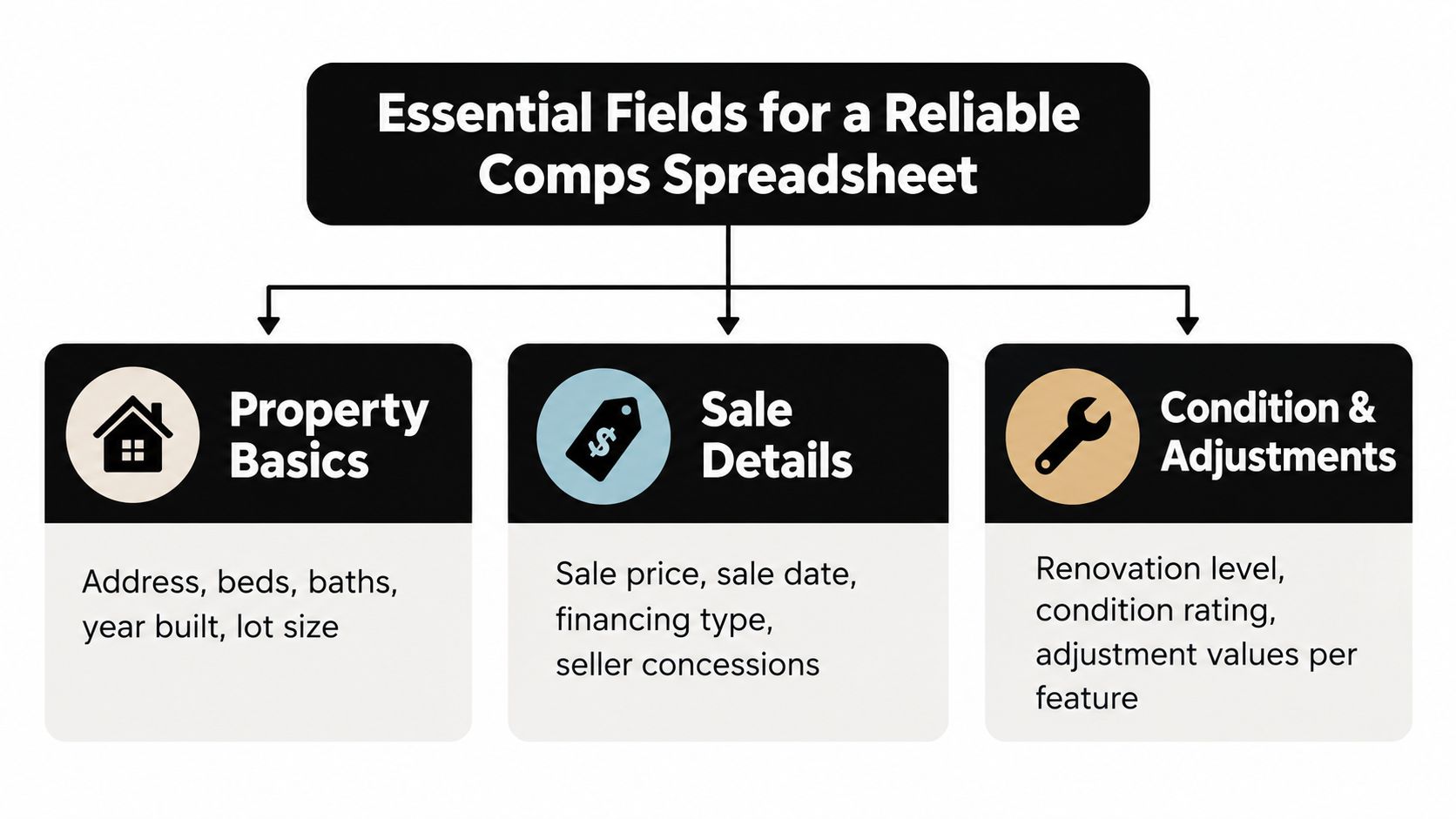
A junior analyst can select five nearby sales and still produce a weak valuation. The problem usually appears in the subject record first. Enter the subject's address, property type, legal use, gross living area, room count, year built, lot and site characteristics, quality, condition, and known functional or location issues. These fields establish the reference point for every later comparison.
Keep property facts separate from transaction facts. Physical fields describe what the property is. Transaction fields show how, when, and under what terms it sold. A close physical match with unverified financing or concessions should not receive the same weight as a sale with a documented, arm's-length transaction.
The columns that carry the valuation
Use the same row structure for every candidate. Consistency makes gaps visible during review.
- Identity and location: Address, parcel reference, neighborhood, subdivision or project, distance from the subject, and market-area match.
- Physical profile: Property type, gross living area, room count, bedroom and bathroom configuration, site size and characteristics, style, age, quality, and condition.
- Transaction record: Sale price, sale date, contract date when available, transaction type, financing, concessions, seller contributions, and arm's-length status.
- Evidence trail: Source name, source date, verification contact or reference, listing history, renovation documentation, and unresolved gaps.
- Adjustment record: Adjustment category, amount or percentage, direction, supporting observation, and analyst commentary.
- Conclusion fields: Adjusted indication, inclusion or exclusion decision, reliability rating, red flags, and notes on how the sale informs the ARV.
A defensible template normally includes at least three closed comparable sales. Secondary-market guidance generally expects those sales to be from the last 12 months, with a 3-year subject-property history and a 12-month comparable-sales history, as described in Fannie Mae's guidance on comparable sales. Use those windows as a starting point, then document why an older sale remains relevant when the local market offers limited evidence.
Dates affect reliability. Record both the sale date and contract date when available, because the contract may reflect market expectations that preceded closing. A sale can look suitable at the start of an analysis and become less persuasive by the effective date after a meaningful market shift.
Design the sheet for review
Place verification notes beside the fields they support. A reviewer should see the source, reliability assessment, and adjustment rationale without opening an overlooked tab. Filters for condition, sale type, date, and reliability let the team isolate stronger evidence quickly.
Separate tabs for the subject, comp inventory, adjustment analysis, and final valuation can keep the workbook readable. The final tab must still preserve enough provenance to trace every selected sale to its underlying record. If an analyst cannot trace a figure, that figure is not ready to support an offer, regardless of how neatly it fits a formula.
Calculating Adjustments and After Repair Value
The adjustment process should normalize the differences between the subject and each comp. Start with the sale price, identify a material difference, estimate the market reaction to that difference, and document the evidence supporting the adjustment. Apply the adjustment consistently across the selected sales, then compare the resulting indications rather than relying on one mechanically calculated figure.
Suppose a comp has a superior renovation level but otherwise resembles the subject. The adjustment should reflect the market contribution of that finish difference, not the contractor's entire renovation invoice. A finished basement, superior site, inferior location, or different functional layout requires the same discipline. The question is always, “How does this difference affect what buyers would pay in this market?”
A practical adjustment sequence
- Describe the difference. Write a plain-language observation, such as superior condition, inferior street position, larger site, or different finished area.
- Choose the evidence. Use paired sales, a sufficiently large local data set, current market analysis, or a clearly reasoned discussion where direct evidence is limited.
- Set the direction. If the comp is superior to the subject, the indication generally needs a downward adjustment. If the comp is inferior, the indication generally needs an upward adjustment.
- Record the amount. Keep the adjustment in a dedicated dollar or percentage field, with the basis beside it.
- Review the total effect. A comp requiring extensive adjustments may be less useful than a slightly less nearby sale that needs fewer and better-supported changes.
Freddie Mac's appraisal guidance says precise adjustments such as 1%, 3%, or 7% should be supported by sufficient data or discussion. It also notes that, when applicable, economies of scale usually warrant only a very small adjustment, typically in the 5% range. Freddie Mac's appraisal best-practices guidance also warns that adjustments without statistical or paired-sale analysis can become subjective and imprecise.
Adjustment discipline: A round number isn't evidence. It's only a conclusion until the template records why the market supports it.
Turn adjusted indications into ARV
After adjusting each selected sale, compare the resulting indications for consistency. Look for a cluster, an outlier, or a pattern that reveals a missing variable. If every renovated comp requires a large downward condition adjustment, the subject may not support the assumed finished product, or the renovation plan may not be sufficient to reach the comp set.
The ARV should represent the subject in its intended post-renovation condition, not the most attractive sale in the neighborhood. Keep a separate field for the selected ARV, the supporting comp range, the reasons for excluding weaker sales, and the confidence level. Investors who want a more detailed explanation of real estate sales comps can use that framework to supplement, not replace, the adjustment notes in their own workbook.
Handling Non-MLS and Low-Reliability Data Sources
Public records aren't automatically reliable because they come from a government database. They may show a recorded price but omit concessions, renovation scope, occupancy, seller distress, or the relationship between the parties. An automated estimate can be useful for screening, but it shouldn't become the value conclusion.
The biggest weakness in many consumer CMA templates is provenance. They commonly capture address, size, beds, baths, price, and date, but don't show how the analyst scored data quality, handled missing renovation history, or determined whether the source was dependable. That gap becomes more serious when the comp search combines public records, broker data, listing portals, and off-market information. This overview of MLS comps illustrates how common templates often emphasize basic property fields without giving equal attention to evidentiary strength.

Add a provenance layer
Create a source field that distinguishes direct, indirect, and unverified information. The label matters less than applying it consistently. A broker-confirmed transaction with notes on condition should be treated differently from an unverified portal record with no interior information.
Add these review columns:
- Source type: Public record, MLS, broker, listing portal, deed, seller, or field observation.
- Verification status: Confirmed, partially confirmed, or unresolved.
- Terms visibility: Whether financing, concessions, seller credits, and arm's-length status are known.
- Condition evidence: Listing photos, inspection notes, permits, renovation history, or no supporting documentation.
- Reliability commentary: A short explanation of what the source establishes and what it doesn't establish.
Don't force a low-reliability sale into the primary comp set just because it supports the offer. Keep it in the candidate inventory, mark the uncertainty, and run the valuation with and without it. If the ARV changes materially, that uncertainty belongs in the offer decision and lender conversation.
A structured data quality assessment helps. The tool or method you use should make missing fields visible rather than filling them with assumptions that look like verified facts.
Red flags that deserve escalation
A deed record with an unusual transfer price may represent a family transfer, partial interest, or distressed transaction. A listing that shows new finishes but has no permit or renovation history may still be useful, but the condition claim requires a lower confidence level. A sale with undisclosed concessions can make the recorded price appear stronger than the economic consideration.
The analyst's job isn't to reject every imperfect record. It's to preserve the imperfection in the file so the next reviewer understands the limitation.
Adapting Templates for Volatile Micro-Markets
A static three-comp worksheet becomes fragile when the market moves quickly or the neighborhood has very few meaningful transactions. In a fast-moving submarket, an older physical match may tell you less than a newer sale with a modest location difference. In a thin rural market, expanding the search area may be more defensible than pretending that a handful of distant sales are local substitutes.
The template needs a decision rule for that trade-off. Don't change the rule from deal to deal because one search produces a higher ARV.
Recency versus similarity
Rank candidate sales on separate dimensions instead of combining everything into one unexplained score. Use a recency field, physical similarity field, location relevance field, transaction reliability field, and condition certainty field. Then explain why a sale received more weight in the conclusion.
A recent sale can deserve priority when buyers in the micro-market have experienced a meaningful change in pricing, inventory, financing, or buyer preferences. Similarity should carry more weight when the market is stable and the property type has enough local evidence. Neither principle should be applied automatically.
In a thin market, widening the search can improve the evidence set, but it can also introduce a different buyer pool. Record the trade-off instead of hiding it.
Build a market-specific worksheet
Add fields for listing status, days on market, price changes, contract activity, and listing-to-sale relationship when those signals are available and material. These aren't substitutes for closed-sale evidence. They help explain whether a closed sale remains representative of the effective date.
A strong volatility worksheet also includes:
- Search decision: Why the analyst expanded the radius, extended the date range, or accepted a less similar sale.
- Market signal: Evidence of changing buyer behavior, marketing time, inventory, or pricing pressure.
- Confidence score: A reasoned rating tied to the quality and consistency of the evidence.
- Red flags: Road exposure, unusual layout, flood or site issues, legal limitations, condition uncertainty, or a nonstandard transaction.
- Scenario conclusion: A supported value view under the most likely market interpretation, with weaker evidence clearly separated.
The real estate video maker templates from Nim can help an acquisitions team present market context visually to partners, but a polished presentation doesn't fix weak comp selection. Keep the underlying fields and assumptions available for review.
Guidance on comparable evidence also points toward recording transaction date, transaction type, and material property details rather than relying only on surface features. This comparison-report template discussion reflects the broader need for confidence scoring, red flags, and adjustment rationale in decision-ready analysis.
Step-by-Step Guide to Using the Template
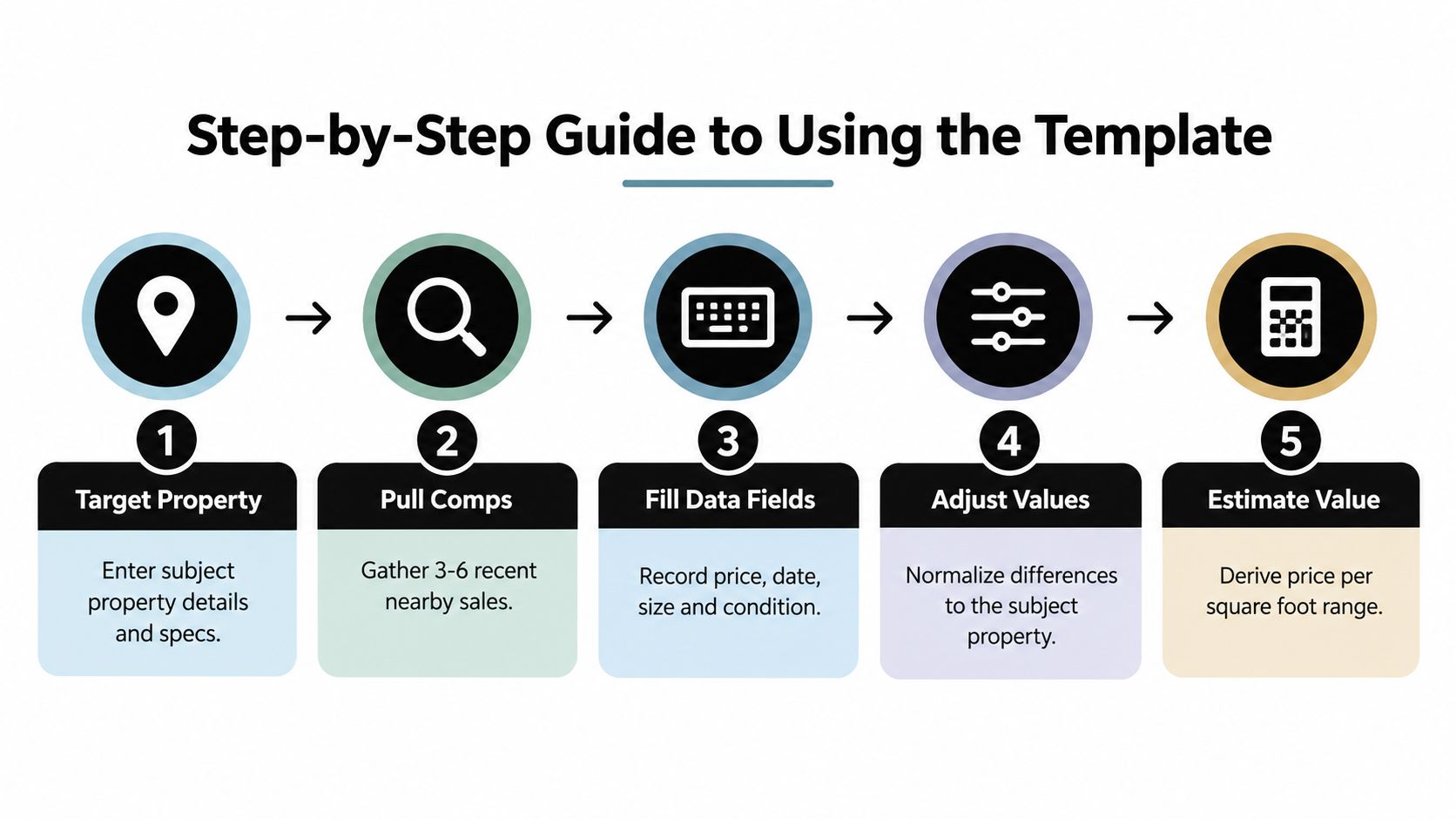
A repeatable workflow keeps speed from turning into carelessness. The analyst should be able to hand the completed file to an acquisitions manager, lender, or partner and show exactly how the conclusion was built.
Start with the subject
Enter the property address, legal use, property type, gross living area, room count, site characteristics, age, quality, current condition, and known location problems. Record the proposed renovation level separately from the current condition. An acquisition file often fails when analysts describe the subject as “fully renovated” before a scope of work supports that conclusion.
Next, define the effective date of the analysis and the intended exit condition. This prevents the comp search from drifting toward whichever sales appear most favorable.
Build and filter the candidate set
Pull nearby closed sales and include other relevant transaction records, listings, and contract information where available. Filter first for legal and physical compatibility, then review date, transaction type, financing, concessions, and arm's-length status.
Do not select a sale because it is merely close. Select it because a buyer considering the subject could reasonably have considered that property as an alternative. If the best physical match has missing condition evidence, preserve it in the candidate list and mark the limitation rather than treating the condition as equal without comment.
Complete the evidence fields
For each surviving candidate, record:
- Transaction facts: Price, sale date, contract date, financing, concessions, and sale type.
- Physical facts: Size, rooms, site, age, style, quality, condition, and legal characteristics.
- Verification facts: Source, contact or record reference, listing history, photos, permits, and renovation evidence.
- Comparison facts: Every material difference from the subject and the expected direction of adjustment.
Then remove sales that fail the basic substitutability test. Keep an exclusion log. A reviewer should see whether a sale was rejected for a non-arm's-length transfer, unreliable condition information, a materially different property type, or another documented reason.
Apply adjustments and conclude value
Make each adjustment traceable. Avoid one large catch-all adjustment for “overall quality” when the differences can be separated into condition, layout, location, and site. Compare the adjusted indications, investigate outliers, and write a short conclusion explaining why the selected ARV represents the subject's expected market position.
Only after the ARV is established should the analyst move to the offer calculation. Start with the supported exit value, subtract the renovation budget and the transaction, financing, holding, and contingency costs used in the deal model, then preserve the required profit margin. If the resulting MAO doesn't support the seller's price, the comp sheet shouldn't be altered to make the transaction work.
The embedded walkthrough can provide another visual reference for the workflow:
Common Comping Mistakes and How to Avoid Them
The most expensive mistakes usually come from treating differences as cosmetic. A renovated sale and a distressed subject may share a street and bedroom count, but they don't occupy the same position in the buyer's choice set. If the analyst uses the renovated sale without documenting the finish gap, the ARV becomes a renovation aspiration rather than a market-supported conclusion.
A professional template makes the contrast visible:
| Weak practice | Disciplined practice |
|---|---|
| Chooses the highest nearby sale first | Starts with substitutability and verifies the transaction |
| Treats public-record price as complete evidence | Checks terms, concessions, sale type, and reliability |
| Uses one broad condition adjustment | Separates condition, quality, layout, location, and site |
| Discards inconvenient sales without notes | Keeps an exclusion log with the reason |
| Changes the comp set until the deal works | Tests whether the deal works under defensible evidence |
Watch for comp padding
Comp padding happens when an analyst adds inferior, distant, old, or weakly verified sales because they support a higher value. The temptation is understandable, especially when a seller, wholesaler, or partner expects a particular ARV. It still destroys the usefulness of the analysis.
Create an exclusion column and use it. A sale can remain visible without influencing the conclusion. That lets the reviewer understand the available market evidence and see whether the selected set was narrowed for a legitimate reason.
Don't ignore functional problems
Busy roads, awkward access, poor parking, external obsolescence, unusual floor plans, additions of uncertain legality, and site limitations can affect substitutability even when the basic property fields match. Record each issue in the subject profile and the comp comparison. If the difference can't be measured confidently, lower the confidence of the indication rather than inventing a precise adjustment.
The same discipline applies to condition. A property with attractive photographs may still have incomplete renovation documentation, deferred structural work, or a finish level below the selected comps. The template should make those uncertainties visible before the offer is submitted.
A high ARV supported by weak evidence isn't conservative underwriting. It's a forecast wearing a spreadsheet costume.
Quick Reference Checklist and Modern AI Alternatives
Before an offer goes out, review the comp set as if you were trying to disprove it. The question isn't whether the spreadsheet looks complete. The question is whether another experienced reviewer can trace the conclusion from the subject, through the sales, to the adjustments and final offer.

Manual review before approval
Use this short approval screen:
- Subject check: Is the current condition separated from the proposed finished condition?
- Substitutability check: Do the selected sales match the subject's legal, physical, and market characteristics?
- Date check: Are sale and contract dates recorded, and is the effective date clear?
- Transaction check: Are financing, concessions, sale type, and arm's-length status known?
- Source check: Can every material fact be traced to a named source?
- Condition check: Is renovation history supported, or is the uncertainty marked?
- Adjustment check: Does every material adjustment have a direction, amount, and rationale?
- Outlier check: Has anyone investigated why one adjusted indication differs from the others?
- Exclusion check: Are rejected sales documented rather than deleted?
- Offer check: Does the MAO still work after the supported ARV is combined with the full deal assumptions?
Authoritative sales-comparison guidance says the appraiser should analyze the most comparable closed sales, contract sales, and listings, use reliable local data, and verify transaction conditions, concessions, and arm's-length status before relying on the set. Fannie Mae's sales-comparison approach guidance supports using the template as a data-quality workflow, not a simple property list.
Where automation fits
Automation can reduce repetitive collection and ranking work, particularly for teams processing many potential acquisitions. It can pull public records, organize candidate sales, apply distance and recency logic, surface property details, and produce a report for human review. It shouldn't be allowed to conceal missing data or convert an uncertain condition assumption into a verified fact.
PropLab is one option for this workflow. Its comp-finding and underwriting features use public records, tax data, and market signals to identify relevant sales, show adjustment breakdowns and confidence scoring, and produce offer-ready reports without requiring MLS access. An analyst can use the output to challenge a manual spreadsheet, then verify the high-impact assumptions before presenting the valuation to a lender or partner.
Teams evaluating automated underwriting tools should also consider the controls around source visibility, adjustment explanations, audit history, and human review. A practical real estate AI vetting guide from DwellShot can help frame those questions. For a deeper look at how the valuation method should be documented, review this guide to the sales comparison approach.
Automation works best as a second set of eyes and a speed layer. The analyst remains responsible for deciding whether a sale is substitutable, whether the condition evidence is credible, and whether the final ARV justifies the risk.
Use PropLab to find and rank comparable sales, review adjustment logic and confidence signals, and turn the analysis into a shareable report for your next acquisition. Build the manual evidence trail first, then use the platform to speed up verification and produce a more defensible MAO.
Tags
About the Author
P
PropLab Team
Real Estate Analysis Experts
The PropLab team consists of experienced real estate investors, data scientists, and software engineers dedicated to helping investors make smarter decisions with AI-powered analysis tools.
Free tool
Pull comps for any address
Comparable sales with adjustments, ready to defend in front of a seller or a lender.