General
Real Estate Underwriting Services Explained
September 24, 2026
16 min read
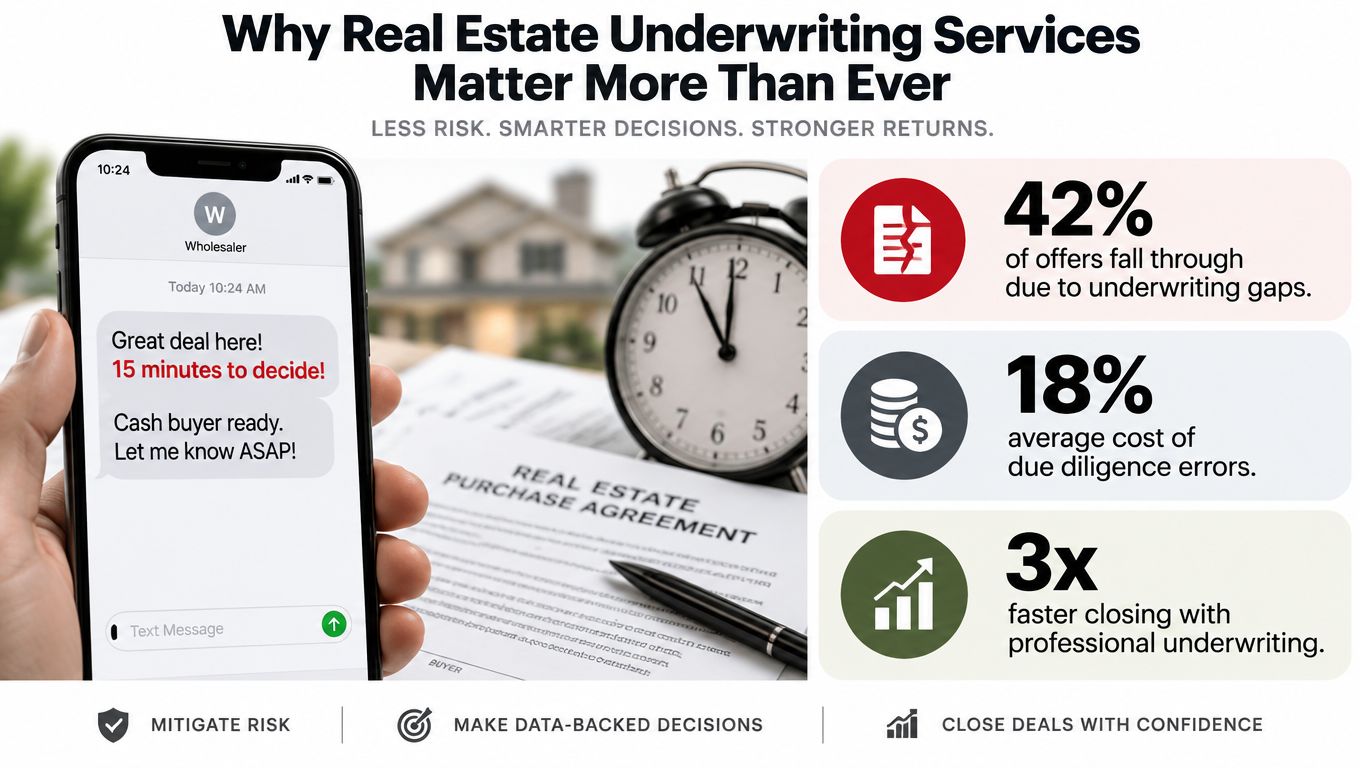
You're staring at a wholesaler's text, a contract in your inbox, or a price-drop alert. The property looks profitable, but another buyer may take it before you finish checking the numbers. That's the moment real estate underwriting services earn their place. They turn an address and a stack of assumptions into a decision about whether to pursue, what to offer, how to finance the purchase, and when to walk away.
Underwriting isn't a checklist that happens after the exciting work. It's the process that tests whether the deal still works after realistic comps, repairs, financing terms, title concerns, and exit risks enter the picture. A strong analysis connects each output to a specific action, so ARV changes your resale plan, repairs change your budget, MAO changes your offer, and red flags change your willingness to proceed.
Why Real Estate Underwriting Services Matter More Than Ever
The cost of a wrong assumption shows up quickly. If a project's after-repair value is overstated, the investor may pay too much before construction begins. If the repair scope misses a system problem, the contingency disappears. If the lender values the property differently, the buyer may need more cash at closing or may lose the financing altogether.
That's why underwriting protects four decisions:
- Pursuit: Decide whether the property deserves more time, inspections, and conversations with sellers.
- Offer price: Convert ARV, repairs, transaction costs, financing, and profit requirements into a maximum allowable offer.
- Financing structure: Test whether the deal fits a bridge loan, hard-money facility, rental loan, or another capital source.
- Exit decision: Identify the conditions that require a price reduction, a different renovation plan, a refinance, or a walk-away.
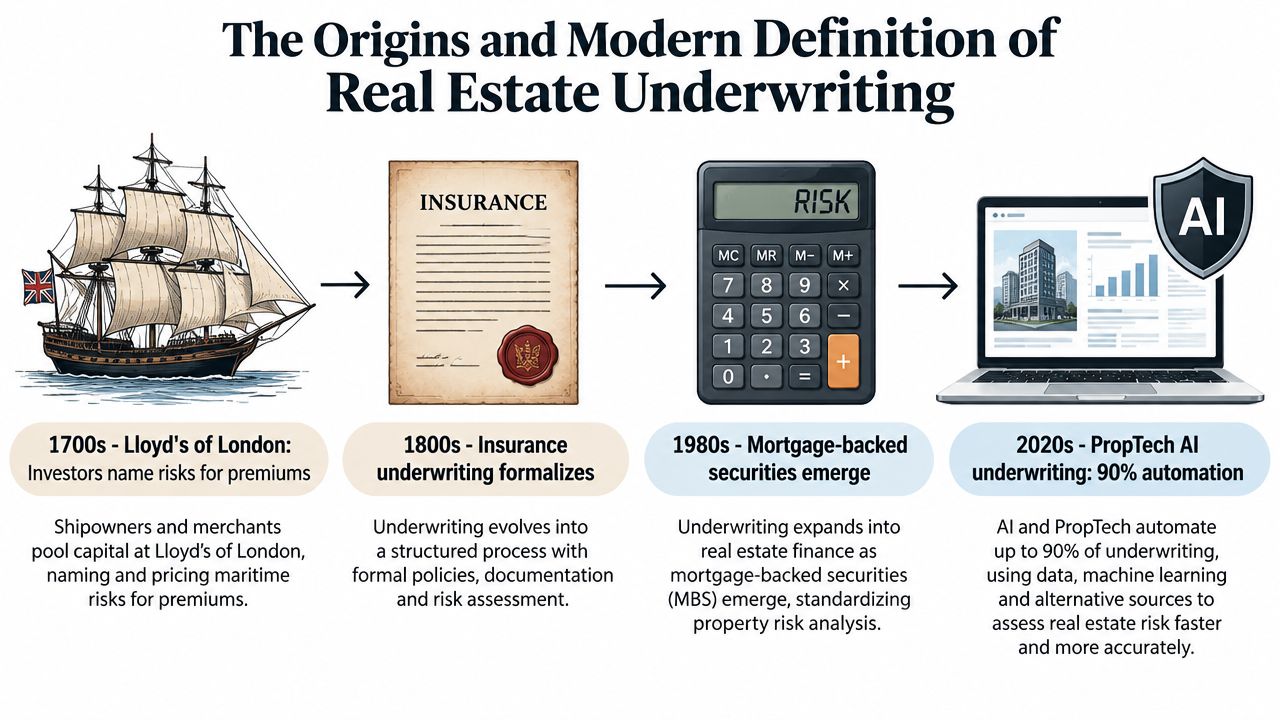
Modern property finance still depends on standardized review of income, assets, title, liens, and appraised value alignment. The broader underwriting tradition traces back to Lloyd's of London, where investors signed their names beneath risks they agreed to cover. In property finance, that practice evolved into lender due diligence around borrower credit, capacity, collateral, and housing history. Investopedia's overview of real estate underwriting describes this transition from risk acceptance to structured mortgage review.
The market around underwriting is large. A 2025 industry estimate placed the global residential mortgage service market at $28.6 billion, with underwriting representing 18.7%, or approximately $5.35 billion, of that value, according to Dataintelo's residential mortgage service market estimate. The same source illustrates how underwriting-adjacent property risk review supports major capital decisions across lending, insurance, and investment.
For investors building their own process, the practical lesson is simple: underwriting should produce a number you can act on, not a report you file away. A useful risk mitigation framework for property decisions should connect every assumption to a consequence in the contract, budget, financing package, or exit plan.
The Origins and Modern Definition of Real Estate Underwriting
The word underwriting comes from an old risk-sharing practice associated with Lloyd's of London. Investors would write their names beneath a description of the risk they were willing to accept in exchange for a premium. The work has changed dramatically, but the central question remains familiar: what risk is being accepted, by whom, and at what price?
In real estate, underwriting is the structured evaluation of a property's value, condition, income, financing, and risk profile for a defined decision. An investor uses it to decide whether to buy. A lender uses it to decide how much to lend and under what terms. An acquisition team uses it to compare opportunities and protect the fund's return requirements.
The workflow still produces four practical outputs:
- After-repair value: A supported estimate of what the property could sell for after the planned work, based on relevant comparable sales.
- Repair estimate: A scope and budget that separates visible cosmetic work from systems, safety, structural, and compliance items.
- Maximum allowable offer or loan amount: The financial ceiling that protects the buyer's required margin or the lender's collateral position.
- Risk flags: Issues involving title, liens, zoning, flood exposure, condition, occupancy, access, or the exit market that can change the price or stop the transaction.
The audience changes the emphasis. Lender underwriting concentrates on borrower credit, repayment capacity, debt-service coverage, collateral, and the credibility of the exit. Investor underwriting concentrates on profit, return on capital, basis, execution risk, and the price required to compensate for uncertainty.
Technology now makes the workflow faster and more repeatable. Current industry commentary describes AI-assisted underwriting, live market signals, and explainable risk scoring as alternatives to slower manual review and static comp sets. That doesn't eliminate judgment. It makes the assumptions easier to expose, challenge, and document.
Practical rule: Underwriting is complete only when another person can follow the assumptions from source data to decision.
The Four Core Outputs Every Underwriter Produces
Consider a 1,400-square-foot, three-bedroom ranch listed at $185,000 in a Midwestern metro. The listing price is only an input. It doesn't tell the investor whether the property is cheap, expensive, or impossible to finance.
ARV sets the ceiling for the exit
The underwriter starts with closed sales that resemble the finished property, not merely houses in the same broad neighborhood. A working set might include three to five closed comps, with attention to sale date, distance, square footage, bedroom count, lot characteristics, and renovation quality. The analysis could support an ARV of $265,000 if the selected sales reflect a finished ranch with comparable utility and appeal.
The familiar 70% rule is a screening shortcut, not a substitute for a full model. Applied to a $265,000 ARV, it gives $185,500 before subtracting repairs and other costs. That immediately shows why a $185,000 list price leaves little room if the property needs meaningful work.
Comps explain why the value is credible
A comp across the street can still be a poor comp. A foreclosure, severely distressed sale, unusual lot, different school boundary, or property with materially different condition can distort the conclusion.
The analyst should document why each comp belongs in the set and how differences affect the conclusion. If the closest sale is a foreclosure while the subject is habitable, using it without adjustment may push ARV down. If a renovated comp has a better layout and more usable square footage, using its full sale price may push ARV up.
Repairs convert condition into a budget
The same ranch could require a $15,000 light cosmetic scope involving paint, flooring, fixtures, and limited kitchen work. It could also require a $35,000 heavier scope if the inspection identifies electrical, plumbing, roof, HVAC, or structural work. Those are not interchangeable assumptions.
A credible estimate ties each line item to photos, inspection findings, contractor input, public records, or a documented property condition indicator. The final budget should also state what it excludes, because an apparently low estimate often hides missing systems or permit costs.
Risk flags determine whether the number survives reality
Foundation cracks, knob-and-tube wiring, flood-zone designation, and zoning constraints can each affect financing, insurance, timing, or resale. One flag may require a larger reserve. Another may make a lender decline the property or force a different exit strategy.
| Output | Calculation or Source | Sample Result | Impact on Max Offer |
|---|---|---|---|
| ARV | Supported closed comparable sales | $265,000 | Sets the resale ceiling |
| Repairs | Scope separated by cosmetic and systems work | $15,000 to $35,000 | Reduces available basis |
| MAO screen | 70% of ARV before full cost adjustments | $185,500 | Establishes an initial offer boundary |
| Risk flags | Title, condition, flood, zoning, and financing review | Property-specific | Adds reserves or reduces the offer |
The investor doesn't use these outputs separately. A lower ARV reduces the revenue side, a larger repair scope reduces the available purchase price, and a risk flag may require both a price adjustment and extra time. The contract number should reflect the combined effect.
How Underwriting Works in a Real Fix and Flip Deal
A fix-and-flip analysis starts when the address arrives, not when the buyer opens a spreadsheet. Suppose the property is a 1,400-square-foot single-family home in a Midwest secondary market. The proposed purchase price is $180,000, the preliminary repair budget is $35,000, and the investor expects to resell after six months.
Step one establishes the resale case
The analyst pulls relevant closed sales and separates finished properties from distressed or materially different homes. In this example, the comp review supports an ARV of $280,000. That number becomes the revenue assumption for the exit, but it remains conditional on delivering the condition, layout, and finish level reflected in the comps.
The analyst then verifies whether the renovation plan creates that finished product. A cosmetic budget can't support an ARV based on a fully modernized home if the scope leaves outdated systems or unresolved defects.
Step two turns the scope into a purchase limit
The $35,000 repair estimate feeds the offer model. The investor applies the chosen acquisition formula, then subtracts repairs and the other costs required by the strategy. Using the 70% screening rule, 70% of the $280,000 ARV equals $196,000. After subtracting the $35,000 repair budget, the initial MAO screen is $161,000.
That's not automatically the final offer. Financing fees, purchase and resale costs, holding costs, insurance, taxes, utilities, and the investor's required profit may reduce it further.
Step three tests the weak points
The analyst changes the assumptions to see whether the deal depends on one optimistic input. If ARV falls by 10%, the value assumption becomes $252,000. If repairs rise by 15%, the $35,000 scope becomes $40,250. Those changes can reduce the offer ceiling sharply before the buyer signs.
| Step | Underwriting Output | Example Number |
|---|---|---|
| Address triage | Initial purchase screen | $180,000 proposed price |
| Comp analysis | ARV | $280,000 |
| Scope review | Repair budget | $35,000 |
| 70% screen | ARV-based ceiling | $196,000 |
| Repair-adjusted screen | Initial MAO | $161,000 |
| Sensitivity test | ARV down 10%, repairs up 15% | $252,000 ARV and $40,250 repairs |
Risk flags then adjust the financing and exit assumptions. A title issue can delay closing. A flood concern can affect insurance. A structural issue can extend the renovation. A weak resale market can increase holding exposure. The final underwriting package should show the base case, the stressed case, and the exact reason for any price reduction.
For a connected real estate deal underwriting workflow, the goal isn't to produce attractive arithmetic. It's to make sure the number sent to the seller still makes sense after the lender, inspector, contractor, and buyer's agent challenge it.
In-House Teams, Third-Party Services, and AI Platforms Compared
Investors usually choose among three operating models. The right choice depends on deal volume, local complexity, turnaround requirements, and how much lender-facing documentation the team needs.
An in-house analyst provides deep market familiarity and direct control over assumptions. That person can learn the team's buy box, preferred contractors, financing relationships, and exit patterns. The trade-off is fixed payroll and management overhead. The model makes more sense for a fund or acquisition operation with steady volume than for an investor who reviews opportunities sporadically.
A third-party service offers specialized review without adding an employee. These providers can deliver lender-oriented analyses, documented comps, repair assumptions, and a repeatable report. They're useful when the investor needs human judgment and defensibility but doesn't need an analyst working inside the company every day.
An AI platform can handle rapid screening and produce structured outputs from available property and market data. That fits wholesalers, flippers, and acquisition teams that need to decide quickly, especially when MLS access or enterprise deployment creates friction. AI still requires human review of unusual properties, incomplete records, condition uncertainty, and deal-specific financing terms.
| Provider Type | Speed per Deal | Cost | Best For |
|---|---|---|---|
| In-house analyst | Controlled by internal workload | Annual employment cost | Funds and high-volume acquisition teams |
| Third-party service | Dependent on provider turnaround | Per-deal fee | Investors needing documented human review |
| AI underwriting platform | Designed for rapid screening | Platform or per-analysis pricing | High-velocity screening and repeatable first-pass analysis |
Use a five-part test before choosing:
- Speed: Can the provider handle one urgent deal and a larger batch without changing the quality of review?
- Defensibility: Does the report show the comps, adjustments, scope assumptions, and limitations a lender or partner will question?
- Consistency: Will two analysts reach comparable conclusions from the same inputs?
- Integration: Can the output move into your CRM, spreadsheet, document system, or lender package?
- Fit: Does the model match your actual acquisition volume and property type?
For a lender-oriented perspective on commercial deal review, investors may also find when to use LendingXpress useful when deciding whether external underwriting support belongs in the financing process. Teams comparing automated options can review AI real estate underwriting software features and pricing before committing to a workflow.
The Hidden Risk Most Investors Miss in the Underwriting Process
The most underestimated risk is often the distance between the buyer's valuation and the lender's valuation. An investor may underwrite an ARV of $300,000, while the lender's appraisal supports only $270,000. The difference doesn't merely change a line in the report. It can reduce the loan basis, increase the required equity, and break the capital stack before closing.
For income-producing property, the gap can begin with NOI. One industry analysis reports that lender NOI is typically 5% to 15% below the borrower's projection, because lenders may use more conservative expense assumptions, lower occupancy credits, and higher reserves. The analysis of lender and borrower underwriting differences also describes how automated workflows can make conservative adjustments more repeatable and visible.
Run the property through two lenses
The buyer asks, “What could this property be worth if my plan works?” The lender asks, “What value and income can I support if the plan underperforms?” Those questions overlap, but they aren't identical.
A buyer may count seller credits as part of the capital stack, assume a favorable cap rate, or use an optimistic occupancy projection. The lender may exclude the credit, apply a more conservative cap rate, or underwrite reserves that the buyer didn't include. Each difference increases the amount of cash the buyer must bring or reduces the price the lender will support.
On a $500,000 acquisition, a 10% valuation haircut equals approximately $50,000 of lost value basis. Whether that translates into exactly $50,000 of additional equity depends on the loan structure, but the exposure is large enough to change the decision.
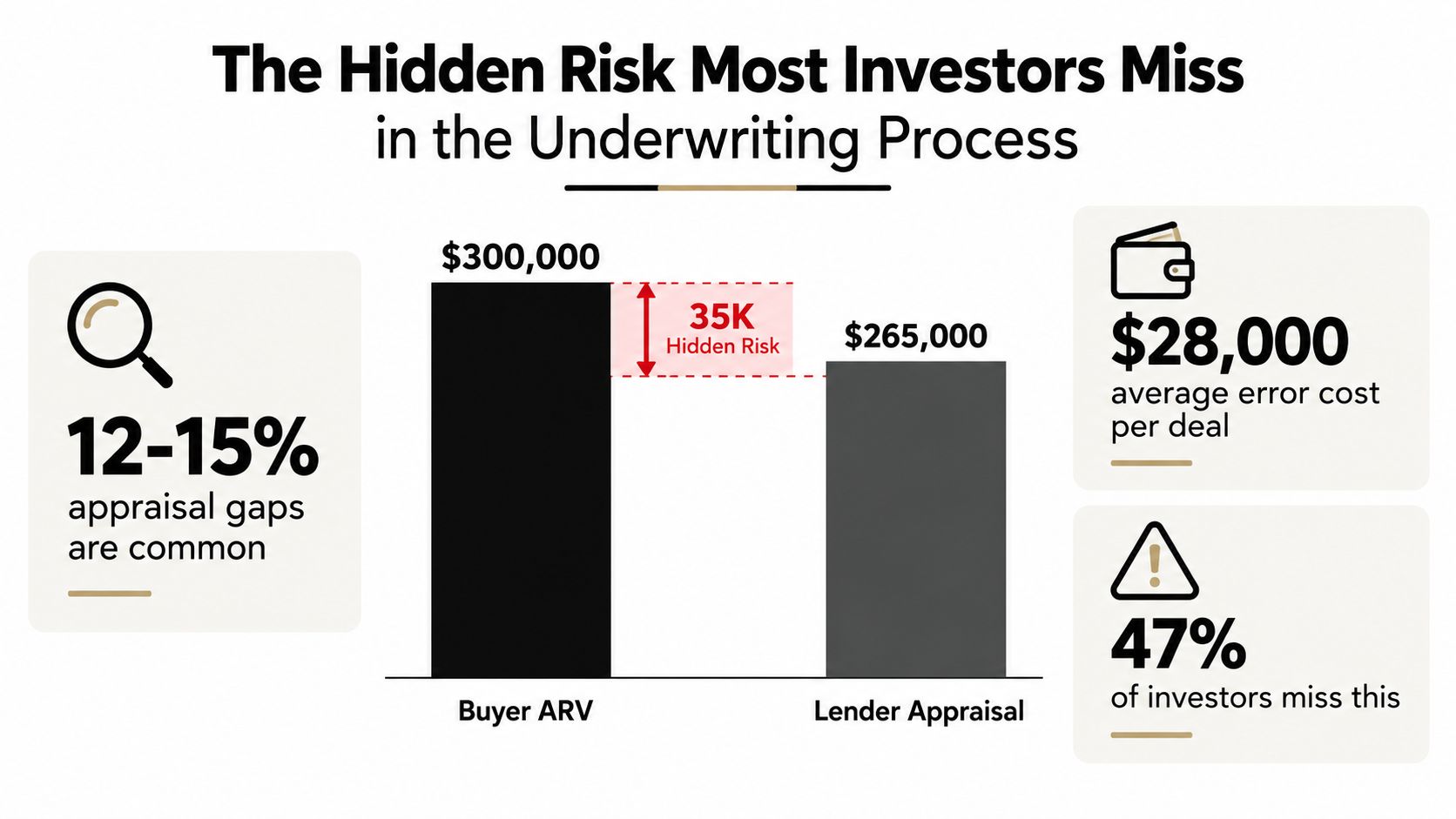
A disciplined investor values the property twice. The first model reflects the buyer's business plan, renovation choices, rent assumptions, and exit. The second model reflects the lender's likely appraisal, NOI adjustments, reserves, and collateral standards.
Lender test: If the deal works only under the buyer's valuation, it isn't financeable enough to treat as a committed acquisition.
The practical response is to request lender feedback early, document the comp differences, and reserve cash for a valuation shortfall. Faster underwriting doesn't remove conservative judgment. It gives the investor a clearer opportunity to model it before making an offer.
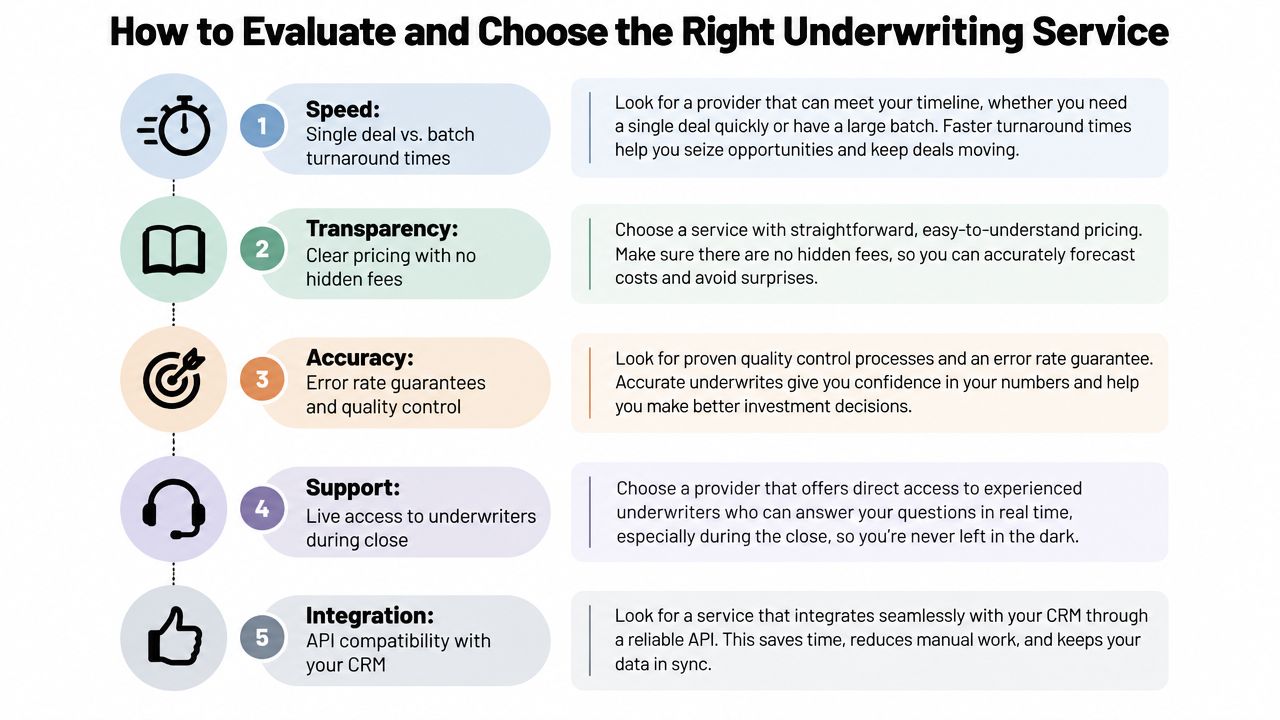
How to Evaluate and Choose the Right Underwriting Service
Treat provider selection like deal underwriting. Don't buy a report until you know what evidence it contains and how you'll use the result.
Start with the five-part filter
- Speed: Ask for the turnaround on a single address, a batch of properties, and a revision after new inspection information arrives.
- Transparency: Confirm that the provider shows comps, adjustment logic, repair line items, assumptions, and limitations instead of returning a black-box value.
- Comp quality: Review sale recency, geographic distance, square-footage similarity, bedroom count, condition tier, and adjustment discipline.
- Export quality: Check whether the package arrives as a clean PDF, spreadsheet, shareable link, or structured data that your systems can use.
- Pricing: Compare flat fees, per-deal charges, subscriptions, and volume terms against the number of properties your team screens.
A provider should explain why a comp was selected and what happens when the best-looking sale is a foreclosure or an unusual transaction. It should also show how a repair estimate changes when the scope moves from cosmetic work to systems or structural work.
Watch for simple warning signs:
- Missing evidence: The provider refuses to disclose the comps behind ARV.
- Unclear adjustments: The report quotes value without addressing square-footage, condition, layout, or lot differences.
- Unverifiable repairs: The estimate has broad totals but no line-by-line explanation.
- Poor handoff: The output can't be shared with partners, lenders, contractors, or internal reviewers.
A first-time flipper may prioritize clarity and education. A buy-and-hold operator may need reliable rent, expense, reserve, and lender-case assumptions. A fund may prioritize batch consistency, audit trails, exports, and integration. Score every provider against the same criteria, then choose the one that fits the decision you make most often.
Putting Underwriting to Work on Your Next Deal
Use one live property and move it through a seven-day cadence:
- Day one: Triage the address with public records and a preliminary MAO screen.
- Day two: Pull closed comps and document the supported ARV range.
- Day three: Build a repair scope, separating visible cosmetic work from systems and structural exposure.
- Day four: Reconcile the offer with the 70% screen, financing terms, costs, and required profit.
- Day five: Check title, liens, flood exposure, zoning, access, and entitlement concerns.
- Day six: Route the complete package through your internal reviewer, lender, or selected underwriting service.
- Day seven: Make the go-or-no-go decision and save a written memo stating the price, assumptions, risks, and next action.
That rhythm turns ARV, repairs, MAO, and red flags into decisions instead of isolated report fields.
PropLab helps investors calculate ARV, estimate rehab costs, identify relevant comps, flag property risks, and produce offer-ready reports from public property and market data. Test your next address with PropLab and use the resulting analysis to set a defensible offer before you commit.
About the Author
P
PropLab Team
Real Estate Analysis Experts
The PropLab team consists of experienced real estate investors, data scientists, and software engineers dedicated to helping investors make smarter decisions with AI-powered analysis tools.
Free tool
Get the ARV of any property in 30 seconds
Skip the spreadsheet. Enter an address and get an after-repair value backed by real comps.