General
Red Flags Risk Assessment How to Price Risk Into Every Offer
September 16, 2026
16 min read
You've found a property that looks profitable at first glance. The asking price leaves room for repairs, the projected resale value appears defensible, and the timeline seems manageable. Then a title issue delays closing, the electrical work lacks permits, insurance terms change, and your holding costs consume the margin you thought you had.
That isn't bad luck. It's an incomplete red flags risk assessment.
A red flag doesn't automatically mean you should reject a property. It means you need to identify the issue, judge its seriousness, estimate the cost to cure it, assess whether it could recur, and reflect the result in your offer and documentation. That process protects fix-and-flip investors, BRRRR operators, wholesalers, acquisitions teams, and lenders from confusing a negotiable inconvenience with a deal-ending liability.
Why Red Flags Make or Break Your Deal Before Rehab Starts
A missed risk rarely stays isolated. A questionable permit can create inspection delays. A delayed inspection can extend financing. Extended financing increases holding costs, while a weaker exit strategy may force a price reduction. Each issue can be manageable on its own, but together they can push a deal below its required margin.
Consider a common acquisition failure. An investor underwrites a house using attractive nearby sales and assumes the basement conversion is legal. After contract, the municipality confirms that the extra living area wasn't permitted. The appraiser excludes it from the valuation, the lender questions the exit, and the contractor discovers that the conversion also needs fire separation and electrical corrections. The investor didn't merely miss a repair. They used an unsupported ARV, understated the rehab, and submitted an offer that depended on three unverified assumptions.
Practical rule: A flag is a request for evidence, not a verdict.
This distinction matters in compliance work, too. The Financial Monitoring Unit's real-estate red-flag guide treats indicators such as unclear source of funds, unexplained intermediaries, unusual powers of attorney, and pricing materially away from market value as prompts for enhanced due diligence. A similar logic applies to investment underwriting. An unusual ownership chain or last-minute settlement change should trigger verification, not an automatic accusation.
The same principle applies before you approve a tenant or business partner. Investors who manage rentals should also know how to spot rental application red flags, because transaction risk doesn't end when the property closes. A weak applicant, an unclear source of funds, or inconsistent documentation can affect rent collection and asset stability.
The underwriting habit that prevents expensive surprises
Run the same first-pass screen on every address:
- Identify: Record title, tax, permit, condition, market, financing, and exit signals.
- Score: Rate severity, likelihood, cost-to-cure exposure, and confidence in the underlying data.
- Price: Adjust ARV confidence, rehab, contingency, financing assumptions, and MAO.
- Document: Save the evidence, owner, status, and decision rationale.
Tools that aggregate public records, tax information, market signals, condition indicators, and relevant comparable sales can make the first pass faster. PropLab, for example, surfaces condition indicators and risk signals without requiring MLS access, then connects those findings with ARV, rehab, and offer analysis. That initial screen isn't a substitute for title, legal, contractor, or environmental diligence. It gives you a disciplined reason to decide where deeper work belongs.
The useful question isn't “Does this property have a red flag?” Every older property has something to investigate. Ask instead, “Which risk can change my valuation, financing, timeline, or exit, and what evidence would resolve it?”
The Six Property Red Flag Categories Every Investor Should Check
A fast screen should cover more than visible damage. Property risk usually sits across legal control, public-record obligations, physical condition, environmental exposure, and market evidence. Check each category before you let a compelling purchase price anchor the underwriting.
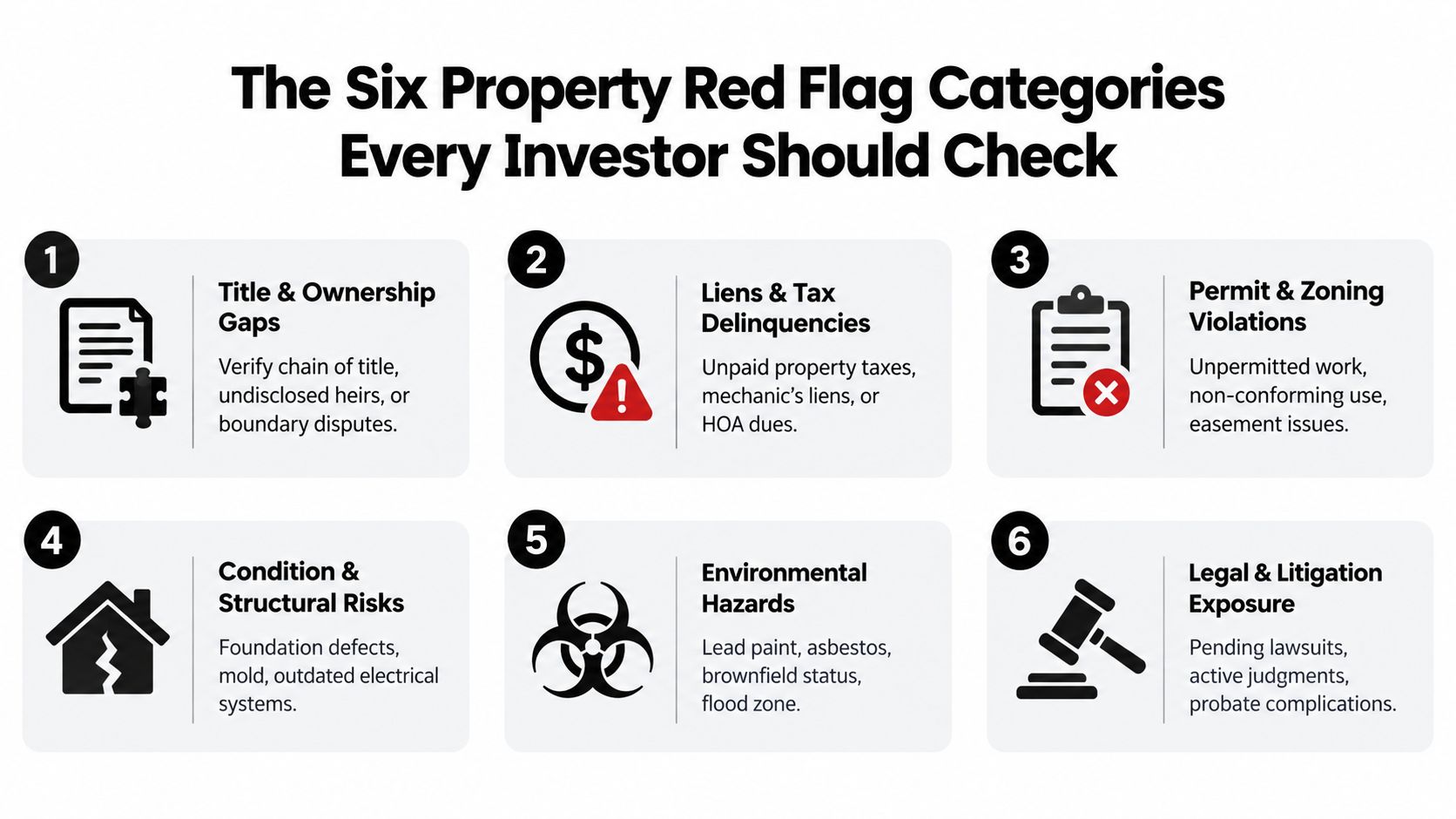
Title and ownership gaps
Start with the chain of title. Look for quitclaim transfers, probate involvement, unexplained ownership changes, inconsistent legal descriptions, undisclosed heirs, boundary disputes, or a seller whose authority doesn't match the recorded owner. A quitclaim chain isn't automatically fatal, but it deserves a title professional's review because it may leave unresolved competing interests.
Verify through the county recorder, title company, probate records, surveys, and the purchase contract. Confirm vesting, signing authority, legal description, access, easements, and any required parties. If the seller acquired the property recently and is now reselling it, ask whether the deed has been properly recorded and whether any transfer documentation remains outstanding.
Liens and tax delinquencies
Unpaid property taxes, municipal charges, mechanic's liens, HOA balances, judgments, and utility claims can follow the property or complicate closing. Ask the title company for a current commitment and require written payoff figures where applicable. Check the tax assessor and treasurer, then compare the public-record balance with the settlement statement.
A lien may be curable, but the cost and timing matter. A contractor lien with a clear payoff is different from a disputed lien that threatens the closing date. Don't place either issue into the same generic “closing risk” bucket.
Permit and zoning violations
Permits tell you whether the municipality recognized the work, not whether the work was performed well. Check additions, basement conversions, accessory units, structural changes, electrical upgrades, plumbing relocations, roofing, and HVAC replacements. Verify zoning, legal use, setbacks, parking, flood requirements, easements, and certificate-of-occupancy rules with the local building department.
On site, compare the floor plan and observed improvements with the permit history. A finished room that doesn't appear in records may be harmless storage, illegal living space, or a costly correction. The answer changes your ARV and your lender's view of the collateral.
Condition and structural risks
Look beyond cosmetic damage. Foundation movement, moisture intrusion, drainage failure, mold, roof age, obsolete electrical systems, sewer defects, plumbing supply issues, and unsafe mechanical equipment can expand the scope after demolition. Use the inspection to identify the issue, then obtain targeted contractor opinions rather than relying on one broad repair allowance.
The critical question is whether the defect affects habitability, insurance, financing eligibility, or resale. A dated kitchen is usually negotiable. A foundation problem with uncertain recurrence is a different underwriting event.
Environmental hazards
Lead-based paint, asbestos, underground tanks, flood exposure, contamination, and brownfield status can affect the work method, insurance, financing, and buyer pool. Verify with environmental databases, municipal records, flood maps, seller disclosures, and specialist inspections where the property history warrants it.
Don't treat an environmental flag as a simple line item. The uncertainty itself may require a testing allowance, schedule buffer, or walk-away condition.
Legal and litigation exposure
Search for pending lawsuits, judgments, code enforcement, probate complications, landlord-tenant disputes, and other proceedings connected to the owner or property. Public records can reveal unresolved obligations that don't appear in a listing package. A local attorney or title company should interpret the legal effect.
Finally, challenge the comps. Verify distance, recency, condition, school boundary, street context, lot utility, and buyer appeal. A sale from a different school zone or a substantially superior renovation can make the ARV look precise while providing weak support. Outlier pricing deserves an explanation, not automatic inclusion.
How to Score and Prioritize Risk Without Over Flagging
A checklist produces observations. A scoring model produces decisions.
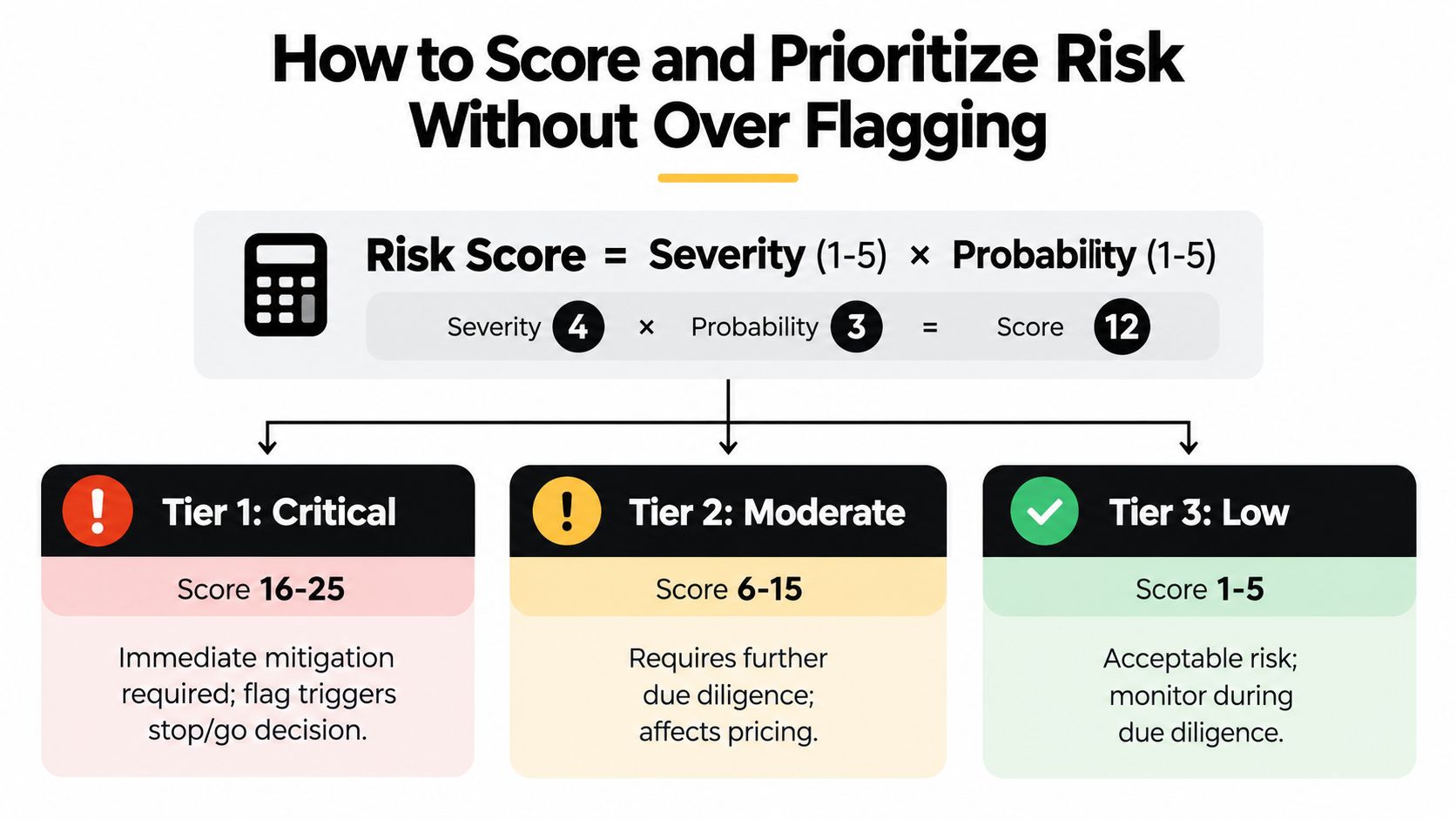
Use separate fields for severity, probability, cost-to-cure exposure, recurrence, and confidence. You can use a simple severity and probability scale from one through five for internal consistency, but don't confuse a tidy score with certainty. The model should help you rank diligence, not manufacture precision.
Score the consequence before the probability
Severity asks what happens if the issue is real. Would it change legal ownership, prevent financing, invalidate part of the ARV, threaten habitability, or create a material schedule delay? Probability asks how likely the issue is, based on available evidence.
Then add cost-to-cure as a separate underwriting input. A moderate structural issue may have a known repair path. An apparently minor title concern may have an uncertain legal resolution and therefore deserve a higher confidence penalty even before you know the final cost.
A practical worksheet can look like this:
| Field | Question | Underwriting use |
|---|---|---|
| Severity | How damaging is the outcome? | Sets escalation priority |
| Probability | How credible is the risk? | Determines diligence intensity |
| Cost to cure | What could resolution require? | Adjusts rehab and contingency |
| Recurrence | Could the problem return? | Tests long-term viability |
| Confidence | How reliable is the evidence? | Penalizes unsupported assumptions |
The analytical case for combining signals is strong, even though the best-known example comes from medicine rather than property. A 2013 BMJ systematic review found that individual clinical red flags often added little diagnostic value alone, while multiple red flags raised the probability of spinal fracture to 90%. The review reported lower post-test probabilities for individual signals, including older age at 9%, prolonged corticosteroid use at 33%, severe trauma at 11%, and contusion or abrasion at 62%. It also reported a 33% post-test probability for a history of malignancy in spinal malignancy assessment. Those figures don't transfer to real estate, but the lesson does: combinations deserve more attention than isolated noise. The BMJ review explains the evidence.
Separate missing data from dangerous behavior
Missing information is not the same as negative information. A transparency methodology used in procurement treats cases with 66% or more missing-data responses as a red flag for data completeness, while cautioning that missingness alone doesn't prove higher substantive risk. The CSIS red-flags methodology supports keeping those dimensions separate.
That distinction prevents alert fatigue. “Permit history unavailable” should produce a documentation task. “Seller refuses to explain an unpermitted addition” should affect behavioral risk and escalation.
Calibrate against actual outcomes
Back-test the model against closed and abandoned deals. Record which flags became real costs, which cleared, and which generated unnecessary review. One risk-assessment source warns that a methodology with historical error rates above 50% performs worse than chance, while procurement-risk research emphasizes testing whether deviations are statistically significant instead of flagging every noisy change. The risk-assessment guidance is useful here.
For a deeper implementation reference, see weighted scoring models. The operating objective is simple: escalate combinations that predict deal damage, resolve low-confidence data gaps quickly, and avoid turning every unusual property feature into a stop signal.
Turning Risk Scores Into a Safer Max Offer Price
A risk score has no value if it stays in a spreadsheet column. Convert it into the number you're willing to pay.
The base fix-and-flip equation is:
MAO = ARV minus rehab minus required profit margin minus risk contingency
That equation is a framework, not a universal formula. Your financing structure, transaction costs, holding period, resale costs, and minimum return requirements still belong in the underwriting. Risk assessment tells you where the standard assumptions need to become more conservative.
Adjust the assumption that carries the risk
A lien flag usually belongs in closing-risk analysis. If the payoff is documented and the seller can clear it, the risk may be a timing condition rather than a permanent value discount. A declining-market signal affects the exit itself, so you may need to lower ARV confidence, lengthen the expected hold, increase the contingency, or reject the deal if the margin depends on an aggressive resale price.
A permit issue can affect both. If the work is legalizable, price the approval process and correction scope. If the improvement is central to the ARV and the municipality may deny the use, underwrite the property without that value until evidence supports inclusion.
Use a confidence framework to distinguish a supported ARV from a fragile one. PropLab's confidence rating scale is one reference for documenting that distinction. Lenders don't need an optimistic number presented with confidence. They need to see why the number deserves trust.
Worked decision example
Assume a flip has a supported ARV, a contractor-backed rehab estimate, a required profit target, and known transaction costs. The first pass identifies two flags:
- A recorded lien with a verifiable payoff demand.
- Sales activity suggesting weaker demand and a less dependable exit.
The lien should lead to a written closing condition, an escrow or payoff process approved by the settlement team, and a schedule buffer. The market flag should alter the valuation and exit assumptions. Applying the same discount to both would be lazy underwriting because the risks behave differently.
| Risk Tier | What It Means | MAO Action |
|---|---|---|
| Critical | The issue may block closing, financing, legal use, or the planned exit | Require resolution or verified mitigation before proceeding, otherwise walk |
| Moderate | The issue can affect price, timing, or scope but may be curable | Add documented cure cost, contingency, and any schedule impact |
| Low | The issue is limited, understood, and unlikely to change the plan | Monitor it and avoid paying a premium for an assumption |
For BRRRR deals, replace resale-only thinking with refinance risk. A repair that produces an attractive finished house may still fail if the appraiser excludes an unpermitted area, insurance becomes difficult, or rent assumptions don't support the debt. A lender-ready analysis should show the conservative case, not merely the desired exit.
Pricing discipline: If the risk can't be resolved before offer submission, price the uncertainty or decline the deal. Don't bury it in optimism.
The final MAO should show which deduction came from rehab, which came from risk, and which came from weak evidence. That makes negotiation clearer and keeps a tight market from persuading you to pay for uncertainty.
Mitigation Playbook for Title Liens Permits and Condition Issues
Once a flag fires, assign an owner and a deliverable. “Under review” isn't mitigation. A resolved issue has evidence attached, a responsible party, and a condition that tells you whether the deal can continue.

Title, liens, and taxes
The title company should obtain the commitment, identify exceptions, request payoff demands, and confirm the release process. The acquisitions manager owns the deadline. The seller or closing attorney usually owns curative documents, probate cooperation, lien releases, and missing signatures.
For ownership defects, review defects in property title explained with counsel rather than assuming a title exception is cosmetic. Required documentation may include recorded releases, affidavits, probate orders, corrected deeds, payoff letters, tax-status confirmations, and an updated title commitment.
Use public records property search to organize the initial record review, then have the title professional confirm what controls closing. Timelines vary by jurisdiction and complexity, so don't promise a cure date until the responsible professional provides one.
Permits and zoning
The local building department owns the determination. Ask for the permit history, violation notices, zoning confirmation, and written guidance on retroactive approval. A licensed contractor or architect should define the correction scope, while the investor carries the pricing decision.
Require the municipality's response, permit applications, inspection requirements, revised plans, and final approvals before assigning full value to the work. If the use cannot be legalized, remove that area from ARV and reassess the layout, rent, and exit.
Condition and environmental exposure
Have a qualified inspector identify the defect, then ask trade contractors for targeted bids. Re-bid uncertain work, especially foundation, drainage, sewer, electrical, mold, and environmental remediation. Track the inspection finding, proposed repair, cost range, recurrence risk, warranty, and insurance implication.
A repair can be affordable and still unacceptable if it is likely to return. Conversely, a larger repair may be manageable when the scope is defined and the financing accommodates it.
Comp and market concerns
Replace weak comps instead of defending them. Re-select sales using location, recency, condition, size, layout, and buyer pool, then document why each comparable belongs in the valuation. Save the adjustment rationale and show how the conclusion changes when questionable sales are removed.
For lender review, export the before-and-after analysis. A clean record showing the original flag, mitigation action, revised assumption, and remaining exposure carries more weight than a note that says “resolved.”
Building Lender Ready Reports That Document Your Risk Assessment
A lender-ready report should let another person reproduce your decision without a call. Start with the property identity, ownership summary, source documents, and a concise risk register. Each flagged item should show the evidence, severity, probability, cost-to-cure treatment, owner, status, and impact on the offer.
Build the report around the decision
Include these components in the order a lender or partner will review them:
- Property and title: Address, legal description, ownership evidence, tax status, liens, and exceptions.
- Market support: Selected comps, distance and recency rationale, condition adjustments, outliers excluded, and ARV confidence.
- Scope and capital: Inspection findings, contractor bids, permit assumptions, environmental questions, and contingency treatment.
- Offer logic: ARV, repairs, financing and holding assumptions, required return, risk deductions, and final MAO.
- Mitigation status: Open conditions, responsible parties, required documents, deadlines, and walk-away triggers.
A lender isn't only evaluating whether the property could be worth more after renovation. They're evaluating collateral quality, execution risk, repayment, and the credibility of the borrower's process. Clear documentation reduces repeated questions because it shows how the investor handled uncertainty rather than hiding it.
That standard applies beyond real estate. If you work with financing intermediaries, understanding how an SBA loan broker works reinforces the broader lesson: financing professionals need organized borrower information, clear assumptions, and documentation that supports the requested capital.
Make the process repeatable
Use a PDF or shareable report with linked evidence, not a scattered folder of screenshots. A platform such as PropLab can combine public-record research, condition indicators, weighted comparable analysis, confidence scoring, rehab assumptions, and MAO logic into an exportable deal package without requiring MLS access.
After closing or walking away, compare the flagged risks with the actual result. Did the title issue clear? Did the contractor's estimate hold? Did the market exit behave as underwritten? That feedback improves thresholds and reduces both false positives and false negatives over time.
Your next-deal routine should be short and consistent: run the property screen, read every high-severity signal, verify the supporting record, score the exposure, adjust the MAO, and attach the evidence before sending the offer. Speed matters, but disciplined speed protects the margin.
Use PropLab to surface property and market risk signals, support ARV and rehab underwriting, calculate a defensible MAO, and package the findings for partners or lenders. Start your next acquisition with a documented red flags risk assessment instead of relying on an optimistic spreadsheet and a last-minute surprise.
Tags
About the Author
P
PropLab Team
Real Estate Analysis Experts
The PropLab team consists of experienced real estate investors, data scientists, and software engineers dedicated to helping investors make smarter decisions with AI-powered analysis tools.
Free account
Underwrite your next deal in under a minute
3 free analyses, no credit card. ARV, rehab, comps and exit strategy in one report.