General
10 Software for Investors Worth Using in 2026
October 1, 2026
22 min read

You've found a property that looks promising, but the decision still depends on several disconnected tasks. You need to verify comparable sales, estimate the after-repair value, price the work, calculate an offer, and explain the numbers to partners or lenders. If the property becomes a project, you'll also need to track contractors, budgets, timelines, tenants, guests, or buyer outreach without losing the assumptions behind the original deal.
That's why the best software for investors isn't necessarily the platform with the longest feature list. Each tool fits a different point in the workflow, and no single product is ideal for sourcing, underwriting, rehab management, rental analysis, short-term rental forecasting, and outreach at the same time. The practical comparison comes down to data coverage, underwriting depth, execution support, pricing structure, and market limitations.
The list below follows the deal rather than a software category. It starts with finding and validating opportunities, moves through offers and financing, and ends with rehabs, rentals, short-term rentals, and acquisition outreach. Use it to build a stack around your strategy, whether you fix and flip, buy and hold, wholesale, operate short-term rentals, or lend against investor deals.
1. PropLab
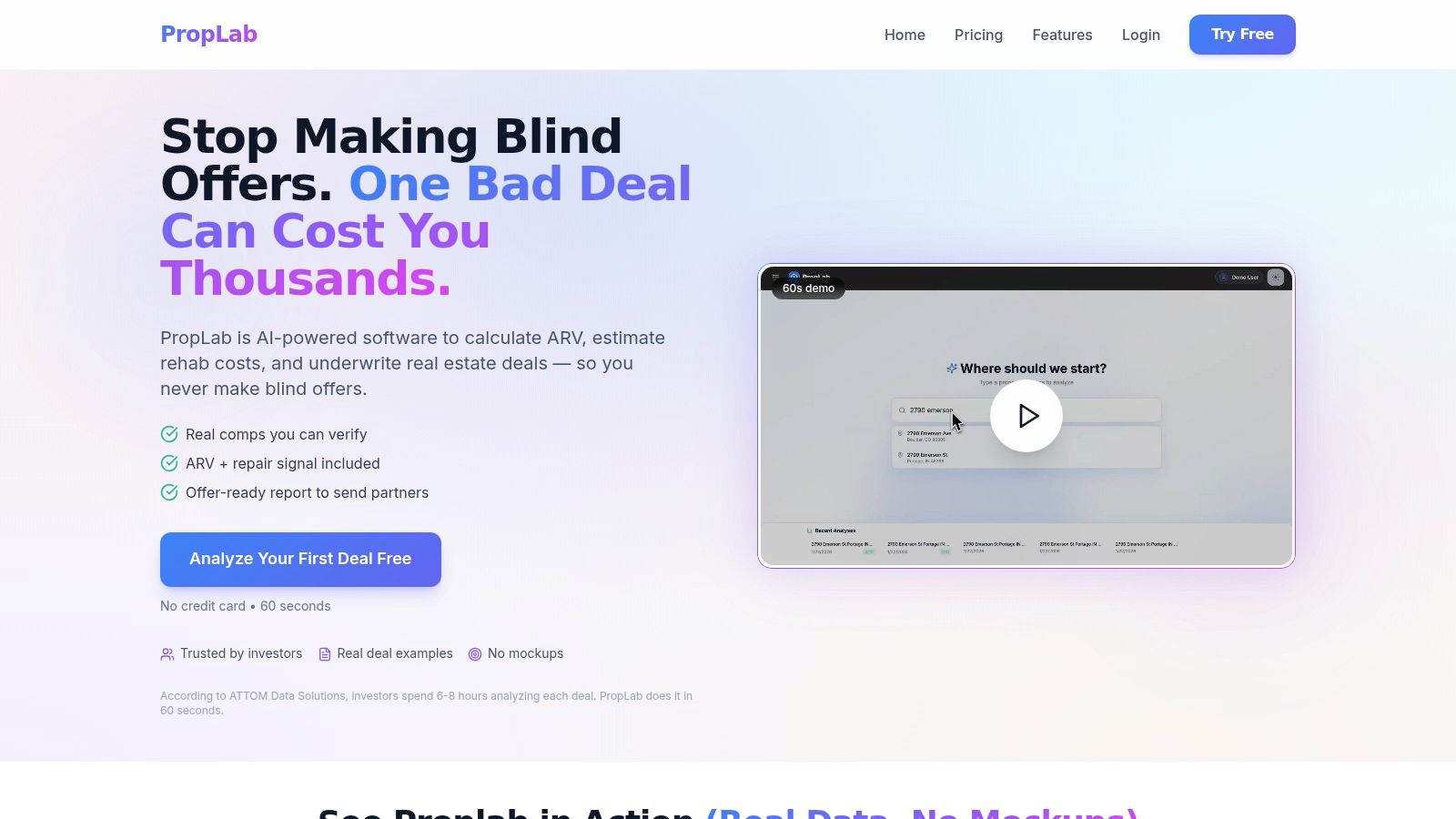
PropLab is the strongest fit when the immediate problem is turning an address into a defensible offer. Its AI-powered underwriting workflow combines public records, tax data, and market signals without requiring MLS access. The platform identifies relevant comparable properties using distance and recency weighting, then shows adjustment breakdowns and confidence scores instead of presenting a valuation as an unexplained number.
That distinction matters in off-market and fragmented data environments. Investors often work in counties where listing access is limited, transaction histories are sparse, or property information varies by location. PropLab's reports surface condition indicators and red flags alongside ARV, repair estimates, and Max Offer Price, helping you see where the conclusion is strong and where local verification is still necessary.
Practical rule: Treat confidence scoring as a reason to investigate the inputs, not as permission to skip inspection or broker review.
Where PropLab fits
The core workflow is designed to compress manual analysis into an address-to-offer process that takes about 60 seconds, according to the publisher's product information. Investors report ARV estimates within roughly 3% to 5% of actual sale prices, though those results depend on local data quality and should be validated against current evidence. The platform also includes a Daily Deals scanner across 90+ major US counties, which can help acquisitions teams build a pipeline before manually reviewing every property.
The output is practical rather than purely analytical. A clear MAO incorporates profit margins, while lender-ready PDF reports and shareable links make it easier to explain assumptions to partners, private lenders, and hard-money lenders. Higher plans add contract generation, API access, and unlimited deal saving. A forever-free tier includes 3 free analyses without a credit card, while paid plans support heavier usage.
Pros
- Fast underwriting: Produces comps, ARV, repairs, and MAO in roughly a minute.
- MLS-independent analysis: Uses public records, tax data, and market signals when MLS access isn't available.
- Auditable outputs: Adjustment details, confidence scoring, red flags, and condition indicators make the result easier to challenge.
- Deal collaboration: Exports professional PDFs and share links for partners and lenders.
- Flexible scaling: Offers free analysis, paid tiers, contract generation, saved deals, and API access.
Cons
- Limited free volume: The free tier is useful for testing, but active acquisition requires paid access or credits.
- Market sensitivity: Thin rural or low-data markets can reduce comp quality, so local records, inspections, and agent input remain important.
Explore PropLab's real estate underwriting platform
2. PropStream
PropStream makes more sense when sourcing and outreach are as important as the first underwriting pass. It combines nationwide property, tax, mortgage, lien, pre-foreclosure, and listing information with lead filters, comping, skip tracing, dialing, and direct-mail workflows. That single-login approach suits wholesalers and acquisitions teams that don't want to move a lead through several disconnected systems.
The platform's lead tools can identify motivated-seller segments, while its analysis features support ARV, ROI, flip, and rental evaluations. You can turn a filtered list into an outreach campaign, then keep monitored properties and team activity in the same operating environment. That's useful for repeatable acquisition work, but it also creates a trade-off. The more outreach volume, users, mail, and add-ons you use, the more important total-cost modeling becomes.
What it replaces and what it doesn't
PropStream can replace a separate property-data subscription, a basic list-building tool, skip-tracing software, and some early-stage marketing services. It doesn't eliminate the need for disciplined comp review or a dedicated project-management process after acquisition. A wholesaler may find it especially efficient, while a flipper who already has reliable lead sources may prefer a more focused underwriting interface.
Before sending a contract, compare the platform's valuation with recent local sales, verify ownership and lien information, and confirm that contact data is legally usable for your outreach channel. For a focused comparison with free-trial considerations, review PropStream free trial options for investors.
Best fit: Wholesalers and acquisitions teams that need property intelligence and outreach in one workflow.
3. DealCheck
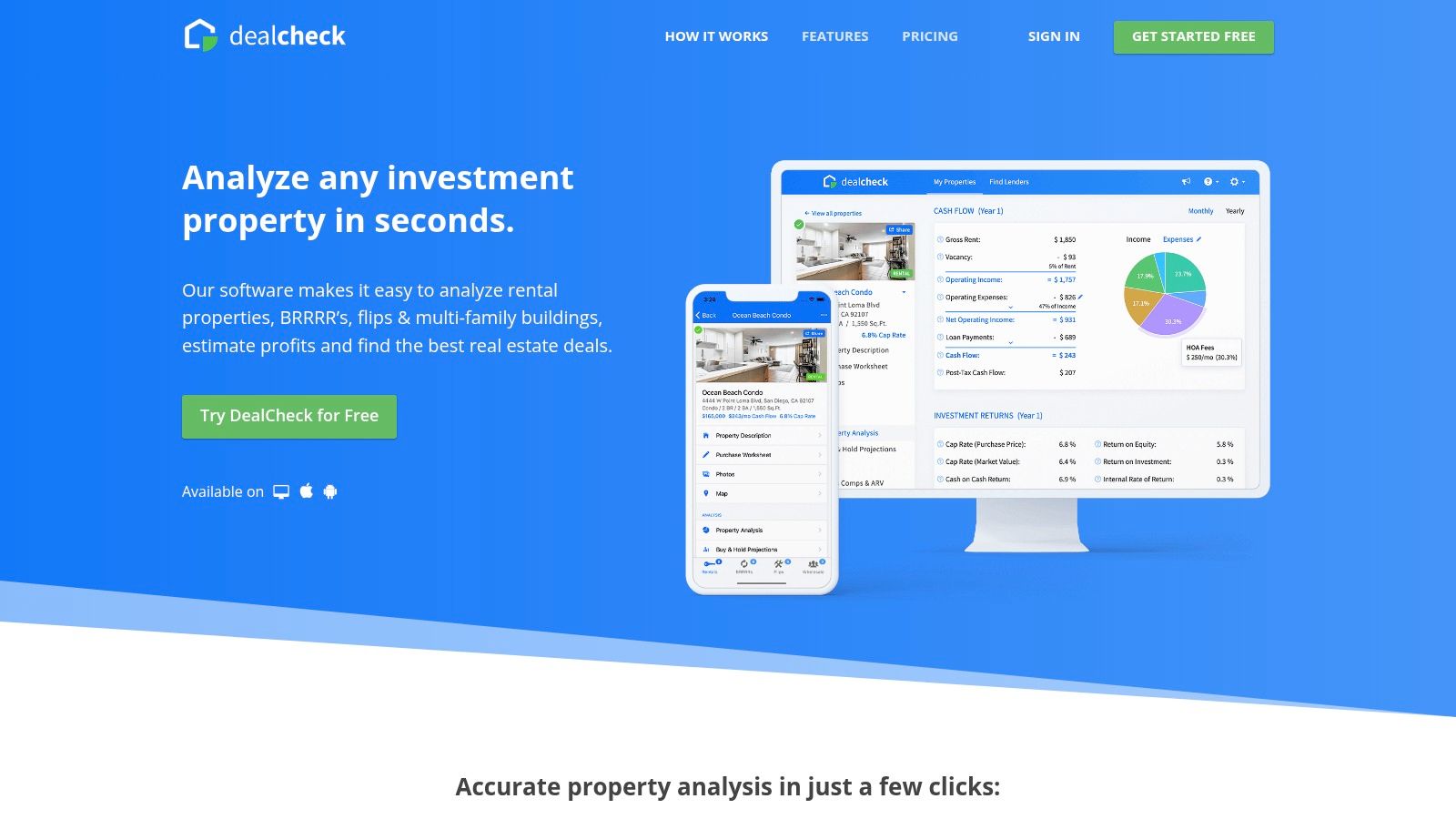
DealCheck is built for investors who want to analyze a property quickly without learning a complex system. It handles rentals, BRRRR scenarios, flips, small multifamily properties, wholesale offers, and Airbnb projections through a relatively approachable interface. The web, iOS, and Android apps make it particularly useful when you're reviewing a lead from a phone, at a property, or between appointments.
Its strength is underwriting clarity. You can enter sales and rental comps, estimate ARV, calculate an offer or MAO, model long-term cash flow, and test refinance assumptions through custom templates. Sharable, white-labeled PDFs and interactive reports help present the decision to a lender or partner without rebuilding the analysis in a spreadsheet.
The right role in a stack
DealCheck is an underwriting layer, not a complete lead-generation machine. You'll typically pair it with a data source such as PropStream, BatchLeads, DealMachine, or PropertyRadar. That separation can be an advantage because it keeps the analysis focused, but it means you'll need a clean process for transferring property facts, rents, repair assumptions, and financing terms.
The free plan gives solo investors a practical way to test the workflow. Pro access is more appropriate when you're analyzing regularly and need unlimited analysis, mobile convenience, or polished reports. The automated comps are useful for screening, but local nuance still matters, especially for unusual homes, small multifamily properties, and neighborhoods with limited comparable sales. For other underwriting options, see real estate underwriting tools that can replace DealCheck.
Best fit: Solo investors and small teams that prioritize fast, repeatable analysis over lead generation.
4. Privy
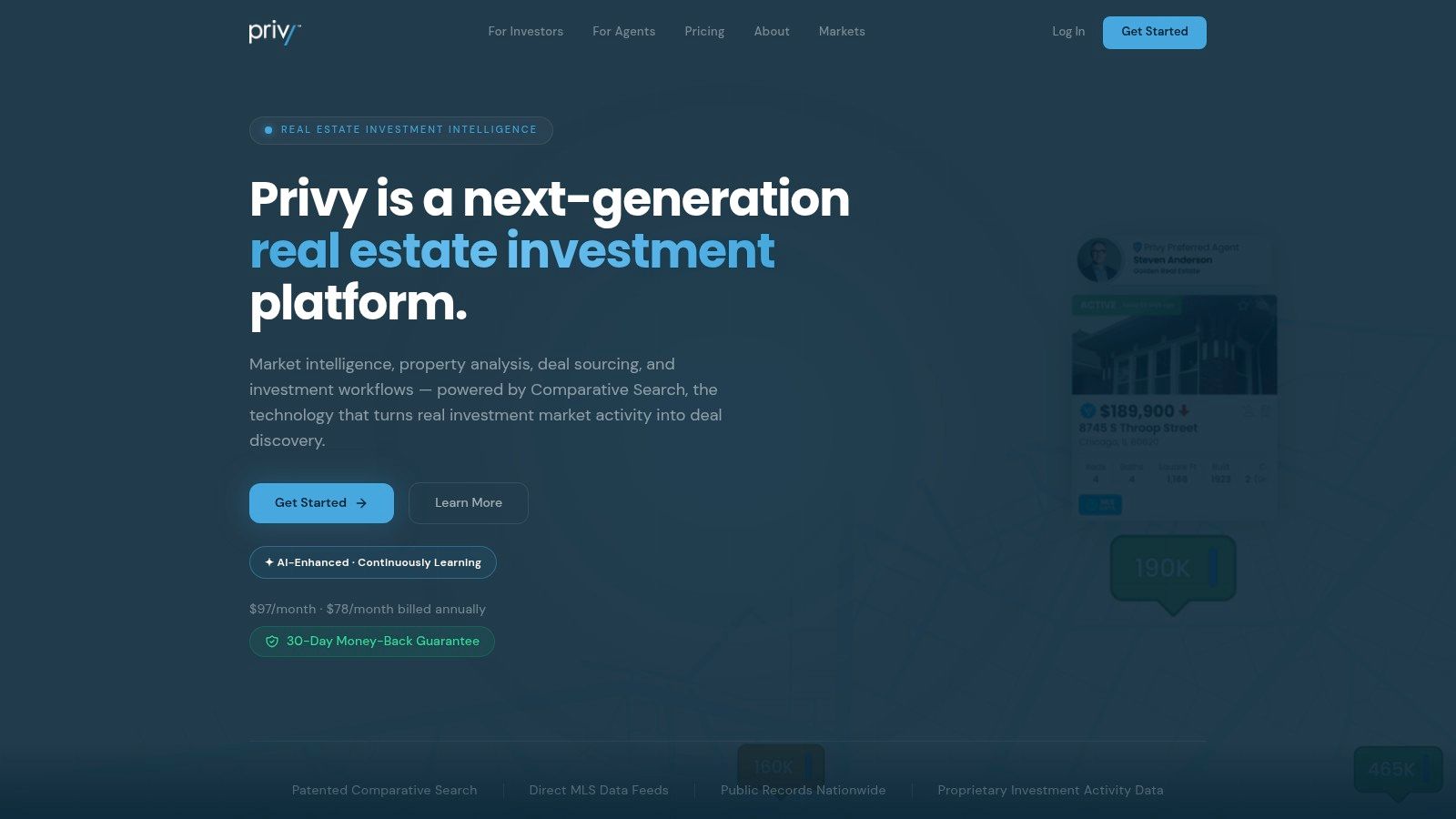
Privy Pro for Investors is the logical choice when MLS-connected data is central to your acquisition process. It combines direct MLS feeds with public records and rental data, then applies investor-focused comparative search to identify on-market opportunities that may fit a selected strategy. Its LiveCMA-style reports and investor activity views are designed to answer a different question from a basic property database: what are active investors doing in this market, and how does this listing compare?
That makes Privy useful for agents who invest, investors without direct MLS access, and buyers who rely heavily on listed inventory. The platform can help surface hot zones based on investor activity and match properties to strategies such as flipping or renting. State and coverage options let users choose between narrower and broader geographic access.
Validate the feed, not just the result
MLS coverage doesn't guarantee identical data quality everywhere. Rules and coverage vary by MLS and state, and non-disclosure states may rely on estimates rather than publicly disclosed sale prices. You should check how the platform handles closed-sale information in the exact market where you're buying, then reconcile the results with local agents, public records, and property-level condition evidence.
Privy isn't a replacement for a rehab-management system, contractor bids, or a full acquisition CRM. Its value is strongest before the offer, when accurate listed-market comps and investor activity can improve screening. Pricing is based on plan and geographic coverage, so compare the required territory with the number of markets you operate in.
Best fit: Investors and investor-agents who need MLS-connected comping and listed-deal discovery.
Explore Privy Pro for Investors
5. BatchLeads
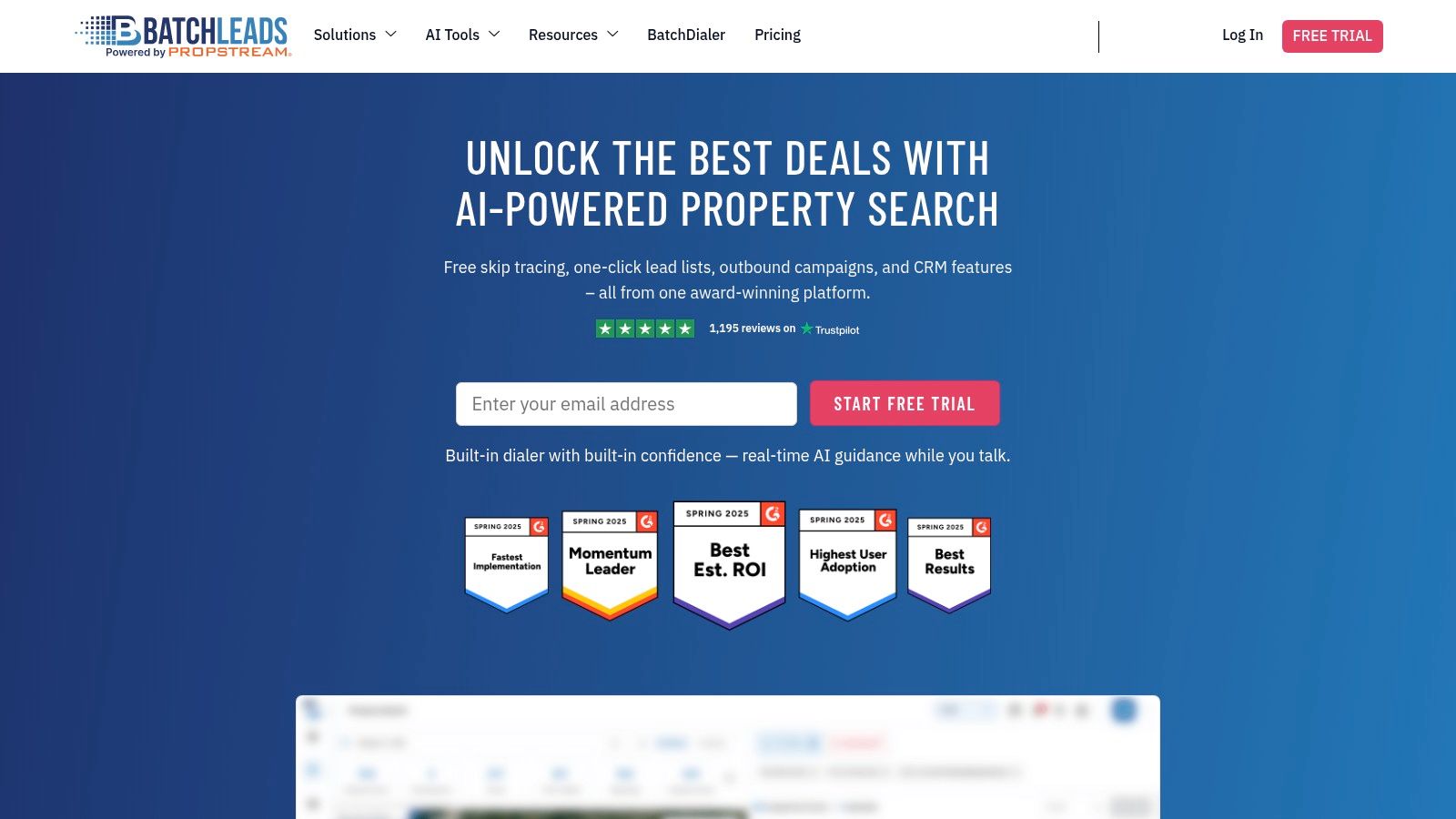
BatchLeads is oriented toward building and working lead lists at scale. Its property and owner database supports more than 140 filters, while integrated phone numbers, emails, dialing, texting, direct mail, and Driving-for-Dollars tools connect list creation to first contact. BatchRank AI scoring adds another prioritization layer for teams that need to decide which records deserve attention first.
That workflow is particularly effective for wholesalers and acquisition teams running consistent outbound campaigns. You can build a list around ownership, property characteristics, distress signals, or geography, then move the records into calls, messages, or mail without exporting everything to separate software. Team seats and higher lead or export limits support a larger operation, though the economics depend heavily on usage.
Where the economics change
BatchLeads is most valuable when you use its communication stack rather than treating it as a passive data subscription. Monthly costs can rise as lead volume, exports, seats, dialing, and messaging expand. A solo investor with a small, referral-driven pipeline may not use enough of the outreach functionality to justify that structure.
The tool also doesn't replace serious underwriting. A lead score can help prioritize a conversation, but it can't confirm condition, ARV, repair scope, title status, or a safe offer. Move qualified leads into PropLab or DealCheck before you commit capital, and preserve the original data and assumptions so your team can explain why a lead became an offer.
Best fit: Wholesalers and acquisition teams that need list building, skip tracing, and outreach in one interface.
6. DealMachine
DealMachine stands out when field acquisition is part of the strategy. Its Driving-for-Dollars mobile app lets investors record routes, save properties, and look up owners while working in a neighborhood. Desk-based list building, contact enrichment, skip tracing, direct mail, and team collaboration then extend that field observation into a repeatable pipeline.
The modular structure is useful for investors who don't want to buy a large all-in-one system. Usage-based direct mail provides a clearer connection between activity and cost, while the REST API, CLI, and webhooks give technically capable teams more control over routing data into their own CRM or workflow. That makes DealMachine a better fit for operators who care about process design, not just list access.
What you still need
DealMachine isn't a full MLS comping platform. Finding an owner or identifying a property from the road doesn't tell you whether the asset supports a flip, rental, BRRRR, or wholesale offer. Pair it with an underwriting application, then verify the property's condition and local comparable sales before contacting an owner with a specific number.
Team costs also grow with seats and record targets. Calculate the cost of data credits, mail, users, and any integrations together. For a small operator, the mobile workflow may be the main reason to choose it. For a larger team, API support and collaboration can matter more than the basic list-building interface.
Best fit: Investors combining Driving-for-Dollars with automated desk-based acquisition workflows.
7. PropertyRadar
PropertyRadar focuses on targeted lead discovery and marketing. Its property, owner, lien, and foreclosure intelligence supports detailed list building, while built-in phone and email data removes the need for a separate skip-tracing step in many workflows. From there, investors can launch phone, SMS, email, direct-mail, and display-ad campaigns inside the platform.
The appeal is control. Instead of buying a broad list and hoping the right prospects respond, you can narrow the audience around specific ownership or property conditions and adjust campaigns as you learn. Solo, Team, and Business tiers provide a path from individual prospecting to collaborative acquisition work, and the mobile apps help keep field and office activity connected.
Where users should watch the bill
The subscription is only part of the cost. Campaign add-ons, including online advertising, can be billed according to property impressions, so a campaign that looks inexpensive at the list-building stage may have a different total after promotion begins. Confirm how each outreach channel is billed before importing a large audience.
PropertyRadar is a sourcing and marketing system, not an offer-validation engine. Use it to identify and contact owners, then move serious prospects into a tool that can explain comps, repair assumptions, financing, and MAO. Advanced automation may also be web-only, which matters if your team expects to manage every campaign from a mobile device.
Best fit: Investors who want granular audience targeting and multichannel outreach from one data platform.
8. FlipperForce
FlipperForce is designed for the point where a promising flip becomes an active construction project. Its Flip Analyzer covers profit, ROI, MAO, financing costs, holding costs, and selling expenses. Once the acquisition is underway, the rehab estimator, project budgets, tasks, schedules, and progress reports help replace the scattered spreadsheets that often separate underwriting from execution.
That connection is the product's main advantage. A flipper can carry assumptions from the purchase decision into a budget, assign work, monitor progress, and report changes to a partner. It's a practical complement to a comping tool because it addresses the operational risk that begins after the offer is accepted. Investors who need to manage their remodel step by step will still need disciplined field processes, documentation, and contractor communication outside the application.
Calibrate every construction assumption
FlipperForce's rehab cost library uses geographically averaged costs. Those averages are useful for an early screen, but they shouldn't replace local contractor bids, supplier pricing, permit requirements, or a site inspection. Update the estimate as soon as the scope becomes clearer, and separate known bids from allowances so the contingency decision remains visible.
The platform is less relevant if you outsource all project management or invest primarily in rentals. Its paid plans include a 30-day free trial, which gives flippers time to test whether task tracking and reporting fit their actual operating style. Solo, Team, and Business options support different levels of collaboration.
Best fit: Fix-and-flip investors who manage rehabs themselves or need tighter budget and schedule control.
9. Rehab Valuator
Rehab Valuator prioritizes speed from deal concept to offer package. It supports analysis for wholesale, fix-and-flip, rental, BRRRR, and ground-up projects, then turns the assumptions into lender presentations or one-page proposals. That document-first approach makes it useful for wholesalers and investors who need to communicate a deal clearly before building a more detailed operating plan.
The MAO calculator, budget and draw templates, sales and rental comps, and owner data create a compact workflow. A wholesaler can prepare an offer, present the opportunity to a buyer, and package funding information without designing a report from scratch. The Lite tier also gives new users a way to test the process on an actual deal before committing to a larger plan.
A presentation tool is not a comping authority
Rehab Valuator's comps and owner data are best treated as supporting evidence. Use a primary data source to confirm recent sales, rents, ownership, liens, and property condition, particularly when the spread depends on a narrow ARV or aggressive repair assumption. Its interface favors speed and presentation over deep MLS analysis, so that trade-off is intentional rather than a defect for the right user.
For lending conversations, keep the original assumptions visible. Show purchase price, repairs, financing, holding costs, selling costs, and exit value separately. A polished one-page proposal can improve communication, but it can't make an uncertain valuation reliable.
Best fit: Wholesalers, flippers, and BRRRR investors who need fast offers and lender-ready deal presentations.
10. AirDNA
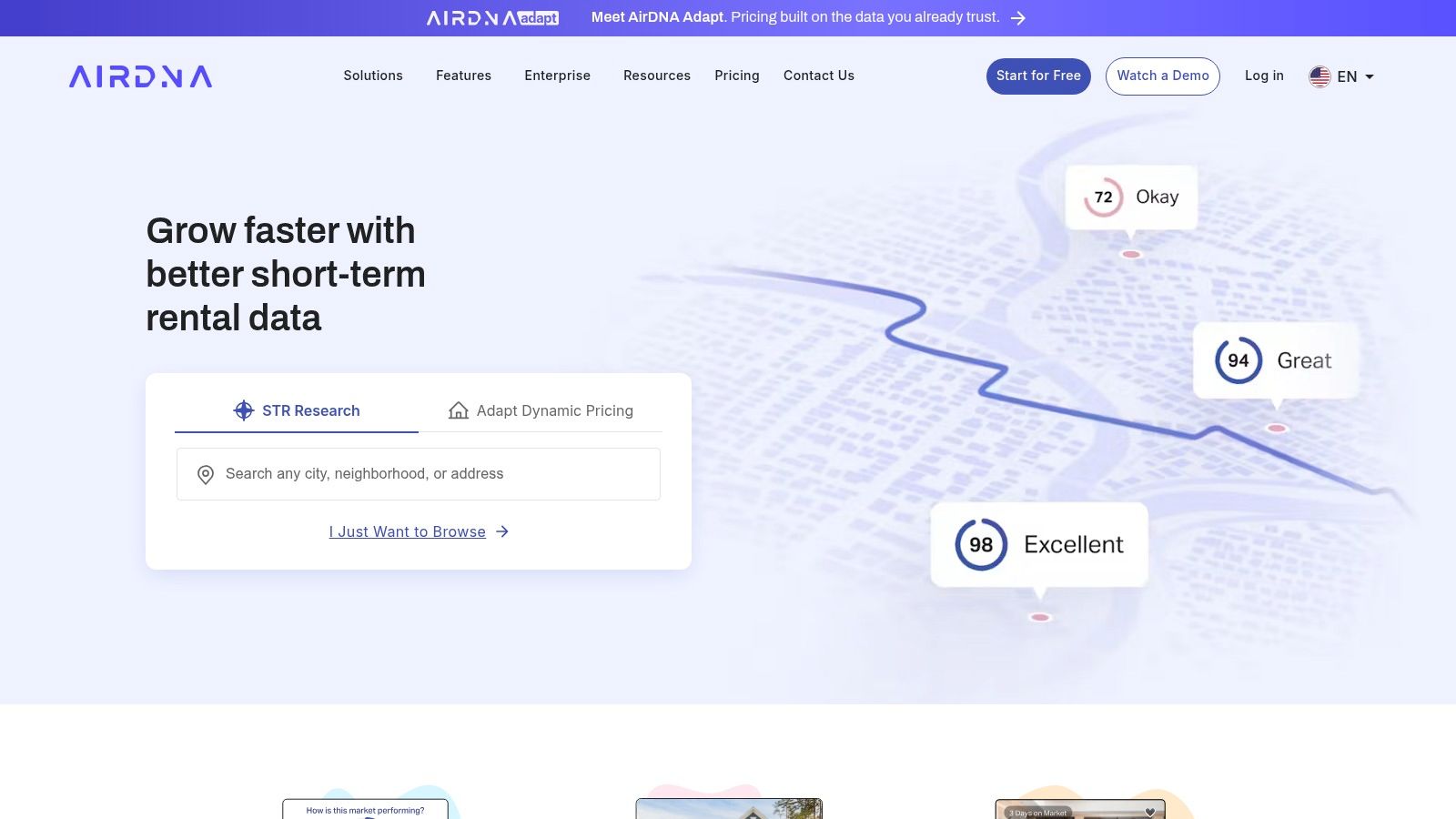
AirDNA is the specialist choice for short-term rental investors. It provides market-level and property-level performance analytics for Airbnb and Vrbo markets, along with revenue estimates, comparable sets, historical and seasonal trends, and dynamic pricing guidance. That makes it useful before purchase, when you're deciding whether a market supports an STR strategy, and after purchase, when you're setting rates and evaluating operating performance.
The platform helps answer questions that standard rental calculators can't. What do comparable short-term rentals earn? How does seasonality affect the revenue pattern? Which property attributes appear relevant in the selected market? Its Rentalizer and market research tools can narrow the opportunity, while enterprise API and business solutions support teams that need to incorporate STR data into a broader process.
Validate the operating model
AirDNA is not a general underwriting platform. It won't replace a rehab estimate, title review, financing model, or long-term rental analysis. It also shouldn't be treated as a guarantee of live platform performance because actual pricing and occupancy can vary with listing quality, reviews, amenities, management, local rules, and changing competition.
Use the output as a range-building tool, then inspect live comparable listings, confirm local STR regulations, and model slower periods and operating costs. Compare projected revenue with realistic cleaning, utilities, management, furnishing, maintenance, taxes, insurance, and financing assumptions. For a deeper STR workflow, review tools for analyzing Airbnb investment properties.
Best fit: Short-term rental investors selecting markets, underwriting properties, and refining pricing.
Top 10 Investor Software Comparison
| Product | Core Features | Accuracy & Speed ★ | Unique Selling Points ✨ | Target Audience 👥 | Pricing & Value 💰 |
|---|---|---|---|---|---|
| 🏆 PropLab (recommended) | AI underwriting: ARV, repairs, MAO; distance/recency-weighted comps; confidence scores; Daily Deals scanner; PDF/link export | ★★★★★, ARV ±3–5%; full workflow ≈60s | 🏆 ✨ No-MLS verifiable comps; automated MAO with margins; Deal Finder + API & contract gen | 👥 Active investors, acquisitions teams, lenders | 💰 Free tier (3 analyses) → Pro: unlimited saves, Deal Finder credits, API; flexible |
| PropStream | Nationwide property/tax/mortgage data; comping; lead filters; integrated marketing (skip trace, dialer) | ★★★★, broad coverage; built-in comp reports | ✨ All-in-one data + outreach; 165+ filters; team workflows | 👥 Wholesalers, acquisitions teams, investor-marketers | 💰 Subscription; add-on costs for outreach/users |
| DealCheck | Fast underwriting for flips/BRRRR/rentals; ARV/MAO calculator; cash-flow projections; web + mobile | ★★★★, quick mobile analyses; Pro = unlimited | ✨ Mobile + white-labeled lender reports; low learning curve | 👥 Solo investors, small teams, agents | 💰 Free useful tier; Pro unlocks unlimited analyses; affordable |
| Privy (Privy Pro) | MLS-fed comps + public records; Comparative Search; investor benchmarking | ★★★★, MLS-grade comps where covered | ✨ Direct MLS feeds; LiveCMA-style investor comps & hot zones | 👥 Investors needing MLS comps; agents | 💰 State-based coverage plans; pricing varies by coverage |
| BatchLeads | Lead-gen & list building; skip tracing; Driving-for-Dollars; Dialer & AI scoring | ★★★, strong marketing throughput; scalable | ✨ BatchRank AI scoring; integrated outreach stack | 👥 Wholesalers, scaling acquisitions teams | 💰 Tiered monthly plans; costs grow with lead/export volume |
| DealMachine | Driving-for-Dollars app; route tracking; owner lookup; direct mail fulfillment; API | ★★★, fast field-to-list workflows | ✨ Mobile-first DfD + per-piece mail pricing; developer API | 👥 Field investors, DfD users, ops teams | 💰 Seat + record pricing; pay-per-mail; modular costs |
| PropertyRadar | Deep property/owner intelligence; list builder; built-in phones/emails; multi-channel outreach | ★★★★, rich data & powerful filters | ✨ Integrated ad campaigns & outreach from platform | 👥 Marketers, teams (popular in West), brokers | 💰 Solo/Team/Business tiers; 5-day trial; campaign add-ons billed separately |
| FlipperForce | Flip analyzer, rehab estimator, budgets, schedules, progress reporting | ★★★, bridges underwriting + rehab management | ✨ Rehab cost libraries + project tracking; reduces spreadsheet work | 👥 Flippers managing rehabs in-house | 💰 30-day trial; paid tiers; local cost calibration recommended |
| Rehab Valuator | Deal analyzers, MAO calculator, lender pitch decks & one-page proposals | ★★★, very fast offer/presentation workflows | ✨ One-page investor/lender proposals; free Lite tier | 👥 Wholesalers, fix-and-flip investors | 💰 Free Lite; Premium/Pro with multi-user options; frequent discounts |
| AirDNA | STR market & property analytics; Rentalizer revenue estimator; occupancy/ADR trends; API | ★★★★, deep STR dataset for revenue/occupancy estimates | ✨ STR-focused comps, dynamic pricing guidance, enterprise API | 👥 Short-term rental investors/operators | 💰 Tiered market plans; enterprise pricing; STR-focused (not long-term) |
Match the Stack to Your Strategy
The right choice depends on where your process loses time or confidence. If your biggest problem is deciding whether a property deserves an offer, start with PropLab or DealCheck. PropLab is the better fit when you need public-record-driven analysis, distance and recency-weighted comps, confidence scoring, red flags, shareable reports, and an MAO designed for fast screening. DealCheck is a strong alternative for investors who want an approachable interface, mobile underwriting, and flexible flip, rental, BRRRR, and small multifamily models.
Wholesalers usually need two layers. Use PropStream, BatchLeads, DealMachine, or PropertyRadar to find owners, build lists, enrich records, and run outreach. Then move qualified leads into an underwriting tool before presenting a price. A motivated seller isn't automatically a good deal, and a lead score doesn't verify condition, title, ARV, repairs, or exit demand.
Fix-and-flip investors should connect acquisition analysis with execution. FlipperForce is the strongest choice in this list for tracking rehab budgets, tasks, schedules, and progress after purchase. Rehab Valuator is more useful when the immediate need is a fast MAO, funding presentation, or one-page proposal. Neither platform removes the need for local bids, inspections, permits, and a documented scope of work.
Buy-and-hold and BRRRR investors should focus on cash flow, rents, refinance assumptions, and operating costs rather than relying only on resale value. DealCheck can model those scenarios, while PropLab can help with the initial ARV, repair, and offer analysis. For STRs, AirDNA provides the specialized market and property data that general investment calculators lack, but validate its projections against live listings, local regulations, and a conservative operating budget.
Privy deserves consideration when MLS-connected comping is central to your strategy or when you're an agent-investor working primarily with listed inventory. Its usefulness depends on the coverage and data-disclosure rules in your market. A public-record tool may be more practical for off-market acquisitions, while an MLS-connected platform can provide stronger context for listed opportunities where reliable closed-sale data is available.
The selection process should also account for interoperability. Investment management software has expanded into a major technology category. One market report valued it at about USD 4.45 billion in 2024, estimated USD 4.94 billion in 2025, and projected USD 8.51 billion by 2030, implying a 2025 to 2030 CAGR of 11.41%. A separate report estimated USD 9.2 billion in 2025 and USD 26.1 billion by 2035, showing why investors now face a crowded software market rather than a shortage of options. These estimates come from investment management software market research, and their differences also show why you shouldn't compare vendors using market-size headlines alone.
Validate the output before you act
Automation is valuable only when you can inspect the reasoning. Real estate technology workflows remain fragmented. In a survey of 343 real estate executives, 62% used Excel for loan or debt information, 44% used an investor CRM, and 39% had an investor portal. Among firms using accounting software, 64% reported integration with property-management systems, while 28% described themselves as partially integrated and 19% as slightly integrated, according to the WMRE proptech report. Those figures explain why the best stack is often modular, but only if the handoffs preserve source data and assumptions.
Before submitting an offer, validate:
- Valuation inputs: Confirm the selected comps, sale dates, distance, condition, adjustments, and local relevance.
- Repair assumptions: Replace generic allowances with inspection findings, contractor bids, permit requirements, and current material costs.
- Rental projections: Check comparable rents, vacancy assumptions, management costs, taxes, insurance, utilities, and financing.
- Lead information: Verify ownership, liens, phone numbers, email permissions, and the legal requirements for your outreach method.
- Scenario sensitivity: Test what happens when the exit value falls, repairs rise, the hold extends, or the refinance terms change.
- Audit trail: Save the report, source records, revision history, and the assumptions used when the decision was made.
Also compare total cost, not just the advertised subscription. Include seats, credits, exports, mailing, dialing, geographic coverage, data add-ons, storage, API access, and usage-based advertising. A low entry price can become expensive when the team adds users or runs high-volume campaigns, while a higher subscription can be efficient if it replaces several disconnected services.
The strongest software for investors doesn't make judgment unnecessary. It gives you faster analysis, clearer documentation, and better control over uncertainty. Choose the platform that matches your strategy, keep the assumptions inspectable, and use local evidence before your capital depends on an automated result.
Learn how to evaluate the return on investment for remodels
PropLab helps investors turn an address into an offer-ready analysis with public records, tax data, market signals, weighted comps, repair estimates, confidence scoring, red flags, and a clear MAO in about 60 seconds. Visit PropLab to test the workflow, compare it with your current stack, and build a more defensible process for flips, rentals, wholesale deals, and lender reviews.
Tags
About the Author
P
PropLab Team
Real Estate Analysis Experts
The PropLab team consists of experienced real estate investors, data scientists, and software engineers dedicated to helping investors make smarter decisions with AI-powered analysis tools.
Free account
Underwrite your next deal in under a minute
3 free analyses, no credit card. ARV, rehab, comps and exit strategy in one report.