Real Estate Investing
AI vs. Manual Lead Generation for Wholesaling
November 13, 2025
13 min read
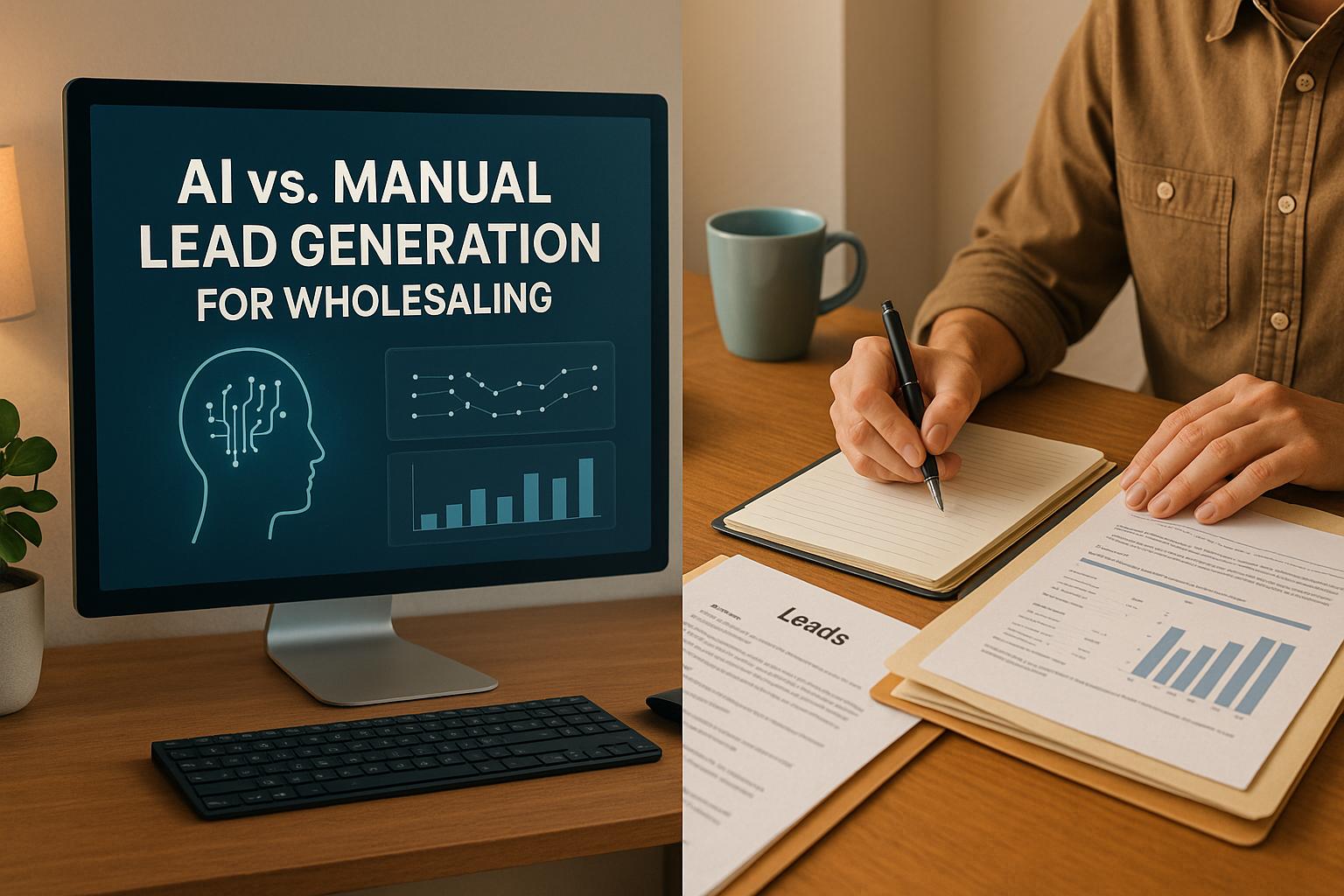
Finding motivated sellers is the backbone of successful real estate wholesaling. But how you generate leads - manually or with AI - can make or break your business. Here's the bottom line:
- Manual lead generation relies on personal outreach methods like cold calling, direct mail, and driving for dollars. It’s time-intensive but builds personal connections.
- AI-driven lead generation automates data analysis, identifies high-potential sellers faster, and scales effortlessly as your business grows.
Key Takeaways:
- Manual methods work well for beginners or small-scale operations but are limited by time and effort.
- AI tools process thousands of leads quickly and consistently, perfect for scaling and handling high volumes.
- A hybrid approach combines AI’s efficiency with the personal touch of manual outreach for the best results.
Quick Overview:
- Manual methods: Great for building relationships but slow and labor-intensive.
- AI tools: Fast, scalable, and accurate but require upfront investment.
Your strategy depends on your business size and goals. Start manually, scale with AI, and blend both for long-term success.
This New AI Just Broke Wholesaling Real Estate...
Manual Lead Generation for Wholesaling
Manual lead generation has long been a staple in the wholesaling world. Unlike automated methods, this approach relies heavily on human effort and direct communication to find motivated sellers. While it demands significant time and energy, many wholesalers appreciate the personal touch it offers. Let’s break down how it works, its advantages, and the challenges it presents.
How Manual Lead Generation Works
This method revolves around personal outreach and interaction. Wholesalers often start by building seller lists from public records, then use a variety of tried-and-true techniques to connect with property owners:
- Cold calling: Reaching out to property owners by phone, which requires persistence and a hefty time commitment.
- Direct mail campaigns: Sending postcards, letters, or even handwritten notes to targeted property owners, with all preparation and follow-up handled manually.
- Driving for dollars: Scouting neighborhoods to spot distressed properties based on visible signs like neglect or disrepair.
- Door-to-door outreach: Knocking on doors to directly engage with homeowners and initiate conversations.
Each of these methods has its own strengths, but they also come with challenges that wholesalers need to navigate.
Benefits of Manual Lead Generation
Manual methods shine when it comes to building personal connections. They give wholesalers the chance to understand a seller’s situation, adjust their approach, and gain valuable insights into the local market. This one-on-one interaction often results in higher-quality leads and better conversion rates.
Another advantage is the ability to adapt strategies in real time. For example, if a seller mentions concerns about timing, a wholesaler can tweak their offer on the spot. In an industry where trust is paramount, developing a personal rapport can often be the key to sealing a deal.
Problems with Manual Lead Generation
The biggest drawback? Time. Manual lead generation methods like cold calling, direct mail campaigns, and driving for dollars require a significant investment of time and effort. Scaling these efforts can be tough since increasing the number of leads typically means committing more hours and manpower.
There’s also the risk of delays and errors. For instance, slow follow-ups or mistakes in data collection can hurt efficiency, especially as lead volume grows. Research highlights how crucial speed is: responding to online leads within five minutes makes you 100 times more likely to close the deal compared to longer response times.
Finally, without proper systems to track and analyze results, it can be hard to pinpoint which strategies are working. This can lead to wasted time and effort sorting through large numbers of leads to find the truly motivated sellers.
AI-Driven Lead Generation for Wholesaling
Artificial intelligence is reshaping how wholesalers connect with motivated sellers, offering a faster and more efficient alternative to traditional methods. Instead of relying on time-consuming manual processes, AI-powered tools can analyze massive datasets, spot trends, and automate outreach efforts, all on a scale that humans simply can't match. This evolution is changing the way wholesaling businesses operate and expand.
How AI Tools Improve Lead Generation
AI tools excel at identifying motivated sellers before they even hit the market. By analyzing key data points - like property ownership history, mortgage details, tax records, and market trends - these systems can predict which property owners are most likely to sell. This data-driven approach removes much of the uncertainty that comes with older, manual methods.
But AI doesn’t stop at finding leads. It can also rank and prioritize them based on their likelihood to convert. Instead of sifting through hundreds of potential leads, wholesalers can focus on the top prospects, ready for immediate follow-up. This saves time and ensures energy is spent on the most promising opportunities.
Another advantage is that machine learning algorithms get smarter over time. The more data they process, the better they become at spotting patterns and identifying motivated sellers specific to your market. Let’s dive into the standout features that make AI-driven systems so effective.
Key Features of AI-Driven Lead Generation
AI platforms offer a level of consistency and automation that manual methods simply can’t match. These systems work around the clock, qualifying and scoring leads by evaluating them against multiple criteria. They assign priority scores and can even initiate contact automatically through messaging or email sequences.
One standout capability is multi-channel follow-up. AI systems ensure no lead slips through the cracks by coordinating outreach across phone calls, texts, emails, and even direct mail. They track response rates across these channels and adjust their approach to match what works best for each lead.
Unlike human teams, AI systems don’t need breaks. They work 24/7, processing leads, responding to inquiries, and nurturing prospects - even on weekends and holidays. In competitive markets, this constant availability can make all the difference.
For wholesalers needing quick deal evaluations, tools like PropLab are a game-changer. PropLab integrates seamlessly with AI-generated leads, providing instant property analysis, ARV calculations, rehab cost estimates, and professional PDF reports. This combination of AI-driven lead generation and instant deal analysis creates a streamlined workflow, making it easier to scale operations efficiently.
Benefits of AI-Driven Lead Generation
AI systems address the biggest challenges of manual lead generation by delivering unmatched speed and reliability. They can process thousands of leads in the time it takes a human to review just a handful, making it possible to scale without adding more staff or increasing work hours.
Consistency is another major win. AI systems don’t have off days, forget to follow up, or vary their approach based on mood. Every lead gets the same level of attention and follow-up, which helps maintain higher conversion rates.
Data accuracy also improves with AI. Automated systems reduce errors in data entry, ensure all information is captured, and maintain standardized formats for better analysis and reporting. Clean, reliable data feeds back into the system, further improving its ability to identify and prioritize leads in the future.
sbb-itb-ef86070
AI vs. Manual Lead Generation Comparison
When deciding between AI and manual lead generation, it’s crucial to weigh their strengths against your specific wholesaling needs. Both approaches can deliver results, but they differ significantly in speed, scale, and resource demands.
Key Differences Between AI and Manual Methods
Speed and Volume
Manual lead generation often limits you to a smaller number of prospects each day due to time constraints. In contrast, AI systems can process and analyze leads at scale, running continuously to ensure no opportunities are missed - especially crucial in fast-paced markets.
Scalability
Scaling manual efforts usually means hiring more team members, which increases labor costs and adds management complexity. AI-driven tools, however, can handle growth seamlessly without requiring additional staff, making them a more efficient option as your business expands.
Consistency
Human-led processes can be inconsistent, impacted by factors like fatigue or varying levels of expertise. AI systems, on the other hand, deliver consistent performance, ensuring every lead receives the same level of attention and follow-up.
Cost Structure
While manual methods may seem cost-effective initially, they become more expensive as your business grows due to rising labor demands. AI tools require a higher upfront investment but save money over time by automating tasks and reducing reliance on human resources.
Data Accuracy
Manual data entry is prone to errors and inconsistencies, which can hinder decision-making. AI systems automate data validation, creating cleaner and more reliable datasets for better insights.
Required Expertise
Manual lead generation depends heavily on market knowledge and personal outreach skills. AI solutions shift the focus to optimizing workflows and interpreting data, reducing the need for specialized expertise in day-to-day operations.
Here’s a quick comparison to help you visualize these differences:
Comparison Table: AI vs. Manual Lead Generation
| Factor | AI-Driven Lead Generation | Manual Lead Generation |
|---|---|---|
| Processing Speed | Handles large volumes continuously | Limited daily capacity |
| Initial Investment | Higher upfront costs | Lower initial expenses |
| Scalability | Expands without extra staff | Requires more manpower |
| Operating Hours | 24/7 functionality | Restricted to business hours |
| Data Accuracy | Automated and consistent | Prone to human errors |
| Follow-up Consistency | Systematic and uniform | May vary with individuals |
| Learning Curve | Moderate setup, then automated | Requires ongoing training |
| Lead Quality | Improves through optimization | Relies on personal expertise |
| Multi-channel Coordination | Automated across platforms | Manual coordination required |
| Long-term Costs | Decrease with scale | Increase as business grows |
AI-driven lead generation stands out for its speed, reliability, and ability to grow alongside your business. While manual methods offer a personal touch and lower initial costs, they struggle to match the efficiency of AI in areas like scalability and data accuracy.
Tools like PropLab further enhance AI-based workflows by providing instant property analysis and professional-grade reports - features that manual methods can’t easily replicate. By understanding these distinctions, you can select the lead generation approach that aligns with your business size, growth plans, and available resources.
Choosing the Right Lead Generation Method
Picking the right lead generation strategy depends on your business's current stage, growth ambitions, and the resources you have at hand. Building on the earlier comparison of manual and AI methods, this section dives deeper into when each approach shines and how combining them can yield the best results.
When to Use Manual Lead Generation
Manual lead generation is an excellent starting point for new wholesalers who are still familiarizing themselves with their local markets. This hands-on approach helps you develop the skills to identify profitable opportunities.
For small-scale operations with tight budgets, manual methods can be a practical choice, especially if you're analyzing fewer than 50 properties a month. At this level, the workload is manageable, and you can dedicate sufficient time to thoroughly research each property.
In relationship-focused markets, personal connections are key. In close-knit communities where referrals and trust drive business, face-to-face interactions often outperform automated outreach. For example, rural markets often rely heavily on personal reputation, making manual outreach to homeowners, agents, and contractors more effective.
Manual methods are also useful when testing new markets or channels. Before investing in AI tools for an unfamiliar area, manually working a few leads can provide valuable insights into response rates and deal quality in that region.
Why AI-Driven Approaches Work Better for Scaling
As your deal volume increases, manual methods become less practical. This is where AI tools excel. If you're analyzing more than 100 properties monthly, AI becomes almost indispensable. Think about it: manually analyzing 100 properties at 45 minutes each adds up to 75 hours, while AI tools can handle the same workload in a fraction of the time.
AI not only saves time but also ensures consistency. When juggling multiple deals, it’s easy to miss details or rush through analyses manually. AI ensures every property is evaluated with the same thorough methodology, maintaining accuracy and reliability.
Another advantage is AI's ability to identify patterns in large datasets. While you might manually compare three or four recent sales, AI can analyze dozens, providing more precise property valuations. This accuracy helps protect your profit margins and minimizes the risk of overpaying.
In competitive markets, speed is critical. Tools like PropLab can generate detailed property reports in minutes, giving you a competitive edge by allowing you to act faster than others.
AI also simplifies geographic expansion. Researching new markets manually demands extensive local knowledge, but AI tools can quickly analyze market conditions, recent sales, and rehab costs across different cities or states. This allows you to scale your business without needing local expertise in every market.
Combining Manual and AI Strategies
A hybrid approach combines the strengths of AI's data processing with the personal touch of manual outreach. This strategy allows you to leverage AI for efficiency while still building the relationships that close deals.
Use AI tools to filter leads, calculate ARVs, and estimate rehab costs. For example, platforms like PropLab can process your lead list and highlight the most promising opportunities, leaving you to focus your manual efforts where they’ll have the most impact.
Once AI identifies viable leads, manual efforts can focus on relationship building. Personal phone calls, handwritten letters, and in-person meetings become more effective when you're equipped with detailed property insights. With AI handling the research, you can confidently discuss market values and renovation costs.
Automated follow-ups can help you manage a large pipeline, but shift to personal communication when sellers show genuine interest. This lets you maintain a high volume of leads while still giving serious prospects the attention they need to close.
Another effective approach is to rely on AI for market research and use manual methods for deal execution. AI can analyze neighborhood trends, track comparable sales, and identify promising markets. You can then use this data to guide your manual prospecting efforts in areas with the most potential.
If you're just starting out, begin with manual methods to build your foundation. As your business grows, gradually integrate AI tools like PropLab to improve efficiency while keeping the personal touch that helps close deals.
Conclusion
Align your lead generation strategy with your business needs and growth stage. Both manual and AI-driven methods offer unique advantages in the wholesaling industry, each serving distinct purposes based on your goals and scale.
Manual approaches are ideal for new wholesalers or those working in smaller, close-knit markets. They help you develop market expertise and build personal relationships. However, as your business expands, the time-intensive nature of manual methods can become a bottleneck. That’s where a hybrid approach - combining manual insights with AI precision - can make a big difference.
AI-driven tools, on the other hand, are designed to streamline processes, saving time while maintaining consistent accuracy. These tools excel in fast-paced markets, where processing large datasets quickly can lead to sharper valuations and smarter investment decisions. The speed and reliability of AI give you an edge when scaling your operations.
By combining AI for data filtering and manual methods for relationship-building, you can maximize efficiency while keeping the human touch that’s essential for successful negotiations.
Key Takeaways
Your lead generation strategy should grow alongside your business. Start with manual methods to build foundational skills and market understanding, then incorporate AI tools as your deal volume increases.
AI truly shines in its ability to deliver speed and accuracy. While manual analysis can be labor-intensive, AI platforms generate detailed reports in minutes, using consistent methods. This becomes critical when competing for time-sensitive deals or entering new markets.
The most effective strategy balances technology with human expertise. AI can identify and qualify leads, but personal connections remain irreplaceable when it comes to turning those leads into deals. Together, these methods create a powerful synergy that helps you close more contracts.
For example, PropLab simplifies property analysis with instant ARV calculations and rehab cost estimates. It handles time-consuming tasks, allowing you to focus on what matters most: building relationships and closing deals. Rather than replacing your expertise, it enhances it.
The future of wholesaling will favor those who can combine technological efficiency with strong personal connections. Whether you’re just starting or scaling up, blending AI tools with manual techniques will set you up for long-term success in an increasingly competitive market.
FAQs
How can combining AI and manual methods enhance lead generation in real estate wholesaling?
A hybrid approach to lead generation blends AI capabilities with human expertise to enhance both efficiency and results. AI takes care of repetitive tasks like spotting potential leads, analyzing property details, and automating the first stages of outreach. This frees up your time, allowing you to concentrate on the most promising prospects.
On the other hand, manual efforts bring a personal touch that builds trust, fosters relationships, and facilitates deal-making. By merging AI's precision and speed with the human ability to connect on a personal level, you can simplify your process and secure more deals in less time.
What are the upfront costs and long-term savings of using AI-driven tools for lead generation?
AI-driven lead generation tools might come with a steeper upfront cost compared to doing things manually. But here's the upside: over time, they can cut operational expenses by as much as 30%. By automating repetitive tasks and streamlining processes, these tools free up time and allow you to concentrate on more impactful activities. In the long run, they prove to be a smart investment that balances efficiency with cost savings.
How does AI improve data accuracy and consistency compared to manual lead generation?
AI improves data accuracy and consistency by taking over repetitive tasks and minimizing human error. It can handle massive amounts of information at lightning speed, ensuring the data remains current and dependable.
Instead of relying on manual processes, AI employs sophisticated algorithms to uncover patterns and insights, streamlining lead generation with greater precision. This automation frees up professionals to concentrate on strategic decision-making rather than time-consuming tasks like data entry or validation.
About the Author
P
PropLab Team
Real Estate Analysis Experts
The PropLab team consists of experienced real estate investors, data scientists, and software engineers dedicated to helping investors make smarter decisions with AI-powered analysis tools.
Free tool
Get the ARV of any property in 30 seconds
Skip the spreadsheet. Enter an address and get an after-repair value backed by real comps.