General
Annual Salary for Real Estate Agents: What You Can Expect
October 22, 2026
17 min read

The median annual salary for real estate agents who work as sales agents is $52,830, based on May 2025 data. The lowest 10% earn under $32,970 a year, while the highest 10% earn more than $123,590.
That spread is the story. If you're picturing a steady paycheck that arrives every two weeks, real estate usually doesn't work that way. Most agents get paid when a deal closes, then they share that money with a brokerage and pay their own business costs. Two licensed agents in the same office, working in the same town, can finish the year in completely different places.
I'll walk you through the numbers the way I'd explain them to a new licensee sitting across from me. We'll look at the national range, trace one commission check from sale price to take-home pay, and finish with a simple way to estimate your own first years.
What Real Estate Agents Actually Earn in 2026
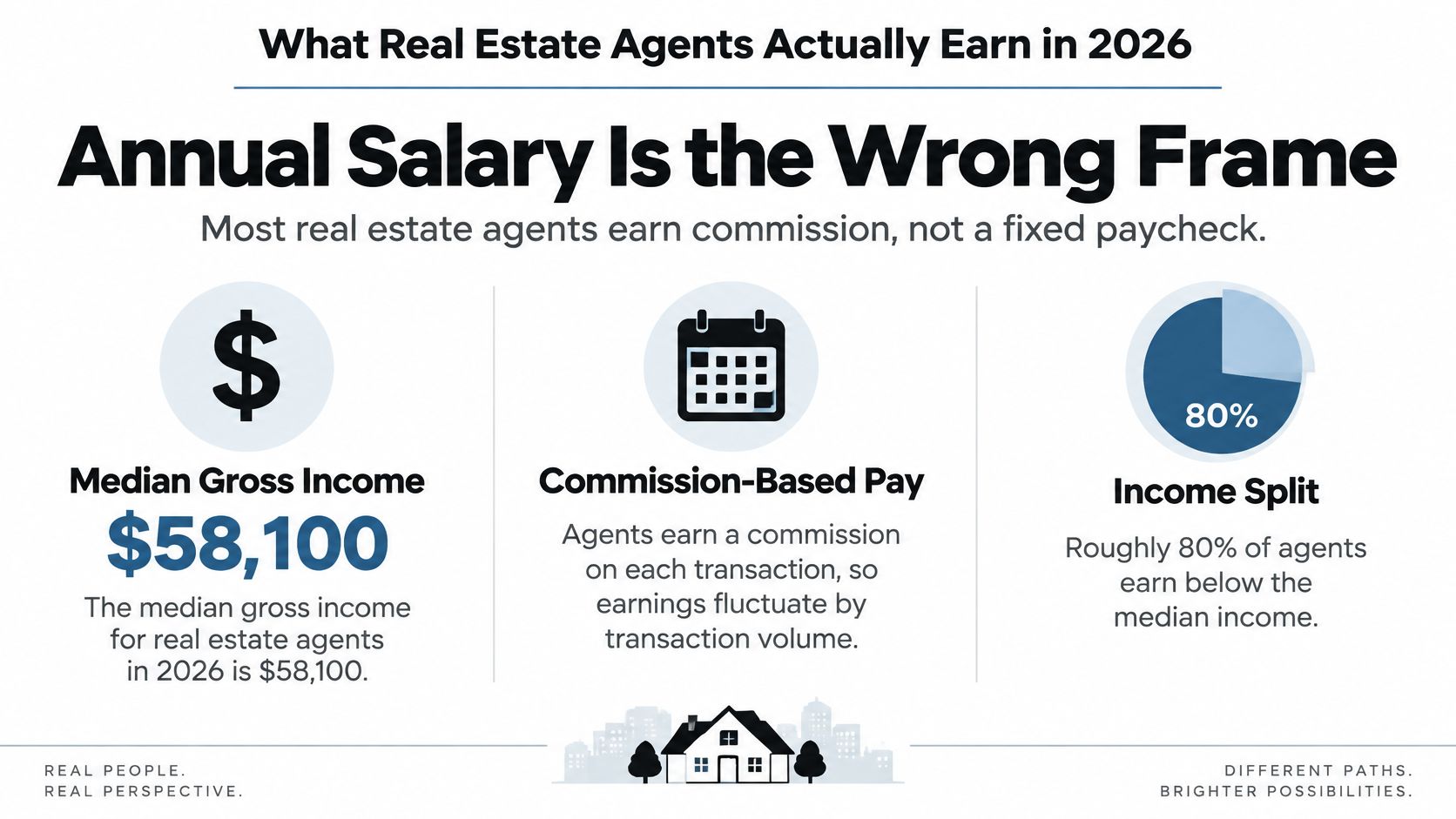
Most agents aren't employees collecting a salary. They're independent contractors who hang their license with a brokerage and earn commission when a buyer or seller they represent completes a transaction. No closing means no commission for that period, however many hours went into showings, calls, and paperwork.
That's why a single figure for annual salary for real estate agents can mislead you. One agent might close steadily all year. Another might spend months building a pipeline, close a small number of deals, and still pay licensing, marketing, and association costs along the way. The job title is the same, but the income pattern isn't.
Two sources worth trusting
You'll see two primary sources used throughout this guide. The U.S. Bureau of Labor Statistics reports wage data for the occupation, which gives you a labor-market benchmark. The National Association of REALTORS® reports member income and transaction activity, which shows how working agents describe their own gross income from real estate.
Neither source tells you what you'll personally keep after splits, taxes, and expenses. Think of them as starting points, not promises. The Bureau of Labor Statistics figure reflects wage-and-salary reporting, while the association figure reflects gross income before an agent's operating costs come out. Keeping that distinction clear prevents the most common misunderstanding new agents make.
Why marketing costs belong in this conversation early
New agents often budget for a license and a laptop, then forget lead generation. Photography, signs, customer relationship software, and local visibility all compete for the same commission dollars. As you research options, even channels like TV ads for real estate agents should be judged as a business expense against expected closings, not as an automatic shortcut to income.
Treat every published salary figure as a doorway into better questions, not as an answer by itself. Ask who was counted, whether the number is gross or net, and how many transactions produced it.
By the end, you should be able to replace the question, "What's the salary?" with a more useful one. Given a market, a split, and a realistic number of closings, what could you keep?
Median Pay, Top Earners, and the Wide Range
Let's slow down on the word median, because it matters here. The median is the middle point. Half of the agents counted earned more than that amount, and half earned less. It isn't the same as an average, where you add every income together and divide by the number of people.
In real estate, averages get pulled upward by a relatively small group of very high producers. If a few agents earn far more than everyone around them, the mean rises, even though the typical agent's experience hasn't changed. The median resists that distortion, so it's the safer benchmark when you're planning a career change.
What the national distribution looks like
The U.S. Bureau of Labor Statistics overview for real estate brokers and sales agents reported a May 2025 median annual wage of $52,830 for real estate sales agents, with the lowest 10% earning under $32,970 and the highest 10% earning more than $123,590, a spread of roughly $90,620 between the bottom and top deciles. The same source reported a $57,400 median for the broader combined occupation of brokers and sales agents, and $52,830 works out to approximately $25.40 per hour for full-time wage-and-salary employment.
That combined figure is higher for a simple reason. Brokers hold a higher level of licensing, can operate a brokerage, and may supervise other agents. When you combine brokers with sales agents, you're no longer looking at sales agents alone. If you're entering as a newly licensed sales agent, use the sales-agent median as your cleaner comparison.
| Wage Point | Annual Figure | Notes |
|---|---|---|
| Lowest 10% of sales agents | Under $32,970 | Bottom decile threshold |
| Median for sales agents | $52,830 | Middle of the sales-agent distribution |
| Highest 10% of sales agents | More than $123,590 | Top decile threshold |
| Median for brokers and sales agents combined | $57,400 | Broader occupation, includes brokers |
How to read the two ends
The bottom decile doesn't automatically mean an agent is failing. It can include people who are newly licensed, working part time, returning after time away, or closing few transactions in a slower or lower-priced market. Annual income also depends on timing. A deal that slips from December into January moves income into a different year, even though the work happened earlier.
The top decile usually reflects a different business altogether. Those agents tend to have an established client base, consistent referrals, and enough transaction volume or price level to produce larger commission checks. Some lead teams or work in higher-priced markets. Their results are real, but they aren't a sensible first-year expectation.
A coach's warning: Don't budget your life around the top decile, and don't judge the whole career by the bottom one. Your job is to understand which inputs move you within the range.
One more limitation deserves your attention. These wage figures don't erase differences in commission structure, self-employment, market conditions, experience, or business expenses. They're labor-market statistics, not guaranteed take-home pay. That's true no matter how neatly a website presents them.
How Commission, Splits, and Fees Shape Take-Home Pay
Commission sounds simple until you follow the money step by step. A client agrees to pay compensation connected to a transaction. That compensation is typically expressed as a percentage of the sale price for the side the agent represents. The check doesn't go straight into the agent's personal bank account and stay there untouched.
First, the brokerage receives its agreed share under the agent's commission split. Then the agent pays business expenses and sets aside money for taxes. What remains is closer to take-home income, and it can look very different from the headline commission.
A sample paycheck you can adapt
Use a round, hypothetical example so the arithmetic stays visible. Suppose you represent one side of a $400,000 sale and the agreed compensation for your side is 2.5% of the price. Multiply $400,000 by 0.025 and you get $10,000 in gross commission for that side before your brokerage split.
Now suppose your agreement gives you 70% and your brokerage 30%. Your share is $7,000, and the brokerage keeps $3,000. That $7,000 still isn't profit. From it, you'd cover items such as these:
- Multiple listing service and association costs: Access and membership expenses connected to practicing in your market.
- Marketing: Photography, advertising, signs, websites, and client follow-up tools.
- Licensing and insurance: Renewal costs and errors and omissions coverage where applicable.
- Transportation and office costs: Fuel, phone service, software, and supplies.
- Taxes: Money you must reserve rather than spend, especially when you're paid as an independent contractor.
Change any input and the result changes. A lower sale price produces a smaller starting commission. A less favorable split leaves you with less from the same closing. Higher expenses reduce what you keep. Once you see those moving parts, you stop asking only how much commission a deal pays and start asking how much reaches you after everyone and everything else is paid.
Gross income isn't net income
The association data covered later describes gross income from real estate activities, not net profit after brokerage splits, marketing, licensing, insurance, taxes, and other operating costs. Keep that label in mind whenever you compare your projection with a published median. You may be comparing your hoped-for spending money with someone else's before-expenses total.
Brokerage structure shapes that comparison too. Before you sign, study how different firms handle splits, caps, desk fees, training, and lead support, and compare those trade-offs with the main types of real estate brokerages available to agents. A generous split with almost no support may leave a beginner with a bigger share of very few closings. A lower split with strong mentoring may produce more closings, though you keep less from each one.
Employee pay versus contractor pay
A W-2 employee arrangement is less common for producing agents, but salary or salary-plus-bonus roles do exist in some teams and brokerages. The appeal is predictability. Taxes and benefits may be handled differently, and your income may not swing as sharply between closings.
The more common 1099 independent contractor model offers more upside and more responsibility. You control much of your schedule and business spending, but you also carry the risk when transactions are delayed or fall through. Neither model is automatically better. The right choice depends on whether you value stability, support, autonomy, or uncapped commission potential most at your current stage.
How Experience Moves the Income Needle
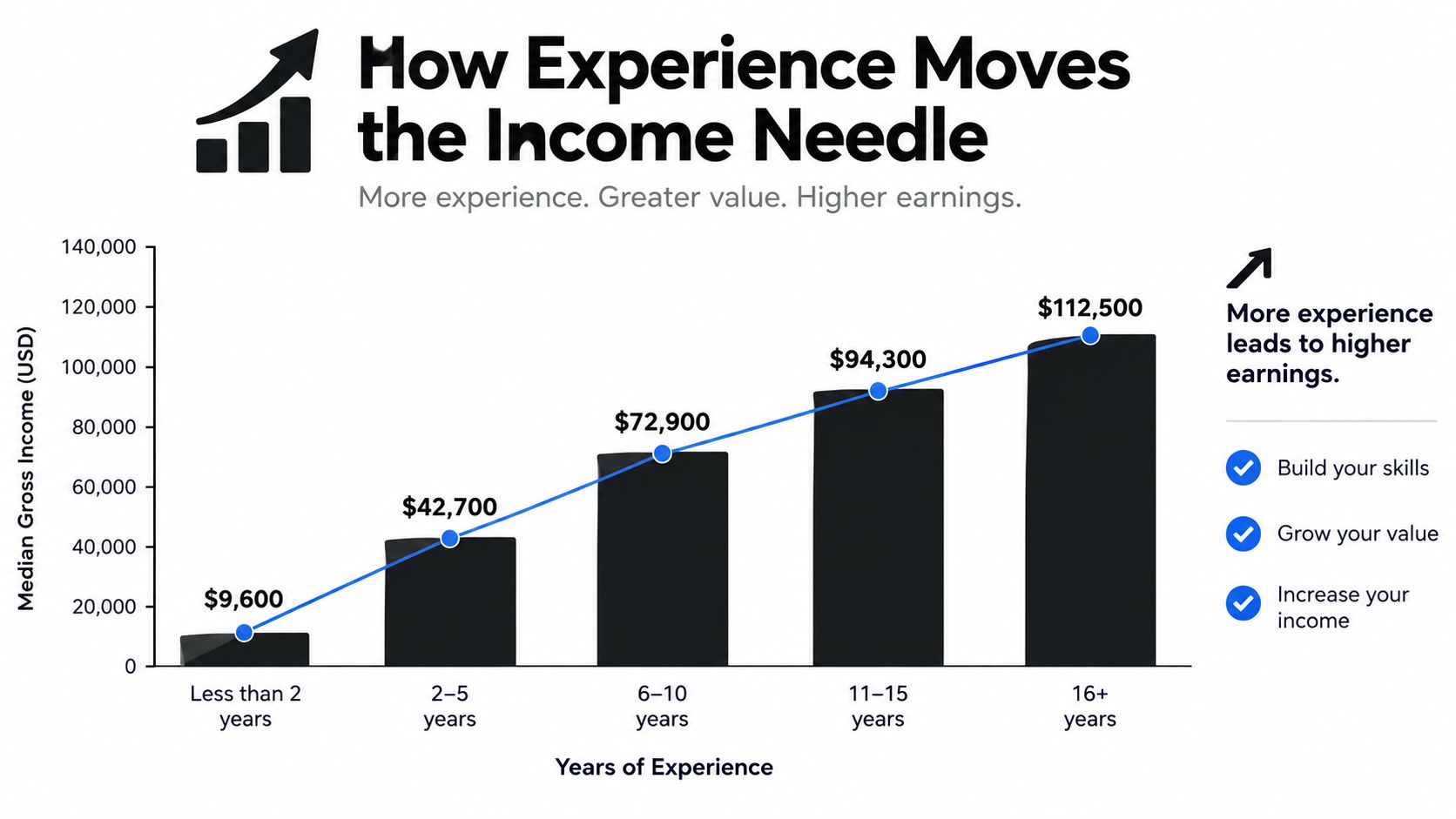
Experience changes more than confidence. It changes how many people trust you with a transaction, how quickly you spot problems, and how much of your business comes from repeat clients and referrals instead of cold outreach. Those advantages compound, which is why the income gap between a beginner and a veteran is so large.
The chart below introduces that career-arc idea visually before we look at the member data in detail.
The beginner and veteran comparison
The National Association of REALTORS® 2025 Member Profile summary reported median gross income of $58,100 in 2024, up from $55,800 in 2023, while members with 16 or more years of experience reported $78,900 and those with two years or less reported $8,100. That $70,800 difference means the veteran group's median gross income was more than nine times higher. The typical member completed 10 transaction sides and reported $2.5 million in sales volume in 2024, both unchanged from 2023.
Read those numbers carefully. They apply to association members, not every licensed agent. They also describe gross income, as covered in the section above. Even with those limits, the pattern is hard to miss. The year-to-year median rose by $2,300, or about 4.1%, but the experience gap dwarfed that movement.
Why the early years pay so little
A new agent is learning contracts, pricing conversations, showing routines, and lead follow-up at the same time. Your sphere may know you personally but not yet think of you professionally. Every transaction requires extra checking, and a thin pipeline means one delayed closing can leave a long gap between checks.
With time, past clients become a source of new business. You recognize pricing and inspection issues sooner, prepare clients more calmly, and spend less energy reinventing basic systems. Experience doesn't guarantee growth, because an inactive veteran can still close very little. It gives consistent agents more chances to convert relationships into transactions.
The short walkthrough below is useful if you learn better by hearing the career ramp explained before you map your own timeline.
Later in a career, some agents keep increasing personal production. Others shift toward team leadership, brokerage management, or a specialty such as luxury, commercial, or probate work. Those paths change where income comes from. The practical lesson is not to wait for year sixteen. It's to build skills, records, and relationships now, because those assets explain much of the gap.
Geography, Schedule, and Pay Model Compared
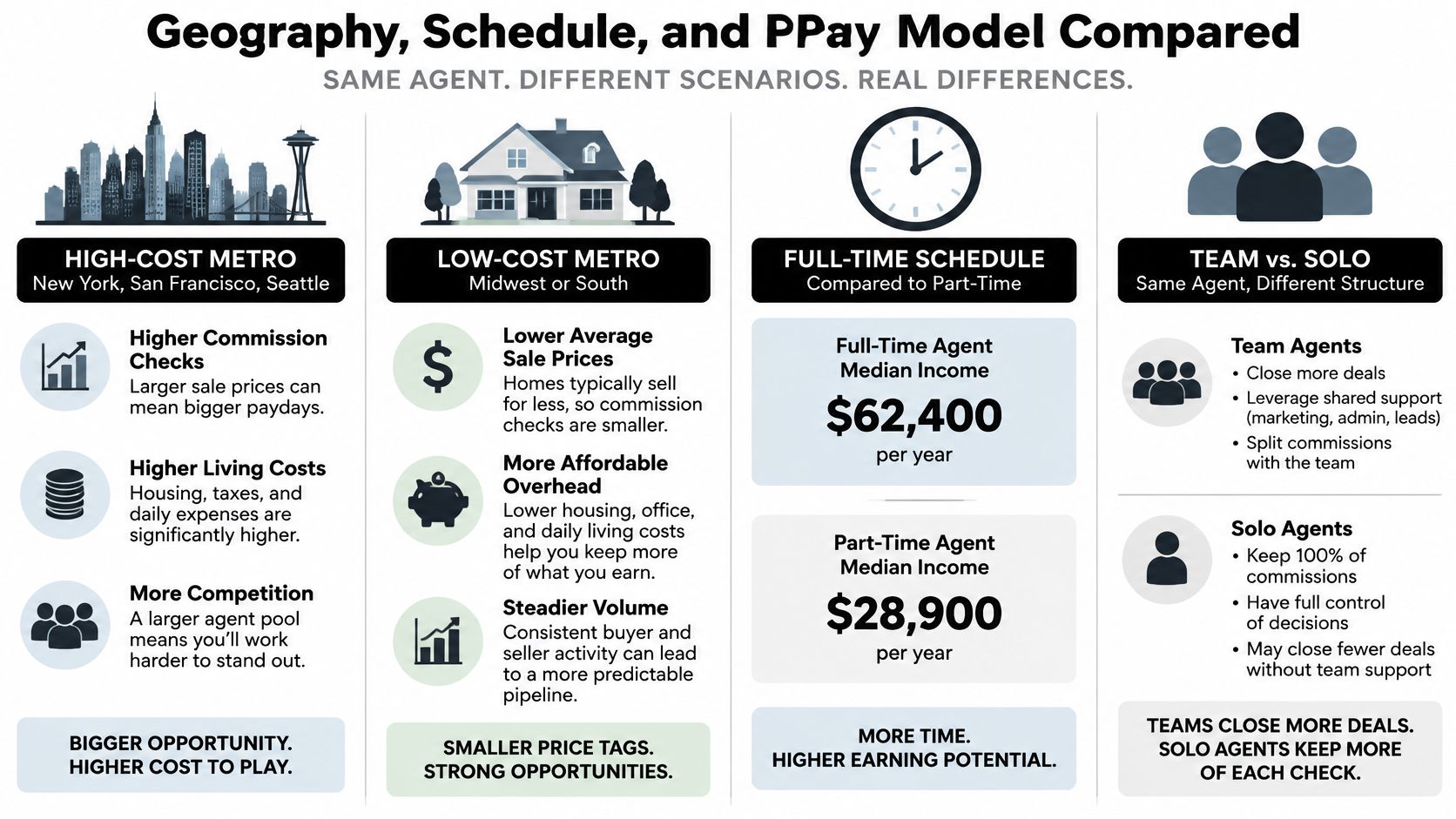
Place the same capable agent in different settings and the annual result changes. Sale prices differ by market, competition differs by neighborhood, and available working hours differ by person. Comparing the settings side by side helps you avoid treating a national median as a local forecast.
The comparison graphic below groups the main variables you'll want to test against your own plans.
Higher-priced and lower-priced markets
In an expensive metro, each closing can produce a larger commission because the percentage is applied to a larger price. That advantage comes with trade-offs. Living costs and business overhead may be higher, marketing can cost more, and established agents may compete fiercely for the same clients.
In a lower-priced market, each transaction may pay less even when the work feels similar. Lower overhead can soften that difference, and an agent may need more closings to reach the same gross commission. Neither setting is automatically easier. You're comparing price per deal, number of reachable deals, expenses, and competition all at once.
If a move is part of your plan, study licensing and local practice before you assume your current systems will transfer unchanged. Agents considering a new state can use the relocating agents Florida market guide as an example of the state-specific homework worth doing before a move. Rules, forms, and client expectations can differ enough to slow your ramp.
Full time, part time, solo, and team
A full-time agent has more hours for prospecting, showings, follow-up, and negotiation. That availability can support more transactions, but it doesn't create clients by itself. A part-time agent may use real estate as supplemental income and accept fewer opportunities because another job limits response time and weekday availability.
Team structures add another layer. A team may provide leads, administrative help, training, and accountability, while taking an additional share for those services. A solo agent keeps a larger portion under the brokerage agreement but must generate business and manage details alone or hire help. Ask which bottleneck is holding you back. If you lack leads, support may matter more than split. If you already have steady clients, keeping more per closing may matter more.
Commission only or salary based
Commission-only pay offers open-ended upside and uneven timing. Salaried or salary-plus-bonus roles offer smoother income but may limit how much of each transaction you keep. For a useful contrast with another transaction-based path, review how a wholesaling real estate salary is discussed and notice how pay labels can hide very different work and risk.
Match the model to your current constraint. Stability helps some beginners stay in the business long enough to learn, while experienced producers may prefer maximum control over each commission dollar.
Before choosing, write down your market's typical price range, your weekly availability, and the support you genuinely need. Those three facts will tell you more than a national headline.
Practical Ways to Raise Your Annual Income
You can't control interest rates or force a seller to accept an offer. You can control your prospecting habits, the clients you cultivate, the price segment you learn, and the agreement you negotiate as your production grows. Start with moves that increase either the number of closings or the amount you keep from each closing.
The photograph below captures the less glamorous side of that work. Income growth usually comes from reviewing pipelines, following up, and making deliberate business decisions between appointments.

Five levers you can work on this year
- Build referrals before you need them: Stay in useful contact with past clients and your sphere through market updates, check-ins, and introductions to trusted local professionals.
- Improve lead quality and follow-up: Compare channels by cost, conversion effort, and fit with your market, using resources such as these proven lead generation strategies for agents to organize your choices.
- Learn a clearer niche: Develop depth in relocation, first-time buyers, multi-family, luxury, or another segment you can serve well and explain confidently.
- Review your split with evidence: Track closed sides, gross commission, expenses, and support received so a later conversation with your broker rests on production rather than hope.
- Audit recurring expenses: Cancel tools you don't use, compare vendors, and tie marketing spending to a defined audience and follow-up plan.
Raising your average sale price can also help, but moving into a higher segment takes preparation. Clients expect sharper pricing knowledge, stronger presentation, and calm negotiation. You can begin by studying listings just above your current range, attending broker tours, and partnering with an experienced agent where appropriate.
Agents who want a structured place to apply these habits can explore the resources built for agents and connect lead activity to a weekly review. The common beginner mistake is chasing the most generous split before you have a reliable pipeline. Keeping a larger share doesn't solve an empty calendar. In your first stage, mentoring, accountability, and opportunities to practice often carry more value than a slightly better percentage on a deal you haven't found yet.
Putting the Numbers Together for Your Own Plan
Build your estimate from three questions. What's a realistic sale price in the segment you expect to serve? What commission compensation and brokerage split should you use for planning? How many sides can you reasonably close at your experience level and schedule?
Multiply price by the side's commission rate, then multiply by your split, then multiply by expected sides. After that, subtract a realistic allowance for business expenses and taxes. Run a cautious version and a stronger version. If the cautious version still feels workable while you build, your plan has a sturdier foundation.
A quick self-check
- Newer agent: Use fewer sides and give yourself time to learn, because the experience data covered earlier shows how low early gross income can be.
- Established agent: Use your actual past sides, average price, split, and expenses rather than a national median.
- Career changer: Separate household survival money from business money so one delayed closing doesn't force rushed decisions.
- Team candidate: Value provided leads and support in dollars and hours before judging the extra split.
Can agents earn six figures? Yes, the top of the distribution shows that some do, but that outcome isn't the middle and shouldn't be your default budget. Do salary-only jobs exist? Some roles do, although commission-based contractor work is more common for producing agents. How do taxes work? That depends on your classification and situation, so get advice from a qualified tax professional before your first closing rather than after the money is spent.
The annual salary for real estate agents is best understood as a range shaped by closings, prices, splits, fees, schedule, market, and experience. You don't passively receive a position in that range. Through consistent client work and honest business math, you move within it.
When you're ready to test deal numbers with the same clarity, PropLab helps you estimate after repair value, repair costs, and a maximum offer price in about a minute, then turn the analysis into a polished report for partners or lenders. Use it to compare opportunities quickly, spot risk before you commit, and bring better numbers to your next client or investment conversation.
Tags
About the Author
P
PropLab Team
Real Estate Analysis Experts
The PropLab team consists of experienced real estate investors, data scientists, and software engineers dedicated to helping investors make smarter decisions with AI-powered analysis tools.
Free account
Underwrite your next deal in under a minute
3 free analyses, no credit card. ARV, rehab, comps and exit strategy in one report.
