General
Comp Cam Selection Guide: Duration, Lift and Engine Match
November 14, 2026
16 min read
The most repeated advice in cam shopping is to buy the biggest cam you can stand, because the chop at idle is free horsepower. It isn't free. You pay for it in low-speed cylinder pressure, in a converter that flashes past the torque curve, in a brake pedal that firms up at a stoplight, and in a carburetor or tune that never quite settles.
Most comp cam selection guides make the same mistake the buyers do: they rank grinds on advertised duration and peak lift, which are the two numbers that sell a camshaft and the two that mislead most often. Those figures are taken on standards that don't line up between brands, so a comparison built on them is a comparison of marketing departments.
The order that works is dull and reliable. Get a duration bracket from the job the engine does, work out valve lift at the rocker ratio you run, put every candidate on one checking lift, then let compression, head flow, gearing and converter stall veto the pick. Do it in that sequence and you rarely buy twice.
Cam Duration and Lift Ranges by Driving Goal
| Driving goal | Duration at 0.050 in | Lobe separation (LSA) | Power peak rpm | Idle quality |
|---|---|---|---|---|
| Stock replacement, daily driver | 190-200° | 112-116° | 2,500-4,500 | Smooth, steady idle |
| Mild street performance | 200-210° | 110-114° | 3,500-5,500 | Slightly lopsided idle |
| Strong street or weekend cruising | 210-220° | 108-112° | 4,000-6,000 | Rough idle, needs careful tuning |
| Towing or low-end torque | 200-212° | 112-114° | 2,000-4,500 | Stable, strong low-rpm vacuum |
| High-rpm racing | 224-240° | 104-110° | 5,000-7,500 | Choppy, not suited to street use |
Read the rows as brackets, not as orders. They assume a pushrod V8 with compression between about 9.0:1 and 10.5:1 and a rocker ratio between 1.5:1 and 1.6:1, which covers the great majority of street builds. Move either of those and the bracket shifts, usually downward for compression and upward for rocker ratio.
Duration at 0.050 inch is the only column that lets you compare one brand against another, because it's measured after the lifter has travelled a fixed distance off the base circle. Lobe separation angle is the spread between the intake and exhaust peaks. Tighten it and the valves sit open together longer, which builds midrange cylinder pressure and roughs up the idle. Widen it and the engine idles smoother, holds more vacuum and gives up some of that midrange bite. Power peak tells you where the combination wants to be driven, and idle quality tells you what the rest of the car has to tolerate in traffic.
Where the 220 degree line falls
A street engine that spends real time below 2,500 rpm doesn't want to be much above 220 degrees at 0.050 inch. Past that line you're choosing a manual gearbox, or an automatic with a looser stall converter and a fuel system somebody has tuned. Fit a 232-degree cam behind a stock converter and the engine drops below its own power band every time you leave a light, which feels like a bad carburetor and gets diagnosed as one.
Why a towing cam looks small on paper
A towing grind trades peak horsepower for a flatter torque curve. Duration stays modest, lobe separation sits around 112 to 114 degrees, and the result holds cylinder pressure and manifold vacuum at 1,800 to 2,500 rpm, exactly where a loaded truck lives. That same vacuum margin is what keeps a hydroboost brake pedal and a vacuum advance canister working on a long downhill grade. There's no prize for a bigger number here.
Pick by the worst case, not the best. The cam has to behave on a cold morning in traffic, not just on the one pull where the tach swings past five grand.
Find the row that matches how the vehicle is driven and write down its duration bracket. Carry that range into the comparison work below, and if two rows fit, take the smaller duration. It is the cheaper mistake to live with, and it is the one you can fix with a converter rather than a rebuild.
How Lobe Lift and Rocker Ratio Set Valve Lift
The number on the cam card is lobe lift. The number the engine sees sits at the valve, and one multiplication gets you there.
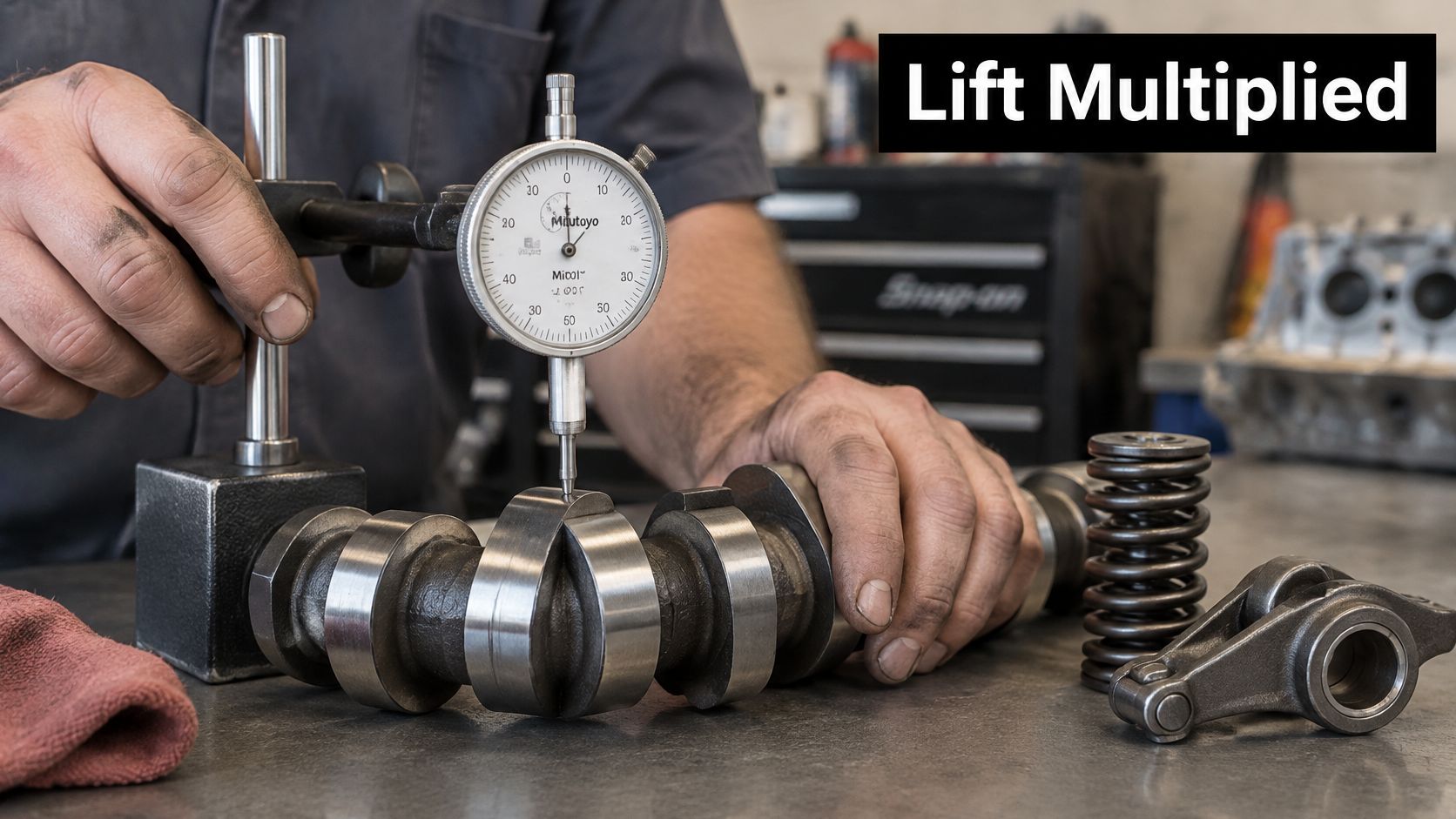
The rocker arm is a lever sitting on a fulcrum, and it multiplies whatever the lobe hands it: valve lift equals lobe lift multiplied by rocker ratio. A lobe of 0.313 inch behind a 1.5:1 rocker opens the valve about 0.470 inch at full lift. The same lobe behind a 1.6:1 rocker delivers roughly 0.501 inch at the valve, three hundredths of an inch of extra lift without touching the camshaft. The COMP Cams valve timing tutorial works the 1.6:1 example to the same result and attaches the warning that belongs with it: the taller ratio also increases valvetrain motion and the clearance the valvetrain needs.
That same tutorial is blunt about the comparison problem. Advertised duration may be measured at approximately 0.006-inch tappet lift, while many manufacturers report duration at 0.050 inch, and the two figures aren't interchangeable. If you line those numbers up in a spreadsheet, you are ranking grinds by which company chose the friendlier standard.
What the extra lift costs
Extra valve lift only helps if the valvetrain can control it. A 1.6:1 rocker moves the retainer closer to the guide at full lift and adds load through the whole curve, so check four things before the cam goes in. Spring installed height has to match the spring's rated pressure, coil bind clearance has to exist at maximum lift with a margin, retainer to seal clearance has to survive full lift plus float, and piston to valve clearance gets verified with clay or a checking spring and a dial indicator rather than trusted from a catalog. Pushrod length and rocker arm slot clearance usually want a second look as well.
Duration is a separate dial
Duration and lift aren't the same decision. Longer duration holds the intake valve open further into the intake stroke, which shifts useful airflow and the power peak upward in rpm. The cost lands at low speed: lower cylinder pressure, rougher idle, less manifold vacuum. That's why a big-lift, short-duration cam can idle like a stocker while a modest-lift, long-duration cam in the same engine won't. Lift changes how far the valve goes. Duration changes when the engine makes its power.
Lift sells the cam. Duration decides whether you can live with it.
Work out valve lift for every candidate at the rocker ratio you run, then confirm spring and clearance before you order. Buy the springs with the cam and that entire class of problem disappears before the engine goes together.
How to Compare Cam Specs at the Same Lift
Comparing two cams from two manufacturers means nothing unless both numbers come off the same ruler, and mixing rulers is where most cam confusion starts. Measured from a low point on the opening ramp a cam looks enormous. Measured from a higher point the same lobe looks mild.
The workflow below keeps every candidate on one standard.
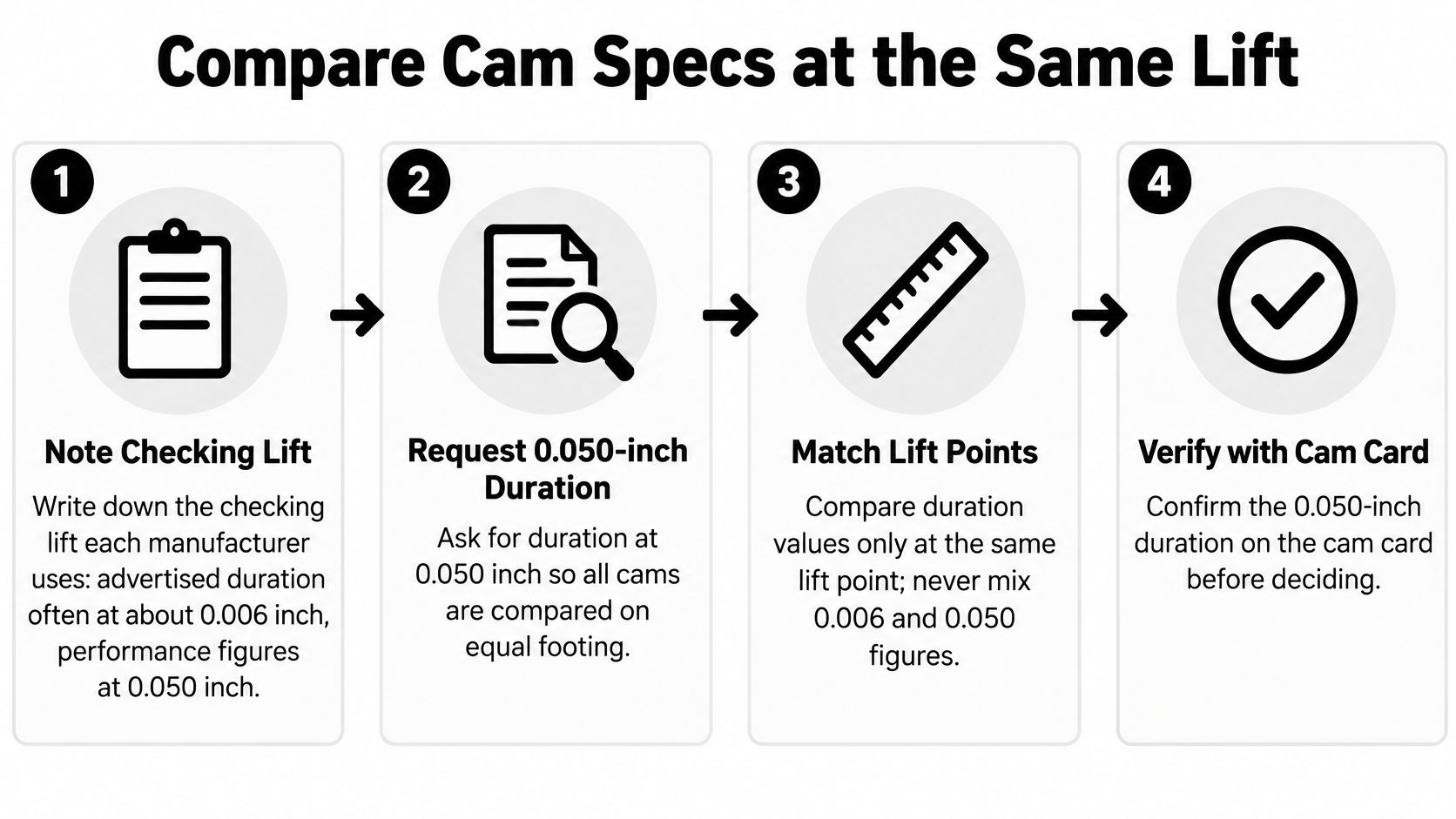
Which is why the first thing you collect isn't duration. It's the standard the duration was measured against.
- Write down the checking lift. Every duration figure you gather goes next to the lift it came from, on the same line. A card that never states its checking lift is telling you nothing you can compare, no matter how impressive the number looks.
- Ask for duration at 0.050 inch. Request it in writing from every manufacturer on your list rather than estimating it from an advertised figure. Estimating turns a comparison into a guess, and the advertised number flatters the cam every single time.
- Confirm lobe lift and rocker ratio. Two cams with identical duration can differ by four hundredths of an inch at the valve once the rocker is applied. Do the multiplication yourself rather than trusting a "valve lift" line that may assume somebody else's rocker ratio.
- Read lobe separation beside duration. LSA doesn't change how long the valve stays open; it changes how the intake and exhaust events overlap. The same 216 degrees on a 108-degree LSA will idle rougher and pull harder in the midrange than the same 216 on a 114. Most buyers read duration and skip this column entirely.
- Match the power peak to real driving. Idle to 5,000 is a street band. 2,500 to 7,000 is a race band. A cam whose useful power only starts at 3,500 is a poor pick for a car that sits at 2,200 rpm on the highway with a 3.08 gear.
- Put the card next to the engine spec sheet. Compression, head flow, intake, exhaust, rear gear, tire diameter and converter stall all decide whether the duration is usable. A cam that wins the paper comparison can still lose against tall gears and a stock converter, and that failure shows up as a car that feels slower than it did before the swap.
If overlap and idle quality are still abstract, this walkthrough shows what the trade sounds like in a running engine.
Finish with a shortlist of two or three cams, all quoted at the same checking lift, all sitting inside your duration bracket. Anything that can't be quoted on that standard doesn't belong on the list, and that includes a grind a friend swears by.
Matching Cam Specs to Your Engine Build
The engine decides how much duration the cylinders can actually use, and compression gets the first vote.
Compression sets both a ceiling and a floor
A low-compression engine tolerates more duration because it isn't fighting detonation, but it also has less cylinder pressure to spare, so a long cam leaves it soft everywhere. A high-compression engine wants enough duration to bleed off a little cranking pressure, yet too much duration drops low-speed pressure below what the combination can stand.
Dynamic compression is the number that decides this, and it depends on when the intake valve closes. A long duration with a late intake closing event in a 10.5:1 engine can pull dynamic compression down to where the engine feels lazy below 3,000 rpm and needs premium fuel anyway. Work out the closed-valve pressure before you commit to the top of a duration bracket.
| Engine setup | Duration at 0.050 in | Lift and spring check |
|---|---|---|
| Stock iron-head small-block | 195-205° | Stock springs usually fine up to about 0.480 in |
| Mild street with aluminum heads | 200-212° | Match springs to installed height and check coil bind above 0.500 in valve lift |
| High compression with iron heads | 210-220° | Strong springs and dynamic compression check |
| Automatic with stall converter | 200-212° | Converter stall must match cam power band |
| Forced induction, low static compression | 218-230° | Check boost and dynamic compression together |
Heads, intake and exhaust decide whether the duration can breathe
A cam only helps if the heads can move the air it's asking for. Big duration behind stock iron heads with small valves just moves the power peak out of reach. Port volume, valve size, carburetor size, intake type and header primary diameter all have to support the rpm band you picked, and a dual-plane intake with a 600 cfm carburetor will strangle a 240-degree cam before the heads ever get a say.
Gearing and converter confirm or veto the row
Rear axle ratio, tire diameter and transmission turn duration into road speed. A 3.08 gear with a tall tire pushes cruise rpm low enough that a mid-range cam never reaches its band. Stall speed matters just as much on an automatic: the converter has to let the engine reach the bottom of its power band before load arrives, or the car drives worse than stock in traffic.
The same matching principle applies on two wheels, and accessori racing per sportive preparate walks through a sportbike build step by step, where cam timing, intake length and final gearing have to move together on an engine turning far higher rpm than any V8.
Find the row above that matches your engine, then confirm your heads, converter and gearing support that duration. If one of them doesn't, step down a row rather than buying parts to rescue the cam.
Driving Conditions That Change the Pick
Two engines with identical parts lists can need different cams because the vehicles do different work, and the difference usually shows up in the first thousand miles.
- Daily driver stuck in traffic. Shorter duration and a wider LSA, around 112 to 116 degrees, keep the idle steady and the vacuum up for brakes and accessories. The engine could cope with more, but you'd pay for it at every stoplight and every cold start.
- Tow rig. Moderate duration with a tighter 112 to 114 LSA holds cylinder pressure down low and keeps heat manageable on a long climb. The owner who chases peak power here usually ends up towing in a lower gear to compensate.
- Weekend car that lives between 3,000 and 5,500 rpm. A mid-range cam in the 210 to 220 bracket is the honest choice, provided the owner accepts a rougher idle and a real tune. Most street builds fall into this range, and most buyers over-buy within it.
- Track or drag car. High-rpm use for short periods can carry considerably more duration, but it drags a transmission and fuel system decision along with it. A cam that needs 7,000 rpm to work is a cam that needs a different driveline to survive.
Altitude and cold starts
Thinner air at altitude reduces the useful power band, so a cam that idles acceptably at sea level can turn marginal at 5,000 feet, with lower vacuum and a rougher transition off idle. Cold starts punish long duration for a different reason: the intake charge has less velocity and less vaporisation, so the engine needs richer cranking fuel and more airflow to catch. If the car lives somewhere cold and high, buy one bracket milder than the table suggests.
Choose the cam for the driving you do most, not the driving you enjoy most.
List the three driving situations you face in a normal month, pick the cam for the most frequent one, then adjust one variable for the rest. Adjusting duration for the rarest case is how a good street car becomes a bad one.
Avoid Costly Mistakes Before You Order
Most bad cam purchases aren't bad cams. They're good cams matched to the wrong combination, and the mismatch is visible on paper before anything ships. These are the six checks I'd run on any final candidate.
- Confirm the checking lift on the card you're buying. The figure in your hand has to be duration at 0.050 inch, the same standard you used to build the shortlist. If the seller's page leads with an advertised number, ask for the 0.050 figure in writing. Skipping this is how a buyer ends up with a cam that looked 20 degrees bigger than the one it replaced and behaves like the same grind.
- Calculate valve lift at your rocker ratio and check the spring. Multiply lobe lift by the ratio you run, then compare that figure against spring pressure at installed height and coil bind clearance. Buying on peak lift alone is the classic route to valve float at 6,000 rpm or a retainer that kisses the guide seal.
- Put duration and LSA against the goal row. Every candidate has to sit inside the bracket for the job, with an LSA that matches the idle you're willing to tolerate. Choosing the largest duration because the number is bigger ignores everything the engine does below 3,000 rpm, which is where most of these cars spend their lives.
- Check static and dynamic compression against that duration. A cam designed around 10.5:1 behaves very differently in a 9:1 short block, and a long duration with a late intake closing can leave a high-compression engine with less cranking pressure than it started with. Work out the dynamic number before you commit.
- Confirm gear, tire and converter against the power band. Highway cruise rpm has to sit inside or just below the cam's band, not below its floor. On an automatic, stall speed has to reach the bottom of the band, otherwise the car lugs off idle and the transmission clunks going into drive.
- Budget the tune as part of the cam. A cam that never gets a timing curve and a fueling calibration to suit it will idle badly, run hot and feel slower than stock. Ignition timing, idle mixture, jetting or injection calibration and, on a flat tappet, the correct break-in procedure all belong in the same purchase decision.
Those six failures get caught by reading a spec sheet against an engine build, not by buying a more expensive camshaft. A candidate that clears all six is sound, and any single failure means stepping back to a milder or differently ground profile rather than adding parts to force the first choice to work.
Before you call anyone, write four numbers on one line: duration at 0.050 inch, valve lift at your rocker ratio, lobe separation angle, and the power band. Send that line, plus compression, head casting, rear gear, tire diameter and converter stall, to your builder or tuner. The answer you get back will be specific, and you'll know within a minute whether the cam you picked is the cam your combination can use.
The same discipline that keeps a cam choice honest, comparing every candidate on one fixed standard before you trust a number, is the discipline behind a defensible valuation. PropLab applies it to comparable sales: it pulls public records, tax data and market signals, ranks comps with distance and recency weighting, shows the adjustment breakdown, and attaches a confidence score, all in about 60 seconds, then exports a professional PDF you can share with a partner or a lender. Paste an address into PropLab and check the comps against your own reading before you make an offer.
About the Author
P
PropLab Team
Real Estate Analysis Experts
The PropLab team consists of experienced real estate investors, data scientists, and software engineers dedicated to helping investors make smarter decisions with AI-powered analysis tools.
Free tool
Pull comps for any address
Comparable sales with adjustments, ready to defend in front of a seller or a lender.
