General
Distressed House for Sale: A Smart Buyer's Playbook
October 4, 2026
18 min read

In 2025, 367,460 U.S. properties had foreclosure filings, representing 0.26% of all housing units, according to Cred iQ's housing market reporting. That volume was still far below the foreclosure crisis, but it marked a clear return of distressed inventory. For buyers, the important question isn't whether a distressed house for sale looks cheap. It's whether the property has spent long enough in financial and legal limbo for its condition, title, and closing risk to change the economics of the deal.
A distressed property can create an opportunity, but the discount rarely arrives without a reason. Water may have been entering through the roof for months. A foreclosure case may have delayed maintenance while ownership remained uncertain. Unpaid taxes, open permits, heirs, tenants, or lienholders may still affect the transaction after your offer is accepted.
This guide treats a distressed house for sale as an operating problem, not a bargain label. You'll learn how to classify the distress, inspect beyond surface damage, underwrite repairs, verify title, find inventory, and decide when walking away protects more capital than negotiating harder.
What a Distressed House for Sale Really Is
A distressed house for sale is a property whose owner can't operate, maintain, finance, or transfer it under normal market conditions. The pressure may come from the building itself, the owner's finances, or a legal process involving creditors, courts, heirs, or municipalities.
The distinction matters because the seller isn't always trying to maximize price. A conventional seller may wait for the strongest offer, complete repairs, stage the home, and provide a clean transaction. A distressed seller may be trying to stop foreclosure, resolve an estate, satisfy a lien, prevent further deterioration, or exit a property they can no longer afford to maintain.
Identify the source of pressure
Start with three questions:
- Is the building failing? Deferred maintenance, water intrusion, fire damage, vacancy, and code violations create physical distress.
- Is the owner under financial pressure? Missed mortgage payments, tax debt, divorce, job loss, or multiple loans can force a sale before the property is ready.
- Is the title or ownership contested? Probate, lis pendens filings, mechanic's liens, judgments, and municipal claims can make a property difficult to transfer.
These categories overlap, but they don't create the same negotiating conditions. A physically neglected property may still have an owner with substantial equity and time to reject a low offer. A financially distressed owner may be highly motivated but unable to deliver the closing documents you expect. A legally distressed property may appear inexpensive while remaining unbuyable until the correct parties and claims are resolved.
For a useful overview of how distressed real estate differs from ordinary transactions, review this distressed real estate guide. The practical takeaway is simple: soft distress usually means inconvenience, cosmetic neglect, or a seller's changing circumstances. Hard distress involves foreclosure, severe physical damage, title defects, or court supervision.
Practical rule: The longer distress continues, the more carefully you should separate the purchase price from the real cost of ownership.
Extended distress gives moisture, vandalism, deferred utilities, and unauthorized occupancy more time to create damage. It also gives liens, filings, probate disputes, and unpaid obligations more time to complicate title. Your first job isn't to negotiate the discount. It's to identify which clock is running, physical, financial, or legal.
The Three Types of Distress and Why They Move Differently
Not every distressed house for sale reaches buyers through the same channel. Classification helps you predict seller motivation, diligence requirements, and closing speed before you spend money on inspections or legal review.
| Type | Seller Motivation | Where You Find It | Title Risk | Closing Speed |
|---|---|---|---|---|
| Physical | Usually modest to moderate, especially when the owner still has equity | MLS listings, investor referrals, vacant-property leads | Usually manageable, but liens and permits still require verification | Often similar to a conventional sale if ownership is clear |
| Financial | Moderate to high, particularly when payments, taxes, or household finances are under pressure | Pre-foreclosure records, public notices, wholesalers, direct outreach | Can be clean, but lender approval or payoff coordination may affect the transaction | Depends on lender, seller, and foreclosure status |
| Legal | Driven by court, estate, creditor, or municipal requirements rather than personal preference | Probate records, court filings, receivership channels, code enforcement records | High until a title professional confirms all claims and authority to sell | Often slower and less predictable |
Physical distress
Physical distress is visible, but the seller's motivation may not be. A roof leak, damaged flooring, overgrown yard, or outdated kitchen can make a listing look neglected without making the owner desperate. The property may still carry a conventional mortgage, and the owner may just want to sell it as-is.
That creates a common mistake. Buyers see repair needs and assume the seller will accept a substantially discounted offer. Sellers with equity may instead price the property around the inconvenience and wait for another buyer.
Financial distress
Financial distress often creates the clearest opportunity for a negotiated purchase. The owner may be behind on payments, facing tax pressure, carrying more than one housing payment, or trying to sell during a major life change. The owner may still control the deed and have authority to sign, but payoff figures and lender deadlines can affect the closing.
A short sale also differs from a foreclosure sale. In a short sale, the lender typically must approve the proceeds because the sale won't fully satisfy the debt. That can make the seller cooperative while making the transaction slower.
Legal distress
Legal distress demands the most restraint. Probate estates may require authority from an executor or court. Code enforcement claims may involve municipal requirements. Mechanic's liens may indicate unpaid work, while a lis pendens signals litigation connected to the property.
For a first-time buyer, financial distress with verified ownership and manageable physical repairs usually offers the clearest spread. Physical distress can work when the title is clean. Legal distress should be approached only after a title professional explains exactly what will be released, paid, or carried into closing.
How to Spot Physical and Hidden Distress Before You Buy
A first walkthrough should test the property, not admire it. Bring a flashlight, phone charger, basic moisture awareness, and enough time to observe how the house behaves when systems operate.
Start with your senses. Musty odor, sewer gas, fresh paint over isolated areas, and persistent humidity deserve investigation. Look beneath windows, around roof penetrations, behind plumbing fixtures, and along basement walls for staining lines, bubbling finishes, or efflorescence. Run every faucet, flush toilets, test visible drains, and operate the HVAC if the seller or agent permits it.
Inspect systems before finishes
The roof, water heater, attic, and basement often reveal more than the kitchen cabinets. Check the roof's apparent age and look for patching. Read the water heater manufacture date rather than assuming it works because it produces hot water. In the attic, inspect insulation and roof sheathing for dark staining or compressed, damp areas. In the basement or crawlspace, look for mineral deposits, damp framing, and signs that water has traveled toward the foundation.
Moisture can begin with poor grading, blocked footing drains, roof breaches, envelope failures, or indoor humidity. If it reaches framing, subflooring, sheathing, or foundations and remains there, it can contribute to rot, corrosion, delamination, staining, and mold growth, as described in Oregon State University's moisture damage resource.

Separate cosmetic signals from structural signals
Use simple comparisons. A coin can help you notice floor slope, but it can't diagnose the cause. Sticking doors, gaps near ceilings, diagonal foundation cracks, and windows that no longer open squarely deserve a structural review. Foundation movement may relate to drainage, irrigation, leaking plumbing, expansive soil, or historical settlement, and each cause requires a different response. For an example of why plumbing beneath a slab needs specialized assessment, this guide to slab leak repair in Dallas provides useful context.
Before ordering a full inspection, walk the property at dusk from across the street. Note exterior lighting, visible occupancy, standing water, roof lines, and neighboring conditions. Speak with one neighbor without asking for private information. Then search the address in court and municipal records for open permits, code cases, utility shutoffs, and recorded disputes.
Those quick checks won't replace a licensed inspection or title search. They can prevent you from paying for a detailed report on a property that already fails your basic risk screen.
Underwriting the Deal with ARV, Repairs, and MAO
A distressed purchase becomes investable only when three figures work together: After-Repair Value, the complete repair budget, and the Maximum Allowable Offer. If one is based on optimism, the entire deal can look profitable while producing a loss.
Establish a defensible ARV
ARV is the expected value after the planned renovation is complete. Don't base it on the most attractive nearby listing. Use closed comparable sales that match the property's location, size, layout, lot characteristics, and finished condition as closely as possible. Then adjust for meaningful differences, such as an extra bathroom, basement finish, parking, or major structural work.
An automated estimate can provide a first-pass sanity check, but it shouldn't replace comp review. A property with severe deferred maintenance may attract comparables that look similar from the street but differ materially in systems and finish quality.
Build repairs from the structure outward
Walk the property with a contractor when possible. Divide the estimate into site and drainage, structure and envelope, major systems, interior finishes, and holding or transaction costs. This prevents a new kitchen from distracting you from foundation drainage or unsafe electrical work.
The familiar investor formula is:
MAO = (ARV × investor discount factor) minus repairs and other deal costs
The discount factor is intended to leave room for closing costs, financing, holding expenses, selling costs, and profit. It isn't a law of physics. A lender's requirements, market liquidity, project duration, and title uncertainty may justify a more conservative offer.
| Metric | Formula | Example Value | Notes |
|---|---|---|---|
| ARV | Selected comparable evidence | Property-specific | Use closed sales and adjust for condition |
| Repairs | Scope of work by category | Contractor estimate | Separate known work from unverified conditions |
| Contingency | Repairs multiplied by a reserve factor | Deal-specific | Neglected homes require room for concealed damage |
| MAO | ARV multiplied by discount factor, minus repairs and costs | Offer ceiling | Never treat it as an automatic bid |
| Profit or equity margin | Expected value minus all project costs | Investment outcome | Recalculate after title and inspection findings |
A disciplined underwriting workflow should be repeatable. Edinhart Realty's flipping tips can supplement your renovation and acquisition checklist, while this real estate deal underwriting framework offers another way to organize the analysis.
Don't hide uncertainty inside one repair number. Put every unknown on a separate line, assign a verification task, and reduce your offer if the task can't be completed before your contingency expires.
Where to Find Distressed Properties Before the Crowd
The earliest lead source isn't always the cheapest. Each channel offers a different combination of information, competition, seller access, and closing risk.
Tax lien auctions can expose properties before a normal listing appears, but the bid process may require cash, strict deadlines, and title research before participation. A winning bid doesn't excuse you from understanding redemption rights, surviving liens, occupancy, or property condition.
Probate records can reveal potential sales before broad marketing begins. The lead may reach an executor, estate attorney, or agent who is still organizing the property. Treat the personal representative's authority as a diligence item, not an assumption.
Pre-foreclosure records and public notices identify owners under financial pressure. A respectful offer may give the owner an alternative to a forced sale, but the notice alone doesn't tell you the payoff amount, junior liens, property condition, or whether the owner wants to sell.
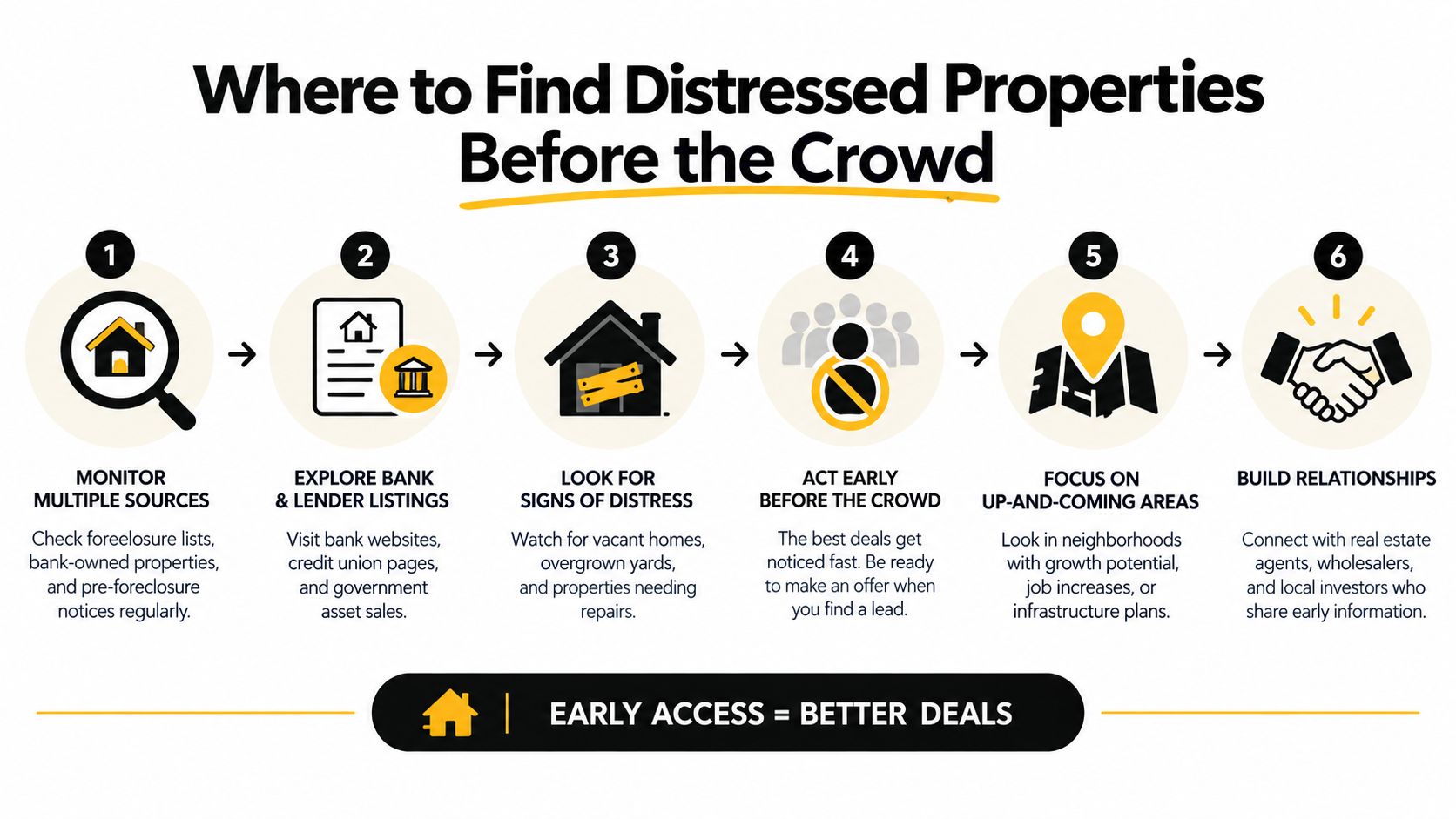
REO portfolios are controlled by lenders after foreclosure. Access may come through asset managers, institutional disposition channels, or agents handling bank-owned listings. Banks often use standardized contracts and addenda, so read the timelines, property disclaimers, and closing requirements carefully.
Wholesalers can bring you contract assignments before a property reaches the retail market. Verify that the wholesaler has an assignable contract, permission to market the interest, clear earnest-money terms, and a realistic closing deadline. A dramatic spread on a flyer isn't evidence of value.
County-specific platforms and Auction.com can help you locate opportunities, but aggregation doesn't equal verification. Use the lead source to find the property, then confirm ownership, liens, taxes, occupancy, and access independently.
A useful distressed property search process starts with one target county and a defined acquisition profile. Tracking every possible source creates noise. Track the sources that produce properties you can inspect, finance, and close.
Red Flags and Risks Most Buyers Miss
The discount isn't the risk. Unverified assumptions are the risk. A low asking price can reflect a damaged building, but it can also reflect a title problem, an occupied property, an incomplete foreclosure, or a seller who lacks authority to transfer ownership.
Title problems can survive the negotiation
Order a preliminary title search before committing meaningful earnest money. Look for mortgages, tax balances, judgments, mechanic's liens, municipal claims, open permits, probate filings, and litigation notices. Ask the title company or attorney what must be released at closing and who has authority to sign.
A municipal lien certificate can reveal obligations that a standard property conversation won't. Open code cases may require repairs, hearings, fines, or certifications. Never assume the seller's inability to pay a lien means the lien disappears when you buy.
Time can alter the condition budget
Properties foreclosed in the second quarter of 2025 had been in the foreclosure process for an average of 645 days, while properties foreclosed in the first quarter had averaged 671 days, according to ATTOM's 2025 foreclosure market report. A long legal timeline gives a vacant or neglected property more time to suffer roof leaks, frozen plumbing, vandalism, pest activity, and unauthorized occupancy.
That timeline also affects closing certainty. A buyer may spend weeks underwriting a property while an appeal, reinstatement, payoff dispute, or court requirement changes the seller's ability to close. Treat every date in the foreclosure process as provisional until your title professional confirms the next enforceable step.
Occupancy is a transaction issue
Squatters, holdover tenants, family members, and heirs can prevent access or delay possession. Don't enter without proper authorization, and don't assume a vacant-looking building is legally vacant. Confirm who occupies the property, whether a lease exists, and how possession will be delivered.
A signed contract doesn't cure a defective title or produce vacant possession.
Before bidding, require a physical walkthrough with proper notice, a title review, a municipal search, and a written explanation of unresolved claims. If the seller can't provide ordinary disclosures, that doesn't automatically end the deal, but it should increase your inspection scope and reduce your tolerance for uncertainty.

Using Valuation Tools and Market Signals to Move Faster
Speed helps only after the decision process is reliable. The aim isn't to replace inspection, title work, or professional valuation. It's to remove repetitive work so you can spend more time testing the assumptions that could hurt the deal.
| Tool / Signal | Primary Use | Speed Advantage | Limitation |
|---|---|---|---|
| Automated valuation model | First-pass value range | Screens leads quickly | May miss condition, layout, or street-level differences |
| Comparable sales platform | Finds and organizes relevant closed sales | Reduces manual comp research | Output still requires human adjustment |
| Permit history | Shows prior renovations and unresolved work | Flags property history early | Records may be incomplete or inconsistent |
| Days-on-market trend | Indicates buyer competition and absorption | Helps frame offer urgency | Doesn't explain why a property sits |
| List-to-sale-price ratio | Tests local pricing behavior | Adds context to negotiation | An area average may not fit a damaged property |
| Code-violation feed | Identifies possible supply and repair pressure | Surfaces municipal risk early | A violation isn't a complete scope of work |
| Licensed appraiser's BPO | Independent value cross-check | Adds professional judgment before a large bid | Costs money and still depends on available evidence |
Build a repeatable underwriting sprint around a new lead. Pull the best available comps, drive by the property, verify the listing and ownership, check permits and code records, confirm financing capacity, and decide whether the property deserves a full inspection. An address-based platform such as PropLab can assemble comparable sales, ARV, repair estimates, risk indicators, and an MAO report for an investment property, but you still need to validate the inputs.
Use signals as filters, not verdicts
A rising code-violation feed may indicate properties needing work, but it doesn't prove a supply spike or a bargain. A short marketing period may signal competition, but it doesn't prove the seller received a sound offer. An AVM may support your initial range, but it can't see concealed moisture or a title dispute.
Cross-check independent inputs before increasing your offer. When the purchase price is substantial, a licensed appraiser's broker price opinion or appraisal can provide a stronger challenge to your assumptions than another automated estimate.
The strongest operators move quickly because they know what they still need to verify. They don't move quickly by skipping the facts that determine whether the property can close and perform.
Your Distressed Property Action Plan
A first-time buyer can turn a distressed house for sale into a controlled process by assigning every decision a deadline and every assumption an evidence requirement.
Build the acquisition plan
Start by choosing the investment thesis. A flip, BRRRR project, and rental purchase can target the same property but require different exit assumptions, financing, reserves, and repair standards. Define the county, property type, acceptable condition, and maximum exposure before reviewing leads.
Create a pipeline using tax records, probate filings, pre-foreclosure notices, bank-owned listings, and vetted wholesalers. Pre-qualify with a hard-money, private, or DSCR lender before touring so you know which properties can actually close.
Screen each lead in order
- Confirm the address and owner. Eliminate duplicate listings and verify that the person offering the property can participate in the sale.
- Review visible condition. Drive by, inspect the exterior where permitted, and note occupancy, drainage, roof condition, and access.
- Estimate value. Select relevant closed comparables and document every adjustment.
- Build the repair scope. Separate structural, systems, safety, finish, and site work.
- Calculate your MAO. Use the agreed underwriting formula, then subtract repairs, transaction costs, holding costs, and a reserve.
- Order title and lien work. Ask for a preliminary search and municipal records before making an unconditional commitment.
- Confirm the sale process. Determine whether the transaction is conventional, short sale, REO, auction, probate, or court supervised.
- Submit a documented offer. Include proof of funds, inspection rights, access requirements, and a closing plan.
- Renegotiate from evidence. Use inspection findings, title defects, and verified repair scope rather than a general request for a lower price.
- Make the walk decision. Exit when the unresolved risk exceeds your financing, time, or management capacity.
Your repair plan doesn't need to produce a luxury renovation. It needs to satisfy safety requirements, protect the structure, support the exit strategy, and match buyer expectations. For restrained finish decisions, these budget-friendly kitchen and bath tips can help you avoid spending on details that don't improve the investment thesis.
Walk away when the repair burden consumes too much of the expected value, title clouds can't be resolved within your transaction window, or holding costs make the project dependent on a perfect exit. The exact threshold depends on financing and strategy, but the principle is fixed: don't let a negotiated price hide an unmanageable project.
Download or create a checklist that records the lead source, ownership, title status, condition findings, comp evidence, repair assumptions, financing terms, and walk-away reasons. Prepared buyers get opportunities because they can verify and respond. Desperate buyers buy uncertainty because they want the discount to be real.
PropLab helps investors evaluate distressed houses with comparable sales, ARV estimates, rehab-cost inputs, risk indicators, and offer-ready MAO reports. Visit PropLab to analyze potential deals faster and build a more defensible acquisition pipeline.
About the Author
P
PropLab Team
Real Estate Analysis Experts
The PropLab team consists of experienced real estate investors, data scientists, and software engineers dedicated to helping investors make smarter decisions with AI-powered analysis tools.
Free tool
Get the ARV of any property in 30 seconds
Skip the spreadsheet. Enter an address and get an after-repair value backed by real comps.
