General
Double Closing Real Estate: How It Works, Rules and Risks
October 27, 2026
15 min read
A double closing is two back-to-back sales in which the investor takes title to the property between the original seller and the end buyer. The critical question isn't how briefly you expect to own it, but whether you can carry the property if the resale doesn't happen.
You may already have a seller under contract and an end buyer willing to pay more. Everyone wants a quick closing, but the title company has started asking where the purchase money will come from, whose lender approves the resale, and what happens if the buyer's wire never arrives.
Those aren't administrative details. They determine whether you have a workable transaction or a purchase obligation you can't afford.
What a Double Closing Is and Why Investors Use It
Say you've contracted to buy a duplex, found a buyer willing to pay more, and want to keep the resale price out of your negotiations with the original seller. Your buyer wants to purchase the property, not acquire your contractual position.
A double closing means back-to-back sales, with the investor holding title for the moment in between.
Think of a relay race. You take the baton from the seller and hand it to the end buyer. An assignment is different: you transfer the right to receive the baton without becoming the runner holding it.
The paperwork reflects that distinction.

What investors are trying to achieve
Investors generally choose this structure for related but distinct reasons:
- Separate negotiations: Each purchase agreement establishes its own price, helping keep the original acquisition price out of the resale negotiation.
- A property sale rather than an assignment: The investor can contract to deliver ownership instead of asking the buyer to accept transferred purchase rights.
- Different presentation of compensation: The investor earns a resale spread rather than displaying an assignment fee on the same settlement statement.
Privacy has limits. Recorded documents, lender requests, mandatory disclosures, and conversations between parties can reveal transaction details. Don't promise secrecy or use separate closings to withhold information someone is legally entitled to receive.
Wholesalers and fix-and-flip investors commonly consider double closings, especially when an end buyer wants a conventional purchase transaction. That means an ordinary property purchase, not necessarily a conventional mortgage.
A useful double closing real estate analysis starts with the transaction's substance: what you're buying, how you'll fund it, and what obligations remain yours if the intended exit disappears.
How the Two Sales Fit Together and Keep Funding Alive
The seller-to-investor purchase is the A-to-B transaction. The investor-to-end-buyer resale is the B-to-C transaction. Each needs its own enforceable purchase agreement, deed, and settlement accounting.
The two closings in a double closing, stage by stage
| Stage | First closing (seller to investor) | Second closing (investor to end buyer) |
|---|---|---|
| Contract | Investor signs a purchase contract with the original seller | End buyer signs a separate contract with the investor, often before the first closing |
| Funding | Investor cash or approved transactional funding pays the purchase price | End buyer's approved mortgage or cash pays the resale price; proceeds repay transactional funding |
| Title | Seller deeds the property to the investor | Investor deeds the property to the end buyer |
| Settlement statement | Acquisition statement accounts for seller payout and purchase costs | Resale statement accounts for resale price, costs, and disbursements |
| Recording order | Acquisition deed goes first | Resale deed follows in the closing agent's approved sequence |
| Who is on record | Investor becomes owner of record | End buyer becomes owner of record after the resale conveyance |
Legal Counsel PA's explanation of simultaneous closings describes these as legally distinct conveyances, commonly settled back-to-back, with transactional funding often providing a single-day acquisition loan repaid from resale proceeds.
The important distinction is between having signed documents and having a funded, completed transaction. Your closing agent must explain when ownership transfers, when disbursement is permitted, and how recording will occur under the applicable procedures.
Why the acquisition needs its own funding
The end buyer's willingness to pay doesn't automatically give you permission to spend that money on your acquisition. Their lender, the escrow instructions, and the title insurer may prohibit that flow of funds unless expressly approved.
Consider a hypothetical example: you agree to purchase for $150,000 and resell for $185,000. The gross spread is $35,000, before closing costs, funding charges, taxes, and other expenses.
If you don't have acquisition cash, an approved transactional lender could provide the purchase money. The closing agent would repay that lender from the resale proceeds according to written disbursement instructions.
That spread isn't your take-home profit. Prepare separate acquisition and resale closing estimates, then deduct every expense from the difference between the prices.
Ask the funding provider for a written term sheet addressing:
- Required cash: Whether the advance covers only the purchase price or also acquisition costs.
- Release conditions: What proof of the end buyer's readiness is necessary before funding.
- Repayment terms: When repayment is due and what happens if the resale is delayed.
- Personal exposure: Whether guarantees, extension charges, or other remedies apply.
Funding rule: A buyer's proof of funds is not the same thing as permission to use the buyer's money for your purchase.
The closing sequence
Use this order as a coordination checklist, not as a substitute for the closing attorney's instructions.
- Obtain title-company acceptance. Confirm that the closing agent and title underwriter accept the proposed funding flow, transactional lender, and deed-recording sequence.
- Check the buyer's actual loan program. The FHA anti-flipping rule generally restricts FHA-insured financing when resale occurs within 90 days of the seller's acquisition, subject to exceptions, as explained in the BiggerPockets double-closing checklist. Get the buyer's lender to evaluate the actual ownership dates and any claimed exception.
- Execute the contracts with required disclosures. Align the closing dates, financing conditions, access rights, and remedies without pretending the agreements are interchangeable.
- Fund and close the acquisition. Confirm cleared funds and satisfaction of the seller-side closing requirements.
- Submit the acquisition deed for recording. Follow the closing agent's approved process rather than assuming a signature alone completes every requirement.
- Complete the resale and subsequent recording. Confirm the buyer-side funding conditions, record the resale deed in order, and disburse proceeds under the approved settlement instructions.
A lender's prequalification letter isn't approval of a rapid resale. Ask whether underwriting has reviewed the investor's acquisition, the resale contract, the source of funds, and any required supporting documents.
When the resale slips
A wire delay can become an ownership problem. If the acquisition closes but the resale fails, the original seller has been paid while you still owe the acquisition lender.
You may need an extension, replacement financing, or a different buyer. Meanwhile, you're responsible for maintaining the property and addressing obligations that arise during ownership.
Model that outcome before committing. Ask the closing agent to confirm the structure in writing before you sign a purchase contract, not after everyone has scheduled closing.
Double Closing Versus Assignment at a Glance
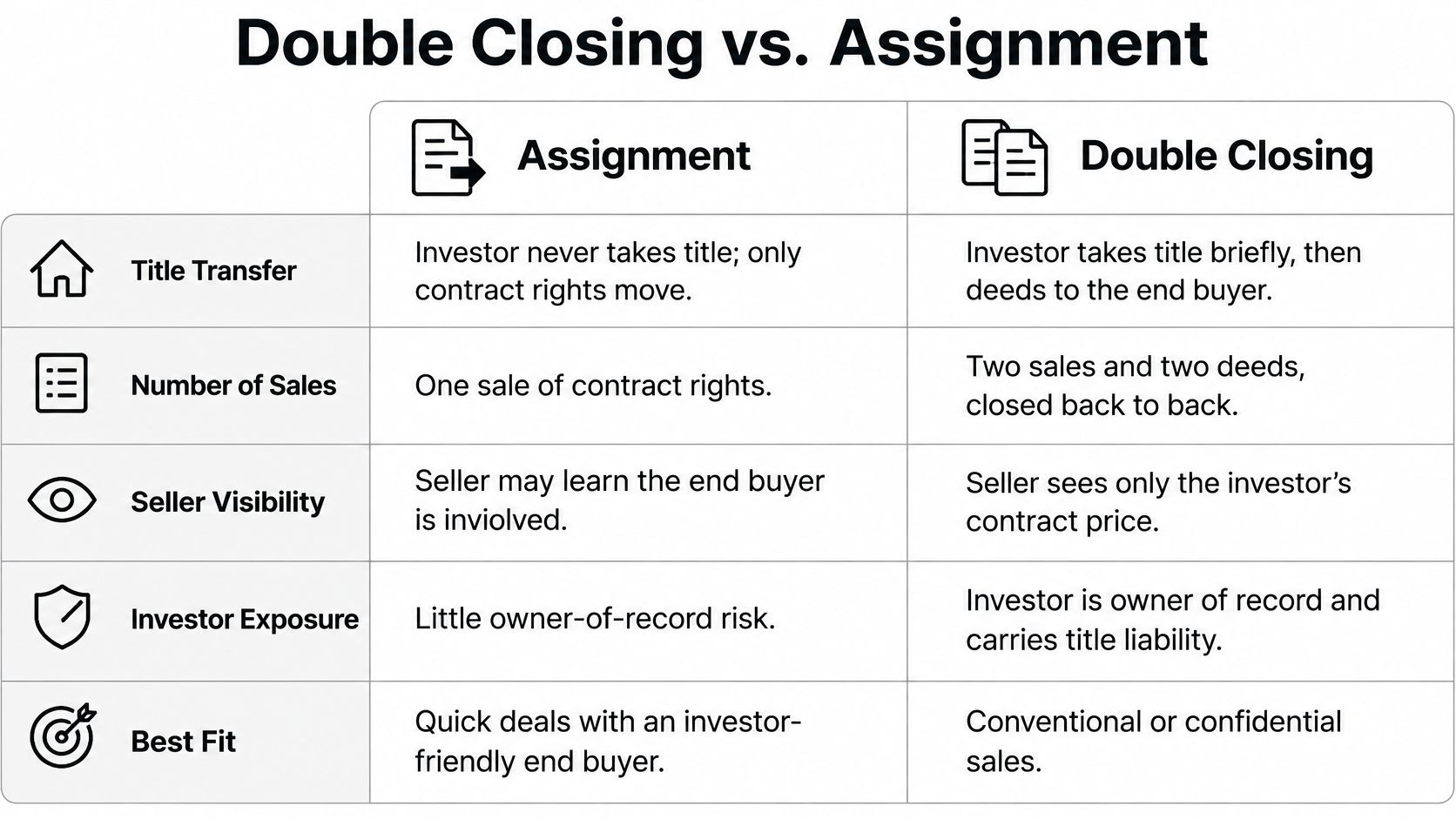
An assignment transfers purchase-contract rights without making the investor the property owner. A double closing requires the investor to complete an acquisition and then a resale.
Double closing compared with assignment
| Factor | Double closing | Assignment |
|---|---|---|
| Title | Investor takes title | Investor transfers contract rights without taking title |
| Settlement statements | Separate acquisition and resale accounting | Assignment fee usually appears in the purchase settlement accounting |
| Original contract price | Not ordinarily shown on the resale statement, but privacy isn't guaranteed | End buyer sees the underlying purchase agreement; lender may review it |
| Financing needed | Investor cash or approved acquisition funding | Usually no acquisition loan for the assignor; contractual deposits may still apply |
| Liability after closing | Ownership exposure during the gap; some obligations can survive resale | Contractual, disclosure, and other applicable legal obligations |
| Added cost | Additional title, recording, settlement, and potential funding expenses | No investor acquisition deed or associated acquisition closing |
| Regulatory exposure | State wholesaling rules and applicable reporting requirements | State assignment, licensing, disclosure, and consumer-protection rules |
| Best fit | An approved property resale where the investor accepts ownership | A permitted, assignable wholesale contract with a willing end buyer |
The visual comparison makes the structural difference easy to recognize, but confidentiality still depends on disclosure duties and transaction documents.
Compare net proceeds, not labels
Suppose a seller accepts your offer and an end buyer will pay a higher amount. An assignment could compensate you through a disclosed fee; a double closing could produce a resale spread.
The economic starting point may look similar, but the expenses and obligations aren't. Request itemized settlement estimates instead of assuming the resale spread makes the more complicated structure worthwhile.
An assignment in real estate also requires careful review of the original contract. A willing buyer doesn't override an assignment prohibition or a required seller consent.
Choose for the actual buyer
An assignment generally suits a straightforward wholesale transaction when the contract, local law, and end buyer permit it. A double closing may fit when the buyer needs a property purchase from the investor and the lender accepts the ownership history.
Neither structure excuses inaccurate marketing. Don't advertise yourself as the current owner when you only hold a purchase contract, and don't assume a resale deed eliminates lender questions about a rapid flip.
Legal and Reporting Rules That Change the Answer
A double closing isn't automatically unlawful, but taking title doesn't automatically remove a transaction from wholesaling regulation. State law may look at what you advertised, what you promised the seller, and how you arranged the resale.
Rules that can apply to a double closing
| Rule | Who it reaches | Double closing trigger | What to do |
|---|---|---|---|
| FinCEN residential real estate reporting | Specified residential transfers to entities or trusts | A potentially covered non-financed transfer without an exemption | Have the closing team determine coverage, reporting responsibility, deadline, and retention duties |
| Oklahoma wholesaling law | Covered wholesalers operating in Oklahoma | Certain simultaneous double closings | Complete required pre-contract disclosures and honor cancellation rights |
| Connecticut wholesale-contract proposal | Contracts within the proposed legislation's scope | Proposed restrictions on the contract's closing period | Verify enactment status and current requirements before relying on a deadline |
| State wholesaling and consumer-protection rules | Investors whose activities fall within applicable law | Marketing, disclosures, agency relationships, and transaction substance | Obtain local legal review and preserve the written record |
Taking title isn't a universal workaround
The Oklahoma Senate Bill 1075 consumer-protection summary explains that the law, effective November 1, 2025, includes certain simultaneous double closings and requires pre-contract written disclosure of intended resale at a higher price, a recommendation to seek legal advice, and a two-business-day cancellation right; noncompliance can make the contract unenforceable.
That changes how an investor should negotiate. A disclosure delivered with the closing package may be too late when the obligation applies before contracting.
Connecticut's proposed wholesale-contract restrictions illustrate another issue: a proposal isn't the same as an enacted requirement. Have counsel verify the current law, its scope, and any permitted written extension rather than treating a legislative summary as closing instructions.
Separate deeds don't erase duties attached to how you obtained the seller's agreement.
Build a defensible file
Give your attorney the advertisements, purchase agreements, resale agreement, entity information, and communications with the seller. Mention seller occupancy and any promises about repairs, timing, representation, or resale.
Keep signed disclosures and delivery records together with the contracts. If a seller later disputes the arrangement, your file should show what you disclosed and when.
The practical question behind whether wholesaling real estate is legal is whether your specific conduct meets the applicable rules. Use the final go-or-no-go checklist to assemble the facts for local counsel, not to replace that review.
Tax and Title Exposure You Take On as Owner of Record
Taking title changes your position from contract holder to property owner. Even brief ownership requires you to address tax reporting, insurance, title protection, and the possibility that your exit won't close.
Tax treatment follows the facts
Don't assume that calling the proceeds a resale spread creates favorable tax treatment. A dealer selling property to customers may recognize ordinary business income, while property held for investment can raise different questions about gain characterization and holding period.
An assignment fee can also produce ordinary income. Choosing between structures solely because someone says a sale is taxed better than a fee is unreliable.
Give your CPA the contracts, settlement statements, funding charges, entity details, and description of your broader business activity. Ask how acquisition costs, selling expenses, interest, and any unsuccessful resale expenses should be handled.
Title protection isn't automatic
Review the title commitment before acquisition. Confirm which exceptions remain, which liens must be discharged, and what coverage the investor will receive.
Lein Law Offices' explanation of title insurance for Wisconsin homebuyers is a useful starting point for distinguishing title protection from a simple ownership search. Coverage still depends on the policy, exclusions, endorsements, and transaction facts.
A clean-looking chain of title doesn't mean every potential claim is insured. Ask the closing agent how a newly discovered lien or recording problem would affect the resale and the end buyer's policy.
Bring these questions to your CPA and title company:
- Insured owner: Which person or entity receives the acquisition owner's policy?
- Failed resale: What coverage and financing remain in place if you must keep the property?
- Entity choice: Which entity should sign, borrow, take title, and report the income?
- Expense allocation: Who pays recording charges, title premiums, taxes, and settlement expenses?
- Property protection: When do insurance, utilities, maintenance, and other owner responsibilities begin?
Reselling doesn't necessarily extinguish contractual warranties or liability for your own conduct. Confirm the tax treatment with a qualified tax professional and the surviving obligations with local counsel.
Confirm the Structure Before You Close
Proceed only when the resale structure serves a real transaction need, you can absorb ownership exposure, and the state rules, lender, and closing team permit the arrangement. An unresolved funding or compliance condition is a reason to pause, not a detail to fix after acquisition.
Use this checklist to organize the approval process.
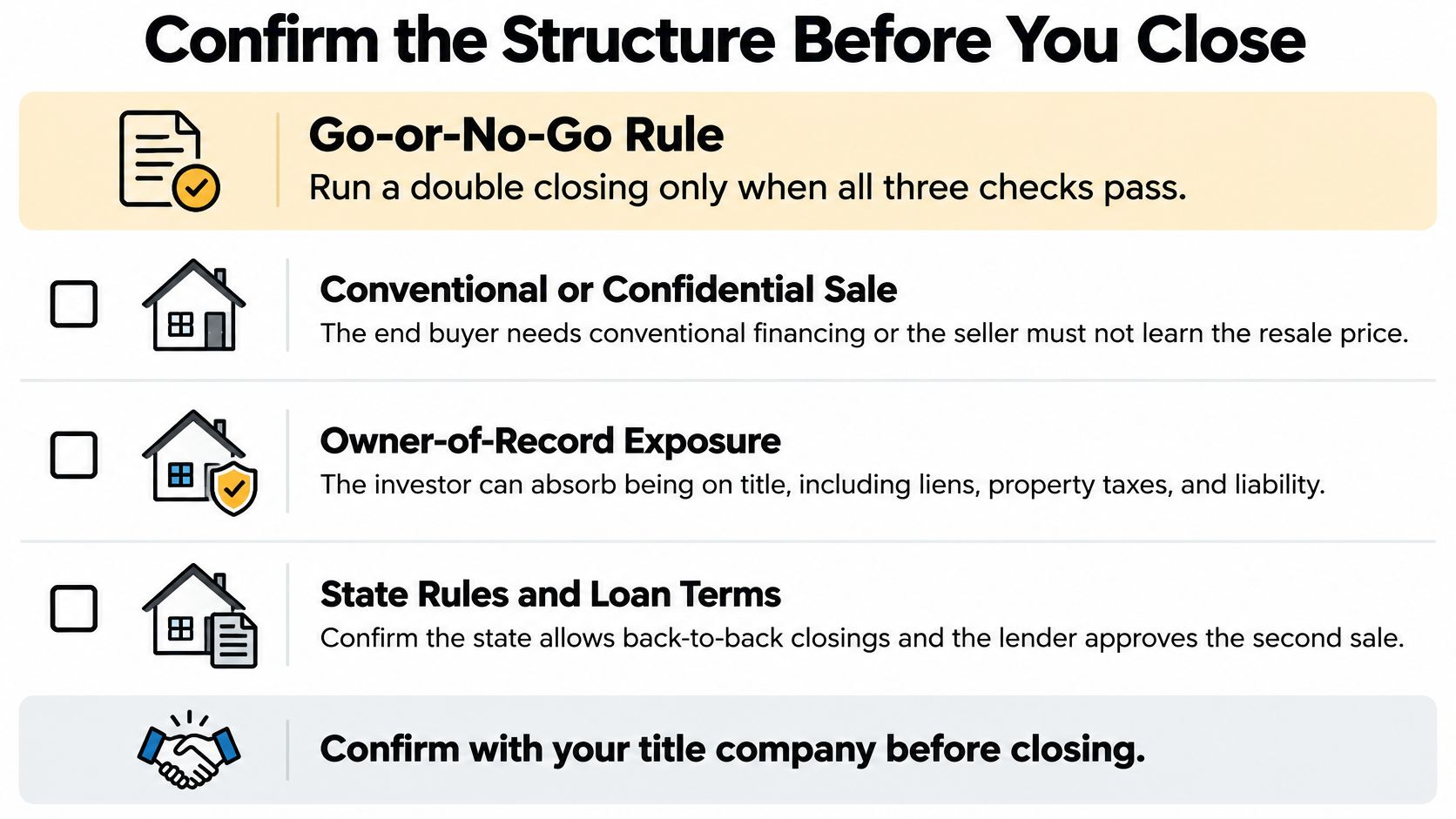
The go-or-no-go checklist
- Identify the property and occupancy. Tell counsel whether it's residential property, whether the seller occupies it, and whether special seller protections might apply.
- Review the advertising. Save the listing, buyer messages, and seller solicitation. Ask whether their substance triggers wholesaling or disclosure requirements, regardless of the label you used.
- Map the parties and ownership. Identify the exact acquiring and reselling entities, authorized signers, and ultimate buyer. Don't substitute an LLC name at closing without renewed document review.
- Determine reporting coverage. Under FinCEN's residential real estate reporting FAQs, specified non-financed residential transfers to legal entities or trusts may be reportable absent an exemption; beneficial owners include substantial-control individuals and people owning or controlling at least 25%, reports are due by the later of the last day of the month after transfer or 30 calendar days after closing, and related certifications generally require five years of retention.
- Verify financing and timing together. Obtain written lender acceptance of the proposed resale and ownership history. Have counsel check any applicable contract deadline and cancellation period.
- Approve the closing mechanics. Get written acceptance of transactional funding, disbursement instructions, title coverage, and recording order.
- Fund the failure case. Identify how you'll repay or replace acquisition financing, insure the property, and cover ownership expenses if the buyer defaults.
- Confirm tax reporting. Have your CPA review the intended entity and transaction treatment before documents are finalized.
For reporting, don't assume every loan removes a transfer from coverage. Have the closing professional apply the rule's financing definition and exemptions to each conveyance, and identify who will collect beneficial-owner information and submit any required report.
The video offers another way to follow the transaction sequence while reviewing your closing plan.
Start with a supportable purchase price
Before making an offer, check comparable sales and whether the expected resale price reflects the property's current condition or completed repairs. An after-repair valuation doesn't prove an immediate buyer will pay that amount for an unrepaired property.
At PropLab, we use public records, tax assessments, and market data without requiring MLS access to generate an address-based analysis with ARV and a shareable report. Our Max Offer Price is calculated from ARV minus repairs, includes a built-in profit margin, and is ready to send to the seller.
Use that analysis as a starting point, then account for transaction-specific closing and funding expenses. A supportable spread makes legal and tax review worth pursuing; it doesn't replace either.
Check the property's economics before committing to an acquisition you might have to hold. Visit PropLab to review comparable sales, estimate ARV and repairs, and create a shareable offer report for your deal team.
Tags
About the Author
P
PropLab Team
Real Estate Analysis Experts
The PropLab team consists of experienced real estate investors, data scientists, and software engineers dedicated to helping investors make smarter decisions with AI-powered analysis tools.
Free account
Underwrite your next deal in under a minute
3 free analyses, no credit card. ARV, rehab, comps and exit strategy in one report.
