General
Finding a Foreclosed Home: Where to Look and How to Vet
November 6, 2026
14 min read
Finding a foreclosed home starts with a scarcity problem, not a discount hunt. The ATTOM 2025 year-end foreclosure market report puts 2025 filings 87% below the nearly 2.9 million properties recorded at the 2010 peak, which means you're competing for a thin slice of inventory, not wading through crisis-era supply. That changes how you should work. You don't need a longer list of distressed addresses. You need a short, verified list, a hard screen for legal and occupancy risk, and a written bid ceiling that survives a worse repair bill than you expect. Treat the foreclosure label as a starting point for diligence, never as proof of value.
Where Foreclosed Homes Are Listed and Which Route Fits You
ATTOM counted 367,460 U.S. properties with foreclosure filings in 2025, up 14% from 2024, yet that total was still 25% below 2019 and equaled just 0.26% of all U.S. housing units, compared with 0.36% in 2019 and 2.23% in 2010. Read the growth rate as activity, not as supply. In most counties you'll find a handful of workable candidates at a time, and several of them won't survive basic checks.
The conversion gap is where pipelines go wrong. The ATTOM analysis of foreclosure activity ticking up in 2025 puts lender repossessions at 46,439, up 27%, a small fraction of the filings that opened the year. Starts, scheduled auctions, completed sales, and bank-owned inventory are four different pools, and each one narrows into the next. Treat a start as a future deal and you'll spend weekends chasing houses that never reach a sale.
Borrower workouts drain the pool further. Loan modifications, repayment plans, and short sales pull a meaningful share of distressed loans off the auction calendar before the sale date arrives. That is why county-level conversion beats national headlines. Track how many filings in your two target counties reach a sale date, then how many of those get postponed or cancelled. A county with fewer filings and clean conversion usually outperforms a county with volume and constant delays. Two counties tracked weekly will tell you more than any national total.
Where to Find Foreclosed Homes by Source
Search several stages at once, because no single source shows the full picture.
| Source | Stage it reveals | How to access it | Main risk |
|---|---|---|---|
| County courthouse and trustee sale notices | Auction | County sheriff or trustee sale postings | Cash or certified funds required, sold as-is |
| Notice of default and lis pendens filings | Default, before auction | County recorder and public record data | Sale date unclear, may never reach auction |
| Lender REO listings | Bank-owned after a failed auction | Bank REO portals and the MLS REO status filter | Competitive pricing, limited inspection access |
| Online auction platforms | Auction | Auction sites tied to county sales | Remote bidding, deposit rules, limited viewing |
| Pre-foreclosure lead lists | Default | Public record data services | Slow owner contact, many leads go nowhere |
Scanners that aggregate these stages across counties save real time. PropLab's Monthly Deals scanner sweeps thousands of properties each month in 90+ major US counties, which covers the sweep but not the verification. Check every result against the county recorder or sheriff calendar before you model anything, because aggregators lag postponements and cancellations.
Match the Route to the Buyer
Auctions suit cash buyers who can move fast, post deposits on short deadlines, and accept as-is sales with limited or no interior access. You also inherit statutory redemption rights and a court process to gain possession if someone still lives there. The entry price looks cheapest here, and the legal exposure is the highest of any route.
REO listings suit buyers who need inspection access and conventional or hard-money financing. The bank already holds title, so the transaction is usually cleaner and you can often walk the property before committing. You'll pay closer to market and face more competition, but you can price the risk you're taking.
Early default filings suit investors willing to negotiate with owners before a sale. You get time to research and talk, but the highest dead-end rate, since modifications, reinstatements, and short sales pull many of these homes out of the pipeline.
The cheapest entry point, the auction, is often the least suitable route for a first-time buyer without legal help or cash reserves.
Whichever route you take, the output should be the same: a written maximum bid that steps down as legal exposure and occupancy risk step up. An auction with unclear possession earns a lower ceiling than an REO you've inspected, even when the headline price is identical.
I'd start with REO properties that allow inspection if you're new to this. You learn how distressed pricing, disclosures, and repairs behave without betting a deposit on a house you've never entered. I'd add auctions only once you have cash, a local attorney who handles possession work, and a pre-bid routine you can run without improvising. The one condition that would change my mind is verified vacant possession plus a clean title search on an auction property. That combination removes the two risks that make auctions dangerous for beginners.
How to Build a Verified Shortlist in One Afternoon
A filing isn't a listing. The ATTOM October 2025 foreclosure market report counted 187,659 U.S. properties with at least one foreclosure filing in the first half of 2025, up 5.8% from the same period in 2024, while 140,006 properties started the foreclosure process. Those stages, default, auction, and real estate owned, describe very different buying situations. Your shortlist has to separate them before you spend time on numbers.
The process below turns three messy sources into one working list.
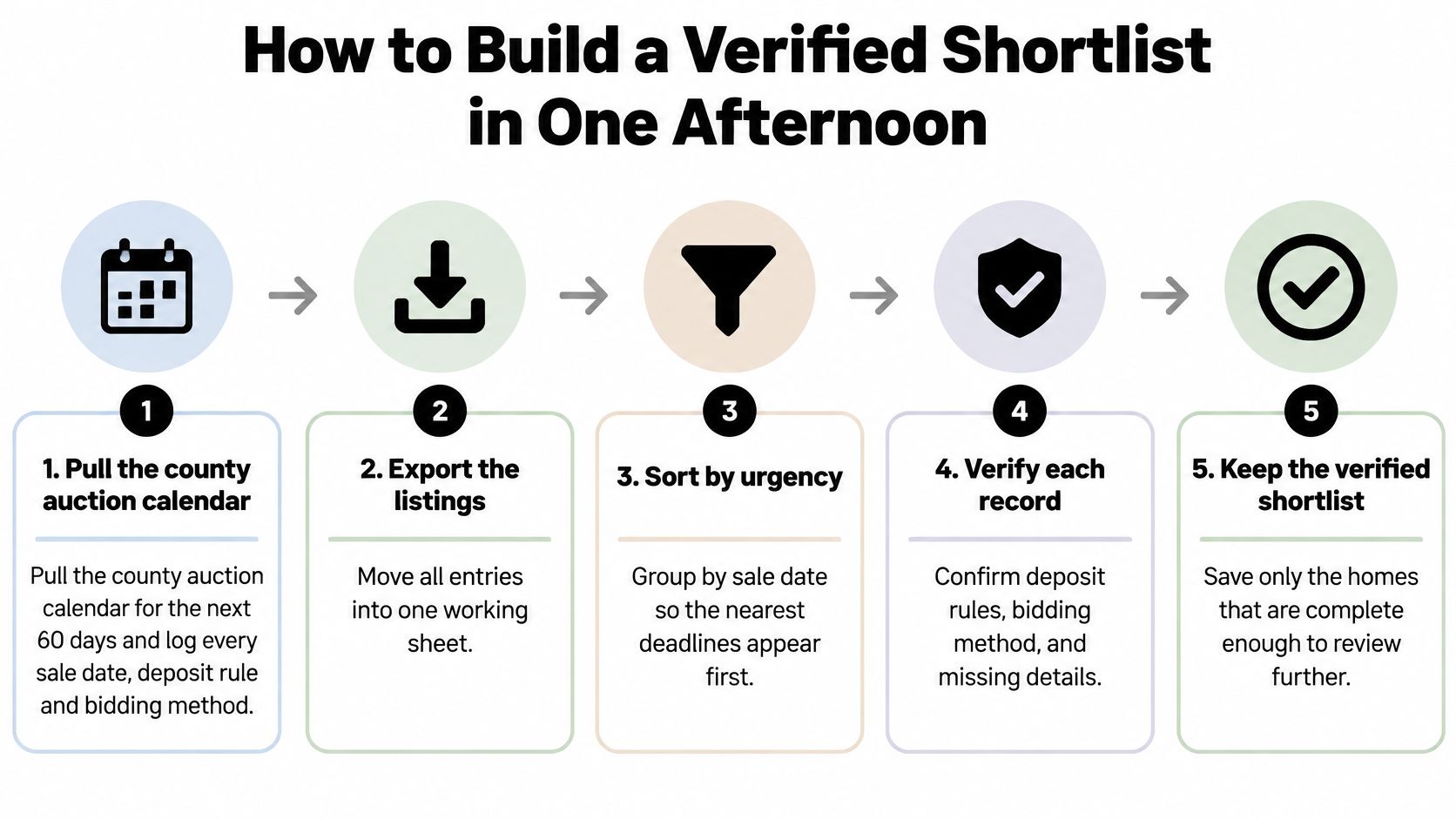
Run these steps in order, in one sitting.
- Pull the county auction calendar for the next 60 days and log every sale date, deposit rule, and bidding method. Auctions drive your deadlines, so they set the shape of everything else.
- Export default filings from the county recorder for the same area and flag any that already carry a scheduled sale date. Those have moved from early stage into auction, and they're the only defaults worth urgent attention.
- Pull REO listings from the MLS REO filter and lender portals, noting which ones offer inspection access. Access determines whether you can price repairs with any confidence.
- Merge the three lists and remove duplicates by address. One house often appears first as a default filing, then as an auction, then as bank-owned, and counting it three times inflates your pipeline.
- Confirm the current status on the county site for every survivor. Postponed or cancelled sales are common, and a stale date wrecks your week.
- Save the survivors in a spreadsheet with stage, sale date, deposit deadline, occupancy status, and a source link. If a row can't hold those fields, it isn't verified yet.
A solid walkthrough of the records side helps here, and our guide to a public records property search covers where recorder and court data live. While you're checking title documents, it's worth understanding color-of-title issues early, since a defective-looking ownership chain can surface in older filings and complicate a resale later.
This short video shows the verification rhythm in practice.
The slip that costs buyers the most time is trusting a listing site that lags behind the county calendar. You'll model repairs on a house whose sale was cancelled last Tuesday. A usable shortlist is short. It's a handful of addresses, each with a dated next step, not forty hopeful leads with no deadlines attached.
Screen Each Listing Before You Invest Time in It
Don't open a spreadsheet until an address passes this screen. These checks are pass or fail, and they take minutes per property once you know where to look. Our real estate due diligence checklist covers the broader version, but foreclosures need these specific gates first.
Use this checklist view to keep the order straight.
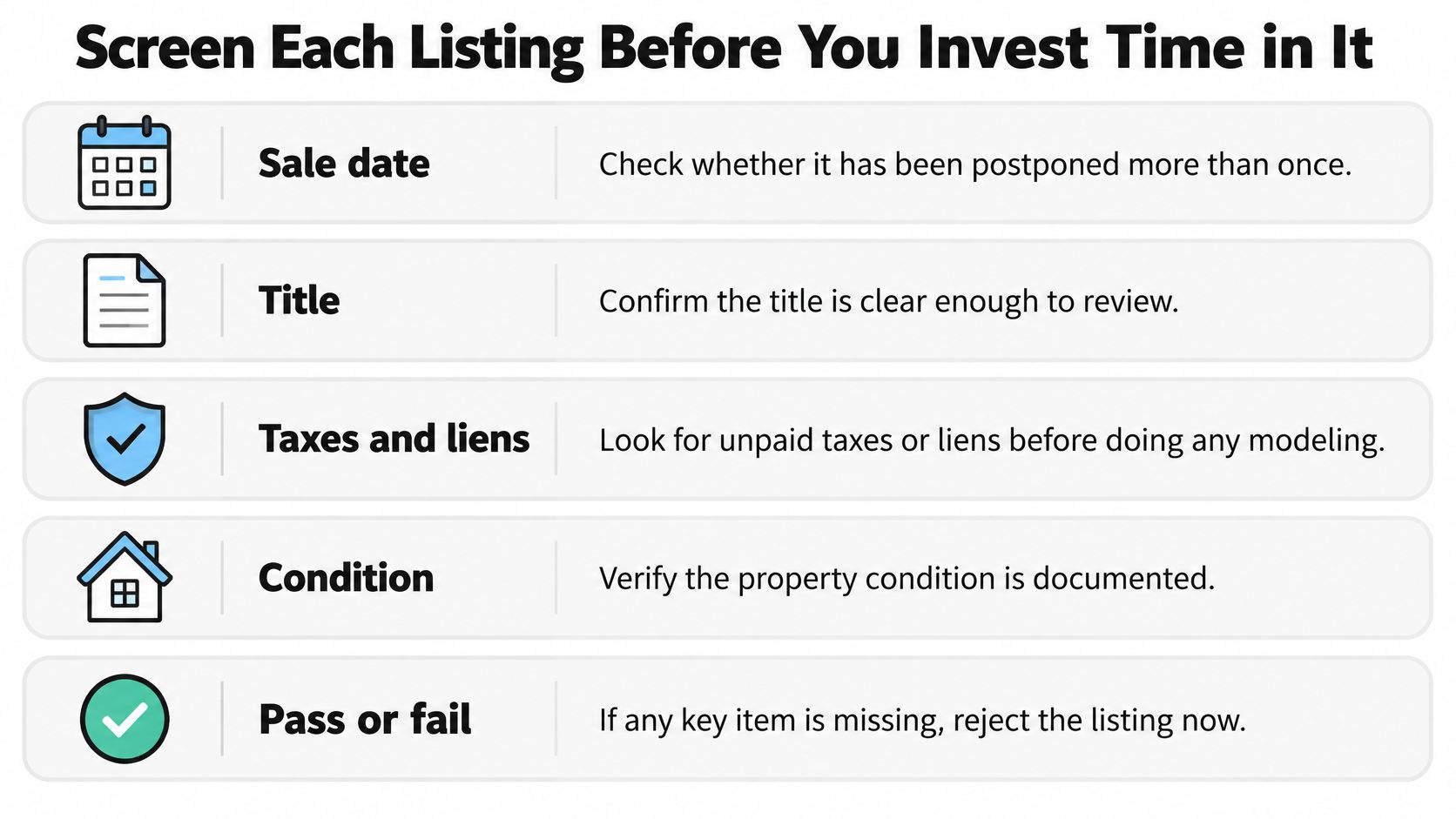
- Sale date: Confirm it's real and hasn't been postponed more than once. Repeated postponements often signal a workout, a bankruptcy, or a title problem you don't want.
- Title position: Check whether senior liens or tax liens sit ahead of the sale. If a senior lien approaches the likely value, the discount is fictional.
- Occupancy: Find out whether anyone lives there and what legal timeline possession would require. An occupant with no realistic move-out date turns your holding period into a guess.
- Taxes and charges: Look for unpaid property taxes, municipal charges, and HOA claims that may survive the sale. These come straight off your margin.
- Legal blockers: Check for bankruptcy stays and any statutory redemption period that lets the former owner buy back in. Either one can freeze your plans after you've paid.
- Condition signals: Read permit history, insurance claims, and neighbor sales. Unclosed fire or structural permits are a serious warning, and if you're buying in a cold climate, checking whether prior owners bothered to improve roof ventilation this winter tells you something about deferred maintenance and ice dam damage hiding under the shingles.
- Comparable sales: Confirm recent nearby comps exist at all. If you can't value it, you can't bid on it.
Two-flag rule: Two red flags and the address comes off the list. No repair estimate rescues a house you can't inspect, can't possess, or can't clear title on.
Run every shortlisted address through these checks in one sitting and record a pass, a conditional pass, or a fail for each. Conditional passes need a named condition, like a title commitment or a confirmed vacancy date, with a deadline attached. Anything vaguer than that is a fail you're postponing.
Price the Bid With a Risk-Adjusted Ceiling
A percentage discount off asking price tells you nothing. Build your ceiling by subtraction instead. Start with an ARV from recent, nearby, condition-matched sales, then subtract itemized repairs, a contingency reserve, holding costs, financing, transaction costs, possession costs, and your required profit. What's left is your maximum bid. If the bidding passes it, you stop, because every dollar above the ceiling comes out of your profit or your reserve.
Time is the input buyers underprice most. The ATTOM August 2025 foreclosure market report reports that U.S. properties completed through foreclosure in Q3 2025 had spent an average of 608 days in the foreclosure process, while Q2 properties averaged 645 days. Those figures describe the legal process, not your ownership period, but they show how slowly title and possession problems can move. A six-month holding assumption can be far too short when occupancy or title issues appear, so price the delay before it happens to you.
Worked Maximum Bid on a $300,000 ARV House
This illustrative example uses a contingency of 10% of repairs, transaction costs at 6% of ARV, and required profit at 10% of ARV.
| Line item | Base case | Repairs at $80,000 |
|---|---|---|
| ARV from recent condition-matched comps | $300,000 | $300,000 |
| Itemized repairs | $60,000 | $80,000 |
| Contingency reserve (10% of repairs) | $6,000 | $8,000 |
| Holding costs (6 months of taxes, insurance, utilities) | $9,000 | $9,000 |
| Financing cost | $10,000 | $10,000 |
| Transaction and closing costs (6% of ARV) | $18,000 | $18,000 |
| Possession or eviction reserve | $7,000 | $7,000 |
| Required profit (10% of ARV) | $30,000 | $30,000 |
| Maximum bid | $160,000 | $138,000 |
Notice what the stress column does. Repairs rising by $20,000 drag the contingency up too, and your ceiling falls by $22,000. If you'd bid the base-case number and the higher repair bill turned out to be real, you'd have paid away most of your margin before swinging a hammer. A renovation cost calculator helps you sanity-check line items against typical ranges, but your own walk-through and contractor quotes should drive the final figure. Our breakdown of how much your maximum offer should be walks through the same subtraction logic in more depth.
Re-run the offer three more ways before you commit. Slow the resale down, drop the resale price, and add extra legal or carrying months. Each run produces a lower ceiling, and the honest bid is the one that still leaves profit under the stressed case.
Reject any deal whose profit survives only the base-case repair estimate. That isn't a margin, it's a hope.
For REO properties, require an independent inspection where permitted and compare the lender's disclosures against permits, tax records, insurance claims, and neighborhood sales. Lender disclosures describe what the bank knows, and banks often know very little about a house they've never occupied. Before any auction, confirm payment rules, deposit deadlines, accepted funds, inspection access, and whether the sale is subject to senior liens or statutory redemption.
Write the ceiling on a bid sheet with these same lines before you walk into the auction room or submit an offer. A number you calculated calmly at your desk will beat a number you invent while someone is bidding against you.
Pick Your First Route and Run the Numbers This Week
You don't need a month of research. You need five moves, done in order, over the next seven days.
- Choose one route. Pick REO with inspection access if you're building experience, or auctions if you already have cash reserves and legal help lined up. One route means one set of rules to learn properly.
- Pick two counties and build the shortlist from the courthouse calendar, recorder filings, and REO portals. Two counties give you enough volume to compare without spreading your verification work too thin.
- Run every address through the pre-bid screen and keep only passes and conditional passes. Most of your list should die at this stage, and that's the screen working correctly.
- Price each survivor with the bid formula, using recent comparable sales for the ARV, a line-by-line repair estimate, and the 70% rule as a sanity check on the maximum offer. Our Comp Finder shows recent comparable sales for any address, and our free calculators, the ARV Calculator, Rehab Cost Calculator, 70% Rule Calculator, Fix and Flip Calculator, BRRRR Calculator, Wholesale Calculator, and Comp Finder, require no account. To run an analysis, you paste a property address, and any MLS, Zillow, or Redfin link works. Verify every output against county records and your own repair walk-through anyway.
- Write a maximum bid for each property before the sale or listing deadline. A ceiling written in advance is a decision. A ceiling improvised at the auction is a reaction.
Do step one today. Choose the route and the two counties, block one afternoon this week for the shortlist, and let the screen and the formula do the arguing for you. Finding a foreclosed home that pencils out is mostly the discipline of rejecting the ones that don't, quickly and on paper, before they cost you a deposit.
Paste any foreclosure address or listing link into PropLab and you'll get comps, an ARV, a rehab estimate, and a max offer price in about a minute, with red flags flagged before you bid. Run your shortlist through it this week and walk into every sale with a stress-tested ceiling already written down.
About the Author
P
PropLab Team
Real Estate Analysis Experts
The PropLab team consists of experienced real estate investors, data scientists, and software engineers dedicated to helping investors make smarter decisions with AI-powered analysis tools.
Free account
Underwrite your next deal in under a minute
3 free analyses, no credit card. ARV, rehab, comps and exit strategy in one report.
