General
Fix and Flip Loans for Beginners: What to Know First
October 11, 2026
17 min read

You've found a house that looks like a bargain. The purchase price seems manageable, the renovation list appears clear, and a quick resale could leave room for profit. Then the lender asks for your projected after-repair value, contractor bids, cash reserves, and exit plan. Suddenly, the house is only one part of the decision.
That's the point many first-time investors discover too late. Fix and flip loans for beginners aren't just money for buying a property. They're short-term financing arrangements whose cost changes every month the project remains unfinished. A deal that looks profitable on a spreadsheet can lose its margin through delays, appraisal problems, extra fees, or a forced sale.
Why the Loan Matters More Than the House
A beginner usually falls in love with the deal through the front door. The lender looks at it through the calendar.
You might buy a worn property for $180,000, expect manageable repairs, and see nearby renovated homes that make the resale look promising. On paper, the house seems to create the profit. In practice, the loan often decides whether that profit survives. If the work runs late, if the draw schedule slows contractors down, or if the resale lands below target, financing keeps charging while your margin gets thinner.
That is why fix and flip loans for beginners should be treated as a project cost that keeps running, not as a simple line item at closing. A short-term loan works more like a taxi meter than a fixed utility bill. The longer the ride takes, the more expensive the trip becomes. Analysts in A review of 2025 HMDA data identified 70,606 conventional first-lien loans fitting a short-term investor or bridge-loan profile, with a median loan amount of $255,000 and a median note rate of 9.99%. For a first-time investor, that means financing deserves the same scrutiny as the purchase price and repair scope.
The four loan families beginners encounter
Hard money loans usually come from private lenders or specialized firms that focus heavily on the property, the renovation plan, and the exit. Speed and flexibility can help when a deal needs a fast close, but beginners need to read the full cost, including points, required reserves, draw rules, and the maturity date. A plain-English overview from Business Loan Warrior hard money loans can help you get familiar with the terms before you compare offers.
Rehab or renovation loans combine the purchase and the work budget. That sounds simple, but the money for repairs is often released in stages after inspections. If your contractor wants a deposit today and the lender reimburses later, you may need cash to keep the job moving.
Bridge loans cover the gap between one stage and the next. They can fund a purchase while you renovate, sell, or refinance. They work well only when the exit is realistic and timed conservatively.
Portfolio loans stay with the lender instead of being packaged into a standard secondary-market product. Because of that, a local bank or credit union may weigh the property, your reserves, and the overall relationship more flexibly than a formula-driven program.
Keep one rule in mind. Choose the loan after you understand the deal's timeline, scope, and exit, because the lender is underwriting the finished project, not just the street address.
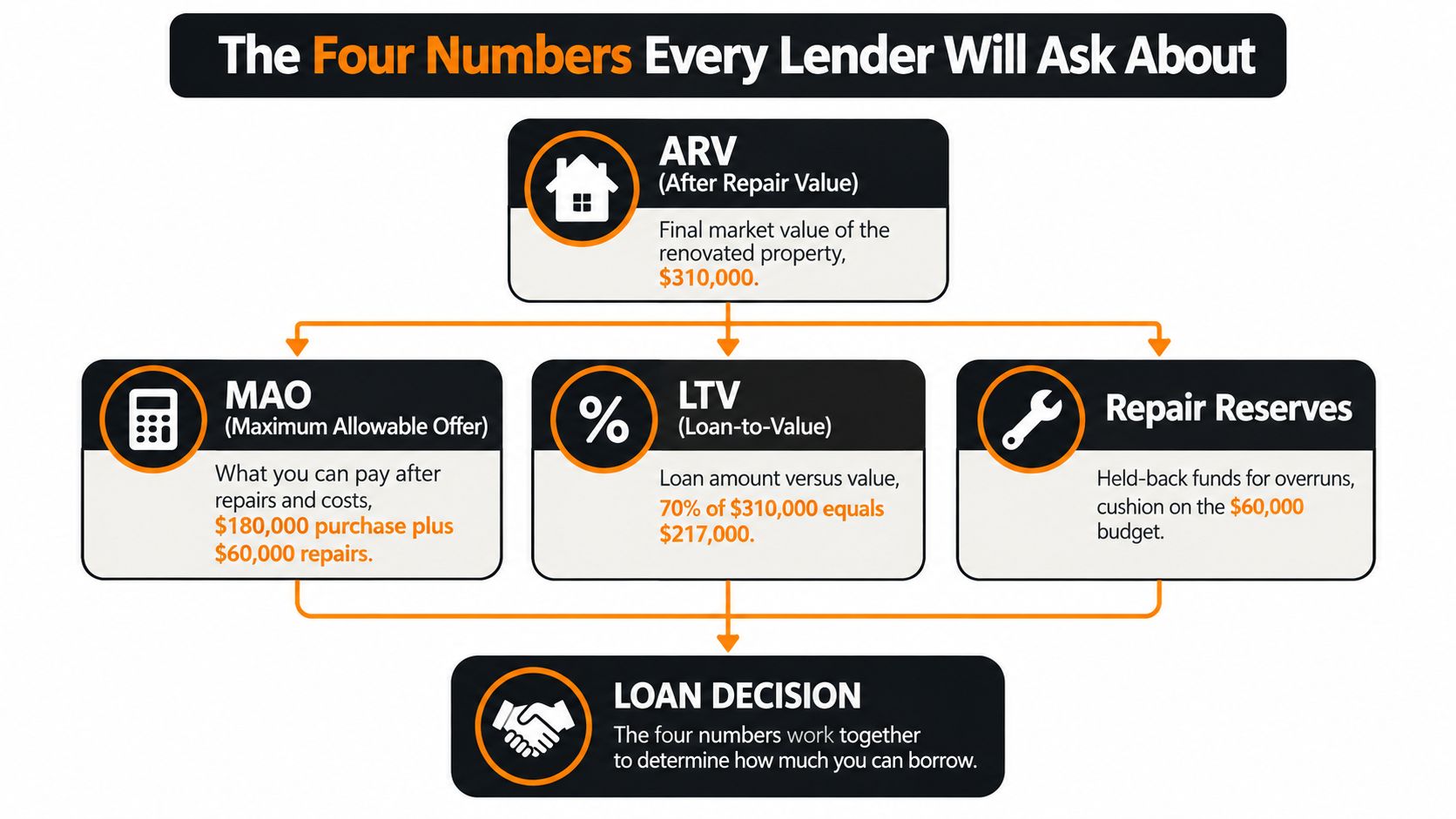
The vocabulary can sound technical, but it is really a simple cost map: ARV, MAO, LTV, and repair reserves. Those terms help you estimate what the finished property may support, what you can safely offer, and how much cash you still need when the project stops behaving like the spreadsheet.
The Four Numbers Every Lender Will Ask About
A lender doesn't begin with your hoped-for profit. The lender starts with the finished property and works backward. You should do the same.
1. Establish the ARV
After-repair value, or ARV, is the market value of the property after the planned renovation is complete. You support it with comparable sales, often called comps. The strongest comps resemble the subject property in location, size, layout, condition, and finish level. A renovated luxury home isn't a reliable comp for a basic starter home just because it sold for more.
In the running example, your projected ARV is $310,000. That is not a number to choose because it makes the deal work. It needs support from nearby sales and a renovation plan that delivers the same quality buyers saw in those properties.
2. Calculate the project basis
Separate the purchase price from the renovation budget. Here, the purchase is $180,000 and planned repairs are $60,000, creating a direct project basis of $240,000 before financing, selling, holding, and closing expenses.
That separation matters because a $60,000 estimate isn't the same as a $60,000 funded budget. Add realistic allowances for permits, design, inspections, cleanup, and work that becomes visible only after demolition. A plumbing or electrical issue can change the schedule as well as the budget, so specialized resources such as commercial construction plumbing services may be useful when the scope includes substantial plumbing work.
3. Use MAO as a decision limit
Maximum allowable offer, or MAO, is the most you can pay while leaving room for repairs, financing, selling costs, risk, and profit. The exact formula depends on your strategy and lender, but the principle is simple: start with supported ARV, subtract every project cost, then protect the required margin.
For a quick first-pass model, you might write:
- ARV: $310,000.
- Purchase price: $180,000.
- Repairs: $60,000.
- Remaining amount before financing and other costs: $70,000.
That $70,000 is not automatically profit. Interest, points, insurance, taxes, utilities, selling commissions, closing costs, and overruns still come out of it. Use a fix-and-flip calculator to test how a different repair budget or resale assumption changes the offer.
4. Check LTV and reserves
Loan-to-value, or LTV, compares the loan amount with the value used by the lender. A lender may use the current value, the as-completed value, or a specified lesser-value rule. Fannie Mae's HomeStyle Renovation framework generally limits the renovation-financed purchase amount to 75% of the lesser of total cost or the appraised as-completed value. Fannie Mae's eligibility guidance explains the framework.
In this example, total cost is $240,000 and ARV is $310,000. The lesser figure is $240,000, so a 75% benchmark would imply $180,000 before other underwriting rules. If the appraisal supports a lower completed value, the available financing can fall.
Repair reserves are cash or controlled funds held for the work and the surprises around it. Don't treat every dollar in the headline loan amount as immediately spendable. You may still need liquidity for deposits, delays, interest, insurance, taxes, utilities, and closing costs.
Hard Money, Rehab, Bridge, and Portfolio Loans Compared
A beginner often sees these labels and assumes they are four names for the same bucket of cash. They are not. Each one changes how quickly money arrives, how repairs get funded, how much cash you must carry yourself, and how much pressure builds if the project runs long.
That matters because financing is not just part of the purchase. It is a time-sensitive carrying cost. The wrong loan can turn a workable deal into a project that bleeds cash while you wait for draws, permits, or a buyer.
| Loan Type | Typical Term | Best For | Speed |
|---|---|---|---|
| Hard money | Short term | Asset-focused projects and flexible underwriting | Fast |
| Rehab loan | Short term | Purchase plus controlled renovation funding | Fast to moderate |
| Bridge loan | Short term | Temporary financing before sale or refinance | Fast to moderate |
| Portfolio loan | Varies by lender | Borrowers with a broader relationship or unusual project | Moderate |
Hard money
Hard money usually works best when the property itself is the main story. The lender often focuses on the collateral, ARV, repair plan, and exit more than on fitting you into a conventional box. That can help when the house needs too much work for a standard mortgage. It also usually means higher pricing, points, property inspections, and a balloon balance at the end.
Use your earlier example. On a $180,000 purchase with a $60,000 renovation, ask four plain questions before you get impressed by speed. Does the lender fund the purchase, the rehab, or both? How much cash do you bring to closing? When do repair funds get released? What happens if the rehab budget comes in light and the true cost is higher?
If you want a practical sense of what lenders screen for, review these hard money lender requirements for beginners. It helps to know the rules before you pay for an appraisal or rush into a contract. You can also compare market examples like Business Loan Warrior hard money loans to see how terms and use cases are framed.
Rehab financing
Rehab financing ties the purchase and the renovation budget together more directly. That can be cleaner for a first project because the lender usually wants the whole job mapped out up front, scope of work, contractor bids, plans if needed, and a draw schedule.
The benefit is structure. The cost is paperwork and timing.
If a contractor misses a milestone, the next draw may pause. Your project does not pause with it. Insurance, utilities, taxes, and interest can keep running while the house sits half-finished. For beginners, that is the part to respect.
Bridge financing
Bridge debt is built around a specific exit. You borrow because you expect a sale, a refinance into longer-term debt, or another clear payoff source. A bridge term that looks long enough on paper can still be too short in real life once permit delays, contractor scheduling, appraisal timing, listing prep, and closing friction show up.
Earlier data in this article already noted how common short terms, interest-only payments, and balloon structures are in this part of the market. Read bridge debt with that in mind. If your timeline has very little slack, a small delay can leave you solving a maturity problem instead of finishing a flip.
Portfolio lending
Portfolio lenders look at the borrower and the property as a fuller picture. Income, assets, experience, bank relationship, and the deal itself may all matter. That can make a community bank or credit union worth a call when the project does not fit a narrow program.
Do not compare only the rate. Ask how draws are handled, whether extensions are realistic, what appraisal rules apply, whether there is a prepayment penalty, whether you sign a personal guarantee, and whether the lender allows a rental conversion if the resale exit weakens. For a beginner, that last question can be the difference between a tight project and a salvageable one.
Reading Rates, Points, and Fees the Right Way
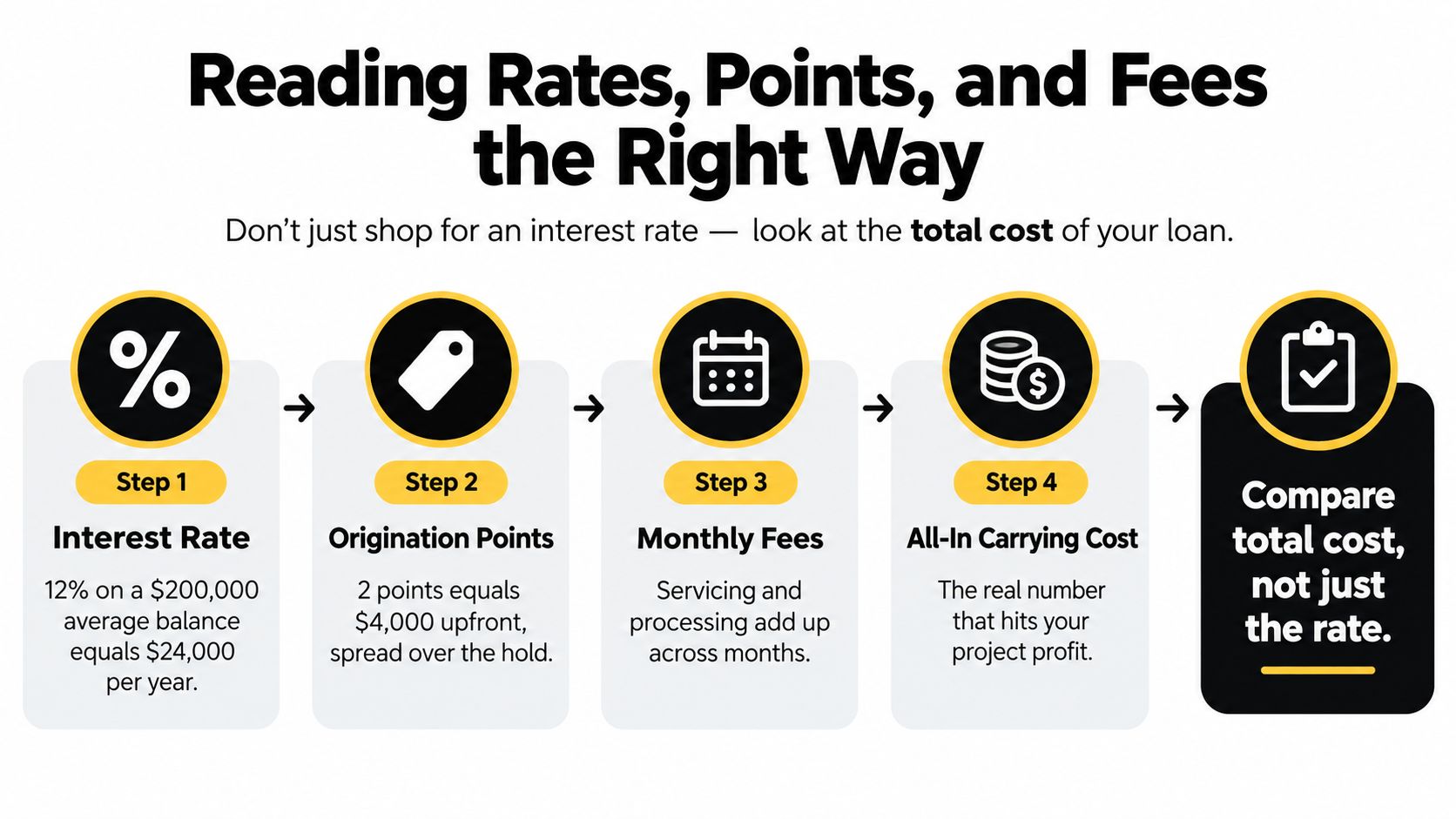
A beginner can look at a quoted rate, feel relieved, and still end up with a bad loan. The reason is simple. A flip loan is not just money you borrow. It is a time-sensitive carrying cost that keeps charging while the project is alive. If the renovation slows down or the resale slips, the financing bill keeps growing beside everything else.
Start with the balance that stays outstanding
Use the balance you expect to carry, not the biggest loan amount on the approval sheet. Suppose your average outstanding balance is $200,000 and the annual interest assumption is 12%. That works out to about $2,000 per month in interest before points and other charges, using the same financing framework shown in Fannie Mae's financing reference. A three-month delay adds roughly $6,000 in interest alone.
That is the part many first-time investors miss. They underwrite the house carefully, then treat the loan like a flat closing cost. It behaves more like a taxi meter. The longer the deal stays open, the more the bill rises.
Interest is only one line. A delay can also keep insurance, taxes, utilities, lawn care, security, permit costs, and contractor oversight running. If your sale price does not improve, those extra months come straight out of profit.
Build the all-in cost
Put every borrowing-related cost in one model before you decide a loan is cheap:
- Interest: Calculate it on the actual drawn or outstanding balance, not only the approved maximum.
- Origination points: Treat upfront points as a project cost spread across the expected hold.
- Draw and inspection fees: Include charges tied to each renovation disbursement.
- Appraisal and title costs: Account for the valuation and closing work required by the lender.
- Taxes and insurance: Continue them through construction and listing.
- Extension charges: Price the cost of missing the planned maturity date.
- Cash-reserve cost: Recognize that reserved funds remain unavailable for another opportunity.
Fannie Mae's eligibility matrix is also a useful benchmark for how borrowing capacity can vary by property type, including cited ceilings of up to 85% LTV for a one-unit investment-property purchase and 75% for two- to four-unit properties. The matrix is a benchmark, not a promise that your renovation lender will offer those terms.
Compare three timelines
Run the same deal three ways: on-time completion, a three-month delay, and a delayed refinance or resale. Change the interest period, utilities, insurance, taxes, extension charges, and expected sale price where needed.
A loan with a slightly higher rate but dependable draws and workable extensions can leave you with more money than a lower-rate quote that slows construction. Sometimes the right answer is not to borrow at all. If the financing cost eats too much of the spread, the deal needs a different structure or no deal.
How to Actually Get the Loan Approved
A lender wants to see a coherent story. The property has a defensible finished value, the renovation budget matches the finished value, the timeline is credible, and the repayment plan doesn't depend on everything going perfectly.

Prepare the property file first
Begin with the address, purchase contract or proposed terms, current photos, tax information, title details, and your renovation description. Then assemble a comp set that explains why your ARV is reasonable. Don't submit a handful of expensive homes just because they support your offer. Show the lender how location, size, layout, condition, and finish quality compare.
Your scope of work should use line items rather than a vague phrase such as “full rehab.” Separate roofing, mechanical systems, plumbing, electrical, windows, kitchens, bathrooms, flooring, paint, exterior work, permits, cleanup, and other relevant categories. Attach contractor bids when available and identify work you intend to perform yourself.
Explain the money and the exit
Give the lender a purchase budget, renovation budget, financing cost estimate, selling-cost estimate, reserve plan, and timeline. State how much cash you're contributing and when you expect each draw to occur.
Your personal package may include identification, credit information, bank or brokerage statements, a schedule of real estate owned, entity documents, and evidence of relevant experience. A first-time investor can offset limited history with a realistic scope, qualified contractors, clear reserves, and a conservative ARV.
Platforms such as PropLab can assemble public-record and market information, apply comp weighting, estimate rehab costs, calculate MAO, and produce a lender-ready report in about 60 seconds, according to the publisher's product description. Treat the output as an underwriting aid, not a substitute for lender review, contractor verification, or an appraisal.
A lender may also ask whether the property can become a rental if resale conditions change. Confirm this before closing. You need to know whether the loan permits a hold, what seasoning requirements apply, whether the lender must approve the change, and whether the finished property can qualify for refinance.
For a visual explanation of the workflow, this video provides additional context:
Keep the package internally consistent. If your contractor's bid says $60,000 but your spreadsheet says $45,000, explain the difference before the lender finds it. If the ARV depends on finishes that aren't in the scope, revise the model rather than hoping the lender overlooks the gap.
When the Smart Move Is to Walk Away or Reframe the Deal
Sometimes the correct financing decision is to avoid borrowing. If the supported ARV leaves too little room after repairs, carrying costs, selling costs, and a contingency, a loan can turn a weak purchase into a larger obligation. Walking away protects capital for a deal with better room.
The second option is to change the exit. A resale may be the original plan, but a rental or BRRRR strategy could make more sense if buyer demand weakens and the property can support permanent financing. That doesn't mean a rental automatically works. You still need realistic assumptions for debt service, vacancy, operating expenses, management, maintenance, and refinance terms.

Use the timeline as a decision signal
ATTOM data reported 74,618 homes flipped in the third quarter of 2024, representing 7.2% of U.S. home sales, with a typical investor ROI of 28.7% and an average completion time of 162 days. HousingWire's coverage of the data also reported that 36.2% of flips were financed.
Those figures don't predict your project. They do show why a nominally short renovation can consume a meaningful part of a loan term before marketing, buyer negotiations, appraisal, and closing. If the property is still unfinished as maturity approaches, you may face an extension, refinance, additional cash contribution, or forced sale.
Calculate your fix-and-flip holding costs before deciding whether to extend. Then ask the lender specific questions about a rental conversion:
- Permission: Can the property remain a rental under the existing loan?
- Seasoning: How long must you own or stabilize it before refinancing?
- Eligibility: Will the finished condition and borrower profile qualify for permanent debt?
- Reserves: Can you fund the property until rent begins and the refinance closes?
A cheap acquisition loan becomes expensive when it removes your ability to choose the exit.
A Beginner Checklist for the First Five Deals
Use this checklist before asking for a term sheet:
- Separate the inputs: Keep purchase price, itemized renovation costs, and supported ARV in distinct lines.
- Set the offer limit: Subtract financing, selling, holding, closing, and contingency costs before deciding what you can pay.
- Stress-test the exit: Model completion on time, a three-month delay, and a delayed sale or refinance.
- Price the whole loan: Include interest, points, draws, inspections, appraisal, title, taxes, insurance, utilities, and extensions.
- Protect liquidity: Reserve cash for the full project duration plus unexpected work.
- Confirm optionality: Ask whether the lender permits a rental or refinance exit.
- Document the assumptions: Save comps, bids, photos, lender quotes, and revisions.
Keep a clean deal journal from the first property. Record the original ARV, actual repair invoices, draw timing, days spent on each phase, final selling costs, and every lender question. That record will sharpen your next model and make future financing conversations more precise.
Fix-and-flip financing becomes easier to handle when you treat it as a project-management tool rather than free capital. Start with conservative value, protect your timeline, and borrow only when the numbers still work after the house takes longer and costs more than planned.
Use PropLab to estimate ARV, organize comparable sales, adjust renovation costs, calculate MAO, and create a lender-ready underwriting report for your next property. Build the analysis before you make the offer, then take the finished numbers to lenders with a clearer plan.
About the Author
P
PropLab Team
Real Estate Analysis Experts
The PropLab team consists of experienced real estate investors, data scientists, and software engineers dedicated to helping investors make smarter decisions with AI-powered analysis tools.
Free tool
Get the ARV of any property in 30 seconds
Skip the spreadsheet. Enter an address and get an after-repair value backed by real comps.
