General
How Does a Private Lender Work for Flippers
November 1, 2026
16 min read

You've found a house a bank won't touch. The kitchen's gutted, the roof is questionable, and the seller wants a close in two weeks, not two months. Your contractor can price the work, but you don't have the purchase money and the rehab money sitting in one account.
That's the moment most flippers ask how does a private lender work, and the honest answer is less glamorous than the pitch. You're not buying cheap money. You're buying a short bridge that a non-bank lender controls through collateral, draws, and a balloon date. If you understand who funds it, what releases each dollar, and what repays it, the loan can work. If you only shop the rate, it can eat the deal.
Where Private Loan Money Comes From
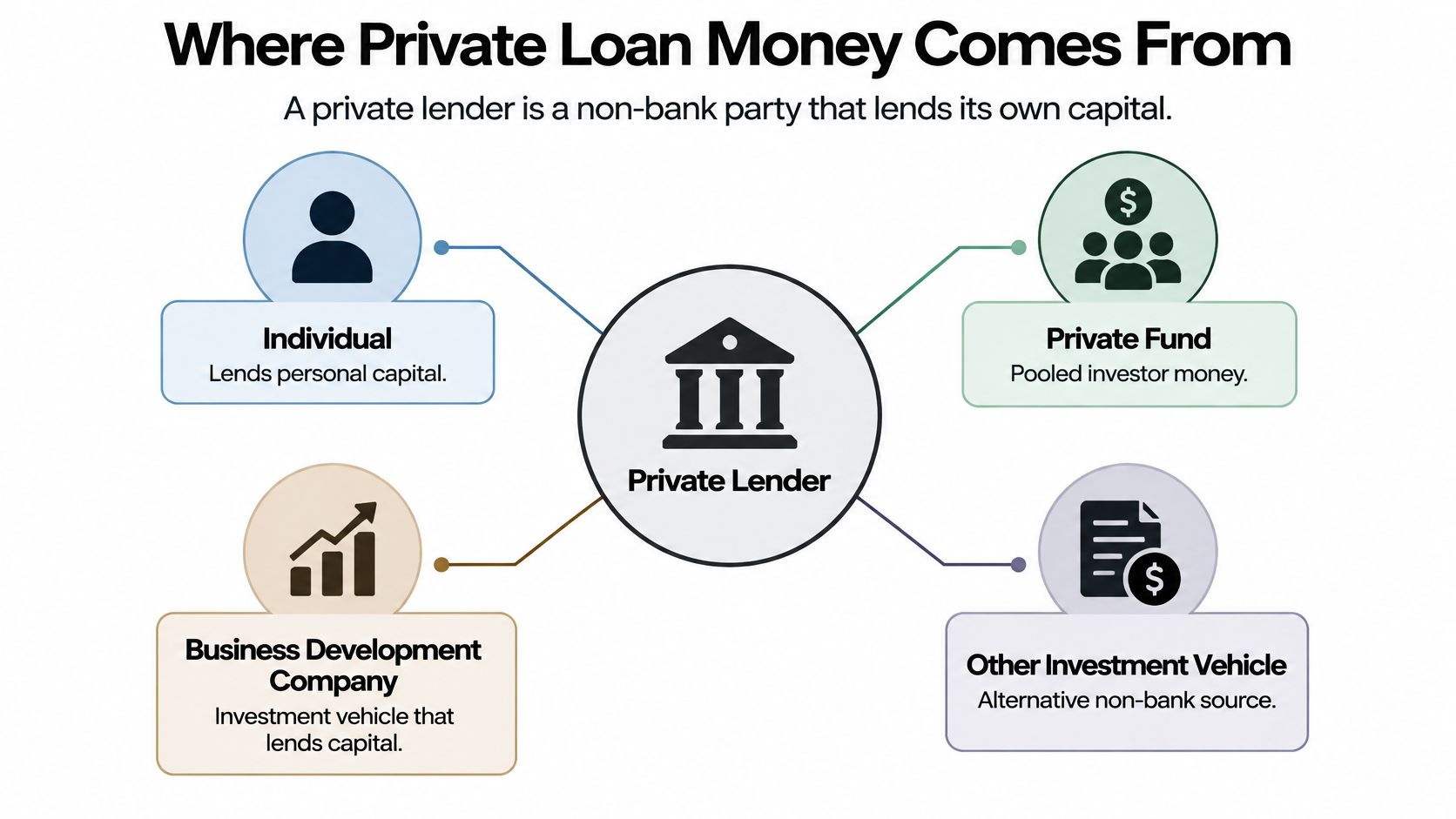
A private lender is a non-bank party that lends its own capital against a property. That party might be one individual writing a check, a pooled fund, or a larger investment vehicle. The house is the lender's safety net, not your paycheck.
Say you bring that gutted house to a local fund. You're not asking for a 30-year mortgage. You're asking for purchase money now, rehab money in stages, and enough time to sell or refinance before the note comes due.
The Five Steps From Term Sheet to Payoff
The path is predictable if you read it in order. Skipping ahead to the rate before you understand these steps is how borrowers misprice a deal.
- Application and plan: You submit the purchase contract, rehab scope, projected value, and how you'll repay. The lender is testing whether the plan fits the property, not just whether you sound confident.
- Valuation: The lender verifies what the property is worth today and sizes the advance against that number. Higher risk usually means a smaller advance, even if your finished-value story is strong.
- Term sheet and closing: You negotiate pricing, points, maturity, guarantees, insurance, and default terms. Title has to clear, and the loan is typically secured by a mortgage or deed of trust on the property.
- Draws: Rehab funds aren't handed over at closing. The lender releases money in stages after inspections confirm the work is done.
- Payoff: Repayment comes from a sale, a refinance, or a stabilized rental that supports longer-term debt. Rent checks alone rarely retire a short bridge.
The lender earns money mainly from interest, points, and extension fees, and some structures add equity participation. That return is the point of the model. You're paying for speed and asset-based judgment, and the lender is pricing the risk that the plan slips.
This isn't a small side market anymore. According to the Federal Reserve note on private credit in the U.S. financial accounts, private-credit loans to U.S. borrowers grew from approximately $120 billion in 2012 to about $1.46 trillion in 2025, driven by demand for faster, more flexible financing for acquisition, construction, and rehabilitation.
Why Private Doesn't Mean Easy
Flexible doesn't mean loose. Draw controls, maturity, default remedies, and lien priority are all negotiated, and a sensible lender protects itself with a loan amount that leaves room below value, required insurance, and enforcement rights if you stop paying. Foreclosure isn't a footnote. It's the lender's recovery plan.
Circle three things on page one before you sign anything. Who funds the loan, what event releases a draw, and what event counts as a default.
If you can't answer those three questions in plain language, you don't yet know how your loan works. You only know what it costs on the brochure.
Private Loan Rates Points and Fees
Start with a loan you can price today. Say you need a $300,000 rehab loan to buy and fix a house. The quote sounds simple until you stack every charge that has to be repaid before you keep a dollar of profit.
First-position private loans are often quoted around 9% to 15% with approximately 1 to 4 points, interest-only payments, and a balloon payoff at maturity, as described in Fidelity Capital's comparison of private lenders and banks. The same source puts typical maturities at roughly 6 to 24 months, with one point equal to 1% of the original principal.
| Term item | Typical range | On a $300,000 loan | What to check |
|---|---|---|---|
| Interest rate | About 9% to 15% first position | $2,250 to $3,750 per month interest-only | Monthly versus accrued |
| Points | About 1 to 4 points | 2 to 4 points = $6,000 to $12,000 | Whether points are withheld from proceeds |
| LTV | Often about 60% to 75% of verified value | $300,000 implies $400,000 to $500,000 of verified value | As-is value versus hoped-for ARV |
| Maturity | Roughly 6 to 24 months | Balloon, not full amortization | Sale, refinance, or cash payoff date |
| Other costs | Legal, appraisal, title, inspection, draws, extensions | Added to points and interest | Default rate and prepayment limits |
What the Headline Rate Hides
Points hit before you've sold anything. At 3 points on that $300,000 loan, you've paid $9,000 for access to the money, and that cost exists whether the flip takes four months or eleven. If points are withheld from proceeds, your cash at closing drops too, which matters when your contractor wants a deposit.
Interest structure changes cash flow just as much. Monthly interest-only payments force discipline during the hold, while accrued interest feels easier month to month and then lands all at once in the payoff. Neither is free. One drains operating cash, the other grows the balloon.
Then come the charges borrowers skim. Legal, appraisal, title, inspection, and draw-administration fees sit on top of interest and points. Add a default rate if you're late, an extension fee if you miss maturity, and prepayment restrictions if you exit early, and the cheaper rate can become the expensive loan.
Why Your Quote Moves
Pricing follows expected loss. A second lien, distressed condition, high LTV, uncertain title, or weak exit strategy usually produces a higher rate, more points, tighter covenants, or a smaller advance. The lender isn't being difficult for sport. It's charging for a worse recovery if the deal fails.
That's why two borrowers can get different quotes on similar houses. The borrower with clean title, more cash in, a tight budget, and a sale comp set that holds up gives the lender an easier exit. The borrower asking for maximum financing on a thin story pays for every gap.
Compare total dollars, not the rate. Add principal, interest over your realistic hold, points, third-party fees, draw charges, and one extension. If expected sale or refinance proceeds don't clear that full stack with room left over, pass or renegotiate the purchase price.
I would price every quote twice, once on your planned timeline and once with extra holding time. A loan that only works on the fastest timeline isn't priced for a real rehab. It's priced for a perfect one.
How a Private Lender Underwrites a Deal
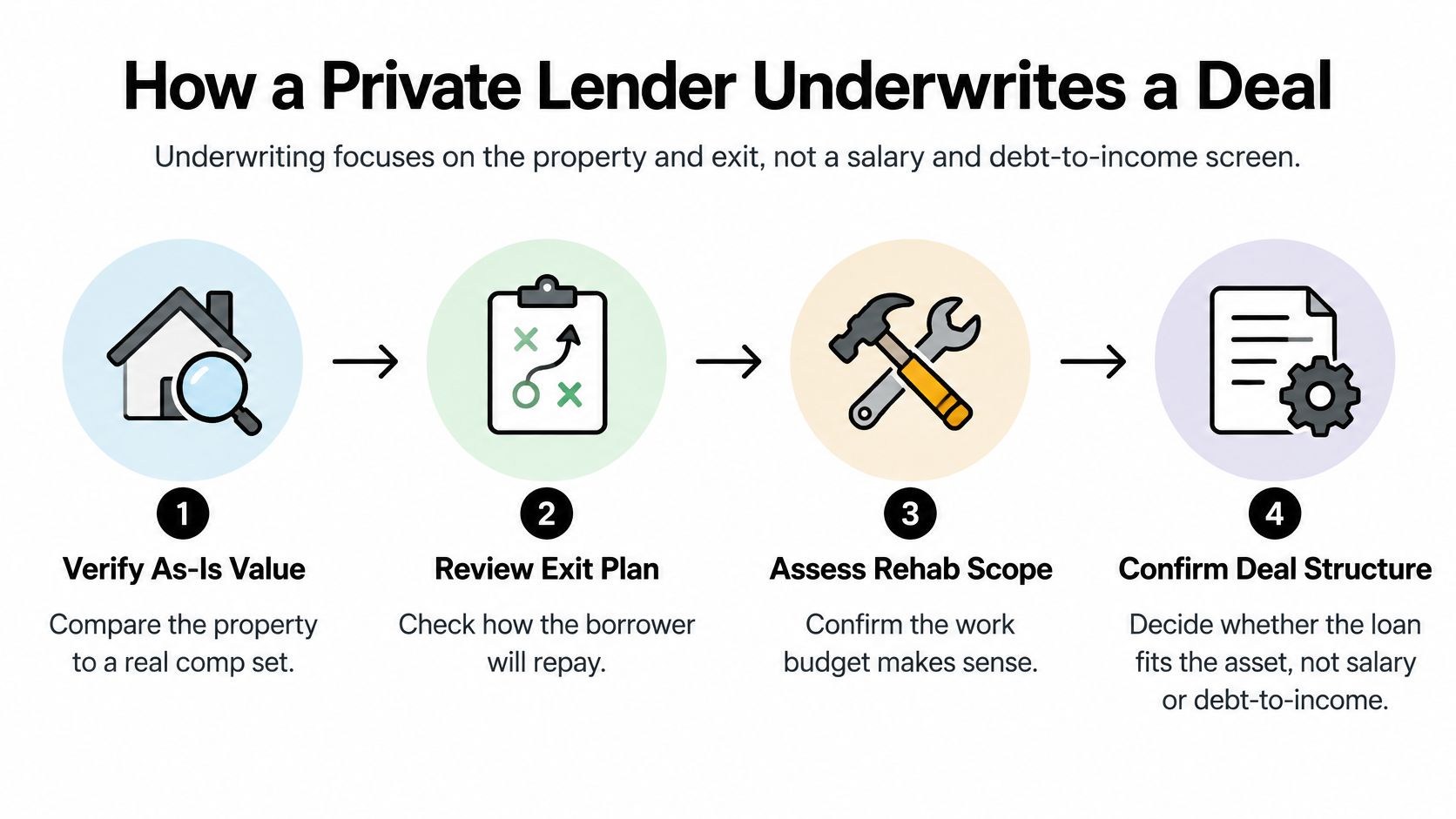
A private lender underwrites the asset and the exit, not a salary-and-tax-return file. According to Legal Clarity's guide to private mortgage lending, the review centers on the collateral's current value, borrower equity, property condition, and a credible repayment or exit strategy, not solely salary, tax returns, or conventional debt-to-income ratios. The same guide puts commonly reported LTV around 60% to 75%, varying by asset type, lien position, market liquidity, and borrower experience.
That doesn't mean your finances are irrelevant. It means the lender asks a different first question. If you stop paying, can this property repay the loan after costs, delays, and a discount to sell it?
The Five Tests in a Lender Packet
- Verify as-is value: Build a comp set from real, nearby, similar sales and defend every adjustment. After-repair value, or ARV, is a projection. It isn't collateral that exists at closing, so a lender won't treat a hoped-for finished value as cash in hand.
- Set the advance: The lender lends a percentage of verified value and leaves an equity cushion below it. First position, a liquid market, and a clean asset support a stronger advance. A second lien, a thin market, or a first-time borrower usually pulls it down.
- Review your skin in the deal: Your track record matters, but so does the cash you're leaving in. A borrower funding the gap between the advance and total project cost is sharing the first loss, and lenders notice that.
- Stress the rehab: Bring a line-item budget, permits, a contingency reserve, and a draw schedule the lender can test on their own. If electrical, roof, and kitchen numbers are round guesses, expect a cut. Review the typical hard money lender requirements before you assume a lender will accept a one-page scope.
- Require a written exit: Name the sale, refinance, or cash payoff, and put a date on it inside maturity. A vague plan to list it when it's done isn't an exit. It's a hope with interest accruing.
The Cushion and the Trap
The lender's cushion is the gap between the loan and verified value. That gap absorbs a price drop, foreclosure costs, unfinished repairs, and the discount a forced sale usually takes. When the cushion is real, the lender can recover even when your profit is gone.
Your trap is the mirror image. Weak comps can lower the approved value, and an underfunded rehab can cut principal, delay closing, or freeze a draw mid-project. That can happen even when the projected ARV looks attractive, because a conservative lender tests as-is value, completed value, total project cost, and your cash contribution as separate numbers.
Assemble the file before the first call. Bring comps you can defend, a budget with contingency, a draw schedule tied to completed work, permit status, and an exit with dates and backup math. A lender who can verify your numbers quickly has less reason to haircut them.
Banks Private Lenders and Hard Money
Put the same distressed house in front of three lenders and you'll get three different conversations. The labels blur in marketing, but the underwriting question behind each door is different.
| Lender | What they underwrite | Term shape | Speed and flexibility | Borrower trade-off |
|---|---|---|---|---|
| Bank mortgage | Income, tax returns, debt-to-income, standard credit | Long amortization at standardized pricing | Slower, stricter property screens | Lowest cost when the file qualifies |
| Private lender | Collateral, plan, experience, and exit; person, fund, or platform | Often short, interest-only, balloon | Negotiated draws, covenants, and extensions | Higher total cost; the counterparty can change |
| Hard-money lender | As-is value and rehab more than salary | Short bridge with points and a balloon | Fast closes on flips banks reject | Usually the tightest draw control and a costly bridge |
Choosing the Right Door
A bank is usually the cheapest capital and the slowest yes. If the property won't appraise in its current condition, your income is hard to document, or the plan is a fast rehab, the bank file often dies on property condition or paperwork before pricing even matters. When the house and borrower both fit the box, take the bank loan and don't overthink it.
A private lender is built for a shorter job. The capital might come from one person, a fund, or a non-bank platform using institutional money, and the structure is a bridge, not a long amortizing payment. You'll trade higher total cost for a yes on a property and timeline a bank won't approve, so run your loan-to-cost numbers against the full advance and your own cash before you compare quotes.
Hard money sits inside private lending, not beside it. It's the property-first version aimed at flips and heavy rehabs, often from individuals or small funds that care more about the house than your tax return. Expect points, interest-only payments, draw control, and a balloon.
Don't treat the words private and hard as opposite categories, and don't assume private means informal. A private lender may be a local funder you can call, or a platform with standardized servicing and enforcement. Ask who you're dealing with, then choose the door that fits the file, the property, and the exit date.
Fix and Flip and BRRRR Loan Paths
Run one house down two exits and the right loan gets obvious. The property, purchase price, and rehab can be identical. The number that breaks the deal is not.
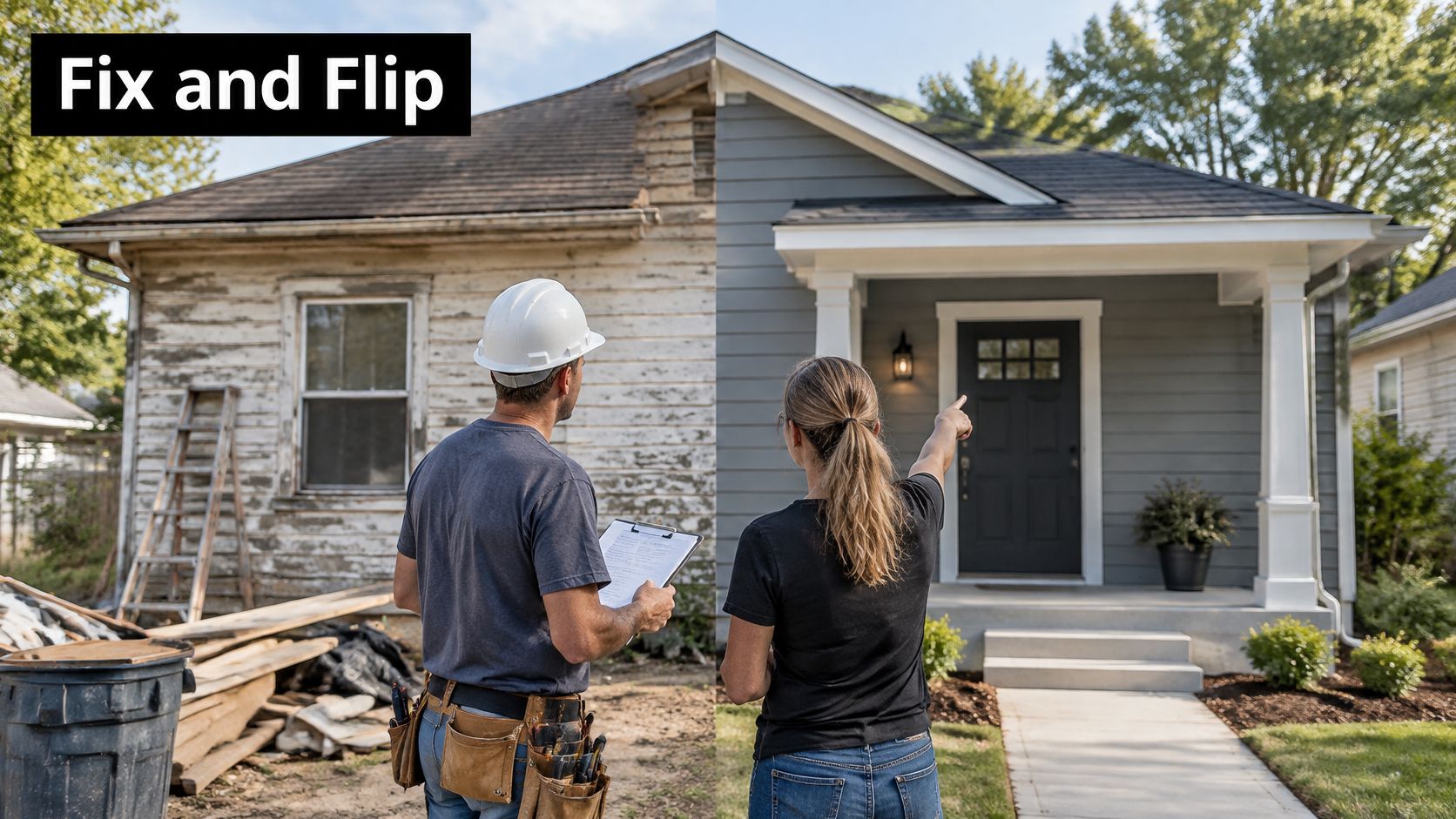
The image below captures the part borrowers love to show lenders, the transformation. The lender cares just as much about what happens after the photos.
Path One: Sell It
On a fix and flip, you borrow to buy and repair, draw rehab money as inspected work is completed, and sell before the balloon. Your profit is the sale price minus purchase, repairs, holding costs, interest, points, and selling costs. Every line matters, but sale price and days held do the damage fastest.
The failure mode is rarely dramatic. The house lists, showings are slow, and you hold through two extra payment cycles while debating a price cut. Each extra month adds interest and possibly an extension fee, and the eventual cut lands on a spread that points have already thinned.
Path Two: Keep It
BRRRR uses the same bridge differently. You buy, rehab, rent, then refinance into longer-term debt, and the private lender is paid off at that refinance. Rent doesn't retire the bridge by itself. The new loan does, if it's large enough.
Two tests have to pass at once. First, how much cash stays trapped in the deal after the refinance. Second, whether rent covers the permanent payment plus taxes, insurance, and vacancy with room to breathe. A worked breakdown of the BRRRR method and its refinance step is worth running on your own numbers before you choose this path.
The video below walks through a renovation sequence, which is useful context for scoping work. Match that scope to your draw schedule, not just your finish list.
A light appraisal or a debt-service limit on the new loan can leave refinance proceeds short of the balloon, even when day-one leverage looked conservative. That's the BRRRR break point. The flip lives or dies on sale price and days held. The BRRRR lives or dies on stabilized rent and refinance proceeds. Write both exits on the same property, plus a third cash payoff, before you pick a quote.
Servicing Draws and Payoff Stress
Private does not mean personal. That's the assumption to drop before closing. The party that quoted your rate may sell the note or transfer servicing, so when a rehab slips you might be requesting a draw or an extension from a different servicer, fund, or securitization vehicle than the one that approved you.
A large share of this capital is institutional now. Principal Asset Management's 2025 private real-estate debt outlook reported that total U.S. commercial real-estate mortgage originations rose 27% in 2025 to $634 billion, while lending standards remained conservative. A standardized platform can enforce a note exactly as written, with no relationship discount for a good story.
Name Who Controls the Loan
Before you sign, identify four roles in writing. Don't accept a company name as an answer for all four.
- Note holder: Who owns the debt and receives the payoff.
- Payment servicer: Who collects payments, tracks balances, and issues payoff statements.
- Draw administrator: Who orders inspections and releases rehab funds, and on what timeline.
- Extension decision-maker: Who can approve more time, and who can only pass the request along.
Then check what's fixed and what's discretionary. Are extension fees, default interest, inspection charges, and protective advances set by contract, or do they need fresh approval at the worst possible moment? A protective advance, where the lender pays taxes or insurance to protect the collateral and adds it to your balance, can raise your payoff when you're already short on cash.
Draw timing deserves the same scrutiny. Ask how inspections are scheduled, what photos or invoices are required, whether partial work gets partial funding, and how many days pass between approval and wire. A contractor who isn't paid on schedule slows down, and a slow rehab is how a servicing detail becomes a maturity problem.
Model Three Exits, Not Approval Odds
Approval is the easy milestone. Payoff is the one that counts. Model three exits on every deal, sale, refinance, and cash payoff, and calculate the minimum sale price and minimum refinance proceeds needed to repay principal, accrued interest, points already spent, fees, and taxes.
Maturity pressure isn't hypothetical at market scale. A 2025 private real-estate debt outlook summarized in the CSBS annual report identified nearly $1 trillion of debt maturing over the following year, with some properties struggling to obtain replacement financing because of lower values and too much debt, while higher rates constrained senior-loan amounts through debt-service-coverage requirements. Your single house faces the same math in miniature.
Rerun your deal under stress before you borrow. Cut the sale price, add a repair overrun, extend the hold, and include one extension fee. On a flip, check cash needed and what's left of profit. On a BRRRR, check cash left in the deal and whether rent still supports the refinance loan. We built PropLab to automate that deal analysis workflow in about 60 seconds, and every analysis generates a professional PDF report with all comps, adjustments, and calculations that you can download, share with partners, or send to lenders. The Fix and Flip Calculator shows profit, cash needed, and ROI, which is exactly the stressed view a lender packet should carry.
A lender can be fully protected while you lose your equity. Foreclosure can recover the loan balance and still leave nothing of your expected profit.
Use a borrow-or-pass test and hold the line. Borrow only if the stressed sale and the stressed refinance both repay the balloon with a margin you can live with. If one exit fails under mild stress and the other needs everything to go right, you don't have two exits. You have one hope and a deadline.
Run your next deal through PropLab before you call a lender, and build the packet a private lender underwrites, with verified comps, an ARV you can defend, a line-item rehab budget, and sale and refinance exits stress-tested against the full payoff. You'll walk into the rate conversation knowing your maximum offer, your cash needed, and the minimum exit price that clears the balloon. That's how you borrow on your terms instead of discovering the lender's at maturity.
About the Author
P
PropLab Team
Real Estate Analysis Experts
The PropLab team consists of experienced real estate investors, data scientists, and software engineers dedicated to helping investors make smarter decisions with AI-powered analysis tools.
Free account
Underwrite your next deal in under a minute
3 free analyses, no credit card. ARV, rehab, comps and exit strategy in one report.
