General
How to Find Abandoned Property: A Practical Investor Guide
November 7, 2026
17 min read
Driving for dollars is the most popular advice on how to find abandoned property, and it's the weakest place to start. An overgrown yard tells you a house looks neglected. It doesn't tell you who owns it, whether a lender is foreclosing, or whether anyone alive can sign a contract. I would start with public records, classify every lead by its legal status, and only then decide whether outreach makes sense.
Public Records That Surface Abandoned Properties
Start with the county tax delinquency list, not a windshield tour. A parcel behind on property taxes gives you a dated, verifiable distress signal and a parcel number you can trace through every other system. Ask the county treasurer or tax collector for the current list and the next tax sale calendar, then work that list before you chase houses that merely look rough.
Where Distress Shows Up First
Code enforcement files often reveal neglect before a tax default becomes severe. Open violations, unsafe structure notices, and demolition orders show what the city has already documented and what a buyer may have to cure. Request the case history by address and parcel number, and note compliance deadlines, reinspection dates, and any fines that may become liens.
Court and recorder records add the legal layer. A lis pendens points to pending litigation or foreclosure, probate filings point to an estate, and deed records show the last transfer. Foreclosure volume alone justifies a standing weekly check, since ATTOM's Year-End 2024 U.S. Foreclosure Market Report reported foreclosure filings on 322,103 U.S. properties in 2024.
Assessor records tie the parcel to a recorded owner, mailing address, and last transfer date. That mailing address matters. A tax bill sent to another state, a deceased person's name, or an address that matches the vacant house itself each suggests a different problem and a different next step.
Weaker Signals Worth Checking Last
Utility shutoff data can confirm inactivity where a local utility releases it, but access rules differ and a disconnected meter doesn't prove abandonment. Unclaimed-property databases are different again. They track owner funds rather than buildings, so they're most useful when you're tracing heirs or a former owner, not when you're underwriting a house.
| Source | What it reveals | Where to look | Check frequency |
|---|---|---|---|
| Tax delinquency list | Parcels behind on property taxes | County treasurer or tax collector | Monthly or before each tax sale calendar |
| Code enforcement cases | Open violations, unsafe structure notices, demolition orders | City or county code office | Every two weeks |
| Court filings and lis pendens | Pending foreclosure, litigation or probate tied to a parcel | County recorder and court clerk index | Weekly for target areas |
| Assessor and deed records | Recorded owner, mailing address, last transfer date | County assessor and recorder | At each lead intake |
| Utility shutoff or inactivity data | Service disconnected or meter inactivity, where public | Local utility, where records are available | Monthly where released |
| Unclaimed-property databases | Owner funds rather than buildings, useful for heirs | State treasury or comptroller database | Quarterly |
Practical rule: One record makes a lead worth logging. Two or three independent records pointing at the same parcel make it worth investigating.
Don't treat frequency as busywork. Tax lists and court indexes change on a schedule, and a parcel that's current this month can enter foreclosure or probate next month. A short, repeated check beats an occasional deep dive that misses filing dates.
The trade-off is volume. Tax and code lists can be long, messy, and full of parcels you'll never buy. That's fine at this stage. You're building a documented pipeline, and you'll narrow it with deed, court, and title checks before you spend money on outreach.
How to Run a Search from Tax Lists to Deeds
Run the search in a fixed order so each step removes weak leads before you invest time in the next one. If you start with owner outreach, you'll contact people who can't sell, owners who already transferred the property, and families in active litigation. The order below protects you from that wasted work.
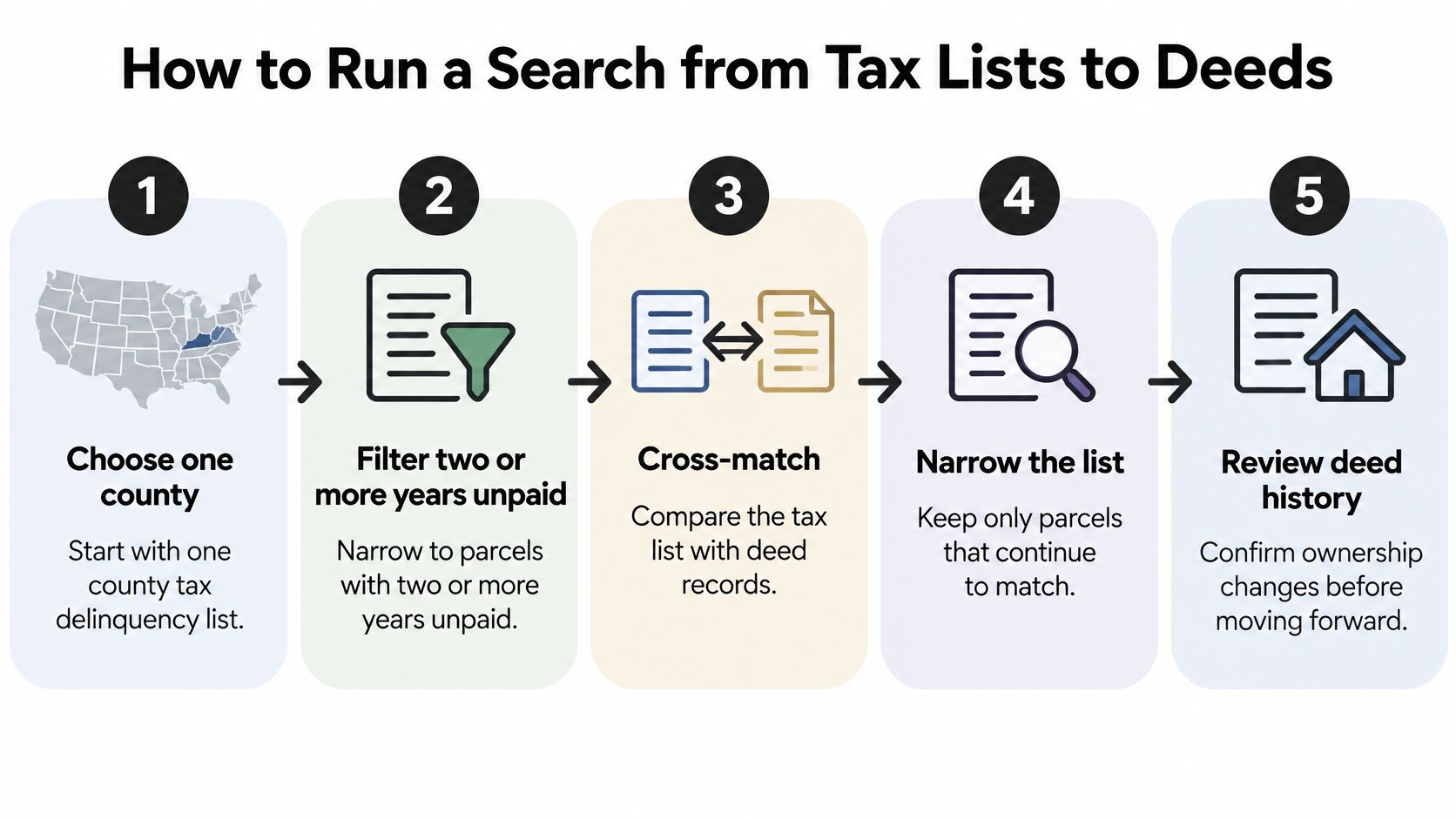
The visual below shows the core sequence from county selection through deed review.
The Seven Step Search
Choose one county and export the tax list. Stay in one jurisdiction until you know its treasurer, recorder, assessor, and court systems. Filter for parcels with two or more years unpaid, because a single late payment often cures, while multi-year delinquency signals deeper distress or absence.
Cross-match against code enforcement. Compare each parcel with open violations, condemnation notices, and demolition orders. A tax-delinquent parcel with an active unsafe structure case deserves priority, but it also carries repair deadlines you need to price early.
Pull assessor and recorder records for survivors. Confirm the recorded owner, mailing address, parcel boundaries, and last deed date. This step catches stale list entries and shows whether the owner is local, out of state, an entity, or possibly deceased.
Search the court clerk index twice. Run both the owner name and the parcel number to find lis pendens, foreclosure, probate, partition, or other litigation. Searching only one identifier misses cases indexed under the other.
Flag every mismatch. Mark deceased owners, out-of-state mailing addresses, name differences between tax and deed records, and entities that may be dissolved. Those flags don't kill a lead, but they change who you contact and what proof you'll need.
Remove parcels that already changed hands. Compare your list with recent sales and newly recorded deeds. Public lists lag reality, and I wouldn't spend skip tracing money on a parcel that closed last month.
Log everything. Record the date, source, search terms, and result for each parcel. That trail helps you avoid duplicate work, proves diligence to partners or lenders, and makes follow-up searches faster.
Where Searches Break Down
The most common slip is searching one spelling of an owner name and stopping. Try middle initials, maiden and married names, trust names, LLC variations, and common misspellings that appear in older deeds. County indexes are literal, so a small variation can hide a foreclosure or probate file.
A clean search under the wrong name isn't a clean title. It's an incomplete search.
Keep the output small enough to work. A shortlist of five to ten parcels per county each month is realistic for one buyer who still has to verify seller authority, inspect from the street, and underwrite repairs. More leads than that usually means your filters are too loose.
For a deeper walkthrough of the systems involved, use our guide to searching property through public records alongside your county work. Then stop researching new parcels until each shortlisted lead has a classification, a named decision maker to verify, and a documented reason to proceed or pass.
Claiming Unclaimed Financial Property
Some people searching for abandoned property mean unclaimed money, not real estate. In the United States, the U.S. Securities and Exchange Commission explains that states safeguard assets left unclaimed for a legally defined period, usually about five years. The state becomes custodian rather than permanent owner, and former owners and heirs can generally claim later, often indefinitely.
The United States Search Order
Search each relevant state database. Use official state treasury or comptroller sites for every state where you lived, worked, ran a business, or held an account. Try current, former, and alternate spellings of your name.
Run the multistate search. Use MissingMoney.com to cover participating states at once, then return to the state site to file. A multistate result is a starting point, not the claim itself.
Search for deceased relatives separately. You'll typically need government identification, prior address evidence, account documentation, and proof of death or inheritance. File through the state, not an unverified finder that contacted you first.
The money involved is material. The National Association of Unclaimed Property Administrators report states that participating state programs returned $4.49 billion to rightful owners during fiscal year 2024. The same report gives an average MissingMoney.com claim value of approximately $2,080 and a median claim value of $100, so many claims are modest even though larger recoveries lift the average.
Outside the United States
Treat abandoned as a legal status set by asset type, jurisdiction, dormancy period, and contact rules. First identify the institution and asset class, then find the statutory threshold and any central scheme, search the official register, contact the original institution with historical names and account references, and escalate to the statutory scheme if needed. In the United Kingdom, the UK government response on expanding the Dormant Assets Scheme describes bank and building society accounts becoming eligible for transfer after at least 15 years without customer activity.
Separating Vacant Buildings From Legally Available Ones
A boarded house isn't automatically an available house. The FastExpert guide to identifying abandoned houses captures the core problem: a property can look abandoned while remaining fully owned, occupied intermittently, under foreclosure, or subject to a lender's rights. Visual neglect is weak evidence, and municipal intervention generally begins only when health or safety risks or tax delinquency force action.
Ownership doesn't disappear because maintenance stopped. A family can hold title while a house sits empty during a move, an estate dispute, a lender workout, or a long repair delay. If you treat appearance as permission, you risk trespass complaints, offers to the wrong party, and contracts that can't close.
Classify Before You Contact Anyone
Put every lead in one category first. The category tells you whether the next move is owner contact, a tax sale calendar, a foreclosure auction, a probate file, or no action at all.
| Lead type | Typical signal | What it permits | Check next |
|---|---|---|---|
| Vacancy with code violation | Boarded windows, open citation | Owner contact; code repairs may be required | Assessor owner record and open permits |
| Tax delinquency | Delinquent tax list entry | Redemption or tax sale route, depending on state | Redemption period and recorded liens |
| Foreclosure | Lis pendens or auction notice | Purchase at auction or after sale; lender rights come first | Lender payoff and any redemption rights |
| Probate or estate | Owner deceased, probate case filed | Sale only through an authorized representative | Probate court file and list of heirs |
| Condemnation or demolition order | Official notice with repair or removal deadline | Acquisition may be restricted; deadlines apply | Municipal order and compliance dates |
| Absentee owner, not distressed | Out-of-area mailing address, occupied home | Negotiated purchase only | Owner contact and occupancy status |
Say you find an overgrown house with mail piled at the door and a lis pendens recorded two months ago. That isn't a free and clear buying opportunity. The family may still hold title, the lender has a live claim, and your realistic routes are a negotiated purchase that satisfies the loan, an auction bid if the case proceeds, or waiting.
The opposite mistake also happens. A tidy house with an out-of-state tax mailing address may be a rental owned by a responsive landlord, not distressed property. You can make a normal offer, but you shouldn't price it like a tax sale or assume the owner wants out.
Let the legal category choose your first action. Appearance only earns the parcel a records check.
This discipline matters most for wholesalers and fix-and-flip buyers working on assignment deadlines or hard money timelines. A lead in probate or active foreclosure can consume weeks before anyone with authority can sign. Classify first, then decide whether the timeline fits your business.
Confirming Who Can Actually Sell the Property
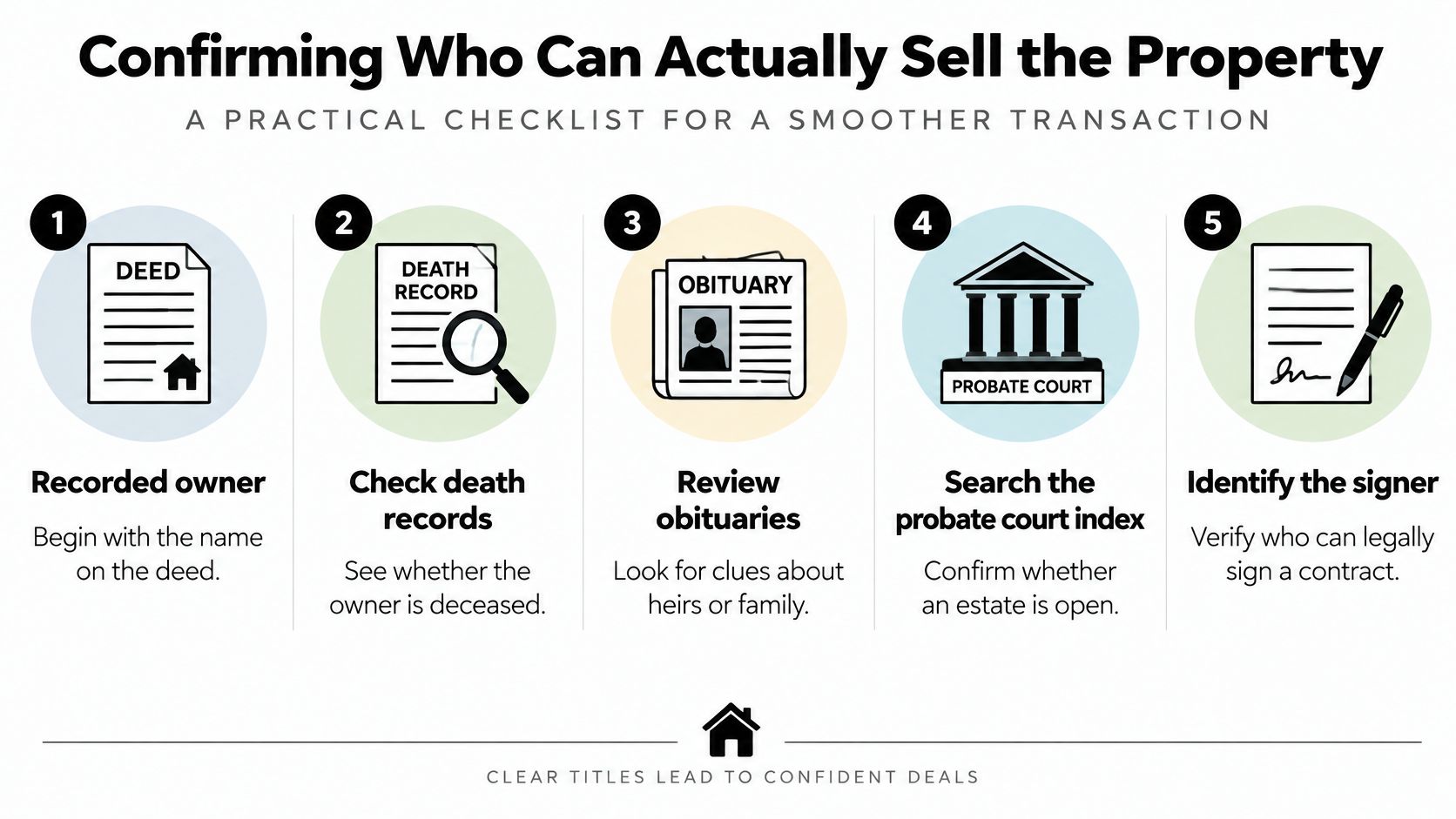
Finding a name on the tax roll isn't the same as finding your seller. The checklist below moves from the recorded owner to the person, or people, who can legally convey title.
The Seller Authority Checklist
- Start with the recorded owner: Pull the current deed and confirm the exact vesting, including spouses, trustees, partners, or multiple individuals. Don't rely on the assessor summary alone because it may shorten names or omit co-owners.
- Check whether that owner is alive: Search death records, obituaries, and the probate court index under name variants. The Community Progress guide to finding vacant property owners notes that when someone dies without a will or probate process, the deceased person can remain the name shown in official county records.
- Pull the probate file if one exists: Identify the executor or administrator, confirm appointment papers, and check whether court approval is required for a sale. A relative handling the yard isn't necessarily the court-appointed representative.
- Map heirs when there's no probate: List likely heirs under state intestacy rules and flag minors, missing relatives, and anyone out of state. This is attorney work once shares, guardianship, or missing heirs are involved.
- Order a title report early: Look for co-owners, mortgages, tax liens, judgments, and unrecorded family transfers that relatives mention casually. Our explainer on how a chain of title affects a purchase is useful background before you review the report with counsel.
- Get authority in writing before negotiating price: Collect signatures or documented consent from each required owner or heir. If one person refuses or can't be found, partition or quiet title may be the only path, and both add time and legal cost.
Heirs' property is the hidden bottleneck behind many vacant homes. Several relatives may each own an undivided interest even though only one pays taxes or cuts the grass. That person usually can't deliver full title alone, and a title company won't insure around missing owners just because the house looks abandoned.
The uncomfortable conclusion is that the most neglected house may be the least transaction-ready. I would rather pursue a moderately distressed property with one living, reachable owner than a severely damaged house split among unknown heirs. Rehab risk is estimable. Missing ownership authority can stop financing, resale, and title insurance entirely.
Hand the completed checklist, deed, probate results, and title report to a real estate attorney before you pay a deposit. Ask one direct question: who must sign for this sale to convey insurable title? If the answer isn't clear, you don't have a seller yet.
Risk Flags and Legal Limits to Check Early
Empty doesn't mean safe to enter. A house can be occupied intermittently by an owner, relative, tenant, caretaker, or unauthorized occupant, and mail or furniture may not be visible from the street. Stay off the property without permission, don't open gates or doors to check, and never tell an occupant the home is abandoned to pressure them out.
Costs That Attach to the Parcel
Municipal liens are the first financial trap. Cities can lien parcels for code enforcement, board-up work, lawn cutting, demolition, water, sewer, and other charges, and those amounts may transfer to the buyer or must be cleared at closing. Pull a municipal lien search separately from the county tax record because the balances don't always appear in the same place.
Demolition and repair orders create deadline risk. If the city has ordered stabilization or removal by a set date, missing that date can trigger fines, city-performed work, or loss of the structure you planned to rehab. Get the order, compliance date, appeal status, and estimated city charges in writing before you set an offer.
Vacant buildings also raise physical and insurance issues you can't solve from records alone. Old fuel tanks, asbestos, lead paint, mold, sewer failures, and fire damage require licensed inspection once you have legal access. Insurers may restrict or price vacant property coverage differently, so confirm bindability before closing rather than after.
Title and Redemption Limits
Review title insurance exceptions line by line. Easements, unpaid liens, boundary problems, and prior unrecorded transfers can limit resale, financing, or your planned use. An exception isn't automatically a deal killer, but you need to know whether it's curable, insurable, or permanent.
Tax sale buyers face a separate limit: the redemption period. Depending on your state and sale type, the former owner may retain a legal right to recover the property by paying required amounts within a statutory window. Don't start a full rehab until you understand when redemption expires and what title you hold.
- Put each flag on the lead record: Record lien amounts, order deadlines, occupancy concerns, environmental suspects, and redemption dates where your underwriting lives.
- Price cure costs separately: Don't bury lien payoffs inside a vague repair allowance.
- Escalate legal questions: Use an attorney to confirm lien priority, redemption rights, occupant status, and title exceptions.
These checks identify exposure. They don't replace legal advice, and they shouldn't be rushed because a seller wants a fast signature.
Value the Lead and Choose an Outcome
Once seller authority and major risk flags are clear, value the property like any other distressed deal. The image below reflects the desk work that should happen before you make an offer.

Pull recent comparable sales in a tight radius to set after-repair value, then estimate rehab room by room and add contingency for hidden damage that's common after vacancy. PropLab pulls property data from public records, tax assessments, and market data, and users do not need MLS access. After an address is pasted, the AI builds a report with comps, ARV, rent, expenses, and exit strategies, which gives you a consistent starting point before local verification.
Use the 70 percent rule as a screen: maximum offer equals ARV times 0.70 minus repairs. For example, an ARV of $220,000 and repairs of $60,000 produce a maximum offer of $94,000, because $220,000 times 0.70 is $154,000, less $60,000. Then adjust for holding costs, closing costs, insurance, financing, and lien payoffs instead of treating the formula as the final answer. Our framework for valuing distressed property before an offer helps structure those adjustments, and a guide to managing investment property finances from Book Tech LLC is worth reading if your repair draws, holding costs, and resale proceeds aren't tracked cleanly.
The walkthrough below is useful when you're comparing a formula result with the actual condition and exit plan.
Choose one outcome and log why. Pursue when value, seller authority, and risk checks pass. Pass when the margin is thin or a flag can't be cleared at a price the seller will accept. Send it to an attorney when title is unclear, a signatory is missing, probate isn't complete, or redemption rights remain unresolved. That last category isn't a maybe pile. It's a stop sign until counsel identifies a lawful path to insurable title.
Run your next shortlisted parcel through PropLab after you've classified it and confirmed who can sell, so your offer is built on comps, ARV, repairs, and a clear maximum price rather than curb appeal. Paste the address, review the report, and pursue, pass, or escalate the lead with a documented reason.
Tags
About the Author
P
PropLab Team
Real Estate Analysis Experts
The PropLab team consists of experienced real estate investors, data scientists, and software engineers dedicated to helping investors make smarter decisions with AI-powered analysis tools.
Free account
Underwrite your next deal in under a minute
3 free analyses, no credit card. ARV, rehab, comps and exit strategy in one report.
