General
How to Find Probate Properties for Real Estate Deals
October 19, 2026
12 min read

You've found a probate case with a familiar name and a possible property address. But the docket doesn't tell you whether the estate owns the house, whether anyone has authority to sell it, or whether a sale would leave enough equity to make a deal work. That's the central challenge in how to find probate properties: locating filings is only the first part. The useful work is matching court records to county property records, then checking title, procedure, and the property itself.
Probate searches don't run through one dependable national list. Courts and record systems vary by state and county, so a repeatable pipeline starts locally and verifies each lead before outreach or underwriting.
Why Probate Properties Are Worth Your Time
Older households account for a large share of homeowners, which gives probate research a durable reason to be part of an investor's sourcing mix. In the third quarter of 2024, the U.S. Census Bureau reported a 79.1% homeownership rate for householders aged 65 and over, compared with 37.0% for householders under age 35 (Census Bureau housing data). Those figures don't predict how many homes will enter probate or come to market. They do help explain why estate records can be worth screening alongside other public-record leads.
The Federal Reserve Bank of Richmond found that the share of people aged 65 and older living in homes they owned increased from 67% in 1970 to 79% in 2022. It also reported that more than one-quarter of adults aged 65 to 74 had lived in the same house for over 30 years, while nearly 40% of those aged 75 and older had done so (Federal Reserve Bank of Richmond research). A long-held property may have accumulated equity or need substantial upkeep, but neither condition should be assumed from an owner's age or length of residence.
Use the demographics to prioritize research, not to predict a seller's decision.
That distinction matters. A probate estate may have no real property, the home may be jointly owned or held in a trust, or the personal representative may have no immediate reason to sell. Even when a property is part of an estate, debts, title issues, family decisions, and court procedures can affect whether a transaction is possible.
Probate is worth the time when you treat it as an ownership and estate signal, not as proof of distress or a built-in discount. The investor's advantage comes from finding a relevant case, confirming the property and authority, and following up when the estate is procedurally ready. A disciplined search may turn up fewer apparent deals than a broad name list, but it also cuts down on false positives and premature outreach.
Starting with Probate Court Records
Probate is generally a public legal process, but it's administered through local court systems. Start with the probate court in the county where the deceased person lived. Check the court's website for its docket search, records request process, case access rules, and instructions for obtaining filings. If the online index is limited, contact the clerk and ask how to search by the decedent's name and filing date.
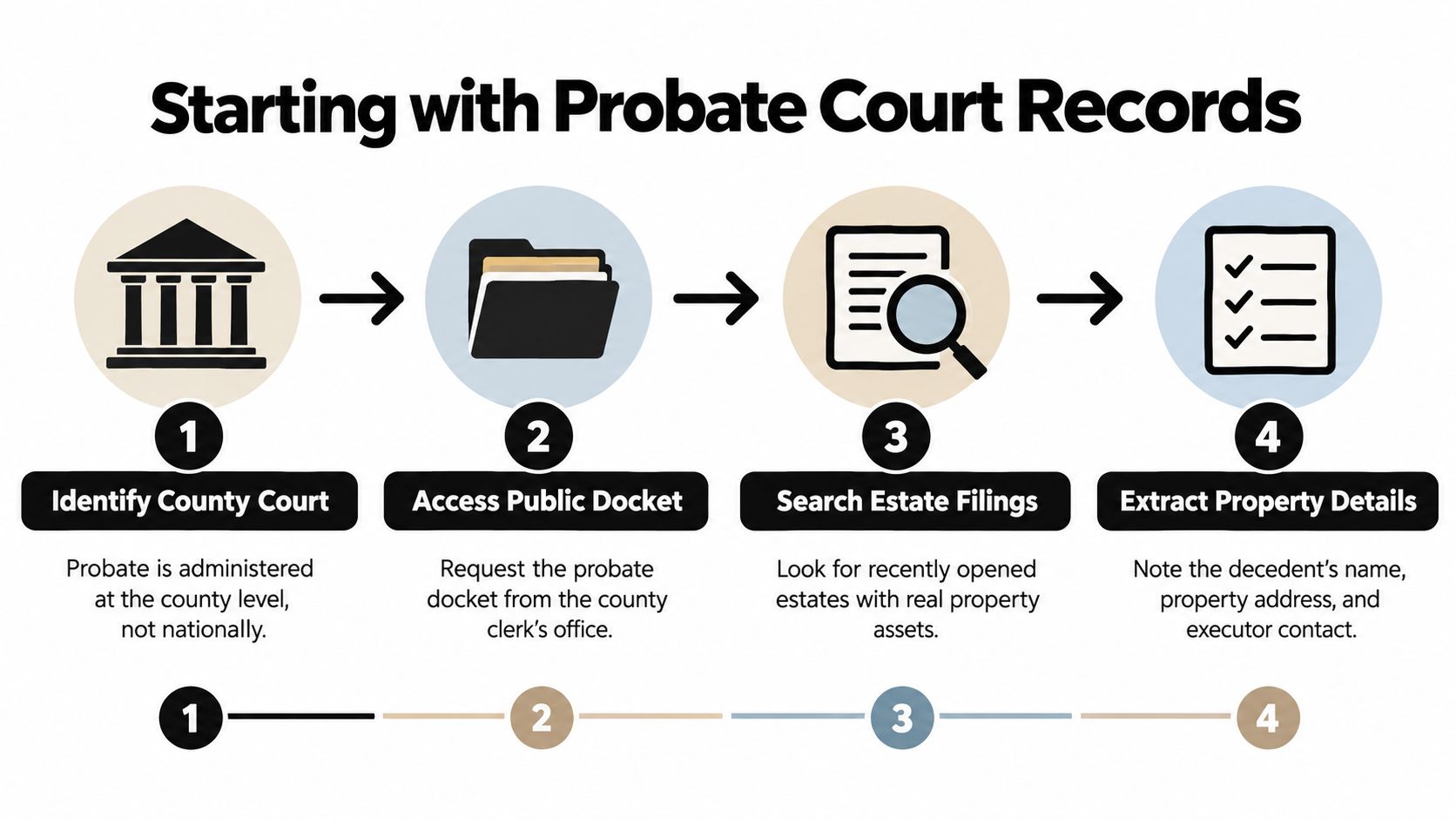
The first records to review are the opening petition and any later inventory, appointment, sale petition, or notice of proposed action. Depending on local filing practices, records may identify the decedent, personal representative or executor, heirs, attorney, filing dates, assets, and whether the representative has asked to sell property. Record the case number and docket status so you can return to the file and check for new activity.
The Uniform Probate Code (UPC) doesn't create a uniform national search system. It was finalized in 1969; its complete original version was adopted by 15 states, while Cornell Law School's current summary identifies 18 states that have adopted it at least in part (Cornell Law School's UPC summary). States that adopted selected provisions or retained separate procedures may handle filings differently. That variation affects court names, case-number formats, online access, and whether real estate in another county requires a separate proceeding.
Practical rule: Search the court that has jurisdiction over the estate, then check whether the property's county has its own relevant case or land-record requirements.
For a Texas-specific overview of local considerations, the guide to finding probate properties in Texas from the Law Office of Bryan Fagan, PLLC, offers relevant background. Use resources like it to orient your search, then confirm requirements with the court and county offices involved.
A filing is not proof that a house is available. It may describe an estate without establishing ownership, sale authority, title status, or whether the property is still part of the estate. Treat the docket as a path to records that need verification, not as a ready-made acquisition list.
Verifying Ownership Through County Records
Once a docket points to a possible property, move from the court file to the county recorder and assessor. The probate case tells you that an estate process exists. The recorded deed and related land records help establish whether the decedent owned the property and whether the estate may have an interest worth pursuing.
Start by matching the decedent's full name against the assessor's ownership records. Confirm the property's street address and parcel or assessor's parcel number (APN), then compare those details with the estate filings. Names can be shared, mailing addresses can differ from property addresses, and a decedent may have owned property jointly or through a trust.
Next, search the recorder's index for the deed history and recorded claims. Review mortgages, tax-related records, judgments, and liens that may affect the estate's equity or the ability to deliver clear title. Check the assessor or tax collector's records for ownership and tax status, and note any mismatch that needs clarification before you spend time on outreach.
| Record Type | What It Confirms | Red Flags to Watch |
|---|---|---|
| Probate docket | Case status, representative, attorney, and filed requests | No appointment, closed case, or no authority to sell |
| Recorded deed | Named owners and recorded transfers | Joint ownership, trust ownership, or a different owner name |
| Recorder's lien and mortgage records | Recorded claims against the property | Unreleased mortgage, judgment, or other unresolved claim |
| Assessor and tax records | Parcel details, assessed ownership, and tax status | Address mismatch, delinquent taxes, or inconsistent ownership |
The IRS describes a personal representative as the person responsible for collecting the estate's assets, paying creditors, and distributing what remains (IRS Publication 559). That role makes the representative or their counsel the appropriate point of contact once appointment and authority are confirmed. It doesn't mean the representative can sell a particular property without satisfying local requirements.
For a Texas-focused explanation of how heirship records relate to real property, the Law Office of Bryan Fagan PLLC's overview of Tarrant County real-property heirship records provides useful context. For a broader workflow on tracing ownership through official sources, PropLab's guide to searching property public records is another reference point.
Before treating the address as a lead, reconcile the court file, deed, parcel data, and lien picture. When ownership or title remains unclear, get a current title report and ask a title professional or real-estate attorney to review it before contracting.
Building a Lead List from Multiple Sources
A reliable probate pipeline combines sources rather than trusting one feed. The county probate docket is the core record, but recorder and assessor data help connect the case to a parcel. Legally required newspaper notices can surface proceedings or proposed actions, and obituaries may provide an early signal that an estate case could follow. An obituary is not a probate filing, so use it to guide a search, not to qualify a property.
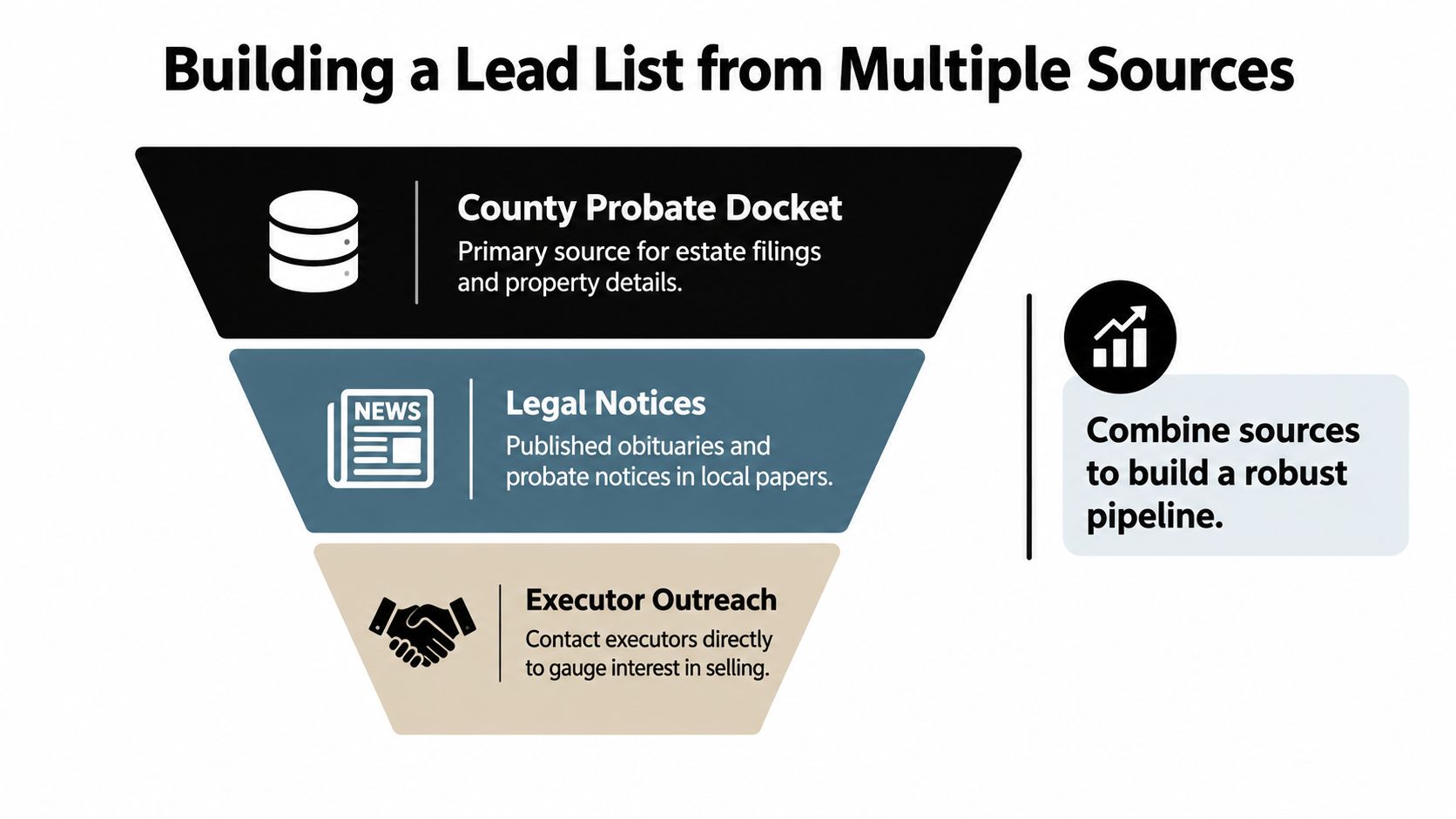
Build one record per case and keep the source for each detail. Capture the decedent's name, case number, filing date, appointed personal representative, attorney, estate mailing address, suspected property address, parcel number, and any sale authorization or proposed-action notice. Keep docket status and follow-up notes alongside the property data so a lead doesn't look current after the case has gone quiet.
Rank cases by readiness, not just recency
A practical triage score considers five signals: whether a representative is confirmed, whether property ownership matches, whether there appears to be equity after liens, whether occupancy or condition warrants further review, and whether the case is procedurally ready for a sale. Don't assign a positive score just because a name appears in a filing. Mark unknowns as unknown until you can verify them.
Common mistakes are easy to avoid once the list separates signals from facts:
- Death notice mistaken for a case: Search the court docket before logging a lead as probate.
- Heirs contacted before authority is clear: Confirm the appointed representative and follow local rules for outreach.
- Joint or trust ownership overlooked: Compare recorded ownership against the probate filings.
- Mailing address treated as the property: Confirm the situs address and parcel in county records.
The useful pipeline is not the longest list. It's the list that lets you see what's verified, what's missing, and what event would justify the next action. That structure also makes it easier to pause stale cases rather than repeatedly contacting people without a procedural reason.
Contacting Personal Representatives and Attorneys
Outreach timing can determine whether a letter is useful or too early. A newly filed case may not yet have a confirmed representative, an inventory of assets, or a clear understanding of creditor claims. Monitor the docket first, then wait until the representative and counsel are identifiable before sending a concise, respectful, non-deceptive message.
California illustrates why procedural milestones matter: a creditor generally has four months from issuance of letters to file a claim against a general personal representative, and formal proceedings require documented notice and publication (Stanislaus County probate FAQs). Those rules aren't a national timeline. Use the relevant county and state rules to decide when to follow up and what to verify.
A workable cadence is straightforward:
- Monitor new filings. Record the case and check whether a representative has been appointed.
- Wait for the right contact. Use the appointed representative or counsel, not an unverified list of heirs.
- Send a clear first letter. Identify yourself, state why you're writing, and make it easy to decline.
- Follow up with a reason. Revisit after the estate has had time to identify assets and debts, or when the docket shows a sale request or other meaningful milestone.
- Re-underwrite before an offer. A change in docket status is a prompt to verify the property again, not an automatic green light.
A sale notice is a reason to review the file, not a substitute for checking authority, title, and the numbers.
The Alameda court explains that an estate may sell real property to pay approved creditor claims and that final distribution requires debts, taxes, and creditor claims to be addressed. Gross apparent equity can therefore overstate what remains available to beneficiaries or for a transaction.
Keep communications professional and avoid language that implies court endorsement or guaranteed savings. Before a binding offer, have local counsel confirm solicitation rules, contract terms, notice requirements, and who can sign. Investors working through a Texas estate can also consult the Law Office of Bryan Fagan, PLLC's resource on how to find a probate lawyer in Texas. For the outreach process itself, PropLab's guide to outbound lead generation offers additional context.
Qualifying Leads Before Making an Offer
A probate filing can point toward a seller, but it doesn't establish that the property is distressed, available, or correctly priced. It won't tell you the home's condition, whether heirs disagree, how much creditors may claim, or whether the court must approve a sale. Treat each as an open question until records, counsel, and property-level checks resolve it.
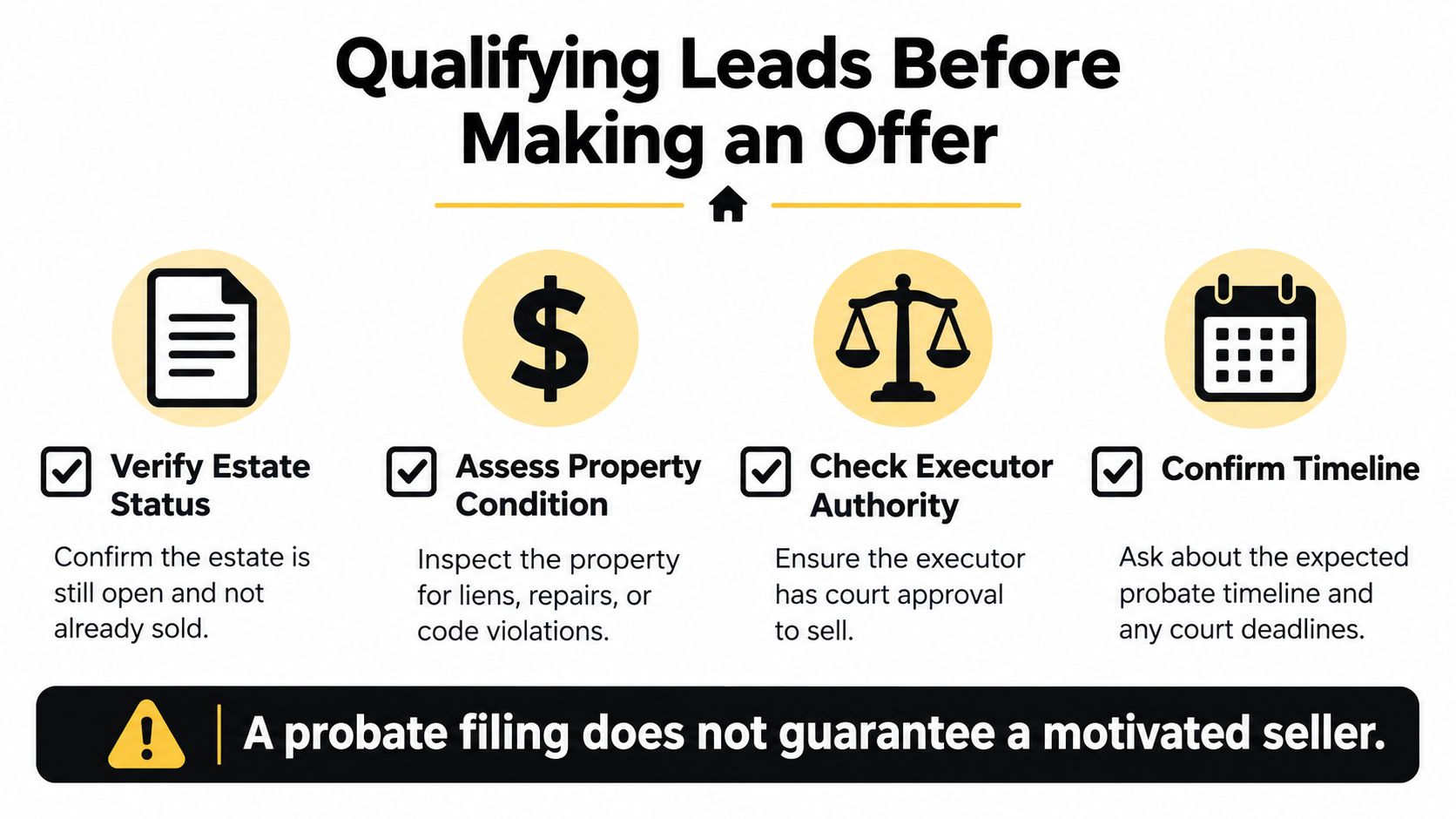
Before making an offer, work through the diligence that can change the deal:
- Confirm estate status: Check that the case is still open and review later docket entries for a sale or transfer.
- Verify title and obligations: Obtain a current title report and check recorded liens, mortgages, taxes, and judgments.
- Confirm signing authority: Establish who can sign and whether the representative has independent sale authority or needs court approval.
- Inspect and underwrite: Assess condition, estimate repairs, and compare the property with relevant sales.
- Calculate distributable equity: Subtract mortgages, delinquent taxes, judgments, administration costs, commissions, repairs, holding costs, and potential claims before setting a maximum offer.
For a structured way to connect comparable sales, repair assumptions, and an offer ceiling, use this guide to underwriting real estate deals. The point isn't to make every probate lead pass. It's to identify which cases have enough verified information to justify the next step.
Probate is best treated as an ownership and motivation signal, not a valuation signal. A docket can help you find a case, but only title work, court-status checks, property evaluation, and conservative underwriting can establish whether the opportunity is real.
PropLab helps real estate investors screen properties using public records, tax data, and market signals, then estimate ARV, rehab costs, and a Max Offer Price in an offer-ready report. If you're building a county-by-county probate pipeline, visit PropLab to assess candidate properties before you commit to an offer.
About the Author
P
PropLab Team
Real Estate Analysis Experts
The PropLab team consists of experienced real estate investors, data scientists, and software engineers dedicated to helping investors make smarter decisions with AI-powered analysis tools.
Free account
Underwrite your next deal in under a minute
3 free analyses, no credit card. ARV, rehab, comps and exit strategy in one report.
