General
How to Get a House Condemned: A Step-by-Step Guide
October 3, 2026
18 min read
You live next to a house with a sagging roof, broken windows, standing water, and weeds high enough to hide the foundation. The owner ignores calls, tenants have moved out, and every storm seems to make the structure worse. You may be asking how to get a house condemned, but the answer isn't a single complaint or a shortcut around a difficult owner. Condemnation is a formal municipal enforcement process, and it depends on documented conditions that make a property unsafe or unfit for occupancy.
The same distinction matters to investors. A condemned house may look like a bargain, yet the legal order, repair requirements, title problems, tenant displacement, and carrying costs can turn a cheap acquisition into an open-ended liability. The practical path is to document the hazards precisely, work through the local code-enforcement process, and underwrite every possible outcome before committing money.
What Condemnation Actually Means and When It Applies
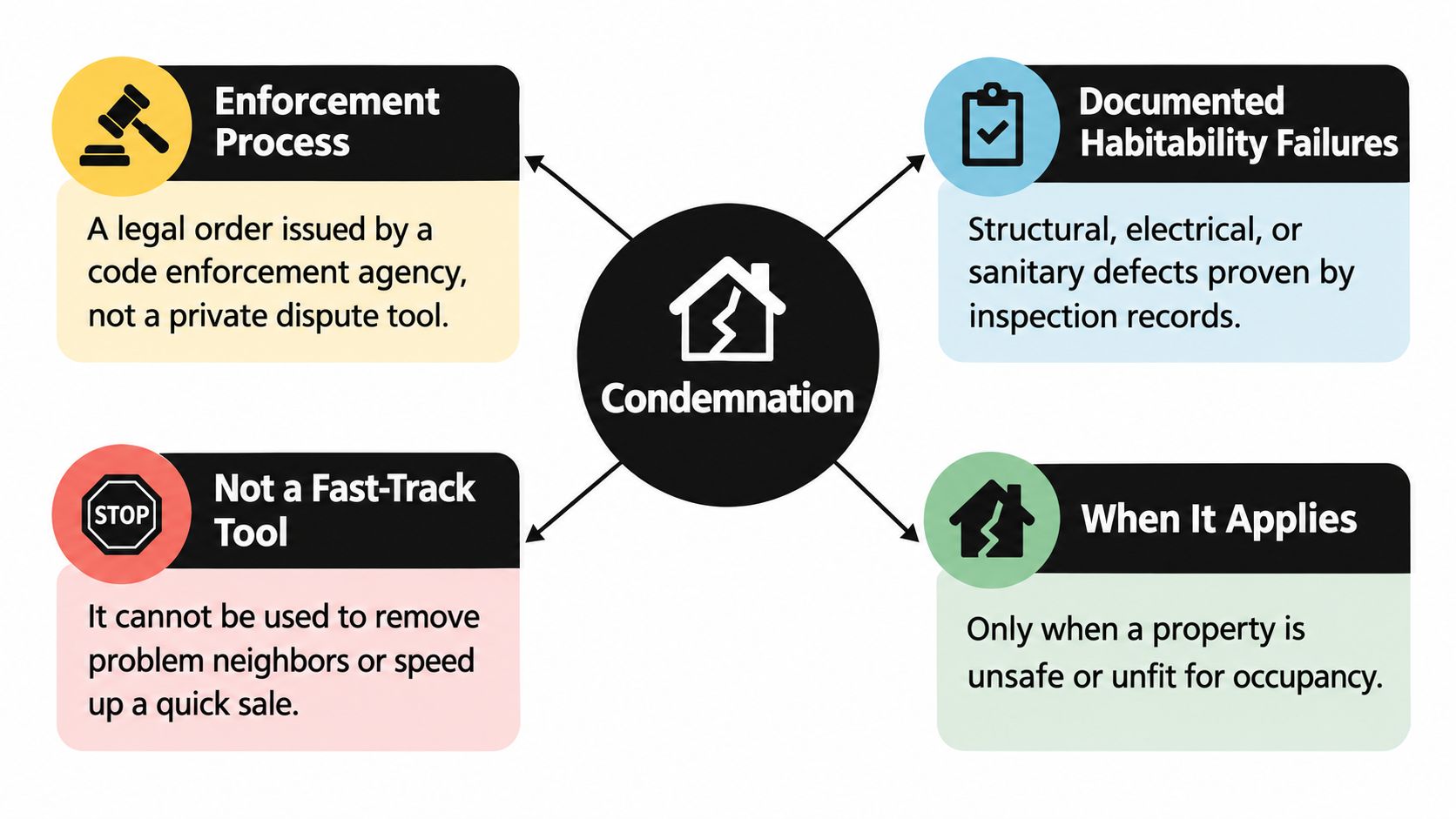
A deteriorating house isn't automatically a condemned house. Peeling paint, an overgrown yard, broken siding, or an ugly exterior may violate local property-maintenance rules, but those conditions alone don't usually establish that the building is unsafe for people to occupy. Condemnation generally requires an inspection and a documented finding that serious failures affect habitability, structural safety, sanitation, fire protection, utilities, or access to a safe exit.
The authority normally rests with a municipal building, housing, or code-enforcement agency. A neighbor, tenant, lender, or investor can report conditions and request an inspection, but a private person can't condemn the property. The agency decides whether the evidence supports a violation notice, an order to repair, a vacate order, or a condemnation proceeding.
Start with the habitability question
Before contacting the city, separate unsafe conditions from general neglect. Ask whether the property presents a credible risk to occupants or the public. A roof that allows extensive water intrusion, exposed electrical systems, an unstable foundation, sewage problems, blocked exits, or major fire damage gives an inspector something concrete to evaluate. A messy yard or an unattractive facade usually doesn't.
Tenants should also understand the difference between code enforcement and ordinary landlord duties. A useful overview of landlord habitability obligations can help clarify whether the problem belongs in a housing complaint, a private landlord-tenant claim, or a broader condemnation inquiry. Those routes can overlap, but they aren't interchangeable.
A U.S. municipal example says the average condemnation takes about 6 months when there is no owner or lienholder opposition, according to the City of Mercedes condemnation process. That process begins with an inspector's evaluation of system failures such as electrical, plumbing, and mechanical deficiencies, along with visible instability including missing doors, missing windows, or a damaged roof. The city then conducts a title search, notifies interested parties, allows time for correction, and may schedule a hearing before a condemnation board.
Practical rule: Report conditions that an inspector can verify, not conclusions about the owner's character or motives.
The United States has no single national dataset for condemned homes. Researchers instead combine USPS vacancy records, Census data, and local code-enforcement files. Vacancy alone is an unreliable substitute for condemnation because the Census treats a home as vacant whenever no resident is present, including vacation homes and homes listed for sale. The strongest early signal is a documented pattern of serious, unresolved violations rather than a property merely appearing empty.
The Hazards That Qualify a House for Condemnation
A house can look neglected without meeting the legal threshold for condemnation. Code officials focus on conditions that make occupancy unsafe, and they usually reach that conclusion after inspections document serious defects that remain unresolved. A complaint starts the process, but repeated inspection cycles, missed correction deadlines, and continuing hazards often determine whether the case escalates.
Local ordinances control the final decision. The categories below provide a practical screening method for neighbors preparing a report and investors deciding whether a condemned property has a repairable problem or a cost that exceeds the deal.
Structural integrity
Begin with the building's ability to remain standing and protect occupants. A collapsing roofline, significant foundation movement, unstable stairs, failing floors, missing structural supports, or walls that have shifted materially warrants prompt attention. Photograph each condition with enough surrounding context to identify its location, then record whether new movement, water entry, or further deterioration appears during later visits.
A ceiling stain alone does not establish a structural emergency. A failed roof that permits prolonged water entry and weakens framing presents a more serious case. Inspectors need evidence of the underlying defect, not a conclusion such as “the house is falling apart.” For an investor, that distinction affects the inspection scope, engineering fees, carrying period, and decision to repair or walk away.
Fire safety and utilities
Fire hazards include exposed wiring, overloaded or damaged electrical components, missing protective systems, unsafe heating equipment, and unpermitted alterations. Gas leaks and improvised connections can create immediate danger. Do not touch or test a suspected electrical or gas hazard. Record visible conditions from a safe location and report them through the proper channel.
A stable exterior does not make a house habitable. Failed plumbing, no safe water supply, sewage discharge, major leaks, or an electrical system that cannot safely serve the building may support enforcement action. After flooding, distinguish surface drying from the full remediation process described in this resource on what to do after a flood. Hidden moisture, contaminated materials, and damaged systems can extend both the repair schedule and the owner's financial exposure.
Sanitation and egress
Sanitation hazards may include sewage backup, extensive contamination, infestations, standing water, or conditions creating an immediate health risk. Clutter alone rarely establishes a condemnable condition. Blocked mechanical systems, contaminated surfaces, vermin, and the inability to maintain sanitary occupancy create a stronger enforcement concern.
Egress means occupants can leave safely. Boarded or blocked exits, unusable emergency windows, obstructed stairs, and unsafe corridors require specific documentation. Identify the affected route and explain whether the obstruction prevents normal escape.
A property condition assessment guide can help organize observations by system and visible defect. The most useful report describes structural integrity, fire safety, sanitation, utilities, and egress precisely, with dates and locations. Cosmetic neglect may reduce value, but officials generally act when defects make occupancy unsafe. Investors should also price the timing risk: condemnation can stop occupancy and revenue while inspections, correction orders, contractors, and reinspection proceed. A low purchase price does not remove those obligations.
Building a Documentation File That Holds Up
A vague complaint forces an enforcement officer to start from scratch. A dated, organized file gives the officer a location, a hazard, a timeline, and a reason to inspect. It also protects you if the owner claims the problem was invented, temporary, or corrected before the city arrived.
Begin with a single timeline document. Record the date, time, location, visible condition, people notified, and any response. Keep the language factual. “Water is entering through the damaged rear roof and pooling on the second-floor ceiling” is more useful than “the owner has abandoned the house.”
Capture evidence an inspector can verify
Use photographs that show both context and detail. A wide image identifies the side of the structure, while a close-up shows the exposed wire, collapsed ceiling, blocked exit, or sewage discharge. Take photographs from public areas or places where you have lawful access. Don't trespass, enter an unstable structure, or move debris to make an image more dramatic.
Keep copies of written complaints, emails, repair requests, inspection notices, and agency responses. If you're a tenant, preserve proof that you notified the landlord and the date of each notice. If you're a neighbor, use the city's formal reporting channel and save the confirmation number or correspondence.
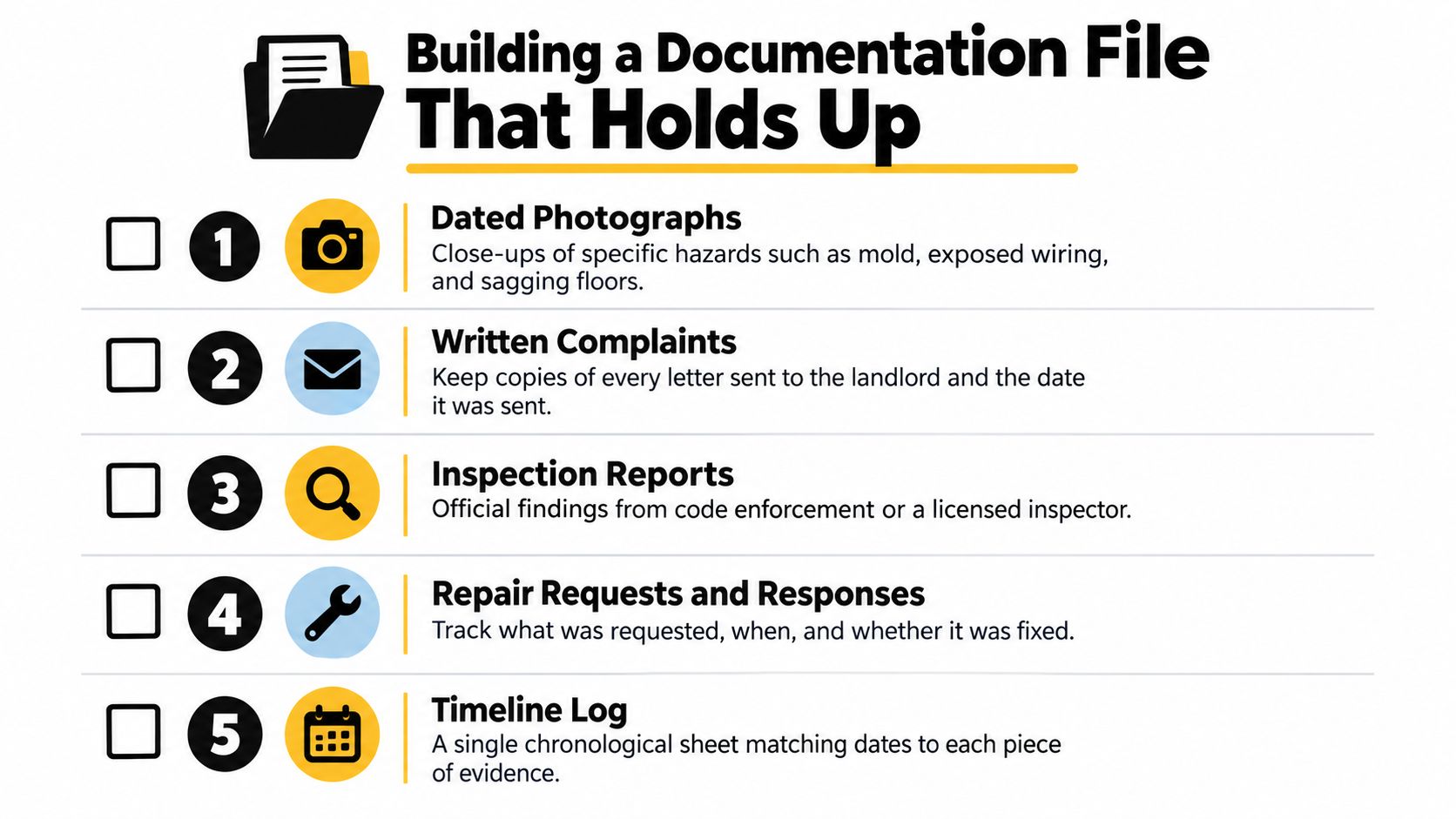
A strong file usually contains:
- Dated photographs: Label each image with the date, location, and hazard shown.
- Written complaints: Keep copies of reports to code enforcement, the owner, landlord, or property manager.
- Inspection records: Save official findings, violation notices, reinspection results, and any records released through the municipality.
- Repair history: Record what the owner promised, what work occurred, and whether the repair addressed the actual defect.
- Timeline log: Maintain one chronological sheet that connects each event to its supporting photograph or document.
Use public records without overclaiming
Local records can reveal whether a problem is isolated or recurring. Search for open and closed violations, unpaid citations, permit history, inspection notes, notices of nuisance, and recorded ownership information. This public records property search guide can help organize the research before you contact an agency or evaluate an acquisition.
Local code-enforcement data is especially valuable because recurring, unremedied, and unpaid citations, together with inspection records, can indicate deterioration that may move toward condemnation, as explained by Community Progress guidance on finding vacant and abandoned properties. That doesn't mean every unpaid citation will produce a condemnation order. It means the history gives an inspector a stronger basis for understanding the property's condition.
Send the completed file through the agency's preferred channel. Ask for the complaint number, the assigned department, and the next procedural step. Don't demand a particular outcome. Ask the officer to inspect and determine whether the documented conditions violate applicable codes.
Working With Code Enforcement Through the Hearing Process
A condemnation case usually develops through repeated inspection cycles, not from one complaint alone. A complaint or routine inspection creates the initial record. The agency identifies violations, gives the responsible party an opportunity to correct them, reinspects the property, and escalates when unsafe conditions remain or the owner stops participating. That sequence affects both timing and cost. Each inspection can extend the process, while each missed deadline can increase repair, relocation, legal, and enforcement expenses.
Follow the notice and cure sequence
The first inspection should produce specific findings. A violation notice may identify structural, fire, sanitation, utility, or egress problems and set a correction deadline. “Clean up the house” does not define a workable cure. The owner needs to know which conditions the agency considers unsafe, which permits are required, and what proof will satisfy the next inspection.
Cure periods commonly range from 30 to 90 days, as described in municipal condemnation guidance. Local law, the severity of the hazard, and the agency's emergency authority determine the actual period. An immediate danger can lead to a rapid vacate response. A repairable defect may allow more time, but extra time is useful only if the owner has a funded scope of work and can obtain contractors and permits.
| Stage | What Happens | Typical Timeframe | Your Move |
|---|---|---|---|
| Complaint or routine inspection | Code enforcement receives a report or identifies a possible violation and inspects the property. | Timing depends on local workload and urgency. | Submit precise evidence, request the case number, and remain available to clarify facts. |
| Violation notice | The agency lists code failures and sets a correction deadline. | Cure periods commonly range from 30 to 90 days. | Read every item, confirm required permits, and create a repair schedule. |
| Reinspection | An officer checks whether the cited conditions were corrected. | Scheduled after the cure period or after the owner requests review. | Finish the complete scope before requesting reinspection. |
| Final notice | The agency may send certified-mail notice to the owner and interested parties if violations remain. | Timing follows local notice rules. | Confirm receipt, respond in writing, and prepare for a hearing. |
| Condemnation hearing | A board or authorized official reviews the record and may issue a condemnation or vacate order. | The municipality sets the date. | Attend, bring organized evidence, and address each finding directly. |
| Posted order and enforcement | Occupancy may be prohibited, utilities may be disconnected, and further abatement or demolition action may follow. | The order controls the statutory window. | Leave if ordered, secure the site lawfully, and obtain written compliance instructions. |
Avoid the three procedural failures
Missed deadlines give the agency a reason to escalate. Put every date on a calendar and ask in writing whether an extension is available before the deadline passes. Keep copies of notices, emails, permits, contractor commitments, and inspection requests. Verbal assurances are difficult to prove when a hearing record is assembled.
Incomplete repairs leave the underlying violation active. Replacing a damaged ceiling while leaving the roof leak, rewiring one visible outlet while ignoring an unsafe panel, or removing debris without restoring a blocked exit will not resolve the case. A licensed professional should define the scope when the work involves structure, electricity, plumbing, gas, or fire safety. That scope also gives the owner a defensible explanation if the agency questions the proposed work.
Failed reinspection can waste completed work and extend the case. Owners sometimes finish repairs but never request the inspection, or assume a contractor's invoice closes the matter. It does not. The enforcement record changes when the agency verifies compliance, so request the inspection promptly and ask for written confirmation of which items remain open.
Insurance can complicate the repair budget. If an insurer disputes coverage for code-required upgrades after a loss, review the policy language and document the property's condition before work begins. The discussion of fighting building code upgrade claim denial can help frame that issue, although the policy, local requirements, and legal advice control the result. The owner usually carries the immediate cost of securing the property, commissioning reports, arranging repairs, and keeping the process active. An investor evaluating the property should price those obligations before treating a low purchase price as an opportunity.
Once an order is posted, occupants may have to leave immediately or within a short statutory period, depending on local emergency authority. Utilities may be disconnected, and access may be restricted. A tenant should ask the housing agency about relocation, deposit, and rent remedies under local law rather than assuming the condemnation order resolves those private claims.
Owner Rights Appeals and Alternatives to Condemnation
A condemnation order is often the city's first formal move, but it is not always the only path. In many cases, the agency is pushing for one of several outcomes, a supervised repair plan, a receiver, a lien-backed abatement, or owner-led demolition. The practical question is who controls the property while the hazard is being fixed, and who pays if the fix goes sideways.
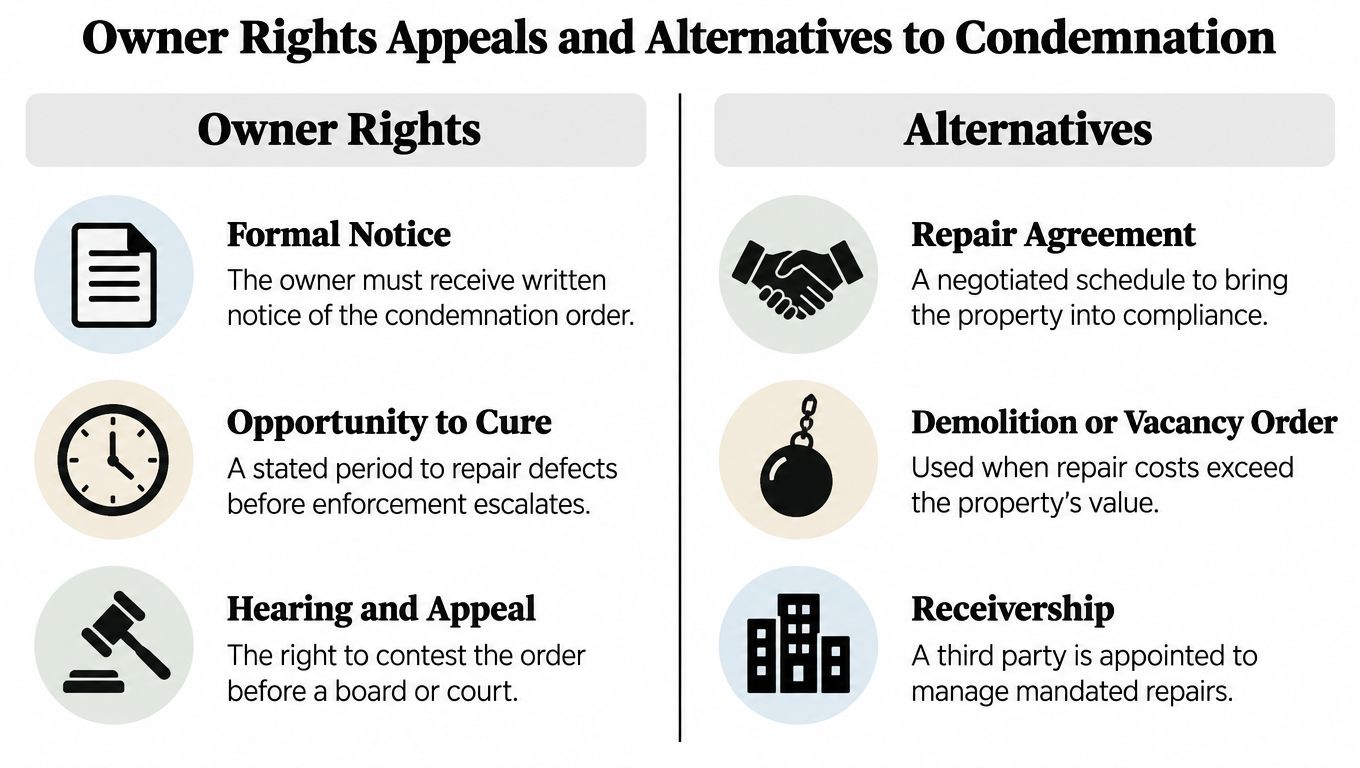
Owners usually have the right to formal notice, a clear list of the cited defects, and the chance to correct them within the period required by local law. They may also have the right to appear at a hearing and challenge the order through the local administrative process or a court appeal. The notice controls the process. It should name the authority involved, list the deadlines, explain hearing dates, and set out the appeal steps in plain terms.
Compare the available paths
A repair agreement keeps the owner in charge. The owner proposes the scope, pulls permits, completes the work, and comes back for scheduled inspections. This can preserve value when the structure is salvageable, but it falls apart if the owner talks about paint and patchwork while ignoring the hazards that triggered the case, or if the money runs out before the work is finished.
Receivership shifts responsibility to a court-appointed or otherwise authorized third party. I have seen it used when an owner will not act, yet the building still has repair value. The trade-off is obvious, less owner control, court oversight, professional fees, and a process that can take time to get in place.
A city can also use liens or other recovery mechanisms after it performs the abatement work or absorbs enforcement costs. The hazard may be gone, but the property can still carry encumbrances. Any buyer should run a current title review and confirm whether municipal charges, tax balances, utility claims, or other liens survive the sale.
Owner-initiated demolition makes sense when repair is not economic or not safe. Even then, the owner still has to clear zoning, permits, utility shutoffs, environmental rules, debris removal, and title issues. Demolition removes the structure, not every debt tied to the parcel.
Choose the remedy that fits your goal
A neighbor usually wants the danger removed, not necessarily the building torn down. A tenant may need relocation help and enforcement of habitability rights. An owner may need time to repair or sell. An investor may prefer a clean demolition path instead of inheriting a rehab that has no realistic finish line.
Condemnation deadlines can run from 30 days to one year depending on jurisdiction, as discussed in who pays to tear down a condemned house. That is why local notice and appeal rules matter so much. A complaint does not guarantee immediate removal, and an owner should not treat the cure period as a blank check to stall without a funded plan.
For owners: An appeal helps only when you can point to a legal or factual mistake, offer a real correction plan, or show that the agency skipped required steps. It does not make a dangerous building safe.
The strongest outcome is usually a written agreement with milestones, permits, inspections, and consequences if the owner misses them. That gives the city a record for escalation if the work stops, and it keeps the block from getting trapped in another round of promises that never turn into repairs.
What Investors Should Know Before Touching a Condemned Property
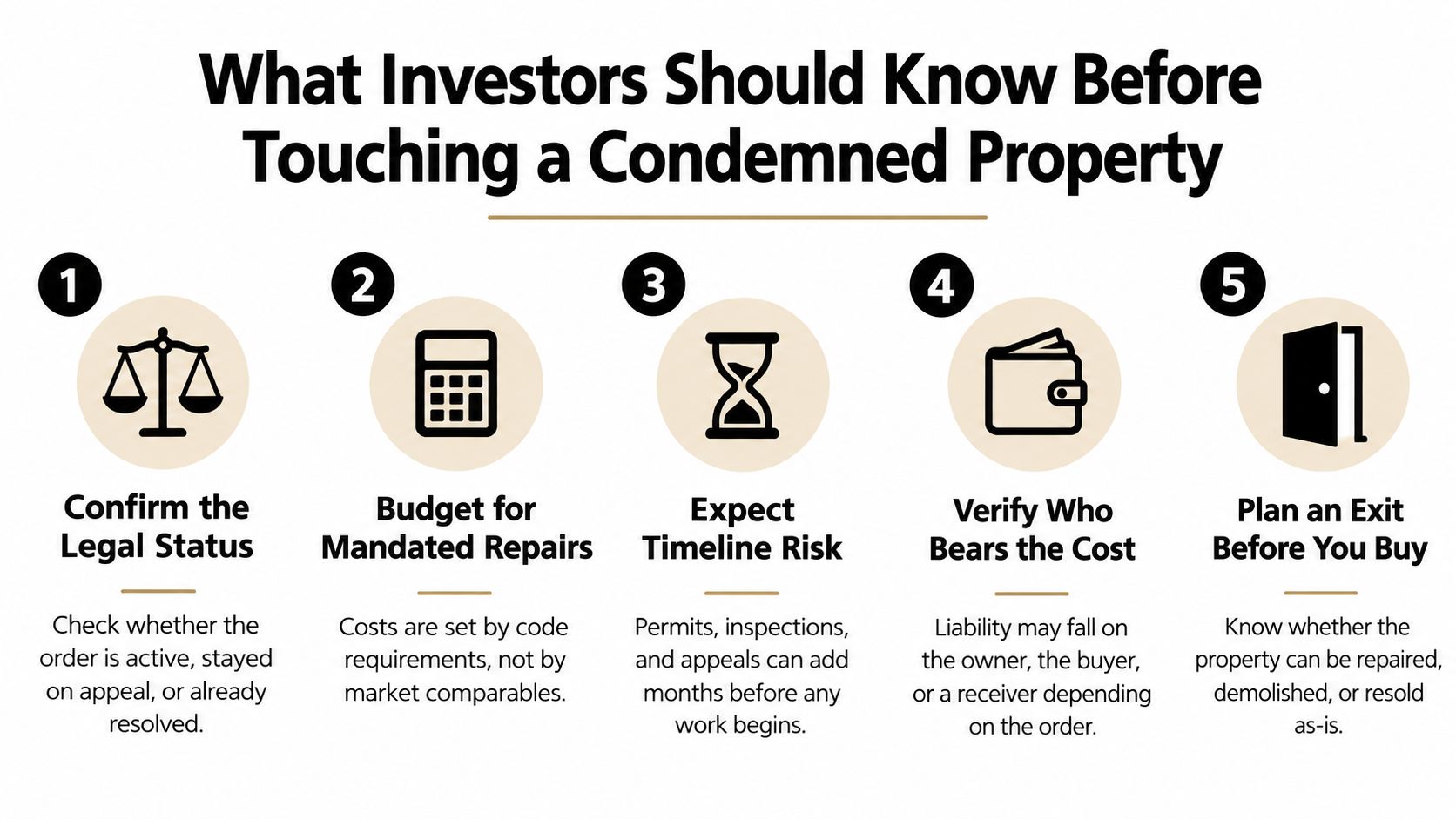
A condemned property isn't just a repair project. It's a legal and operational position with an uncertain finish line. The buyer may inherit an active order, unpaid municipal charges, unresolved title issues, tenant obligations, demolition exposure, and a property that can't be occupied or conventionally financed until the agency clears it.
The first risk is timing. A municipal example puts an uncontested condemnation process at about 6 months, while title objections, appeals, incomplete work, and inspection delays can extend the timeline. That period can produce taxes, insurance, security, utilities, interest, legal fees, and maintenance costs without rental income.
Underwrite the worst credible outcome
Start with the legal file, not the asking price. Request the condemnation order, every violation notice, inspection report, reinspection result, hearing record, and written communication with the agency. Confirm whether the order is active, stayed, appealed, or resolved. Then obtain a title search and ask the municipality directly about liens, abatements, demolition claims, permits, and required approvals.
The broader vacant-property environment explains why agencies often move incrementally. One urban cost study estimated about 18,700 vacant-property inspections per year and roughly $250,000 in annual inspection costs, using a 20-minute door-to-door inspection model, as reported in this condemned-house investment overview. A resource-constrained office may prioritize cases with repeated inspection records and strong documentation, so a single complaint rarely determines the final result.
Use this decision sequence:
- Confirm the legal status: Determine whether the order is active, stayed, appealed, or closed.
- Define the mandatory scope: Separate agency-required repairs from optional improvements.
- Price the full timeline: Include carrying costs while permits, work, inspections, and appeals remain unresolved.
- Model displacement and access: Identify tenant, occupant, security, and site-control obligations.
- Test repair against demolition: Compare the cost and risk of saving the structure with clearing the lot.
- Set an exit before closing: Decide whether you can repair, demolish, resell, assign, or walk away.
Identify who bears each cost
The deed doesn't answer every liability question. Depending on the order and transaction documents, the current owner, buyer, receiver, contractor, insurer, lender, or municipality may bear different costs. Never assume that buying at a discount transfers a clean, repairable asset to you.
Tenant displacement creates another exposure. If occupants must leave, the owner may face relocation duties, deposit disputes, temporary housing claims, or litigation under applicable state and local law. A buyer should resolve those obligations before closing, not after taking possession.
Use a conservative valuation model. Estimate the finished value from relevant nearby sales, subtract the complete repair or demolition scope, add carrying and professional costs, and reserve room for unknown defects. If the deal works only when every permit arrives on time, every contractor quote holds, and the city accepts partial work, the margin is probably too thin.
For a faster preliminary review of a distressed acquisition, condemned property for sale analysis can help organize the property condition, public-record issues, and repair decision before you spend heavily on due diligence. The final decision should still rely on the municipal file, qualified inspections, title work, and advice from professionals familiar with the local rules.
A condemned house can be rescued, demolished, or abandoned by the owner. Your job as an investor is to know which outcome the documents and numbers support before you buy. If you can't identify the legal path, funding source, repair scope, and exit strategy, walking away is often the most disciplined investment decision.
PropLab helps investors evaluate distressed properties by combining public records, market signals, condition indicators, ARV analysis, repair estimates, and offer-ready reporting in one workflow. Visit PropLab to review condemned-property opportunities, test repair-versus-demolition scenarios, and make a defensible offer before the legal and carrying-cost risks compound.
About the Author
P
PropLab Team
Real Estate Analysis Experts
The PropLab team consists of experienced real estate investors, data scientists, and software engineers dedicated to helping investors make smarter decisions with AI-powered analysis tools.
Free account
Underwrite your next deal in under a minute
3 free analyses, no credit card. ARV, rehab, comps and exit strategy in one report.
