General
How to Get Foreclosure Listings: Sources, Steps and Checks
November 2, 2026
13 min read
You've found a site showing dozens of foreclosures, copied the addresses into a spreadsheet, and started running numbers. Then half the sales turn out to be postponed, one address is only at the default stage, and another property was sold weeks ago. That's the normal starting point, and it's why learning how to get foreclosure listings isn't about finding the longest list. It's about knowing which public record created the lead, how current that record is, and how much verification the source still leaves on you.
Where Foreclosure Listings Come From
Every U.S. foreclosure moves through three stages, and each stage creates a different paper trail. Default begins with a Notice of Default or Lis Pendens. Auction begins when a trustee or sheriff publishes a Notice of Trustee Sale or sheriff's sale notice. REO, short for real estate owned, starts after the lender takes the property and prepares to sell it.
That sequence matters because no single site publishes all three stages equally well. A default notice gives you an owner and a debt problem before there's a sale date. An auction notice gives you a date, location, and opening bid. An REO record gives you a lender that's actively trying to dispose of the asset.
Sources by Stage
| Source | Stage | What You Get | Typical Cost |
|---|---|---|---|
| County recorder or clerk | Default | Notice of Default or Lis Pendens | Free or per-page fee |
| Trustee or sheriff sale calendar | Auction | Sale date, location and opening bid | Free |
| Local newspaper legal notices | Default and auction | Published sale notices | Newspaper subscription or single-copy price |
| Lender REO websites | REO | Bank-owned homes for sale | Free to browse |
| HUD, Fannie Mae and Freddie Mac REO sites | REO | Government-held and agency-owned homes | Free to browse |
| Online auction platforms | Auction and REO | Online sales with bidding terms | Buyer premium stated in sale terms |
| Paid aggregator subscriptions | All stages | Compiled filings and alerts | Monthly subscription fee |
The scale looks larger than the buyable inventory. In 2024, 322,103 U.S. properties had foreclosure filings, including default notices, scheduled auctions, or bank repossessions, according to ATTOM's 2024 year-end foreclosure market report. That total mixes early leads with scheduled sales and completed repossessions, so it doesn't tell you how many properties you can bid on this month.
If you're checking several counties or pulling data programmatically, Scrappey's guide to property data APIs is useful context for comparing structured property feeds with manual public-record searches. Don't let a feed replace the county record, though. The feed finds candidates faster. The county record proves the case still exists.
Practical rule: Rank a source by how close it is to the recorded document, not by how many listings it displays.
Start with a sheet that has one row per county. List the recorder, sale office, required newspaper, and any paid service you'll check each week, then record the day and time you last checked each one.
Pulling Listings from County and Trustee Records
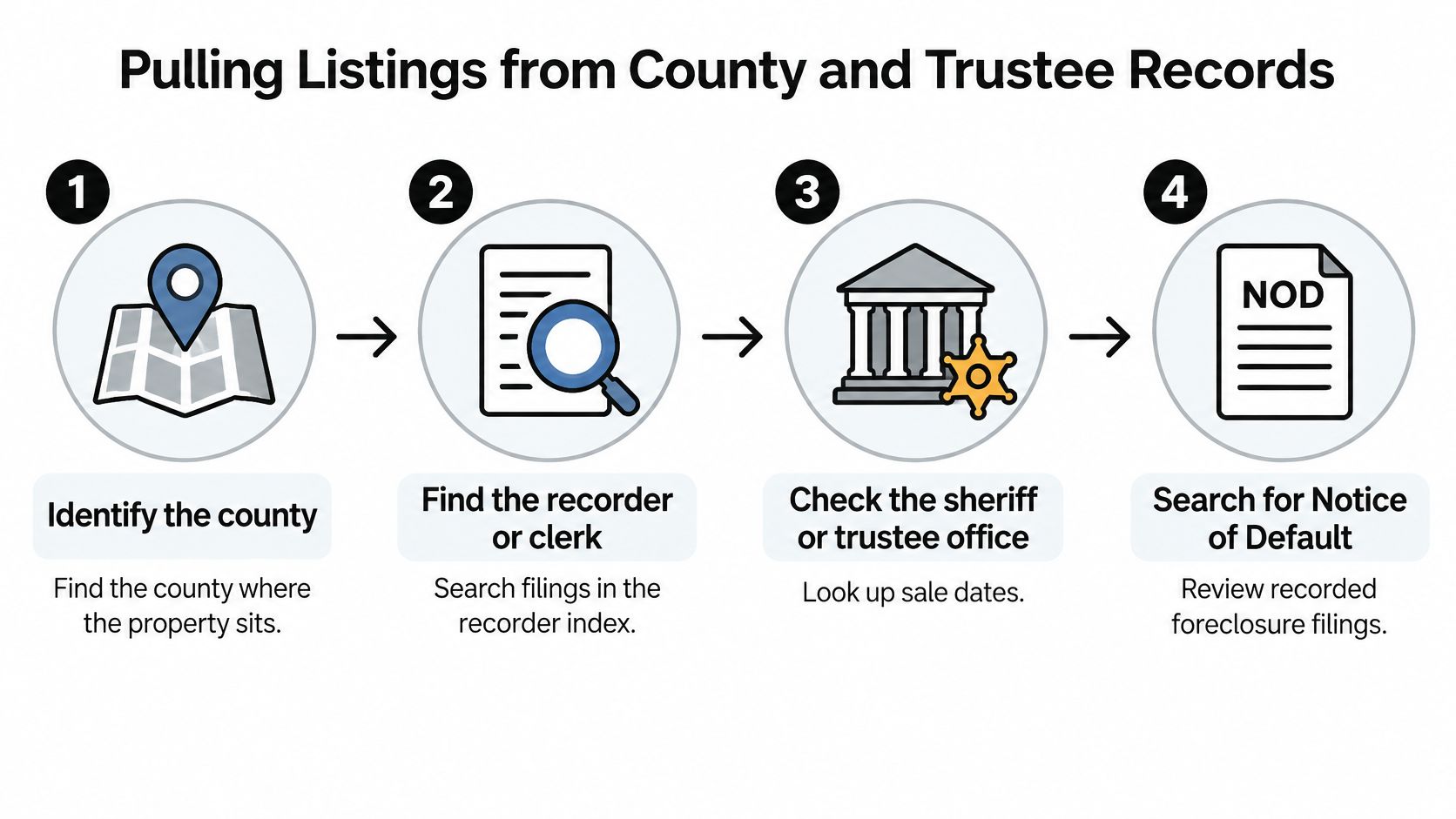
County records take more time than an aggregator, but they settle arguments about stage, ownership, and sale status. Work in the same order every time so you don't build a list around a stale notice.
The workflow below moves from identifying the right office to pulling the actual filing.
Six Steps for a Clean Pull
Identify the county first: Find where the property sits, then locate that county's recorder or clerk for filings and its sheriff or trustee office for sale dates. A neighboring county's database won't help, even if the mailing city looks familiar.
Search by document type: Query the recorder index for Notice of Default and Lis Pendens filings from the last 90 to 180 days. Filtering by document type catches cases that a borrower-name search misses because of spelling variants, trusts, or business entities.
Pull the sale calendar separately: Record each sale date, location, opening bid, deposit rule, and postponement from the trustee or sheriff calendar. The common slip is treating a default notice as proof that a sale's already scheduled. It isn't.
Check legal notices: Review the local newspaper's legal notices because some states still require publication there. You'll occasionally catch a sale, correction, or postponement that hasn't reached the online calendar yet.
Key every lead to the parcel: Store the parcel number and legal description, not just the street address. Borrower names and address formats change across filings, and that small difference can make the same property look like two leads or disappear from a later search.
Recheck before the sale week: Revisit each parcel as its sale date approaches. Owners cure defaults, courts dismiss cases, trustees postpone sales, and borrowers file bankruptcy. If you don't recheck, you'll price, travel to, or prepare funds for sales that no longer exist.
For a structured approach to organizing what you collect from those pages, this real estate data extraction guide covers the mechanics of turning listing pages into usable records. Pair that discipline with a public records property search workflow so parcel, tax, and ownership details stay attached to the same lead.
The national filing count shows why parcel-level tracking matters. ATTOM's 2025 year-end report counted 367,460 U.S. properties with at least one foreclosure filing in 2025, while 289,441 properties had foreclosure proceedings initiated, so a raw filing count overstates auction-ready inventory.
Your finished pull should be a parcel list tagged by stage and sale date. That's the list you verify again before you spend money on title work or drive to a property.
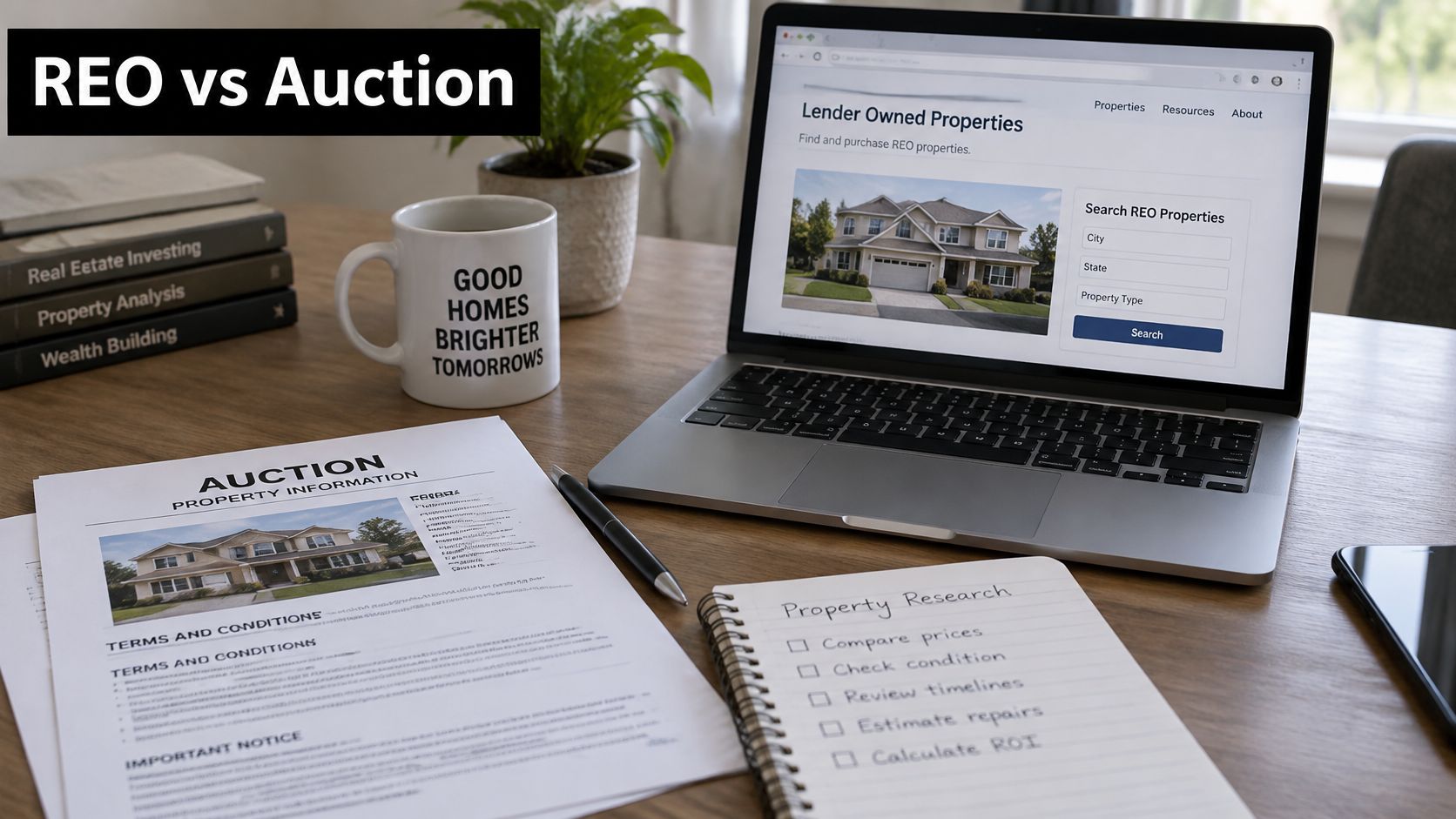
Comparing Lender REO and Auction Channels
Channels don't just differ in price. They differ in who does the verification work. With REO, the lender has already taken ownership. At a trustee auction, you're buying the outcome of a legal process and accepting much more title and occupancy risk.
Keep your notes, sale terms, and source for each lead together from the start.
| Channel | Lead Stage | Discount Potential | Verification Needed |
|---|---|---|---|
| Lender REO listing pages | REO | Usually smaller | Title and condition checks |
| Government agency REO sites | REO | Priced under each agency program | Title and condition checks |
| Online auction platforms | Auction and REO | Set by bidding in each market | Terms, buyer fees and occupancy |
| Trustee or sheriff auctions | Auction | Often deepest, highest risk | Full title, lien and redemption checks |
| Paid aggregator subscriptions | All stages | Created by your purchase price | Confirm every record at source |
Lender and agency REO is usually the easiest route to transact. You can often inspect through a listing agent, review disclosures where they're offered, and close through a familiar contract process. The trade-off is a thinner discount and slower asset-manager decisions.
Trustee and sheriff auctions can produce the deepest discount because the buyer absorbs uncertainty. You may have limited interior access, a large cash deposit, existing occupants, and liens that survive the sale. That discount isn't free. It's compensation for work and risk the seller hasn't removed.
This walkthrough shows how auction terms and property research fit together before you register to bid.
Online auction platforms sit between those extremes. Photos, deadlines, and bidding are convenient, but buyer premiums, reserve rules, proof-of-funds requirements, and closing timelines differ by platform and property. Read the specific sale terms before you register, not after you've won.
Paid aggregators save search time and provide alerts, filters, and historical filings. They don't confirm that a sale is still active. I'd use them for discovery, then confirm the parcel, docket, or trustee notice at the source.
Choose channels based on your cash, timeline, and risk tolerance. Log which channel produced each lead, then compare bid-ready results after three months instead of judging by raw lead volume.
Screening Leads and Fixing Common Problems
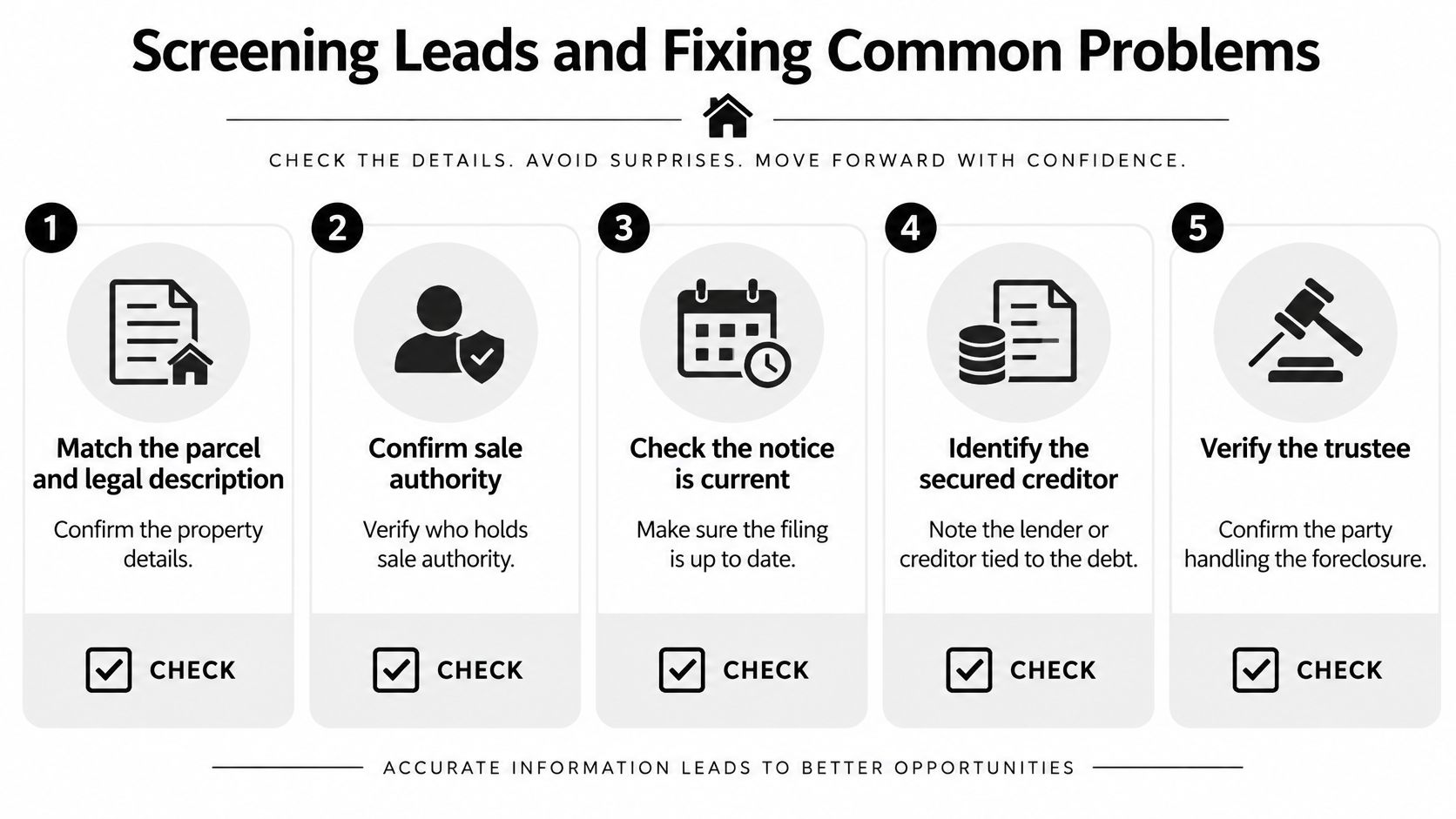
Screen in two passes. The first pass proves the listing is real and current. The second proves the numbers still work after title, repairs, and resale risk are included.
The checklist below covers the identity and authority checks that should happen before valuation.
Pass One Validates the Listing
Match the parcel number and legal description across the notice, tax record, and deed history. Confirm who holds sale authority, whether the notice is current, and the secured creditor, trustee, sale venue, deposit requirement, and postponement rules. If those fields don't line up, don't underwrite the property yet.
Pay close attention to the foreclosing lien's position. A junior-lien sale can leave a senior mortgage in place, which turns an apparently cheap bid into an expensive assumption of someone else's debt.
Pass Two Tests Investability
Order a preliminary title search for senior liens, municipal charges, tax balances, code violations, bankruptcy indicators, and other encumbrances. Then estimate repairs and resale or rental value from comparable sales you've verified for location, condition, size, and sale date. A disciplined data quality assessment helps you separate a sourced figure from an aggregator estimate that nobody has checked.
Use a hard bid ceiling. Say the after-repair value is $300,000. Subtract $60,000 in repairs, $25,000 in holding and closing costs, and a $45,000 profit margin, and your maximum bid is $170,000. If title exposure or eviction cost is still unknown, subtract a reserve or walk away.
If any critical field is unverified, label the lead research-only, not bid-ready.
Auction status alone doesn't prove a discount. ATTOM's 2025 foreclosure summary reported that foreclosure filings affected 0.26% of U.S. housing units, so the address universe is limited and only part of it becomes an actionable acquisition.
| Problem | Likely Cause | Fix |
|---|---|---|
| Notice of default but no sale date | Case not yet at auction stage | Keep on watch list and recheck the sale calendar monthly |
| Sale date moved or disappeared | Postponement or cure | Confirm with trustee or sheriff office before travel or deposit |
| Parcel missing from search | Name or address variation | Search by parcel number and legal description |
| Property sold or removed | Redemption or payoff before sale | Mark as closed and log the outcome |
| Surprise lien after bidding | Senior lien missed in screening | Order preliminary title before bidding |
| Occupant still living there | Owner or tenant in possession | Price eviction time and cost into the bid ceiling |
Log every outcome, including dead ends. A postponed sale, cured default, and unaffordable opening bid all teach you which sources waste time and which counties produce deals you can close.
Compliance and Owner Contact Rules
Set your contact rules before you call, text, mail, or knock. Several states regulate solicitation of homeowners in default and restrict what intermediaries may promise, so confirm the rules in the state where the property sits. When the law is unclear, ask a local real estate attorney before you launch outreach.
Identify Yourself Truthfully
Never imply that you're the lender, trustee, sheriff, court, or a government agency. State who you are, why you're contacting the owner, and what transaction you're proposing. Don't offer to stop a foreclosure for a fee unless you're licensed and authorized to provide that service.
That boundary protects the owner and you. Distressed owners are frequent targets for rescue scams, and vague promises about saving a home can create legal exposure even when you intended to discuss a purchase.
- Honor stop requests: Record the date, channel, and exact request, then remove the owner from future outreach.
- Document every notice: Keep the source, document date, retrieval date, parcel number, and sale status in one dated log.
- Verify before bidding: Confirm sale authority and deposit terms in the current notice itself, never from an aggregator alert alone.
- Protect owner information: Limit access to contact details and use them only for the transaction you disclosed.
If you use a skip trace API or another tool to locate an owner, keep the same record of source, purpose, contact attempt, and outcome. Finding a phone number doesn't create permission to keep calling after the owner says stop.
Keep the channel, date, and outcome for every parcel and owner contact in one file. If a seller, partner, lender, or regulator questions a figure or conversation later, you should be able to show exactly where it came from.
Set Up a Weekly Listing Routine
A weekly routine beats occasional marathon searches because foreclosure status changes between filings. Put each task on the same day so postponements and new sale dates don't sit unnoticed in your sheet.
A Schedule You Can Copy
- First working day: Pull new Notices of Default and Notices of Sale from the recorder and sale calendars for your target counties. Early-week pulls catch newly recorded cases before you plan inspections or outreach.
- Midweek: Check newspaper legal notices and the REO channels you've chosen. Some required publications and lender listings appear there before aggregators refresh them.
- Friday: Re-verify every parcel with a sale date in the next 30 days against the latest trustee, sheriff, or court notice. Move cured, dismissed, redeemed, and postponed cases off the active list.
- Monthly: Review which channel produced your bid-ready leads. Drop or downgrade channels that generate only research-only records, duplicates, or sales you can't verify.
Keep two tiers in your sheet, research-only and bid-ready. A lead moves up only when parcel identity, sale status, title exposure, occupancy, repairs, value, and bid ceiling are verified. That one distinction prevents a long list from creating false confidence.
For valuation, PropLab pulls property data from public records, tax assessments, and market data, and users don't need MLS access. To run an analysis, paste a property address, and any MLS, Zillow, or Redfin link works. That keeps listing discovery separate from the offer decision, which is exactly where foreclosure buyers need discipline.
Set a calendar reminder for your first pull this week. Start with one county, complete the full verification cycle, and expand only after that county's routine runs without stale or duplicate leads.
Once your weekly pull produces a verified parcel, paste its address into PropLab to check comparable sales, estimate value and repairs, and set a maximum offer before you contact an owner or bid. That final check turns a promising foreclosure filing into a priced decision instead of a guess at auction.
Tags
About the Author
P
PropLab Team
Real Estate Analysis Experts
The PropLab team consists of experienced real estate investors, data scientists, and software engineers dedicated to helping investors make smarter decisions with AI-powered analysis tools.
Free account
Underwrite your next deal in under a minute
3 free analyses, no credit card. ARV, rehab, comps and exit strategy in one report.
