General
Interest Rate Sensitivity for Real Estate Investors
October 24, 2026
15 min read

You're looking at a flip that penciled last spring. Same house. Same repair scope. Then your lender sends a fresh quote, your agent says showings have slowed, and suddenly the margin you counted on is gone. That's interest rate sensitivity at work, and it usually hurts your exit before it shows up in sold prices.
Why Rate Changes Hit Your Deal Before Prices Move
You lock your offer using an after repair value, or ARV, from recent sales. ARV is what you expect the finished home to sell for. Two weeks later, your bridge loan quote is higher. That loan is short term money that carries you through rehab. Your monthly carry just rose.
Next, buyer traffic thins. Buyers aren't arguing about your finishes. They're doing payment math at the kitchen table and deciding they can't stretch. You feel it as fewer calls, slower offers, and more requests for concessions.
Sold price medians can look calm while this is happening. That's the trap. Prices are a lagging snapshot of deals that already closed. Volume, financing, and days on market move first.
Volume Moves Before Price
A store's foot traffic can fall for weeks before the owner cuts prices on the shelf tags. Housing works the same way. Fewer qualified buyers and fewer willing sellers change your exit odds long before a headline price index confirms it.
Research summarized by the Federal Reserve Bank of New York found that a 1-percentage-point decline in mortgage rates was associated with existing-home sales increasing by approximately 5% to 10%, while house prices generally rose by less than 5%. Read that in reverse and you get your bad week. Activity swings harder than price.
If you only watch prices, you're watching the last thing to move on your deal.
That changes the decision in front of you. Don't ask only whether ARV drops. Ask whether you can still sell on time, refinance on time, and carry the loan if you can't. You'll get a clear definition, the metrics that size the risk, a way to trace a shock through ARV and your offer ceiling, a repeatable stress test, and defenses you can apply before you sign.
What Interest Rate Sensitivity Actually Measures
Start with a seesaw. Put buyer purchasing power on one end. Put borrowing cost on the other. When rates rise, the board tips. Buyers can finance less house for the same monthly payment.
How far it tips depends on how much debt sits on the board. A cash buyer barely notices. A buyer with substantial debt feels every move. A flipper on short-term debt feels it twice, once on carry and once on exit.
Interest rate sensitivity is the degree to which property values, transaction volume, and financing terms change when borrowing costs move. It's not one number. It's three linked reactions you have to judge separately.
The Rate Most Investors Watch Is the Wrong One
Here's where readers get tripped up. The Federal Reserve sets an overnight policy rate. That's the federal funds rate. Your buyer doesn't borrow at that rate.
Your buyer borrows at a long-term mortgage rate. That rate tracks longer term Treasury yields and market expectations more closely. The policy rate can stay put while mortgage rates climb, or the opposite. If you underwrite off headlines about the Fed, you're steering by the wrong gauge.
- Policy rate: Sets the overnight cost of money for banks and influences short-term and floating-rate loans.
- Mortgage rate: Sets your buyer's monthly payment and therefore what price they can pay you.
- Your deal rate: Your bridge, rehab, or refinance rate, which sets your carry and your exit proceeds.
A Quantitative Anchor You Can Use
Rates aren't background noise. They're a direct input. A Federal Reserve study using data from more than 2.7 million mortgages estimated that a 1-percentage-point increase in the rate on a 30-year fixed mortgage reduces demand for first mortgages by approximately 2% to 3%, with about one-third of the response coming from borrowers substituting second mortgages.
That substitution detail matters for your decision. Some households restructure financing instead of walking away. Headline mortgage volume can therefore overstate how much total borrowing fell. Still, demand falls. For you, that means a smaller buyer pool at your list price, even if some buyers get creative to stay in the game.
So treat a rate move like a repair overrun. You wouldn't ignore a bigger rehab bill. Don't ignore a bigger financing bill either. Both eat the same margin.
Measuring Sensitivity with Duration, DV01 and Cap-Rate Elasticity
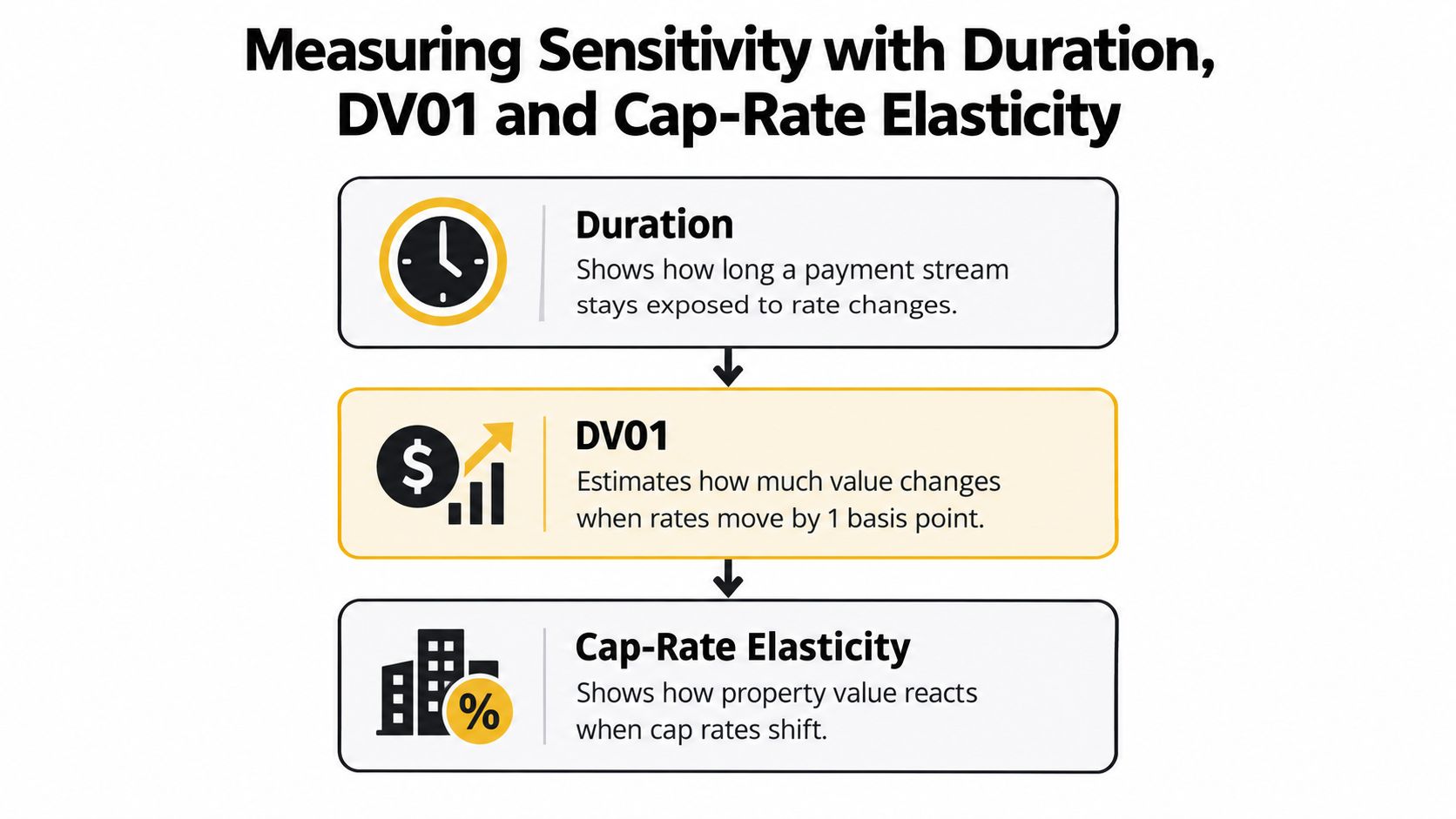
Bond traders solved this measurement problem long ago. You can borrow their tools without becoming one. Each metric answers a different question, so pick based on the decision you're making.
Here's how the three metrics stack from simplest to most practical for a property deal.
Duration Tells You How Long You're Exposed
Duration measures how long a stream of payments stays exposed to rate changes. Think of payments as buckets of water arriving over time. If most buckets arrive far in the future, a rate change today has more time to change what those buckets are worth now.
Modified duration turns that idea into a percentage. It estimates how much value changes for a given rate move. Longer payment streams swing more. Shorter streams swing less. That's why a long hold rental reacts differently from a quick flip, even at the same rate change.
DV01 Puts a Dollar Sign on a Tiny Move
DV01 is the dollar value change when rates move by one basis point. A basis point is one hundredth of a percentage point. Small unit, practical answer.
You use DV01 thinking when you ask a lender's question. If rates tick up a little, how many dollars of value or loan proceeds disappear across this loan or this portfolio? You don't need a trading desk formula. You need the habit of converting a rate wiggle into dollars before you commit, because dollars are what your margin is made of.
Cap-Rate Elasticity Connects Yield to Value
For income property, value comes from income divided by the cap rate, the yield buyers require. When rates rise, buyers often require a higher yield, so cap rates face upward pressure. Same income, higher required yield, lower value. The cap rate equation for real estate shows that math in detail.
Cap-rate elasticity describes how strongly value reacts when that required yield shifts. A stabilized property with durable income absorbs the shift better. A thin margin deal with optimistic rent swings harder, because there's no cushion between income and the yield buyers demand.
| Your situation | Metric to reach for first |
|---|---|
| Flip with short term debt | Dollar exposure on carry and exit |
| Rental you plan to hold | Duration and cap-rate elasticity |
| Loan or portfolio review | DV01 style dollar sensitivity |
Practical rule: If your money comes back soon, focus on dollars of carry. If it comes back slowly, focus on duration and yield.
Tracing Rate Shocks Through ARV, MAO and Lender Underwriting
Let's walk one shock through one deal. Rates jump while you're mid rehab. Nothing about the house changed. Everything about the math did.
This desk level view is where the shock first lands, in payment math and comp selection.

Payment Capacity Shrinks the Buyer Pool First
For a fixed loan amount, the monthly principal and interest payment rises as the rate climbs, and it doesn't rise in a neat straight line. Buyers qualify against a payment, not a price. When the payment for your list price crosses their limit, they don't negotiate harder. They disappear.
Federal Reserve Bank of San Francisco research found that an unexpected 1-percentage-point increase in mortgage rates caused by a monetary-policy shock was associated with an immediate 1% decline in house prices, reaching approximately 3% lower prices three weeks later. Three weeks is faster than a typical appraisal cycle. Your comps can go stale while drywall is going up.
ARV and MAO Absorb the Hit Next
ARV built on older sales assumes buyers who could finance those prices. After a shock, that assumption weakens. This doesn't always mean you slash ARV. It means you trust it less and you test a slower sale alongside a lower price.
Maximum allowable offer, or MAO, is your offer ceiling. You get it by starting from ARV, then subtracting repairs, costs, and your required profit. Lower the ARV or lengthen the exit and MAO falls. If you already bought above the new MAO, you don't have a pricing problem. You have a basis problem.
The walkthrough below shows how an analyst traces that chain instead of guessing at a haircut.
Lenders Reprice the Same Risk From Their Side
Slower sales extend your holding period. Extended holding means more interest, taxes, insurance, and possibly extension fees on rehab draws. Your true loan cost rises even if the stated rate never changes.
Lenders see that. They may size to a lower loan to value, hold back more reserves, or test whether rental income covers debt service with room to spare. That coverage test is the debt service coverage ratio, explained in the debt service coverage ratio guide for real estate. If coverage fails at the refinance rate, your exit through a loan closes even if a buyer might still pay your price.
Your decision changes at each link. Reprice the offer, cut scope, add reserves, or walk. What you can't do is keep the original ARV, timeline, and loan size all at once after the shock.
Step-by-Step Stress Tests for Flips, BRRRR and Lenders
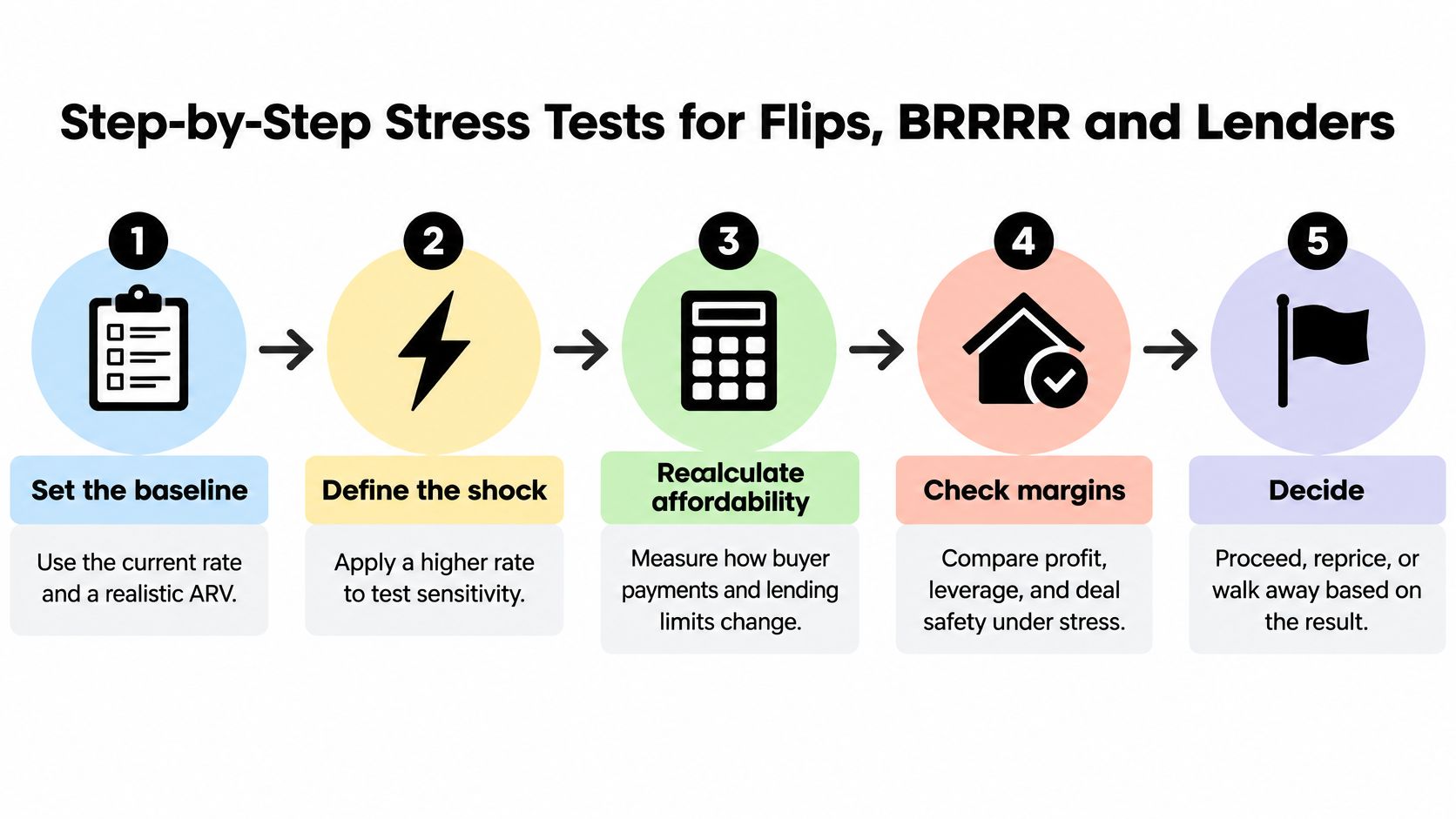
A stress test is a rehearsal. You break the deal on paper so the market doesn't break it with your money in it. Run the same five steps every time, then change what you stress based on your exit.
This sequence keeps the test repeatable across deals.
The Five Step Sequence
- Set the baseline: Use today's actual financing quote and a realistic ARV from recent, physically similar sales. Write down your expected days on market.
- Define the shock: Pick the rate that matters for your next financing event, then model it higher. Name the event, such as resale, refinance, extension, or maturity.
- Recalculate affordability: Rework the buyer's payment or your debt service at the shocked rate. Note who drops out.
- Rerun the deal: Rebuild ARV confidence, MAO, carrying costs, and loan proceeds under the shock. Test price and timing separately, then together.
- Decide: Proceed, reprice, restructure, or walk away based on which assumption breaks first.
Apply It to a Flip
Your critical rates are the bridge rate and your buyer's mortgage rate at resale. Stress both. Add a resale delay of several months and price the extra carry, taxes, insurance, and any extension fee your lender charges.
Then ask one question. Does the stressed MAO still sit above what you paid or plan to pay, with profit left? If the deal only works on a fast sale at full ARV, it doesn't work. It's a hope with a loan attached.
Apply It to BRRRR
BRRRR means buy, rehab, rent, refinance, repeat. Your make or break moment is the refinance. Stress the refinance rate against your coverage threshold and against a conservative appraisal, not the value you wish for.
Refinance windows can reopen fast, which cuts both ways. ICE estimated that about 3.1 million mortgage holders were in the money to refinance when rates fell below 6.38%, defined as achieving at least a 75-basis-point reduction, while refinance rate-and-term locks rose more than 170% year over year in December 2025. A modest drop can increase volume for some owners. Don't build your plan on catching that window. Build it to survive missing it.
Stress the financing event you can't avoid, not the headline rate you happen to see today.
Apply It as a Lender
Your borrower's starting coupon is the least interesting rate on the deal. Test the refinance rate available at maturity and a stressed exit value if you had to sell the collateral. Collateral value can hold up while liquidation takes far longer, and time is where your return leaks out.
Run the shock three ways. Price only, liquidity only, then both. The version that breaks your deal tells you what to negotiate, whether that's price, reserves, loan size, or term.
Mitigation Strategies and Tools for Modeling Rate Risk
You can't control rates. You can control how much a rate move is allowed to hurt you. Most defenses are boring, which is why they work.
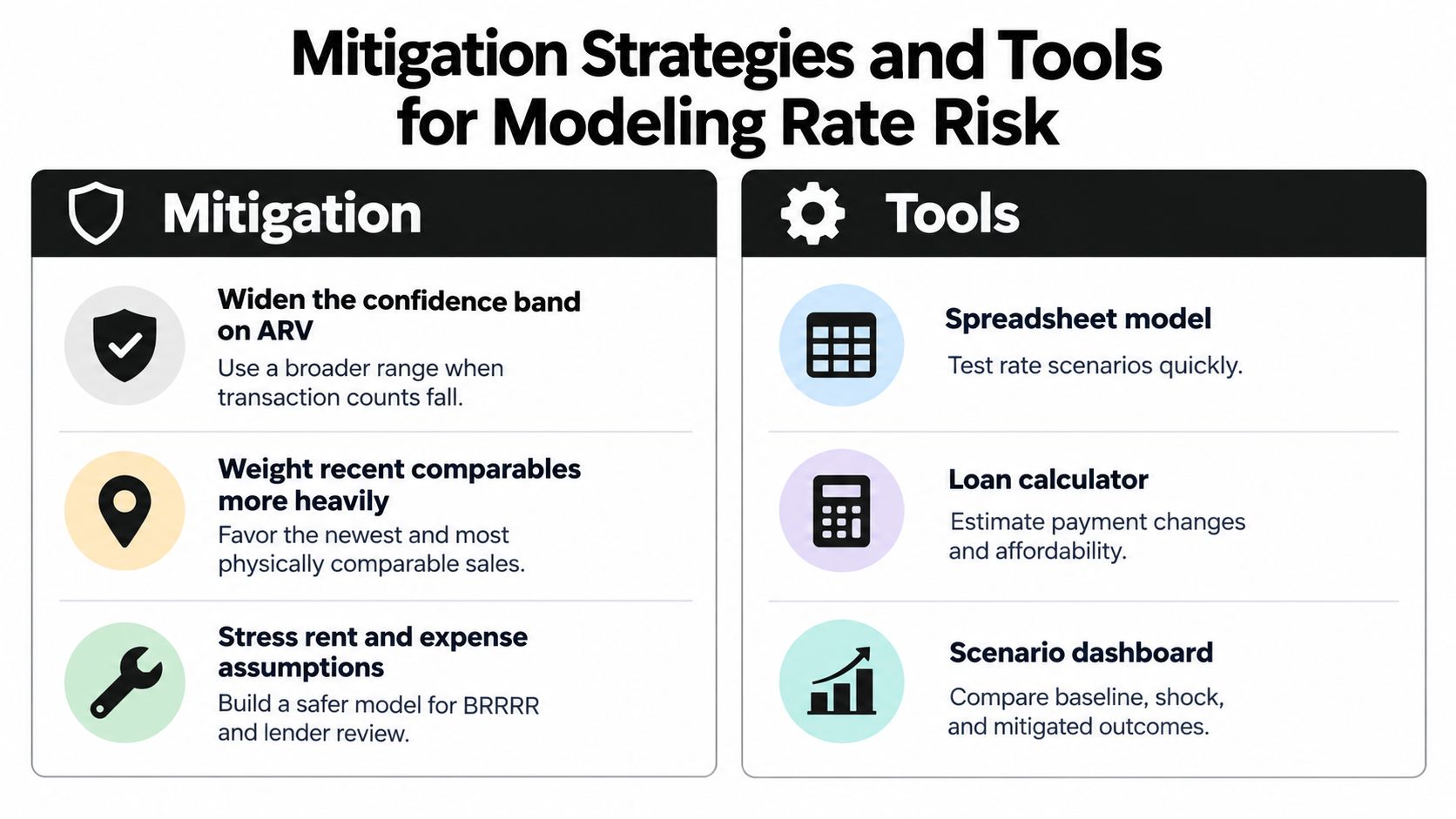
Here's the side by side view of defenses and the tools that support them.
Defenses That Cost Discipline, Not Money
Start with your comp set. In Q3 2025, about 80% of outstanding U.S. mortgages carried rates below 6%, including 20.0% below 3% and 31.5% between 3% and 4%, so recent sales may reflect a thin and rate-locked supply. Owners sitting on cheap loans avoid selling. Fewer sales means each comp carries more weight and deserves more suspicion.
- Widen the ARV confidence band: When transaction counts fall, present a range to yourself and underwrite to the cautious end.
- Weight recency and physical similarity: A newer sale of a similar home beats an older sale you have to adjust heavily.
- Stress timing separately from price: Model a slower exit even if you keep ARV unchanged, because carry is a real cost either way.
- Size reserves for the slow case: Cash held for extra months of carry turns a delay into an inconvenience instead of a default.
It also helps to evaluate profits against industry benchmarks when you review whether your stressed margin still looks like a healthy deal or like you're paying yourself too little for the risk. That outside check keeps optimism honest.
Spreadsheet Versus Platform Workflow
A custom spreadsheet gives you full control. You see every formula. The cost is manual work. You source comps yourself, rebuild scenarios by hand, and risk copying an old assumption into a new deal.
A platform workflow trades some control for speed and repeatability. Comp selection, distance and recency weighting, and adjustment breakdowns happen in a consistent structure. You rerun the same property with a different rate and exit timeline without rebuilding the file.
Judge both on three criteria. How fast can you produce a scenario grid? How clearly can a partner or lender audit the comps? How likely are you to rerun it before every offer? The broader habits behind that last question are covered in this portfolio risk management guide. The best tool is the one you'll use on a bad week, not just a good one.
Your Next Step with Rate Stress Testing
Let's put the pieces in order. You know which rate hits your buyer and which one hits you. You have duration, DV01 style dollar thinking, and cap-rate elasticity to size the exposure. You've traced a shock through payment capacity, ARV, MAO, and lender sizing.
You also have a sequence. Baseline, shock, affordability, rerun, decide. And you have defenses, wider confidence bands, fresher comps, a slower exit modeled on its own, and reserves sized for that slower case.
Why This Belongs in Every Offer
Investors often file rate risk under macro commentary, something to discuss after the numbers are done. That's backwards. Rate sensitivity changes the numbers themselves. It changes who can buy from you, how long you'll wait, what a lender will fund, and therefore what you can safely pay today.
A deal that survives only at today's rate is a bet on rates, not a bet on real estate. You may still take that bet sometimes. Take it knowingly, with the price adjusted for it.
One Deal, This Week
Pick one open or upcoming deal. Don't start with your whole pipeline. Name its next financing event. For a flip, that's the bridge loan and the buyer's mortgage at resale. For BRRRR, that's the refinance. For a loan, that's maturity.
Now run two versions side by side.
- Baseline version: Today's quote, your current ARV, your hoped for timeline.
- Stressed version: A higher rate at that financing event, a more cautious ARV, and a slower exit with full carry priced in.
Compare the offer ceiling in each version. The gap between them is your rate exposure in dollars. If you can't live with the stressed answer, reprice now while repricing is free. After closing, it isn't.
Do this once and it feels like homework. Do it on every offer and it becomes how you buy. That's the whole point. You're not predicting rates. You're refusing to let a rate you didn't model decide whether you make money.
Run your next deal through PropLab to get a comp backed ARV, a confidence scored valuation, and a Max Offer Price with repairs and margin built in, then rerun those outputs under your stressed rate and slower exit to see if the offer still clears. Start with a free analysis on one property this week and share the exportable report with your partner or lender before you commit capital.
Tags
About the Author
P
PropLab Team
Real Estate Analysis Experts
The PropLab team consists of experienced real estate investors, data scientists, and software engineers dedicated to helping investors make smarter decisions with AI-powered analysis tools.
Free tool
Get the ARV of any property in 30 seconds
Skip the spreadsheet. Enter an address and get an after-repair value backed by real comps.
