General
Off-Market Property Sales: How to Find and Price Them
November 27, 2026
21 min read

In 2022, off-market transactions accounted for 17.8% of all residential property sales in England and Wales, according to TwentyEA's Property & Homemover Report. Most investors treat private deals as a secret handshake club where insiders scoop up steep bargains while everyone else fights over public portals. That framing is backwards and expensive.
Off-market property sales aren't a shortcut to below-market pricing. They're a pricing and due-diligence problem where you're underwriting with less public data, weaker price discovery, and a seller who wants something specific in exchange for skipping the open market. Sometimes that trade leaves room for a real discount; just as often, the spread is too thin to cover hidden repair scope, title defects, or extra holding time.
If you buy privately without a disciplined offer model, you don't beat the market. You just overpay.
What Off-Market Property Sales Actually Are
An off-market sale is a completed transaction where the property was never publicly advertised for the entire marketing period. It isn't a home that sat on a portal for a week, drew weak interest, and got pulled down while the agent worked old inquiries. If the property hit the public feed at any point before closing, it's a withdrawn or re-marketed listing, not a true private sale.
Acquisitions teams routinely confuse true private deals with two neighboring categories:
- Pre-market and "coming soon" listings: An agent teases a property before full MLS or portal launch to build early demand. These homes are headed for public exposure, so buyers aren't negotiating in a closed channel.
- Pocket listings and office exclusives: A brokerage keeps a signed listing inside its own office or shares it selectively with known clients. Some of these close privately, while others eventually migrate to public portals if the first round of buyers passes.
In practice, four types of participants sit across the table in a genuine private transaction. You'll deal with a private homeowner who wants discretion, a retained buying agent working against a specific acquisition brief, an estate agent matching an unadvertised home to a pre-vetted buyer already on file, or an investor who approached the owner directly. In higher-value urban submarkets, boutique specialists like Luxury Homes London curate unadvertised homes for discerning buyers specifically for sellers who refuse public portals and open-house traffic.
How Large the Off-Market Segment Is
Most buyers assume private sales are a rounding error until they look at completed transaction volume. Research reported by Property Reporter covering 2022 to 2024 found that 15.8% of properties in England and Wales changed hands without being publicly marketed, averaging roughly one in six completed sales. The annual share moved sharply with shifting buyer demand and interest rates, sliding from 17.8% in 2022 to 17.2% in 2023 and down to 11.4% in 2024.
In the United States, listing-side tracking shows a comparable pool of restricted inventory. Research cited by Newsweek found that private office-exclusive listings in the Bright MLS Mid-Atlantic region reached nearly 8% of new listings by February 2025.
| Market | Period | Off-market share | What it measures |
|---|---|---|---|
| England and Wales | 2022-2024 average | 15.8% | Roughly one in six completed sales |
| England and Wales | 2022 | 17.8% | Peak year in the series |
| England and Wales | 2023 | 17.2% | Slight contraction from 2022 |
| England and Wales | 2024 | 11.4% | Sharp contraction as conditions changed |
| Bright MLS Mid-Atlantic new listings | February 2025 | Nearly 8% | Office-exclusive listings, not completed sales |
Notice the definitional trap sitting right inside that table. You can't compare a completed-sale figure from England and Wales directly against an office-exclusive new-listing share from Bright MLS without accounting for attrition. A property that starts private and later goes live on the MLS inflates listing-side counts, whereas completed-sale data only captures homes that stayed off public channels from start to finish.
Why Off-Market Does Not Mean Below Market
Restricted exposure usually lowers a seller's realized price, not because the buyer found a magic discount, but because fewer bidders competed for the asset. That distinction changes how you underwrite. Treating a private deal as automatically cheap makes you sloppy on comps, and sloppy comps wipe out your margin faster than a bidding war ever will.
Empirical benchmarks show just how narrow private-sale discounts are once you strip away mythology. In a 180,921-property residential study published in the Journal of Real Estate Finance and Economics, estate-sale homes (a close proxy for privately marketed, seller-motivated stock) sold for 3.6% less than comparable typical transactions while closing roughly 3.4% faster, or about four days sooner. Sellers traded a modest slice of price for speed and simpler execution, while buyers priced in limited marketing and uncertain physical condition.
Separating Cash Certainty From Privacy
Payment structure explains an even larger slice of the gap than secrecy does. A propensity-score-matched study of residential sales in Tallahassee, Florida from 2006 to 2015, archived on PubMed Central, found that cash-only transactions carried an average 4.9% discount relative to overall housing prices. On a projected $250,000 home, that equals roughly $12,250, reflecting the seller's willingness to trade price to skip financing contingencies, appraisal delays, and lender fallout.
When you isolate routine private listings from cash or estate distress, the spread shrinks dramatically. A national dataset covering 2024 to 2025 reported by WRE News found that probable private listings sold just 1.26% below standard MLS transactions in 2024 and 0.87% below in 2025, working out to approximately $3,055 per sale in 2025. In that same dataset, coming-soon listings sold 1.16% above standard MLS sales in 2025, confirming that pre-market teasing isn't economically equivalent to a private sale.
| Benchmark | Sample or period | Measured gap | How to use it |
|---|---|---|---|
| Estate-sale proxy study | 180,921 residential transactions | 3.6% below comparable sales, |
Baseline for seller-motivated private stock; adjust for condition, never apply blind |
| Cash-only sales study | Tallahassee, 2006-2015, propensity-score matched | 4.9% below overall prices (~$12,250 on a $250,000 home) | Sizes the certainty premium a cash offer can justify |
| Probable private listings | 2024 national dataset | 1.26% below standard MLS sales | Too thin on its own to cover title, condition or financing risk |
| Probable private listings | 2025 national dataset | 0.87% below standard MLS sales (~$3,055 per sale) | Treat as an upper bound on the privacy discount |
| Coming-soon listings | 2025 national dataset | 1.16% above standard MLS sales | Limited pre-market exposure is not the same as a private sale |
Underwriting rule: A 1% to 2% privacy discount won't absorb a single surprise roof replacement, a title cloud, or an overestimated after-repair value. Never bid off the seller's asking price; build your valuation from scratch as if the property had full open-market exposure.
The Four Numbers Every Private Offer Needs
Because private deals carry selection bias, applying a blanket percentage off market value guarantees bad decisions. You'll overpay for dated homes with hidden repair scope and walk past motivated owners whose timeline gives you real negotiating power. Instead, every defensible offer model rests on four independent quantities:
- Condition-adjusted market value: Estimate what the property would fetch on the open market in its current state, plus its stabilized value after repairs, using verified nearby sales rather than the seller's anchor price.
- Expected days to resale: Model how long the asset will sit once you list it publicly, adjusting for local absorption rather than assuming the fastest comp in the zip code.
- Carrying costs: Tally debt service, property taxes, insurance, utilities, and maintenance across your full rehab and resale window.
- Risk reserve: Hold back an explicit buffer for condition uncertainty, title friction, and weaker comparable data before you translate your numbers into a maximum offer.
Where Off-Market Deals Actually Come From
Stop thinking of private inventory as a hidden vault you open by knowing the right broker at a cocktail party. Acquisitions teams that close private deals reliably treat sourcing as disciplined channel testing. Every channel has a distinct cost shape, lead time, and seller profile, and mixing five unmeasured channels at once is the fastest way to burn marketing cash.
Before building a weekly routine, map the five primary sources that consistently put unadvertised properties on an investor's desk.
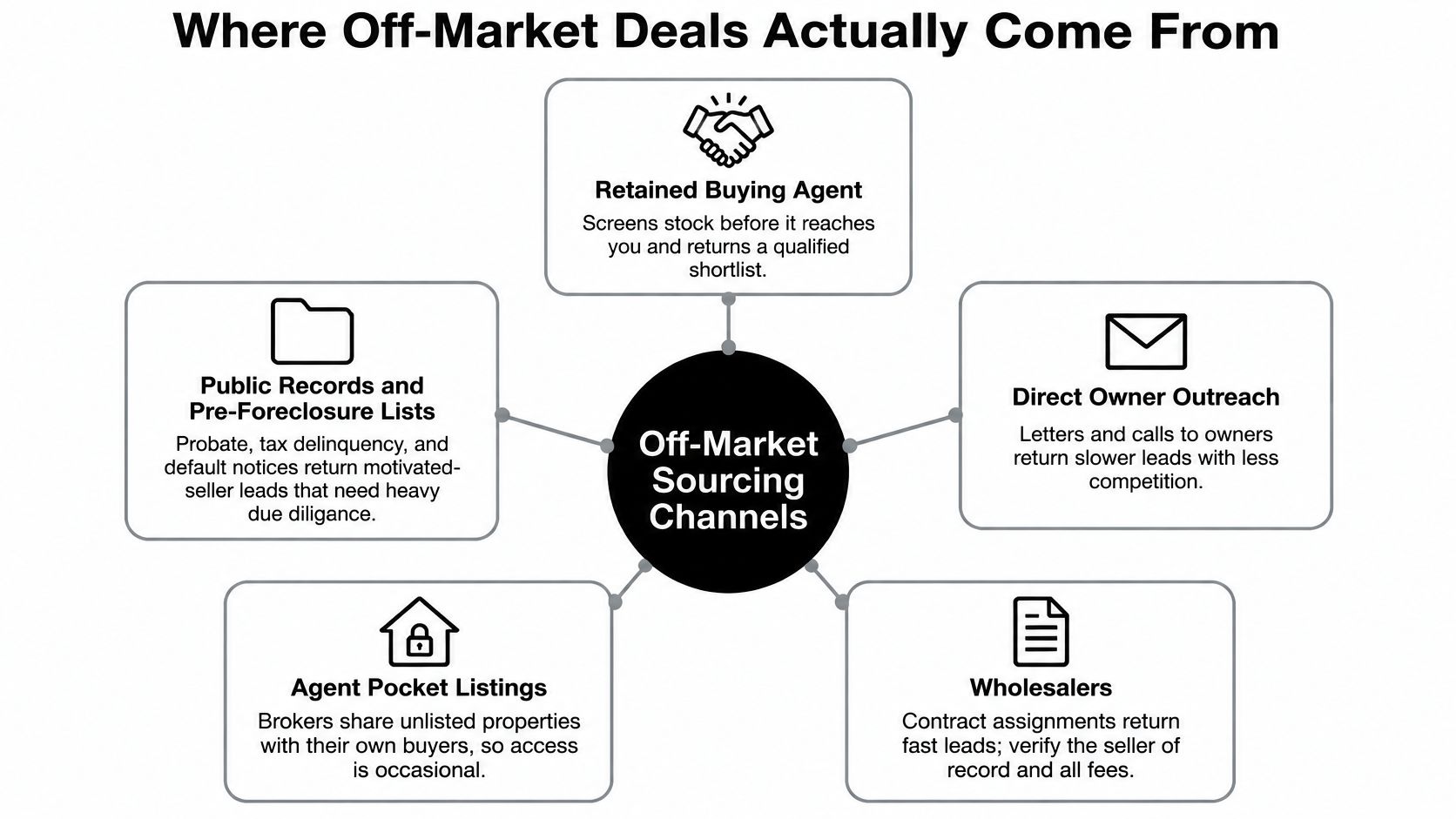
Comparing the Five Sourcing Channels
A retained buying agent filters stock before it ever reaches your inbox, returning a short, pre-qualified list matched to your buy box. Expect to pay a percentage commission or fixed fee per introduction or completed purchase, with deal flow arriving steadily once the agent trusts you can close.
By contrast, agent pocket listings come from listing brokers who match a discreet seller to buyers already sitting in their database. You don't pay an upfront retainer, yet access stays sporadic unless you're the buyer who inspects quickly, waives fluff, and closes on time.
Direct owner outreach through handwritten letters, postcards, door knocking, or targeted calls reaches long-term owners before they speak to a broker. Competition drops sharply here, though response cycles take weeks or months of repeat touches to mature, and your upfront spend goes into data lists and postage.
Wholesalers sit at the opposite end of the speed curve. They lock up motivated sellers under assignable purchase agreements and pitch you deals ready to close fast. Their assignment fee is baked directly into your purchase price, so you have to verify the seller of record, confirm chain of title, and audit their repair assumptions yourself.
Finally, public records and referral edges pull leads from probate filings, tax delinquency notices, pre-foreclosures, and local professionals who hear about sales early. Property managers, general contractors, local investor groups, and probate attorneys regularly meet owners who need a clean exit without staging a house. If you're building relationships with estate attorneys, it helps to understand how legal billing affects an estate's cash flow and urgency; Semper Terra breaks down how families compare tiered, hourly and flat fees when settling an estate. These leads carry the highest motivation and the heaviest due-diligence burden.
Running a Measurable Weekly Routine
Pick one channel at a time and commit to it for a full quarter so your numbers mean something. Log every inbound address in a simple CRM or spreadsheet on the day it arrives, recording the source, date of first contact, and current status.
Track three metrics every Friday:
- Cost per lead: Total channel spend (mailers, list subscriptions, referral gifts, or retainer fees) divided by qualified seller conversations.
- Lead-to-offer rate: The share of conversations that clear initial screening and receive a written, underwritten offer.
- Days to first viewing: How quickly a lead moves from initial contact to physical walkthrough, which exposes bottlenecks in your own follow-up.
High lead volume without signed contracts is an expensive hobby. If a channel can't show measurable progress toward accepted offers within a quarter, cut the spend and reallocate your hours to a source you can track.
How to Evaluate an Off-Market Deal in Six Steps
Once an unadvertised address lands on your desk, speed only helps if your underwriting holds up under scrutiny. Private sellers don't hand you a tidy MLS packet with high-resolution photos and standardized disclosures, so your evaluation process has to replace that missing structure.
Here is the six-step sequence that moves a raw off-market lead from first message to a defensible offer.
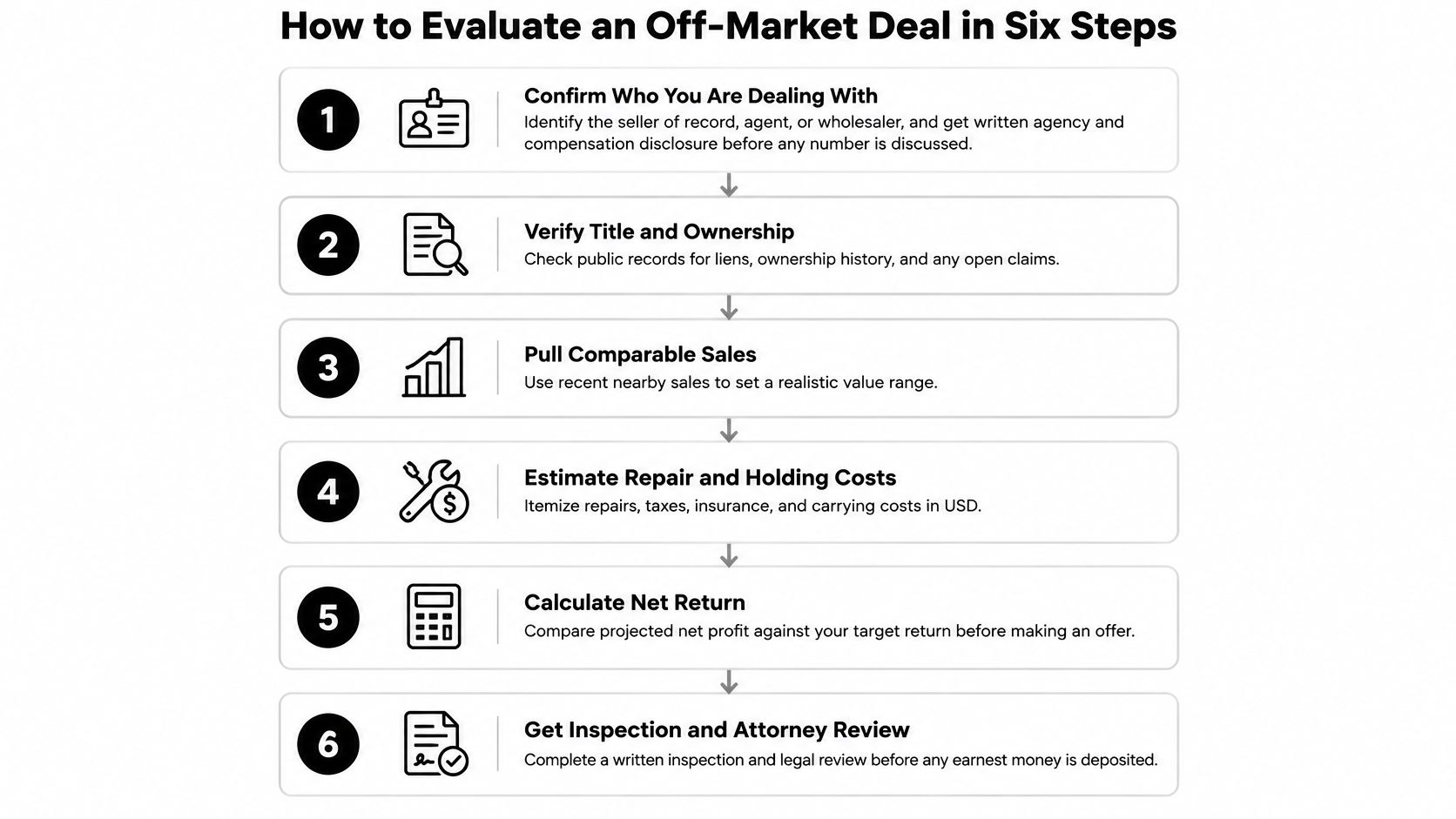
Confirm who sits across the table. Verify whether you're speaking with the deeded owner, a licensed listing agent, or a wholesaler holding an assignable contract before anyone mentions a dollar figure. Require written agency and compensation disclosure up front so you know who represents whom and whether a hidden fee is sitting inside the price. If the contact can't show authority to sell or assign, stop underwriting and move on.
Verify title, ownership, and build your own comps. Pull county records to confirm ownership history, existing mortgages, and open liens before trusting any seller claims. Then assemble condition-adjusted comparables yourself rather than accepting a wholesaler's cherry-picked sheet, pulling three to six recent nearby sales (say within half a mile from the past six months) and adjusting for square footage, bedrooms, bathrooms, lot size, and finish level. You don't need MLS access to do this reliably; our platform pulls property data from public records, tax assessments, and market data, and our guide to real estate comp analysis walks through how to weight distance and recency cleanly.
Set your After Repair Value as a range. A single ARV number creates false precision on a private deal where comp density might be uneven. Anchor a low, base, and high value range with an explicit confidence level based on how closely your comps match the subject property's layout and neighborhood pocket. For reference, users report that our ARV estimates land within 3-5% of actual sale prices in most markets, which is the tightness you should demand before locking in a rehab budget.
Itemize repair and holding costs from a walkthrough. Walk the property with a contractor or detailed checklist and price every major system (roof, HVAC, electrical panel, plumbing supply and drain lines, foundation, windows, kitchen, and baths) line by line. Add property taxes, hazard insurance, utilities, and financing carry across your projected timeline, then tack on a dedicated contingency line for defects hidden behind drywall. Guessing a flat per-square-foot rehab number without opening the electrical panel is how flips lose their entire margin.
Calculate your maximum offer and net return. Subtract total rehab costs, closing costs on both purchase and resale, full holding costs, and your required profit margin from your conservative ARV. Compare the resulting net return against your minimum hurdle rate for that strategy before putting anything in writing. If the seller's verbal expectation sits well above your number, you now know whether terms can bridge the gap or the deal is dead.
Stress-test the offer before depositing earnest money. Never sign off on a base-case spreadsheet alone, and always schedule a formal inspection and attorney review before your deposit goes hard. Say you rerun your numbers in a downside scenario where ARV comes in 5% low, rehab runs 20% over budget, and resale stretches 90 days longer than planned. If the deal flips negative under that stress test, your offer is too high and needs to come down before you pick up the phone.
Seeing how experienced investors weigh comps and seller motivation in real time makes these adjustments click faster. The video below walks through evaluating private deals on the ground so you can spot pricing traps early.
An off-market spreadsheet isn't finished when the base case looks profitable. It's finished when the downside case still leaves you solvent.
How to Approach a Private Seller and Hold Your Number
Most investors blow private negotiations in the first five minutes by leading with a low price and hoping the seller counters. A homeowner who skipped the open market isn't shopping for a haggler. They're shopping for certainty, privacy, and a clean closing date.
Lead With Proof and Questions
Open every serious conversation with your closing credentials, not your bid. Put a current proof-of-funds letter, your named closing attorney or solicitor, and your target completion date on the table immediately so the seller knows you're real.
Before you name a single figure, ask three direct questions and let the owner talk:
- Why skip the open market? Their answer tells you whether they value privacy, hate showings, or are hiding deferred maintenance.
- What is your ideal timescale? A seller who needs thirty days to pack reacts very differently from an estate executor facing a tax deadline.
- What did a local agent quote you? Knowing their anchor price shows you early whether their expectations live in reality.
Present Built Numbers and Restructure Terms
When you deliver your offer, attach the evidence behind it: your adjusted comparable sales and your line-item repair summary. A number backed by transparent math reads as an underwriting conclusion rather than an arbitrary lowball.
If the owner's expectation exceeds your maximum by more than your risk reserve, don't creep your price upward just to keep the call alive. Restructure the terms instead. Offering a flexible completion window, a short post-closing rent-back so they can move calmly, or buying the house strictly as-seen with no clean-out required often solves their real problem without touching your margin.
Put conduct and clarity in writing from the start: a simple non-disclosure agreement if requested, a non-circumvention clause protecting the introducer, explicit agency and referral-fee disclosures, and a clear line stating who pays which closing costs. Include a firm decision deadline in the same message, and write your walk-away price on a piece of paper before you dial. Sellers accept offers when your terms solve their headache, not when you argue hardest.
The Diligence Checklist That Keeps a Private Offer Safe
The gap between a fast off-market close and an expensive lawsuit is documentation, not luck. Skipping the MLS removes public eyeballs, portal history, and standard brokerage nudges that usually catch sloppy paperwork early. Without that built-in friction, undocumented assumptions replace verification.
Offer-Ready Evidence and Stop Signals
Treat every item in the table below as mandatory evidence before your offer turns into a non-refundable commitment. One unresolved stop signal should pause or end the deal immediately.
| Evidence | What it confirms | Stop signal |
|---|---|---|
| Independent title and lien search | Clean ownership, mortgages and judgment liens | Unreleased lien or unclear heirship |
| Permit and zoning verification | That additions, conversions and use are legal | Unpermitted addition or non-conforming use |
| Insurance and flood-risk review | Insurability and true carrying cost | Quote far above the seller's number, or no quote at all |
| Seller disclosure and known-defect questionnaire | What the owner already knows | Refusal to sign, or answers that shift between calls |
| Occupancy and tenant confirmation | Vacant possession or a lease you inherit | Verbal lease, or an occupant who is not on the deed |
| Repair-scope walk or contractor estimate | Real rehab numbers against your model | Access refused, or scope beyond a cosmetic refresh |
| Written agency and compensation disclosure | Who represents whom and who gets paid | Undisclosed assignment fee or double-ended commission |
| HOA dues, covenants and assessments | Recurring cost and use restrictions | Pending special assessment or rental cap |
| Code violations and utility status | Immediate spend on day one | Open violation with no remediation plan |
Title work deserves special discipline on private sales, particularly with inherited homes or direct-to-owner contracts where no broker ever audited the deed. If you're unfamiliar with what owner's and lender's policies cover when an old lien surfaces, Lein Law Offices outlines title insurance basics for Northern Wisconsin buyers in plain terms that illustrate why independent title verification matters everywhere. For a broader step-by-step verification workflow across inspections, municipal checks, and financial records, run through our real estate due diligence checklist before waiving a single contingency.
Legal Duties and Contract Mechanics
Private status doesn't pause the law. As United States Real Estate Investor notes, off-market sales don't eliminate seller disclosure duties; rules vary by jurisdiction, yet known material defects generally remain relevant even without an MLS listing. Regulators and industry bodies are also scrutinizing whether owners receive clear notice before agreeing to restricted marketing and whether closed networks introduce fair-housing or fiduciary risks.
Contract check: Speed comes from having your inspector, title company, and lender queued up before signing, never from stripping protective clauses out of the purchase agreement.
Build four concrete protections into your off-market contract so you preserve your speed advantage without betting blind:
- Inspection window: A defined period allowing full access for licensed inspectors and contractors to verify your repair scope.
- Financing and appraisal contingency: Protection if your lender's independent valuation lands below the agreed purchase price, unless you're closing strictly in cash.
- Document-delivery deadline: A hard date by which the seller must deliver leases, HOA packets, disclosures, and payoff details, with your review clock starting only after receipt.
- Protected walk-away right: Plain language confirming your earnest money returns in full if you cancel within the contingency window based on documented findings.
When Off-Market Suits You and When It Does Not
Not every investor belongs in private deal channels. Chasing unadvertised homes without the right capital structure, operational support, or valuation discipline burns months you could spend closing cleanly on listed inventory.
| Buyer or investor | Fit | Main risk to manage |
|---|---|---|
| Cash-heavy fix-and-flip with a contractor on call | Strong | Paying peak-market prices into a slower resale market |
| BRRRR and buy-and-hold investor | Moderate | Thin rent comps on a property with no rental history |
| Wholesaler assigning the contract | Conditional | Agency, disclosure and marketing rules |
| First-time investor relying on portal alerts | Poor | Sees almost none of this inventory and has no pipeline |
| Acquisitions team needing volume | Strong with process | Inconsistent underwriting across analysts |
| Lender underwriting a private sale | Workable | Valuing a property with limited comparable data |
A cash-heavy flipper with a contractor ready to walk a house within twenty-four hours is the natural buyer for private stock; their speed solves a seller's problem. A BRRRR investor faces trickier math because an owner-occupied private home rarely comes with verified rent history, making refinance appraisals tighter. Wholesalers operate right along the edge of disclosure, licensing, and agency rules, while a first-time buyer refreshing portal alerts won't see genuine private inventory until they build a dedicated outreach routine. For acquisitions teams and private lenders, the bottleneck isn't contacts, it's consistent valuation across every file.
Why Private Volume Expands and Contracts
Treat off-market share as a shifting market signal rather than a permanent constant. Historical data from Hamptons showed that 7% of homes across Great Britain sold off-market in 2019 before climbing through 2020 and 2021 to a five-year high of 10%. Geography shifted alongside volume, with 57% of those private sales occurring outside London, up from 49% in 2019 and 45% in 2015.
Price tier mattered even more. Among London homes priced above £1 million, the off-market share climbed to 28%, up from 18% three years earlier, marking a 10-percentage-point jump or roughly a 56% relative rise. Tight inventory, high-value submarkets, and relationship-driven neighborhoods push sellers to trade public exposure for quiet execution.
Use one blunt test before investing hours into any private lead: if you can't clearly name what the seller gains by staying off the open market, you're probably paying for their convenience.
Set Your Maximum Offer Before You Make the Call
Decide your ceiling before you ever dial the owner, never in the driveway after an emotional walkthrough. Put the equation on one line and keep it visible during the call: condition-adjusted value minus repairs minus closing and holding costs minus your required profit equals your maximum offer. Write every underlying assumption right beside that figure, because under negotiation pressure people rarely abandon their formula, they inflate their ARV or trim their rehab line to justify saying yes.
Underwrite every off-market address the same day it hits your inbox. When you run a property through PropLab, the Max Offer Price is calculated from ARV minus repairs, includes a built-in profit margin, and is ready to send to the seller. You can export the Offer-Ready Report as a professional PDF with a shareable link in a lender-ready format, getting your capital partner or hard money lender aligned before you open price discussions. If you want to double-check how different exit strategies shift your offer ceiling, review our breakdown of how much your max offer should be across flips and rentals.
Hold one final rule: if the documented discount doesn't cover your diligence findings plus full carrying costs, walk away cleanly. The next motivated private seller is one mailing away.
When an unadvertised address lands on your desk, PropLab pulls public records, tax assessments, and market data without MLS access to generate comps, an ARV, rehab estimates, and an offer-ready PDF report in about 60 seconds. Run your next private lead before you make the call so your maximum offer, risk reserve, and lender packet are locked in from minute one.
Tags
About the Author
P
PropLab Team
Real Estate Analysis Experts
The PropLab team consists of experienced real estate investors, data scientists, and software engineers dedicated to helping investors make smarter decisions with AI-powered analysis tools.
Free tool
Get the ARV of any property in 30 seconds
Skip the spreadsheet. Enter an address and get an after-repair value backed by real comps.
