General
Off the Market Homes: How Investors Find Them
October 31, 2026
15 min read

In a National Association of REALTORS® 2025 seller profile, for-sale-by-owner sales made up just 5% of transactions from July 2024 through June 2025, down from as much as 21% in 1985. That changes the way investors should think about off the market homes: they aren't a giant stash of overlooked bargains. They're a smaller, varied pool of leads where seller motivation, property condition, and the reliability of the available records determine whether the deal is worth pursuing.
A withdrawn listing, an heir's property, and a direct sale to a neighbor can all be called off-market, but they don't carry the same information or negotiating power. Start by naming the path. Then value the house on evidence you can verify, not on the assumption that less exposure automatically means a lower price.
What Off the Market Homes Actually Cover
Say an owner is open to selling, but a buyer can't find the home in public listings. That's a practical working definition of an off-market home: a property offered or transferred without a public listing a buyer can find. It's not the same as a home temporarily unavailable between showings, and “off-market” isn't one standardized transaction type.
The label can cover a direct owner sale, an agent's pocket or pre-market opportunity, a withdrawn listing, a distress or pre-foreclosure lead, an inherited property, an auction, or a wholesaler assignment. Before spending on mail, skip tracing, or offers, record which path you're dealing with. That first label helps you anticipate who controls the sale, what information may be missing, and what level of influence is realistic.
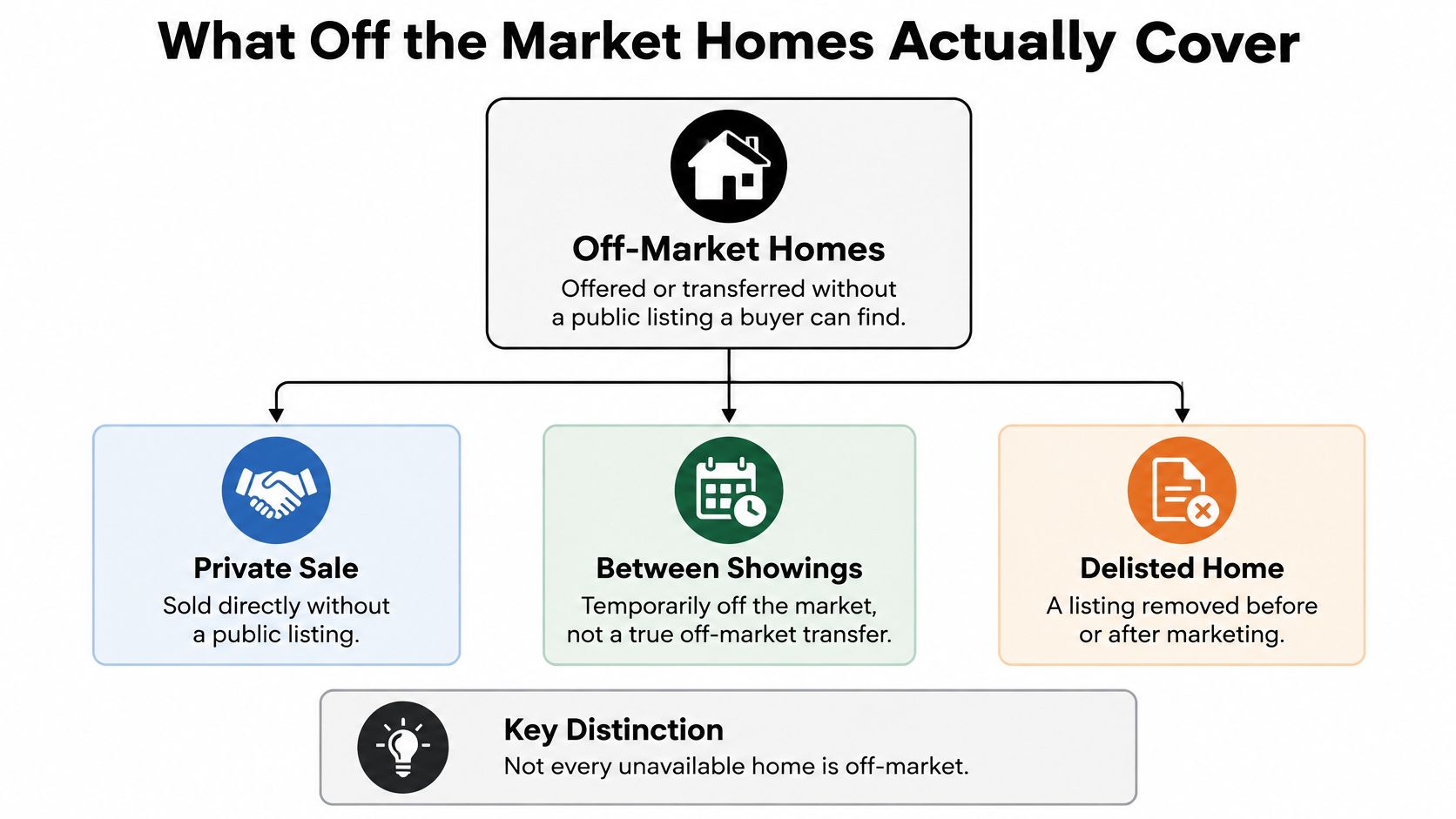
The National Association of REALTORS® reported that 5% of sellers used FSBO in its 2025 profile, which covers transactions from July 2024 through June 2025, while 91% used an agent. The FSBO share had reached as much as 21% in 1985. And a direct sale isn't necessarily a home actively marketed to the public: 60% of FSBO sellers already knew the buyer, while 40% did not actively market the property. Those figures point to a specialized channel shaped by relationships, privacy, estate situations, and sales before public exposure, not a hidden half of the market.
| Path | Who sells | Usual motive | Information quality | Leverage |
|---|---|---|---|---|
| FSBO direct to owner | Owner | Speed, privacy, or a known buyer | Thin; many aren't marketed | High if the buyer is already known |
| Pocket or pre-market | Listing agent network | Privacy or a price test | Better notes, limited exposure | Moderate |
| Withdrawn or delisted | Owner who paused a listing | Refused a cut, or waiting to relist | Last price and days on market exist | Low until motive is confirmed |
| Pre-foreclosure or distress | Pressured owner | Time and cash | Public records often lag | High, with title and condition risk |
| Probate or inherited | Heirs or estate | Speed, distance, or disagreement | Condition often unknown | Moderate to high |
| Auction | Court, lender, or seller | A timed or forced sale | As-is, inspection limited | Set by competing bidders |
| Wholesaler assignment | Investor, not the occupant | A fee on the spread | Only as good as the package | Fee can erase the discount |
Pocket listings still follow a different path from direct owner sales: an agent may privately circulate an opportunity rather than expose it broadly. For a useful explanation of that seller-side choice, see Homes By Carmen's pocket listing guide.
The sourcing work is more specialized when the direct-sale pool is small. A relationship sale may be real but weak as a market-value signal; an estate may be available but carry unknown condition or authority questions. Motivation and record quality change the deal. Name the path before you price it.
Legal and Ethical Limits on Off-Market Outreach
An owner record gives you a lead, not permission to contact someone by every channel. Before a campaign, check the solicitation and licensing rules that apply where the property sits. Do-not-call requirements, text rules, and mail rules can differ by channel and location, so don't treat a county record as consent to robocall or text.
Keep outreach truthful and respectful
Identify yourself and your purpose. Don't imply you're from the county, a lender, a court, or another authority. When contacting someone facing financial pressure or dealing with an inherited property, don't turn urgency into pressure. First establish whether the person you're speaking with has authority to discuss or sign a sale.
Fair housing rules apply to advertising and conversations, including how you describe neighborhoods and who you target or exclude. If a broker controls a pocket or office-exclusive opportunity, respect the brokerage's policies and any applicable cooperation rules. If you're not the listing agent, don't tell a seller that a property can't be shown or marketed elsewhere unless that's accurate.
For a campaign that uses property-owner contact details, decide what channel is allowed and how you'll handle a request to stop before sending the first message. A skip-tracing API guide for investor outreach can help explain the mechanics of identifying contact records, but a matched phone or mailing address doesn't remove your compliance obligations.
Protect the contract and the closing
Write down the actual seller, agreed price, timing, and conditions. Leave room for title work. Unreleased liens, unpaid taxes, and estate disputes can appear late, so don't treat a signed offer as proof that the seller has clear authority or title.
Off-market doesn't mean exempt from disclosure. Keep known defects, permit problems, flood concerns, and insurance issues in the file, and don't represent a property as inspected when it hasn't been. Auction terms can be different again, often with an as-is sale and bidder-specific conditions. Read those terms before deciding what due diligence you can complete.
Go or no-go: If the pitch only works because the seller doesn't understand the price, title situation, or who you are, don't make it. Confirm local solicitation and licensing rules before outreach, and bring in a real-estate attorney when estate authority or foreclosure paperwork is unclear.
How to Source Off-Market Homes Without False Urgency
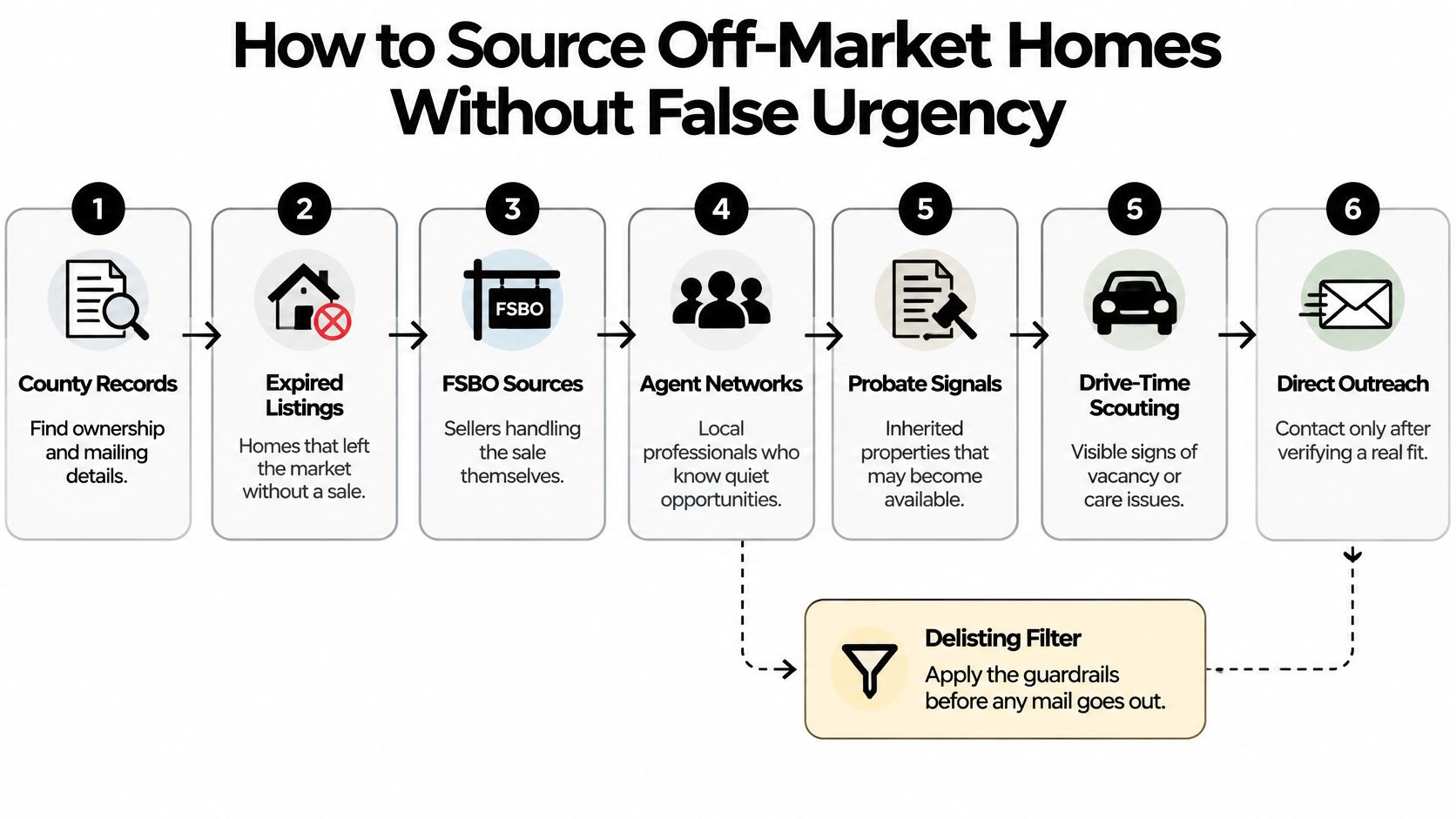
A sourcing channel tells you where a lead came from. It doesn't prove the owner is motivated. Apply the legal and ethical guardrails before each campaign, then use a consistent sequence so you know what each channel can produce.
Build a lead from the source
Networking. Tell agents, attorneys, property managers, and local investors your buy box, price band, and closing speed. Ask about pre-market opportunities or owners they already know, not to “send deals.”
Driving for dollars. Log addresses with visible vacancy, deferred maintenance, or boarded openings. Then match each one to the owner of record. A rough-looking exterior is a reason to check the property, not proof that the owner needs to sell.
Direct mail. Write to owners of identified properties, inherited homes, or long-held homes. Make one clear offer path and provide an easy way to decline. If you're building a repeatable process for finding potential sellers, this overview of how to generate cash buyer leads offers useful context on investor lead generation.
Public records. Check tax, deed, code, and lien records for ownership details and potential distress signals. Treat a filing date as a clue to investigate, not proof of a sale or current motivation.
Probate. Review the case enough to understand who has authority to act. Contact heirs gently, and don't assume that a family member who answers the phone can sign an agreement.
Auctions. Separate trustee, sheriff, and estate sales. Read the bidder terms and budget for an as-is property where inspection access may be limited.
Wholesalers. Ask for the comparable sales, the actual assignment fee, and evidence that the contract can be assigned. The deal package is only as useful as its records and terms.
Screen withdrawn listings before outreach
A delisted home can look like a ready-made opportunity in a spreadsheet. But national delistings rose 47% year over year in June 2025, and year-to-date delistings rose 34%, alongside a 29% year-over-year increase in active inventory, according to Fortune's report on 2025 housing-market delistings. A withdrawn owner may have paused, refused a price cut, or decided to relist. The withdrawal alone doesn't establish a bargain or a seller's willingness to negotiate.
Before mailing, record why the property left the market, its last asking price, and how long it was exposed. Keep the lead only if the owner's reason fits a problem you can solve at a price that works. Mark stale records clearly; an old filing or withdrawn status shouldn't create false urgency.
For a broader process for organizing repeated seller conversations and follow-up, see this guide to outbound lead generation. Outreach should follow verified fit, not substitute for it.
The Price Gaps Investors Should Not Treat as Rules
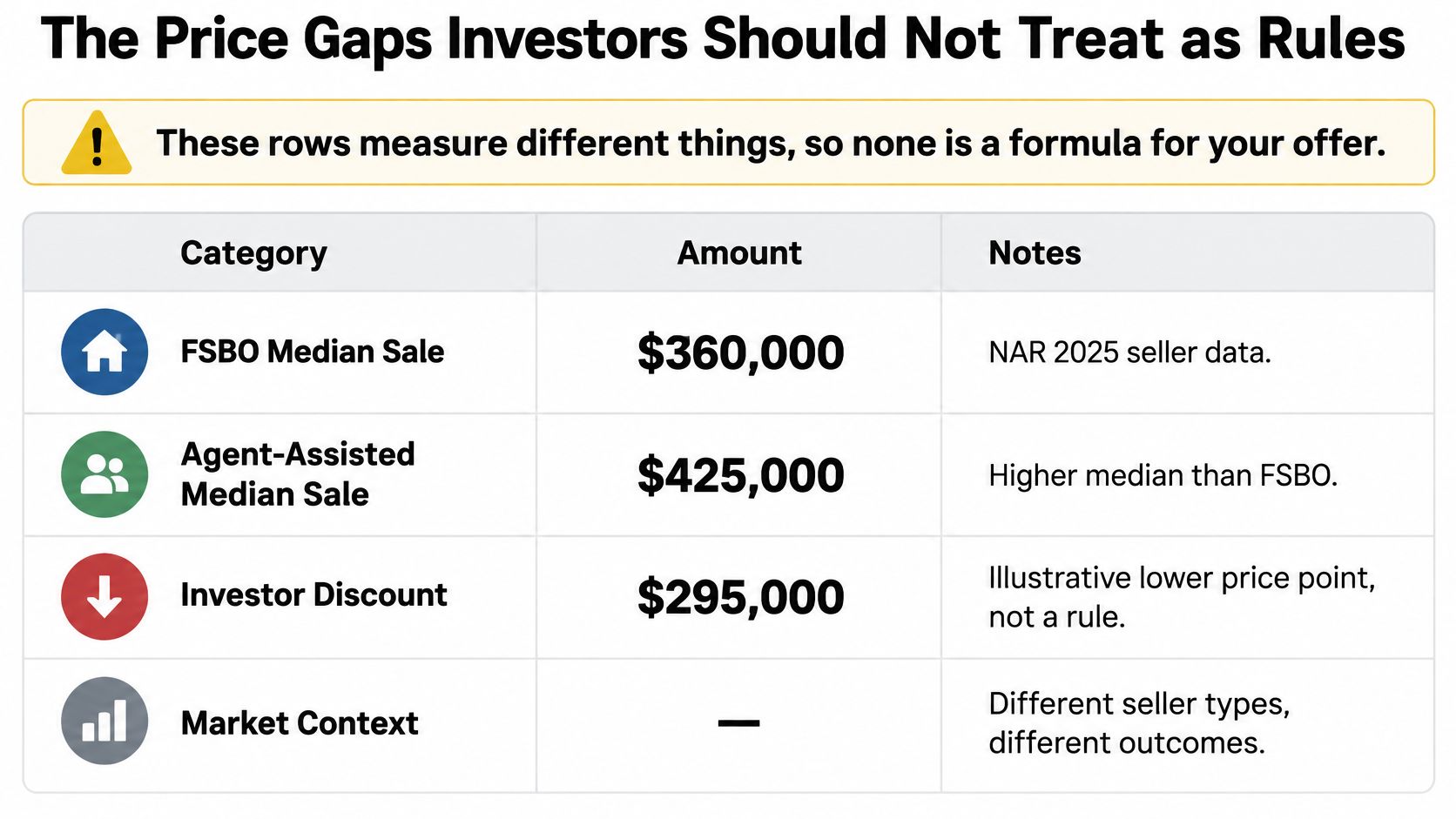
These rows measure different things, so none is a formula for your offer. A median FSBO sale price compares groups of sellers; a matched off-MLS study compares different sets of transactions. Neither tells you what a particular house is worth without checking its location, condition, marketing history, and deal terms.
| Source | What was measured | Private or FSBO figure | Listed comparison |
|---|---|---|---|
| NAR 2025 seller profile | Median sale price | $360,000 FSBO | $425,000 agent-assisted, about $65,000 or 15% higher |
| NAR same medians on FSBO base | Relative gap | FSBO median as the base | About 18% |
| NAR share trend | FSBO share of sales | 5% in the 2025 profile | 21% in 1985, about a 76% relative drop |
| 2025 study, 15 million-plus sales | Off-MLS versus MLS price | About 1.3% less overall | About 2.2% less on lower-priced homes |
| Same 2025 study by community | Off-MLS price gap | About 1.9% less in communities of color | About 1.1% less in majority-white neighborhoods |
| 2023–2024 private-sale analysis | Private versus MLS | About 3.2% less in predominantly minority neighborhoods | About 1.2% less in predominantly white neighborhoods |
| Bright MLS and Drexel | Matched MLS versus off-MLS | Off-MLS lower | MLS sales roughly 17.5% higher |
| San Francisco County 2022–2024 | MLS advantage | Off-MLS lower | About 18.6% average MLS advantage |
The NAR 2025 seller profile put the median FSBO sale at $360,000, compared with $425,000 for agent-assisted sales. That's a $65,000 gap, or about 15% relative to the agent-assisted median; NAR also described the difference as about 18% using the FSBO median as the base.
Those medians don't show that selling off-market causes a lower price. FSBO homes may differ in condition, location, urgency, property type, or seller circumstances. The same NAR profile identifies pricing the home, preparing it for sale, and completing the transaction on time as difficult steps for FSBO sellers. That context matters: these are not automatically interchangeable groups for comp selection.
Read each comparison on its own terms
The 2025 study summarized by HousingWire examined more than 15 million transactions and reported a smaller overall off-MLS gap, with different comparisons for lower-priced homes and communities. Its summary also describes a separate analysis of 2023–2024 sales in predominantly minority and predominantly white neighborhoods. Those neighborhood-specific findings aren't a blanket adjustment to apply to a single property.
A Bright MLS and Drexel analysis discussed by Fortune reported a roughly 17.5% MLS advantage over comparable off-MLS homes; the same Fortune article reports an 18.6% average MLS advantage in a San Francisco County study for 2022–2024. Those comparisons speak to their own samples and methods, not to every private sale.
Price the property first from recent, relevant open-market sales. Then ask what this seller is exchanging for privacy, speed, or a simpler process, and whether the condition and record quality justify any additional concession. A published gap can prompt a question; it can't set your maximum offer.
Why Investors Still Chase Private Inventory
The appeal is access and timing, not a guaranteed cheaper house. A seller may value a quick, private conversation over preparing for showings. An investor may learn about repair needs before the owner cleans up or stages the home, or agree on terms before a public campaign begins. Those advantages can matter when the buyer can close reliably and the seller's alternative is less convenient.
The fit differs by strategy. A flipper needs room for repairs and a resale spread. A wholesaler needs enough room for an assignment fee while leaving the end buyer a workable deal. A buy-and-hold or BRRRR investor may care more about purchase basis and rental performance than about a retail exit.
The weak point is assuming a private price is a tested market value. In NAR's 2024 profile, 63% of FSBO sellers said they didn't actively market their property, 40% relied on an appraisal, 36% used recent nearby sales to set the price, and 17% said getting the price right was the most difficult step, according to the NAR 2024 profile of home buyers and sellers. Limited exposure can mean fewer competing bids, while an appraisal or older nearby sales may not reflect current conditions.
Underwrite the seller's alternative, not just the seller's ask. A private sale can be a useful lead and a poor after-repair-value comparable at the same time.
Normalize each private transaction before using it in analysis: check the sale date, buyer-seller relationship, condition, financing, concessions, marketing period, and whether the transfer appears arm's length. Use verified open-market sales to establish ARV. Treat private transactions as secondary evidence unless you can confirm enough detail to compare them confidently.
Pursue the lead only when the seller's alternative is worse than your number after repairs, title, and a thinner comp set. If the owner already tested the market and still expects an aspirational price, the absence of a public listing doesn't create an edge.
Three Off-Market Situations and What the Numbers Mean
A neighbor buys from a longtime owner
A longtime owner offers the home directly to a neighbor who already knows the house. That relationship may make the transaction simple, but it can also shape the price. The NAR 2025 seller profile found that 60% of FSBO sellers already knew the buyer.
Treat the sale as a relationship lead, not automatically as proof of market value. Unless you can verify the condition, concessions, and arm's-length nature of the transaction, don't use its price as your ARV benchmark. The decision is whether open-market sales support your number without borrowing confidence from a neighbor-to-neighbor deal.
A withdrawn listing still carries its old ask
An owner pulls a listing after a long marketing run and continues quoting the original price. The Fortune account of 2025 delistings describes a market where withdrawals rose as inventory increased, which means a removed listing may reflect a pause or a rejected price cut rather than a newly motivated seller.
Check the last ask and how long the property was exposed, then ask why the owner withdrew. If your offer only works when the seller accepts a reduction they already rejected, it isn't a discount opportunity yet. Walk away unless the owner's position changes or the numbers work without that assumption.
An out-of-state heir needs a dated home handled
An heir who lives far away may value speed and fewer showings. That convenience can be real, but the house may have deferred maintenance, estate paperwork may be incomplete, and nearby sales may not match its block or condition.
The HousingWire summary of off-MLS pricing differences describes how comparisons vary by seller path and neighborhood. Don't turn those broad comparisons into an automatic discount for this house. Label the lead as an estate, confirm who can sign, and price the uncertainty in condition, title, and comparable evidence before deciding whether to proceed.

Price the Offer Before You Contact the Seller
Before a serious call, write down four things: the path, why the home is off the market, an ARV supported by recent open-market sales, and a repair estimate that assumes no retail preparation. Keep private-sale prices in your notes, but don't let them set ARV unless you can verify that the sale was arm's length and the property's condition is known.
Calculate the maximum offer from ARV minus repairs and the profit or assignment fee the deal needs. Then reduce it if title is unclear, disclosures are thin, or the comps are old or distant. If your number meets or exceeds the seller's last public ask, you may be taking on a price the market already rejected rather than buying an actual discount.
PropLab pulls property information from public records, tax assessments, and market data without requiring MLS access. Its analysis can help organize comps and ARV; the Max Offer Price is calculated from ARV minus repairs with a built-in profit margin. You can also use this guide to a real-estate offer calculator to understand how to frame the offer arithmetic.
For investors comparing funding options and timelines, this overview of financing investment-property purchases can help clarify how financing terms fit into an acquisition. Make the offer plainly, show your math, and pursue the lead only if the number still clears review.
Use PropLab to analyze a property's comps, ARV, and repair costs, then produce a clear maximum offer report you can share with partners or lenders. To assess your next off-market lead before contacting the seller, visit PropLab.
About the Author
P
PropLab Team
Real Estate Analysis Experts
The PropLab team consists of experienced real estate investors, data scientists, and software engineers dedicated to helping investors make smarter decisions with AI-powered analysis tools.
Free account
Underwrite your next deal in under a minute
3 free analyses, no credit card. ARV, rehab, comps and exit strategy in one report.
