General
Pros and Cons of Buying a Foreclosure House
October 21, 2026
13 min read
A foreclosure listing can look like the answer to a familiar investor problem: nearby homes appear to sell for more, and this one is priced low enough to leave room for a renovation and a profit. Then the details arrive. The property may be difficult to inspect, the auction may require certified funds, the title may need professional review, and the repair budget may be little more than an informed guess.
The pros and cons of buying a foreclosure house depend on more than its asking price. The key is to compare the likely resale value with the full cost of acquiring, repairing, financing, holding, and selling the property, while accounting for uncertainty. A low price is an opportunity only if the remaining spread can absorb the risks.
Why Foreclosure Discounts Need Careful Evaluation
An investor spots a distressed home listed well below the asking prices of nearby properties. The initial calculation looks promising: buy low, complete repairs, and sell at a higher price. But asking prices aren't reliable measures of what the home will be worth after renovation, and they don't reveal what the property will cost to make sale-ready.
A credible estimate starts with condition-adjusted comparable sales, not the most attractive nearby listing. The investor then subtracts the renovation scope, acquisition and closing costs, financing, holding expenses, and the cost of selling. For a property that can't be inspected fully, the calculation also needs a contingency for hidden conditions and a plan for what happens if the sale takes longer than expected.
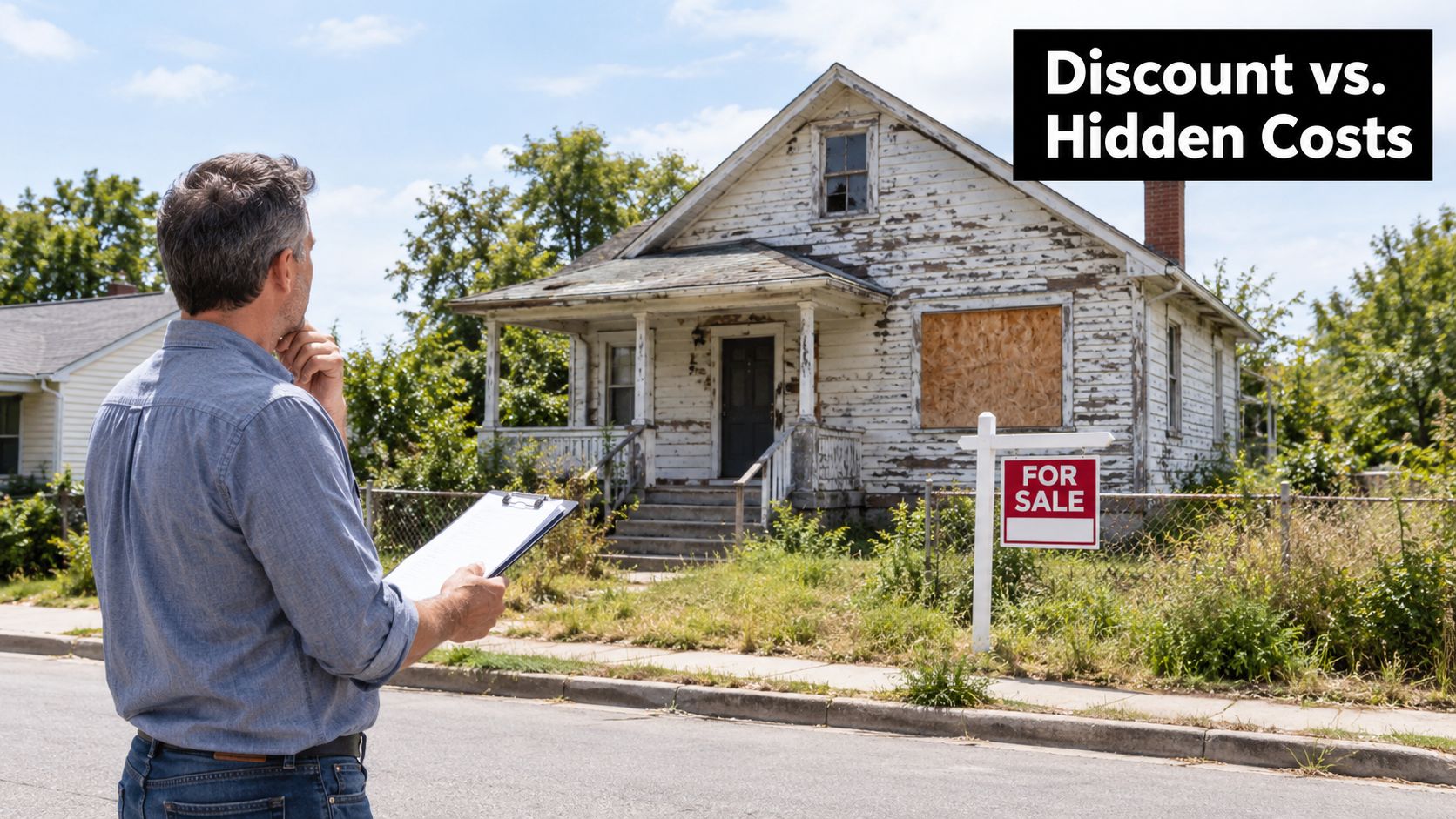
Foreclosure describes a sale process, not a uniform property type. A vacant home with visible wear that's listed by a bank can present a different investment from an occupied property sold at auction with limited inspection access. The purchase channel changes what you can learn before committing, how quickly you must pay, and whether conventional financing is realistic.
Research reviewed by the Federal Reserve found that estimated foreclosure discounts range from nearly 0% to 28%, with most studies reporting discounts above 12%. Newer studies that account more carefully for observable property condition and other factors generally estimate discounts of 10% to 20% (Federal Reserve review of foreclosure discounts). Those findings describe historical patterns, not a guaranteed margin on any particular property.
Practical rule: Treat the discount as a starting hypothesis. The deal works only if your conservative resale estimate still covers the full project cost, your required profit, and the uncertainty you can't remove before closing.
Understanding Foreclosure Sales Channels
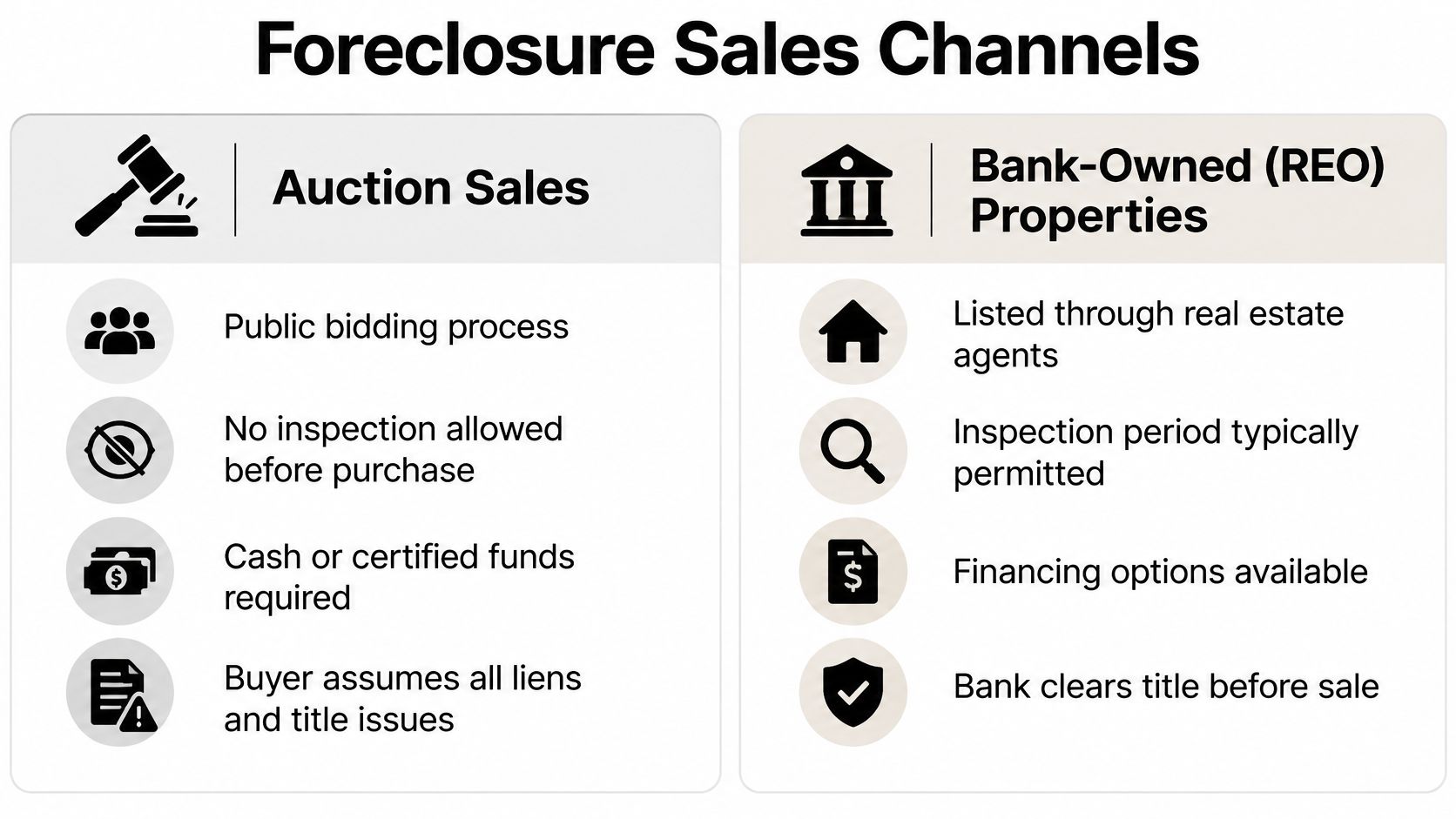
A foreclosure purchase typically falls into a materially different risk category depending on whether the home is being sold at auction or as bank-owned real estate, commonly called REO. The channel affects access and terms before it affects the price. A discount that suits a buyer with ready capital and experience managing uncertainty may not suit an investor relying on lender financing and a detailed inspection.
Auction purchases commonly require certified funds, offer little or no pre-bid inspection, and sell as-is. They may not provide clear-title protection, so buyers should investigate title and possible surviving liens before bidding. The short payment timeline can also make traditional financing impractical. REO properties may allow inspections and lender underwriting, but major repairs can still cause appraisal or financing problems (foreclosure auction and REO market overview).
The word foreclosure also tells you little about occupancy or condition. A property could be vacant, occupied by its former owner, or tenant-occupied. Confirm access, possession terms, and the seller's requirements before building an offer around an assumption that you'll be able to start work immediately.
| Factor | Auction Sale | Bank-Owned REO |
|---|---|---|
| Inspection access | Often limited or unavailable before bidding | May permit an inspection |
| Payment and financing | Certified funds and fast payment may be required | Lender underwriting may be possible |
| Sale condition | Commonly sold as-is | May also be sold as-is |
| Title and liens | Buyer may need to investigate title and lien exposure before bidding | Title and closing process may offer more opportunity for review |
| Condition and appraisal | Hidden issues may be difficult to assess before purchase | Major repairs can still create appraisal or loan obstacles |
The distinction should shape the entire underwriting, not just the closing checklist. An auction buyer must price the uncertainty of limited access and tight terms into the bid. An REO buyer may have more room to inspect and arrange financing, but should still confirm that the lender will accept the property in its current condition.
Here's a short visual introduction to foreclosure sale channels:
Price Potential and Hidden Margin
The investor's target isn't a low purchase price. It's a defensible gap between what the property should sell for after work and what it will cost to acquire, improve, finance, hold, and resell. That gap can exist, but a headline comparison with nearby asking prices doesn't prove it.
A better starting point is to select sales that resemble the property's location, size, layout, and condition, then adjust for meaningful differences. A renovated home may help estimate the ceiling for an after-repair value, but it isn't a direct comparable for a distressed house that still needs substantial work. Likewise, an auction price below a neighboring listing may reflect a different level of risk, not a ready-made profit.
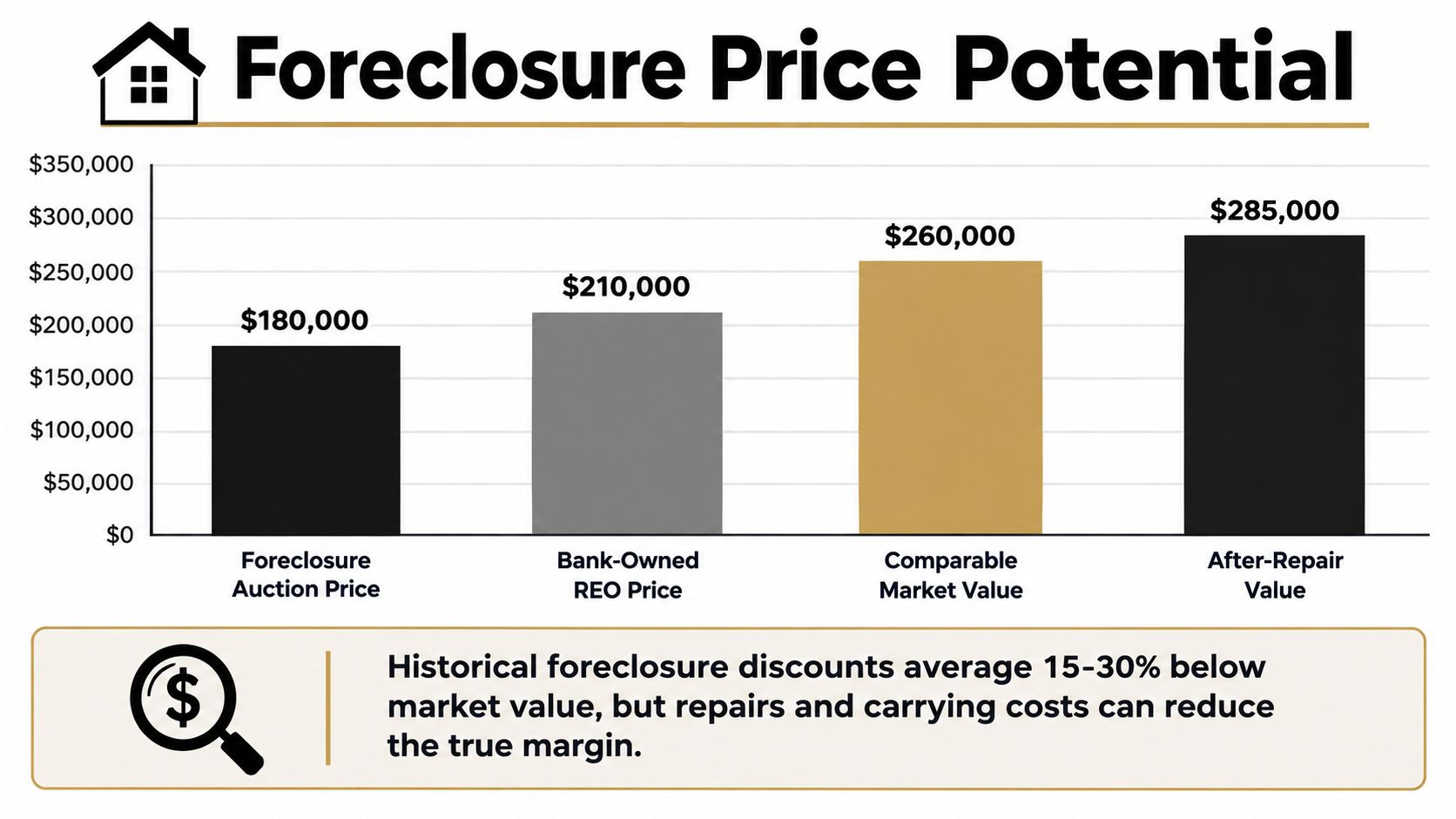
The historical discount range matters because it warns against assuming every foreclosure carries a deep discount. The Federal Reserve review cited earlier found estimates from nearly zero to 28%, while newer, more carefully adjusted studies generally put discounts between 10% and 20%. In practical terms, a sale price can look attractive and still leave too little room for the actual repair scope and transaction costs.
Build an offer backward from a conservative resale estimate. Deduct documented repairs, financing and holding costs, transaction expenses, the profit you require, and a contingency that reflects inspection access and confidence in title and comparable sales. The distressed-property valuation guide can help frame that valuation work, but no estimate replaces property-specific due diligence.
A useful offer price isn't the number that wins the bid. It's the highest number at which the deal still works after realistic costs and uncertainty.
Set separate maximum offers for auction and REO purchases. Auction terms may leave more unknowns and less time to resolve them, while an REO listing may allow a more complete inspection and a conventional underwriting process. Applying one generic foreclosure discount to both channels hides the very risks that determine whether the margin is real.
Key Benefits and Drawbacks of Foreclosure Purchases
The upside is straightforward: a foreclosure may be available below a well-supported market value, creating room for renovation, equity, or a rental strategy. A property that needs work can also let an investor choose improvements that support the intended exit, whether that's resale or long-term ownership.
The drawback is that the buyer may be taking responsibility for more than the visible defects. Limited access can conceal structural, electrical, plumbing, or environmental problems. Deferred maintenance, vandalism, or neglected systems can expand the work after possession. Title questions, strict auction terms, appraisal issues, and delays can each consume time and money even when the purchase price looks favorable.
| Potential benefit | What can make it disappear |
|---|---|
| Below-market acquisition | The comparison may be based on asking prices or homes in better condition |
| Renovation upside | Unseen defects or incomplete scopes can push the project beyond budget |
| Potential equity after improvements | The exit value depends on comps, completed work, financing, and buyer demand |
| Negotiation opportunity on an REO | Seller terms, appraisal requirements, or competing offers may limit flexibility |
| Access to distressed inventory | Nearby distress can weigh on resale values and buyer perception |
The neighborhood matters as well as the building. Federal Reserve research using San Francisco housing data found that a newly listed foreclosure reduced nearby home sale prices by about 1% within 0.1 miles. Other studies summarized by the Federal Reserve reported reductions of roughly 0.9% to 1% within approximately 260 to 660 feet (Federal Reserve research on nearby foreclosure effects). These are historical findings, not a formula for predicting a specific property's future sale price. They do make nearby distressed inventory worth checking when assessing comps and exit demand.
Buying a foreclosure is like purchasing a damaged building at a warehouse sale. The sticker price matters, but it doesn't reveal what's broken, which obligations come with the purchase, or what it will take to make the asset usable. If water damage is a concern, the AMPM Restoration Services home buying guide offers context for recognizing why moisture issues deserve careful attention.
A foreclosure is most attractive when you can identify the likely obligations and price them into the offer. When access is poor or evidence is incomplete, the buyer needs either a bigger margin or a reason to walk away.
How Condition Financing and Resale Change the Deal
Consider a fix-and-flip investor who sees an auction property priced below similar renovated homes. The investor estimates the repair scope from exterior observations and available records, then plans to borrow for the purchase and work. That plan can fail before renovation begins if the auction requires funds on a timeline the lender can't meet, or if title review reveals an issue that changes the acquisition cost.
Even when the purchase closes, an inaccessible interior makes the repair estimate less dependable. The apparent scope might cover visible damage but miss a hidden problem behind a wall or beneath a floor. Once the buyer gets access, the contractor may need to revise the scope, change the schedule, or price work that wasn't included in the original budget.
Financing adds another test. An REO property may allow lender underwriting, but that doesn't mean the lender will approve a home with major repairs or accept the investor's estimate of value. If an appraisal comes in below expectations or the condition fails requirements, the buyer may need more cash, a different financing plan, or a revised exit.
Resale assumptions need similar discipline. Renovation can improve marketability, but buyers compare the finished property with available alternatives, not the investor's purchase price. A longer hold may add financing and other carrying costs, while contractor scheduling, neighborhood inventory, or changing buyer preferences may affect the timing or price of a sale.
The offer calculation should therefore start with a cautious resale value, then subtract the documented repair scope, financing and holding expenses, transaction costs, required profit, and a contingency matched to inspection access, title complexity, and confidence in the comps. That's the basis of an uncertainty-adjusted maximum offer, rather than a bid derived from the discount alone (foreclosure purchase and due diligence guidance).
Separate the channels in your model. An auction maximum should reflect limited access and strict payment terms. An REO maximum can incorporate inspection findings and lender feedback, but it still needs room for appraisal and condition risk.
Investors comparing funding choices can review hard money lender requirements before committing to an acquisition strategy. For a project where roof work is part of the scope, information on payment options for Florida homeowners may also help clarify how roofing expenses can be financed. Neither resource substitutes for confirming the terms and availability of financing for the specific investment.
Mitigating Foreclosure Investment Risks
No diligence process removes every unknown, especially when an auction limits access. A disciplined sequence can still show which risks are manageable, which need a lower offer, and which make the property unsuitable.
Identify the channel and access terms. Confirm whether the property is an auction or an REO listing, what payment rules apply, whether inspection is permitted, and how possession will work. Don't assume that a vacant-looking home is empty or immediately available for renovation.
Review title, liens, taxes, and closing obligations. Have a qualified title professional or real estate attorney assess the record and explain any unresolved claims or obligations. Ask what protection is available through title insurance and what the sale documents exclude. At auction, complete as much of this work as possible before bidding.
Build a condition record. Inspect the home when access allows. Document visible damage and have appropriate contractors assess structural, mechanical, and environmental concerns. If you can't inspect the interior, treat the budget as lower confidence and increase your contingency rather than presenting a rough estimate as a firm scope.
Test the value and the exit. Use condition-adjusted comparable sales, not just nearby listings. Check whether other distressed properties could affect resale or rental demand, and consider whether the planned exit remains credible if the project takes longer than expected.
Confirm financing before you commit. Discuss both borrower requirements and property condition with the lender. For an auction, verify that the payment timeline and funds are workable. For an REO purchase, ask what repairs or appraisal findings could prevent approval.
Price the remaining uncertainty. Obtain a documented repair scope where possible, then deduct the project costs, carrying costs, transaction expenses, required profit, and contingency from a conservative resale value. A real estate due diligence checklist can help organize the records and questions that need attention.
Maintenance delays can expose a property to further deterioration after it comes under government control. A Government Accountability Office review of federal foreclosure procedures identified this as a concern. That reinforces a practical point: the property's condition can change while ownership and maintenance responsibilities are being sorted out, so verify its state rather than relying on an old description.
Know When a Foreclosure Purchase Fits
A foreclosure can suit an investor who has adequate liquidity or financing, understands the sale channel, can assess the property with appropriate help, and has a credible exit plan. The investor also needs a contingency that reflects what remains unknown, not one copied from a different project.
Warning signs are easier to spot when you ask what the deal depends on. If it works only at the most optimistic resale value, with no repair surprises and an immediate exit, the margin isn't strong. If you're relying on an incomplete title picture, assuming an auction will accept ordinary mortgage financing, or borrowing before you understand the property's condition, pause before proceeding.
Use a simple decision rule:
- Proceed when the uncertainty-adjusted spread still supports your required profit and you understand the closing and possession terms.
- Renegotiate when the opportunity remains credible but a lower price is needed to cover unresolved condition, title, financing, or resale risks.
- Walk away when you can't bound the downside well enough to set a responsible maximum offer.
The headline discount can help you find a candidate, but it can't tell you whether the project works. A foreclosure is a genuine opportunity only when the price, condition, financing, title, and exit all fit the same conservative underwriting case.
PropLab helps investors assess foreclosure deals by estimating after-repair value, rehab costs, and a maximum offer in an underwriting report. Visit PropLab to compare a property's potential value with the costs and risks that shape your bid.
About the Author
P
PropLab Team
Real Estate Analysis Experts
The PropLab team consists of experienced real estate investors, data scientists, and software engineers dedicated to helping investors make smarter decisions with AI-powered analysis tools.
Free account
Underwrite your next deal in under a minute
3 free analyses, no credit card. ARV, rehab, comps and exit strategy in one report.
