General
Real Estate Skip Tracing: A Legal Step-by-Step Guide
October 25, 2026
16 min read
You mailed a vacant house last Tuesday. The tax bill goes to a box three states away, the envelope came back, and the number on the old listing is dead. A vendor file just dropped two new phones into the row, and your instinct is to dial before lunch.
Slow down. That file is a guess about a person, not a green light to call, and it says nothing about whether the house is a deal. I'm going to walk you through real estate skip tracing the way I walk a new acquisitions hire: what the record can tell you, where each field comes from, the checks you clear before anyone picks up a phone, and how you keep a bad match from burning the afternoon.
What Real Estate Skip Tracing Is and Why Investors Use It
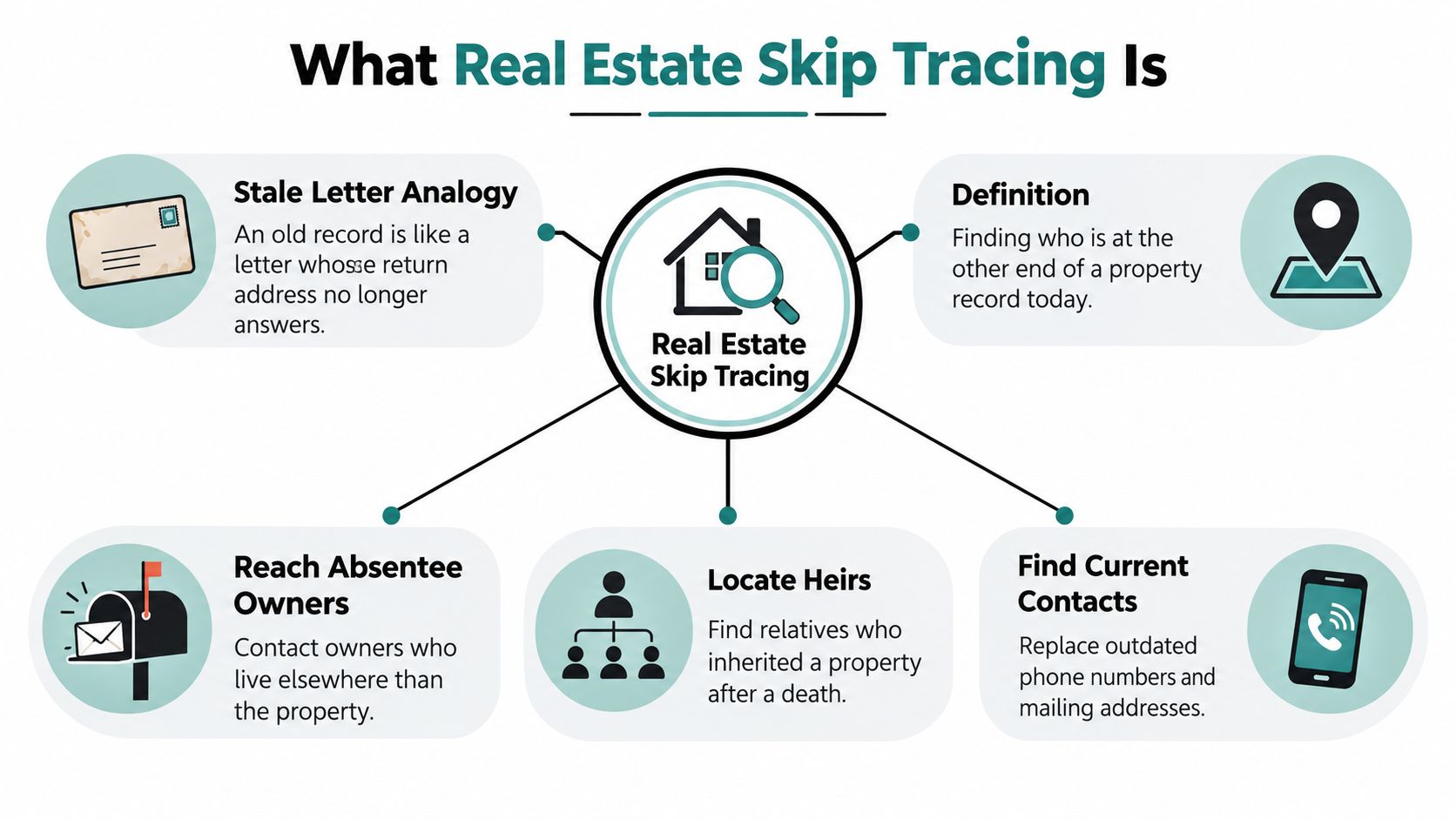
A deed points to an owner, but the name on it may not lead to the person who can discuss a sale. Skip tracing helps you follow the record to possible owners, heirs, occupants, or other contacts. Treat each result as an identity match to test, not a confirmed phone number.
Real estate skip tracing combines property records with linked public and administrative information to build a likely picture of who is connected to a property. The match is probabilistic: a name, address, or phone number can be outdated or belong to someone else. The stronger the identity match, the more confidence you can place in the contact. That still does not prove the property is a good opportunity.
The deed may list a trust or LLC rather than an individual. A tax bill may go to an out-of-state mailing address. After an owner's death, an heir or personal representative may have authority over the property while the tax roll still names the deceased. Each case calls for a different lead to verify.
Investors often research four situations:
- Absentee owners: The owner lives elsewhere, so a visit may reach a tenant or an empty home.
- Heirs: Control may have passed to relatives who have not yet updated property records.
- Vacant or tax-delinquent homes: Vacancy and overdue taxes are reasons to investigate, not proof that an owner is unreachable or willing to sell.
- Entity owners: A person connected to an LLC may be able to discuss the property, but a registered agent may only handle legal notices.
Ownership and occupancy clues can help you decide whom to research without contacting the owner first. Keep the confidence levels separate: a likely contact does not make a property a likely deal.
A vacancy or nonresidential status in an administrative record can be wrong, so use it as a prompt to verify, not as a conclusion. The Census Bureau working paper on administrative records discusses the limits of administrative records. A status code is a lead, not the last word.
Where Owner Data Comes From and What Each Source Shows
A deed names the owner on record, while a tax roll shows where the county sends property-tax notices. Neither tells you by itself who can make a decision today. Skip tracing combines public records with contact databases, then tests whether the records and candidate contacts point to the same person. Public records establish the property and ownership trail; enrichment databases suggest possible phone numbers, emails, and relatives. Treat each match as a probability, not a confirmed identity.
| Source | What It Reveals | Typical Limit |
|---|---|---|
| County deed records | Current owner of record, sale date and price | May lag unrecorded transfers; an owner may be a trust or LLC |
| County assessor and tax roll | Owner name, tax mailing address, assessed value, tax status | The mailing address may be outdated or belong to a management office |
| Probate and estate filings | Executor, personal representative, and heirs | Available only after a death, and access varies by county |
| Secretary of State LLC filings | Organizer, registered agent, and listed managers | A registered agent may be a service company, not the decision-maker |
| Court judgment and lien records | Liens, judgments, and lawsuits tied to an owner | Common names can create false matches; check the address |
| Utility and service records (where accessible) | Account holder and service start or stop dates | Access and permitted use vary by market and provider |
| Phone and email append databases | Phone numbers and emails associated with a name and address | A number may be stale, shared, or tied to a tenant |
| Consumer-report and credit-header data | Identity and address history | Check permissible-purpose rules before use |
| Vacancy and occupancy indicators | Likely vacant or occupied status | Vacancy alone does not establish distress or show whether an owner can be reached |
A reading order that keeps you honest
Begin with the deed and tax roll. Check whether the recorded owner and tax-mailing address align with the property. If the owner has died, review probate filings; if the title names an entity, look at its state filings for possible decision-makers. Then compare any appended phone or email with the names and addresses already in the file. A matching name alone is weak evidence. Agreement across independent records raises confidence, but it still does not prove who will answer.
County and state records differ in format, update speed, and access. A probate index may be searchable in one county and available only on paper in another. For an introduction to locating and reading these files, use this public records property search guide.
Vacancy is a historical signal, not a synonym for distress or a dependable way to identify an unreachable owner. The 2020 Census housing vacancy story reports a national vacancy rate of 9.7%, compared with 11.4% in 2010 and 9.0% in 2000. For the Census, a unit is vacant if no one is living in it on Census Day. Categories include for rent, rented but not occupied, for sale, sold but not occupied, seasonal, and other vacant. That definition is a snapshot, not proof of a property's current condition.
Keep the two confidence questions separate: how likely the property record points to an opportunity, and how likely a contact record points to the right person. A strong contact match cannot make a weak property lead worthwhile; a promising property does not validate an uncertain phone number.
Practical rule: Log the source and retrieval date for every field. If a match conflicts with another record, you can trace where it came from and reassess before relying on it.
Legal and Ethical Limits and the Pre-Contact Gate
A file shows a vacant property and a phone number, but the number belongs to a tenant, not the owner. That is why skip tracing needs two separate checks: whether the identity match is convincing, and whether the contact is legally permitted. A populated phone field is a lead to assess, not permission to call.
When the file becomes a regulated record
The Consumer Financial Protection Bureau describes the Fair Credit Reporting Act's requirements for consumer reports, including accuracy, dispute rights, and limits on permissible use. The FCRA permits use of a consumer report only for purposes authorized by the law. Ordinary prospecting based on property ownership does not automatically make a file a consumer report. Data used to evaluate creditworthiness, tenant eligibility, employment, or another covered decision may bring FCRA duties into play.
Classify each dataset by its intended use before adding it to your system, and record that purpose. Keep files used for regulated decisions separate from prospecting lists. A vendor disclaimer does not establish a permissible purpose. The Telephone Consumer Protection Act also treats marketing texts as calls, so having a skip-traced number does not prove consent to send a marketing text.
Accuracy is a separate concern. Consumers can dispute inaccurate data, and covered furnishers must address information that is incomplete or cannot be verified. A name-only match is weak evidence of identity.
Consider two common errors. “James Miller” matches several owners in one county, and an appended number belongs to a renter rather than the absentee owner. Or a deceased owner's number still works because a relative kept the line. In either case, a call reaches the wrong person and leaves you with a record to correct. Contact confidence should affect how much confidence you place in the property opportunity, too. If the person behind the number is uncertain, the apparent lead may be weaker than it looks.
The NAR privacy principles emphasize responsible handling of personal information and its collection and use only when useful and legally permitted. Personal information can identify, contact, or locate someone, including information combined from multiple sources.
For each lead, retain its source, retrieval time, stated purpose, suppression status, and an audit trail showing which fields informed the decision. If an owner says a phone, address, or relationship is wrong, you need a way to correct the record, not just a note that the match came from a vendor.
Six checks before anyone dials
A long list of numbers is not a usable pipeline until each contact passes a compliance check. Treat this gate like a lock: every applicable condition must clear before outreach.
- Classify the data. Record whether the file is a consumer report or another type of data before ingestion.
- Record the business purpose. Tie it to the specific person and intended use. “Investing” alone does not explain why this record is being used.
- Screen the number. Check applicable do-not-call lists and your internal opt-out file.
- Choose the channel carefully. Manual calls, autodialed calls, prerecorded messages, AI-voice calls, and texts may have different requirements. A matched number is not consent.
- Set a confidence threshold. If the identity match is too uncertain, hold off on outreach. A weak contact match should lower your confidence in the lead, not invite a guess.
- Keep the audit trail. Record what you knew and when, so you can explain the decision and correct errors.
This is general information, not legal advice. Telemarketing and privacy rules vary by state and country. Ask local counsel to review the rules where you operate.
A compliance documentation checklist can help you map these records to your CRM fields.
How to Run a Skip Trace Step by Step
Contact data is an entity-resolution problem. Deeds, tax rolls, assessor files, probate, and LLC filings often name the owner and still miss the decision-maker and a usable phone. You score candidates. You don't accept the first populated cell.
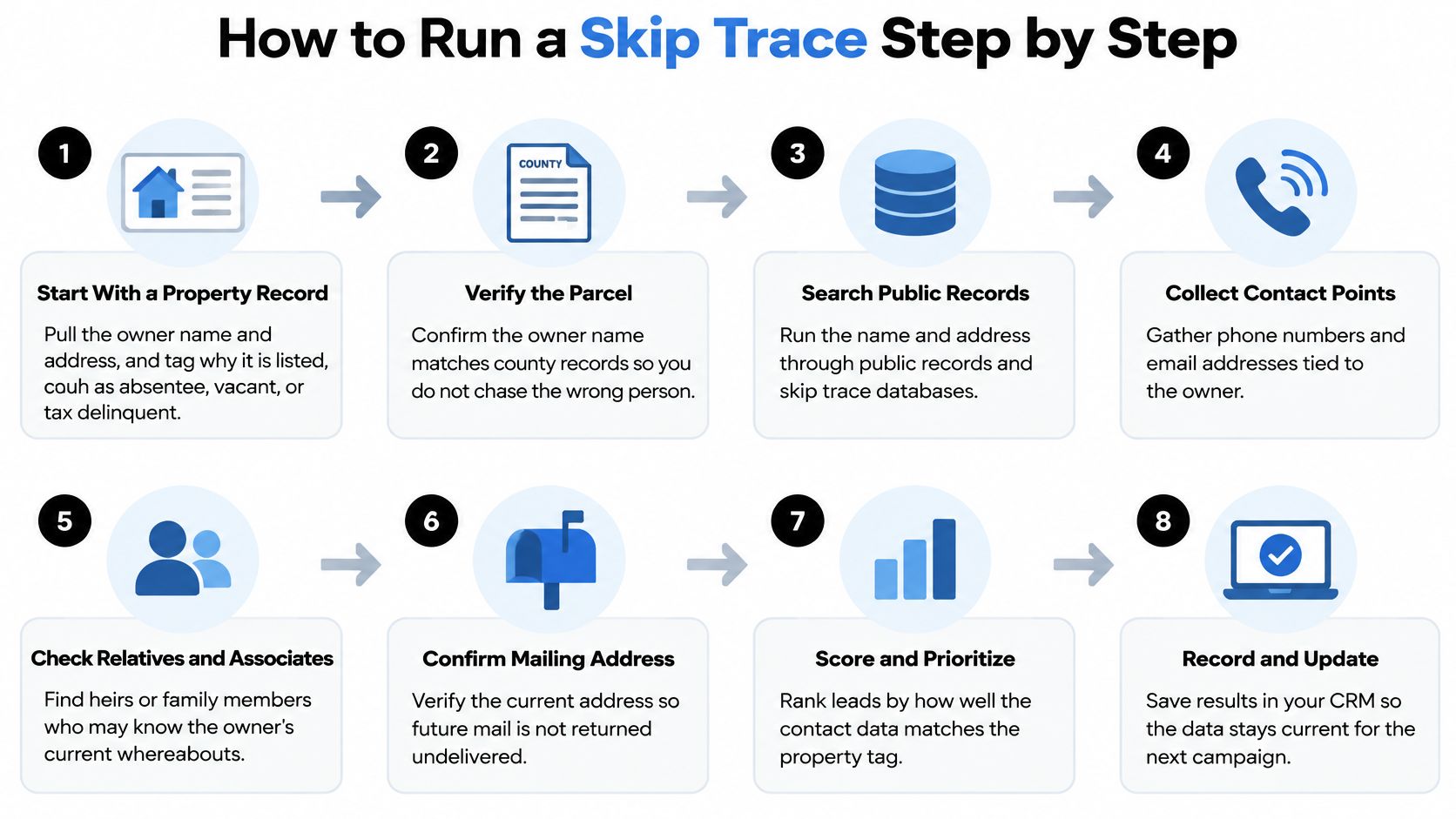
The graphic is the overview. The checkpoints below are the ones that keep a wrong person off your dialer.
- Start with a property record that already has an owner name and an address. Tag why it's on the list: absentee, vacant, tax-delinquent, or probate. Skip the tag and you can't tell later whether the list type was worth the spend.
- Normalize names and addresses before any match. Standardize suffixes and unit numbers, and split individuals from trusts and LLCs. A raw "Smith Family LLC" glued to "John Smith" will match the wrong human.
- Pull candidates from public records and enrichment separately. Credit-header data, utility records, and other proprietary sets can raise recall. Keep each source's hits in their own columns so you can see agreement instead of a blended blob.
- Score on independent corroboration. Deed name, tax mailing address, recent activity, and entity records should point the same way. One field repeating itself isn't two sources.
- Suppress conflicts. When ownership, mailing address, and phone identity disagree, hold the record. Calling through a conflict is how you reach a prior owner.
- Verify the top candidates by hand. Confirm the number is tied to the owner, and check for a deceased owner or an entity manager who isn't the agent on the filing.
- Log provenance for every field you keep. Source and date, not just the value.
- Measure in test batches by county, property type, vacancy status, and owner profile. Coverage isn't even across markets. A county that hits well on individuals can fall apart on LLCs.
A hit is a number that's both reachable and tied to the correct owner, not a filled cell. Published estimates vary a lot. Property-data guidance on skip tracing puts public-record-only contact hit rates near 50%, and enriched workflows approaching 80–95%. Track precision and recall apart. Precision is how often a returned number is the right person. Recall is how many of the true owners you found at all. Test your own sample before you trust either band.
A tax-delinquent LLC, walked through
The house is tax-delinquent. The tax mailing address is out of state, and an LLC is on the deed. Normalization splits the LLC from any individual names in the file. Enrichment returns two phones. Scoring marks the number tied to the manager's registered address as medium confidence, because the phone's name doesn't match the manager. You hold it. The Secretary of State filing then confirms the manager, and you log which filing, which append, and which date supported each field. Outreach waits until the pre-contact gate is clear.
If you want the same sequence on screen, this walkthrough covers the handoff from list to call.
Common Pitfalls and How to Fix Them
The expensive failure looks like a win. The trace "succeeds," a phone rings, and you've reached a tenant, a prior owner, or a stranger who shares a common name. You've spent acquisition time, and you may have created a privacy problem.
Treat each match as an uncertainty problem with three tiers.
High confidence means several independent sources agree on owner name, mailing address, and recency. Those are the ones you can take toward outreach, still subject to the gate above.
Medium confidence means two sources agree, but one field is stale or the owner is an entity. Verify before any contact. A second look is cheaper than a wrong conversation.
Low confidence is one source, or a name-only match. Hold it for manual verification. Don't let a dialer touch it.
A "successful" trace can still be a bad commercial result. Contacting a non-owner wastes the budget you meant for sellers. Contacting the wrong person adds reputational and legal risk on top of the wasted call. Stale numbers, shared household lines, deceased owners, tenant-associated mobiles, and incorrectly linked relatives all produce that pattern. So do entity-owned houses where the file stops at a registered-agent service company.
| Tier | Evidence | Action |
|---|---|---|
| High | Several independent sources agree on owner name, mailing address, and recency | Contact |
| Medium | Two sources agree, but one field is stale or entity-linked | Verify before any contact |
| Low | One source only, or a name-only match | Hold for manual verification |
What the warning signs look like in the file
- Stale contact: the mailing address hasn't moved in years while the deed has, or the only phone predates the last sale. Re-pull before you dial.
- Shared or tenant line: the name on the phone doesn't match the owner, and a lease or utility hint points at an occupant. Don't pitch the occupant as if they can sell.
- Deceased owner: the roll still shows the decedent and probate was never opened in your search. Find the representative before you leave a message.
- Entity fog: you have the LLC and a registered agent, and no manager. That's not a decision-maker.
- Vacancy overread: the house looks empty, so the team assumes distress and an unreachable owner. Empty can be a seasonal place, a renovation, or a landlord between tenants.
Write the tier and the reason in every lead file. "High, deed and tax mail agree, phone seen this year" is a reason. "Skip traced" is not. Six months from now, another caller on your team should see why the last person was allowed to dial.
Connecting Skip Tracing to Deal Sourcing and Follow-Up
Skip tracing is the key to the door. Underwriting decides whether the house is worth opening. A verified owner phone doesn't prove motivation, equity, condition, or a workable offer.
Run the pipeline as one chain, not five disconnected tools.
Sourcing pulls the list from vacancy, absentee ownership, tax delinquency, or probate. Skip tracing turns those records into scored people. Underwriting tests after-repair value, repair cost, and a maximum offer. Outreach happens only after the gate. Follow-up logs what was said and whether the person opted out.
Two scores that must not collapse into one
Contact confidence asks whether this is the right person and a reachable number. Property opportunity confidence asks whether equity, condition, and motivation support an offer. They stay separate. A high contact score on a thin deal is still a thin deal. A strong comp set with a low-tier phone is a research project, not a conversation.
Pair the identity score with public-record and tax signals, condition, comparable sales, and valuation, and show the uncertainty instead of one blended "lead score." That's how wholesalers, acquisition teams, and lenders stop treating a partial personal-data match as proof a property is financeable.
PropLab sits on the property side of that split. Its Daily Deals scanner builds a pipeline from public-record signals, and its after-repair value and maximum-offer analysis adds confidence scoring and red flags so the house is judged on the deal. PDF reports and share links carry that analysis to partners and lenders. The skip-trace tier still has to come from your own contact workflow.
Follow-up that doesn't rot the list
Store the source, the confidence tier, and the consent status in the CRM. Suppress opted-out contacts across every campaign, not just the one they replied to. Re-verify numbers before the next campaign, because a good hit goes stale. Compare reply rates by tier so you learn which data is worth paying for. If medium-tier calls never convert after verification, stop buying that append.
The outreach habits that keep this chain from turning into spam are covered in outbound lead generation. Build the list, score the person, underwrite the house, then talk.
PropLab helps you judge the house after the contact checks are done, with after-repair value, repair-based maximum offers, and shareable reports built from public records and tax data. Pair that property read with the contact confidence you just scored, so you aren't offering on a phone number. Visit PropLab when you're ready to underwrite the next record instead of dialing it blind.
Tags
About the Author
P
PropLab Team
Real Estate Analysis Experts
The PropLab team consists of experienced real estate investors, data scientists, and software engineers dedicated to helping investors make smarter decisions with AI-powered analysis tools.
Free account
Underwrite your next deal in under a minute
3 free analyses, no credit card. ARV, rehab, comps and exit strategy in one report.
