General
Roof Replacement Cost Per Square Foot: 2026 Price Guide
November 24, 2026
16 min read
A full roof replacement in 2026 typically costs about $4 to $11 per square foot installed. Architectural asphalt usually lands at $5 to $8 per square foot, while standing-seam metal commonly runs about $10 to $18.
The width of that band is the scope hiding inside the unit rate, not a typo in the average. The 2024 Cost vs. Value report modeled a midrange asphalt-shingle job at $30,680 for a 30-square roof, which is 3,000 square feet. Divide the project cost by that area and you get about $10.23 per square foot installed. The scope included removal of the existing roofing, fiberglass asphalt shingles, new underlayment, drip edge, and aluminum flashing on a rectangular hip roof. That same project was estimated to add $17,461 in resale value, a 57% cost recoupment.
A national benchmark like that is more useful for underwriting than a shingle-only price, because it already carries tear-off, installation, and standard accessories. It still is not a bid. Labor markets, pitch, complexity, disposal, permits, and concealed deck damage move the final number. A property with 2,000 square feet of actual roof area would imply roughly $20,453 at that same benchmark rate, and a 4,000-square-foot roof would imply about $40,907. I would treat either figure as a starting prior and add a contingency for what you cannot see from the curb.
Typical Roof Replacement Cost per Square Foot in 2026
The useful starting point for roof replacement cost per square foot is the material and scope named in the quote. A basic installed shingle price and a modeled full replacement can both be labeled “asphalt” while covering different work. Match those details before treating the rates as comparable.
| Roofing material and scope | Typical installed cost per sq ft | Source and year |
|---|---|---|
| Three-tab asphalt shingles | $4 to $6 per square foot | The Roofing Brief's 2026 report, which also places architectural asphalt at $5 to $8 |
| Architectural asphalt shingles | $5-$8 | The Roofing Brief, 2026 |
| All asphalt shingle grades | $4 to $8.50 per square foot | RoofReplacementCost.ai, 2025 |
| Asphalt, modeled full project | $10.62 per square foot | 2025 Cost vs. Value benchmark, as published by Smart American Living, based on a $31,871 project on a 3,000-square-foot roof |
These rows serve different estimating purposes. Three-tab is the lower-cost mainstream shingle option; architectural shingles cost more and have a heavier appearance from the street. For a flip, that appearance can matter to the listing presentation, but it does not establish what the installation quote includes.
Use the all-grades asphalt band while the shingle line remains undecided. Once you select a product, compare proposals for that product rather than averaging the broad band with the modeled full-project rate. An average of unlike scopes gives you a budget that matches neither job.
Why the modeled asphalt rate sits higher
The modeled asphalt project includes tear-off, underlayment, and accessory metals. Those line items help explain why its unit rate sits above the basic installed-shingle bands. The difference deserves a scope check before you treat a lower proposal as a saving.
Ask the contractor to identify those items in writing. A price may look competitive because the proposal includes less work, or because a charge appears elsewhere in the estimate. The headline rate alone cannot distinguish between those situations.
Standing-seam metal belongs in a separate comparison from asphalt. Tile and slate also need material-specific proposals because their material costs and installation skills differ. An asphalt allowance is a poor substitute for pricing the roof covering you intend to buy.
How to use the table
Choose the row that matches your intended material, then check whether the proposal covers the same replacement work. Keep the product choice separate from the scope check: matching shingles do not guarantee matching bids.
For each proposal, check tear-off layers, underlayment, accessory metals, disposal, access, decking, and code items. Identify what is included, what is excluded, and what will be priced only after removal. Decking deserves particular attention because concealed damage can change the total after the old covering comes off.
The commercial-roofing discussion of hidden fees in roof replacement provides useful prompts for checking disposal, access, and work uncovered during tear-off. Use those categories to question the estimate, rather than transferring a commercial project's pricing to a residential roof.
Practical rule: Compare the same product and the same scope. A lower unit rate is meaningful only when you know which line items it buys.
How to Measure the Roof and Convert It to Squares
Price the sloped surface, not the living area. A 2,000-square-foot house can carry a much larger roof once pitch, overhangs, and extra planes are counted. Originexteriors walks through the estimator's sequence: measure plan area, apply a pitch factor, convert to squares, then add waste.
The five steps
- Measure each plane's plan area. Take length times width on every roof section from the footprint or an aerial measure, then add the sections. This is the flat "shadow" of the roof, and it is the only number you can pull from a floor plan without lying to yourself.
- Apply a pitch factor. A steeper roof has more surface than its shadow. The pitch factor converts plan area into actual sloped area, which is what shingles cover. Skip this on a 10/12 and you will under-order material and understate labor hours.
- Convert to roofing squares. One roofing square equals 100 square feet. Divide sloped area by 100. A 3,000-square-foot roof is 30 squares. Crews, suppliers, and most bid forms talk in squares, so this is the unit that makes a quote readable.
- Add waste before you buy. Cuts at hips, valleys, ridges, and penetrations consume material you cannot install. Order the measured squares plus the waste allowance, or the crew will make a second trip and you will pay for it.
- Multiply by a local installed rate. Squares times the installed rate for your material is the base. Keep tear-off, decking, flashing, underlayment, ventilation, permits, and disposal as their own lines instead of hoping a generic unit price swallowed them.
Waste allowance by roof complexity
| Roof complexity | Typical pitch | Waste allowance |
|---|---|---|
| Simple low-slope roof | Low slope | 5-10% |
| Conventional roof | 5/12 to 7/12 | 10-15% |
| Steep, cut-up roof | Steep, with many hips, valleys, and skylights | 15-25% |
Simple low-slope roofs commonly need about 5% to 10% waste. Conventional 5/12 to 7/12 roofs generally need 10% to 15%. Steep roofs, or designs with many hips, valleys, skylights, and penetrations, can need 15% to 25%. A low-slope rectangle can live at the bottom of that table. A cut-up Victorian should not.
Three slips show up on almost every bad investor estimate. People multiply living area instead of roof area. They ignore pitch on steep roofs. They skip waste on roofs full of hips and valleys. Any one of those makes the unit price look precise while the quantity is wrong.
Roof Features, Labor Market and Timing
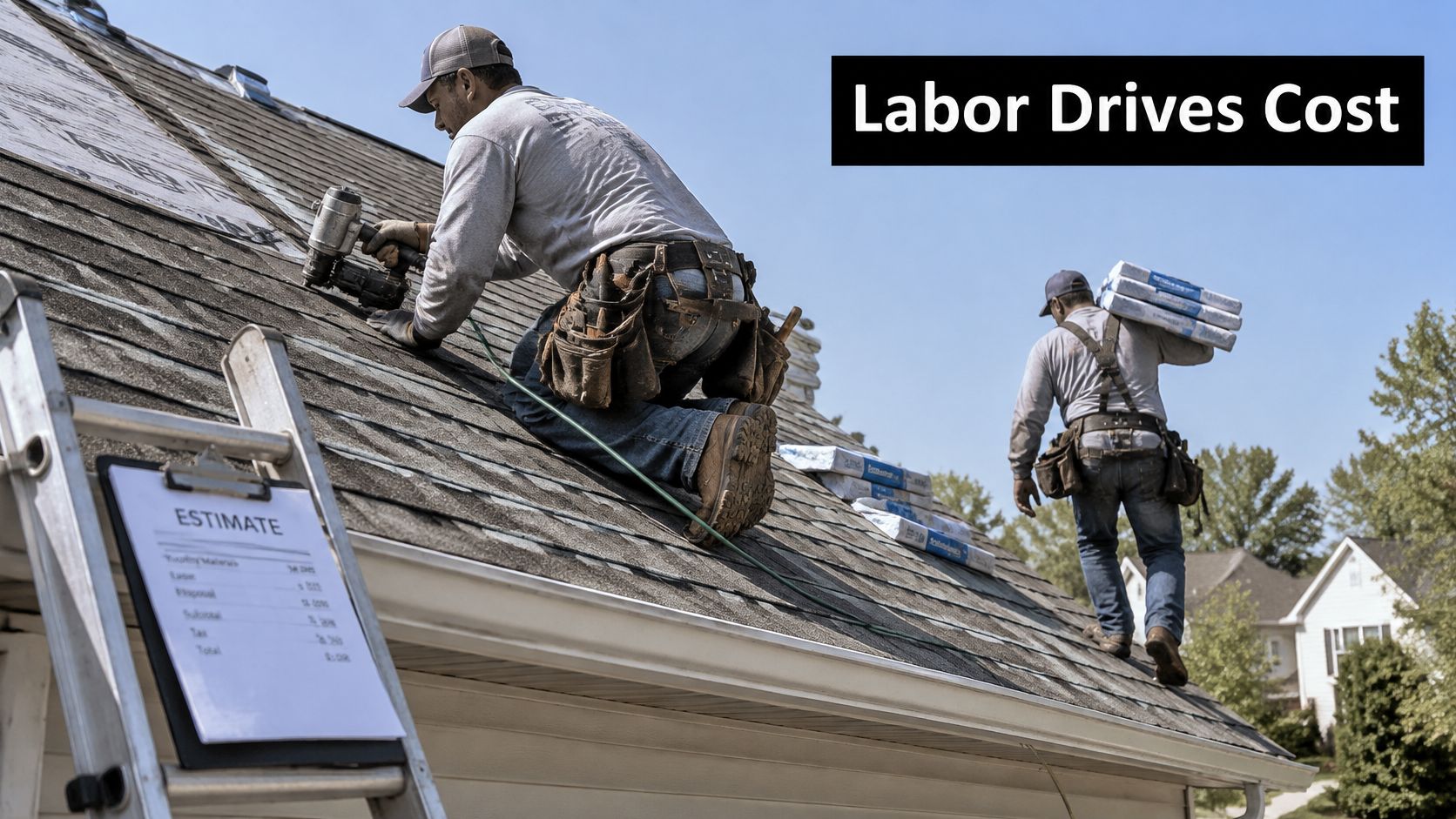
Crew cost moves a roof budget as much as the shingle you pick. NerdWallet's roof replacement cost guide places labor around 40% to 60% of the installed total in many markets, and it places a broad U.S. installed range at roughly $4 to $11 per square foot. Materials alone span about $1 to $30 per square foot depending on asphalt, metal, tile, or slate. Asphalt is typically the lowest-cost mainstream option. Premium metal, tile, and slate raise both the material bill and how long the crew is on the roof. Regional labor and logistics can shift comparable projects by roughly 30% to 40%, so a national average can miss a rehab budget by a wide margin.
What changes the rate on a specific house
- Steep pitch: Crews move slower, and fall protection adds setup time. The same shingle costs more per square on a steep roof than on a walkable one.
- Extra layers: Each layer still on the deck adds tear-off labor and disposal weight. A second layer is not a free "overlay savings" if the code or the deck condition forces a strip.
- Rotted decking: You find it after the shingles come off. Budget a sheet allowance before you open the roof, or the change order writes itself.
- Penetrations and skylights: Every pipe, chimney, and skylight is flashing work, not just another few square feet of shingle.
- Access: Tight lots, three-story walls, and nowhere to stage a dumpster mean more equipment and more hours for the same squares.
- Code items: Ice-and-water protection and ventilation are scope, not optional upgrades, in many jurisdictions.
A smaller roof can cost more per square foot than a larger, simpler one. Mobilization, the dumpster, and the first day of setup do not shrink in proportion to area. That is why a 12-square cut-up roof can look "expensive" next to a 30-square rectangle even when both use the same shingle.
Place and calendar
Verisk's underwriting review of America's roofs is a useful place to see how far local bands drift. Architectural-shingle installations are reported around $6 to $10 or more per square foot in parts of the Northeast, versus roughly $5 to $9.50 in central Texas. Standing-seam metal commonly reaches about $10 to $18 per square foot. The same review's 2025 figures show roofer labor costs up 0.79% year over year and roofing materials up 1.48%. Inflation is real, and it is not the same percentage on every line of the estimate.
Storm demand, restricted access, and code-required ventilation can lift labor and extras without changing the nominal roof area. Start from the local band for your material, adjust for pitch, access, and climate, then replace the worksheet with current bids. A square-foot figure is a prior. It is not the rehab number you should wire.
Watch a crew walk a roof and you will see where the hours go: pitch, penetrations, and how the material has to be staged.
What a Per-Square-Foot Price Includes and Leaves Out
Equal unit prices are not equal jobs. Iconic Roofers puts the gap plainly: a $6-per-square-foot quote is not comparable with another $6 quote unless both use the same measured roof area, tear-off assumptions, accessory package, and decking allowance. The question most price roundups skip is, "What exactly is included in the per-square-foot number, and what costs can appear after the roof is opened?"
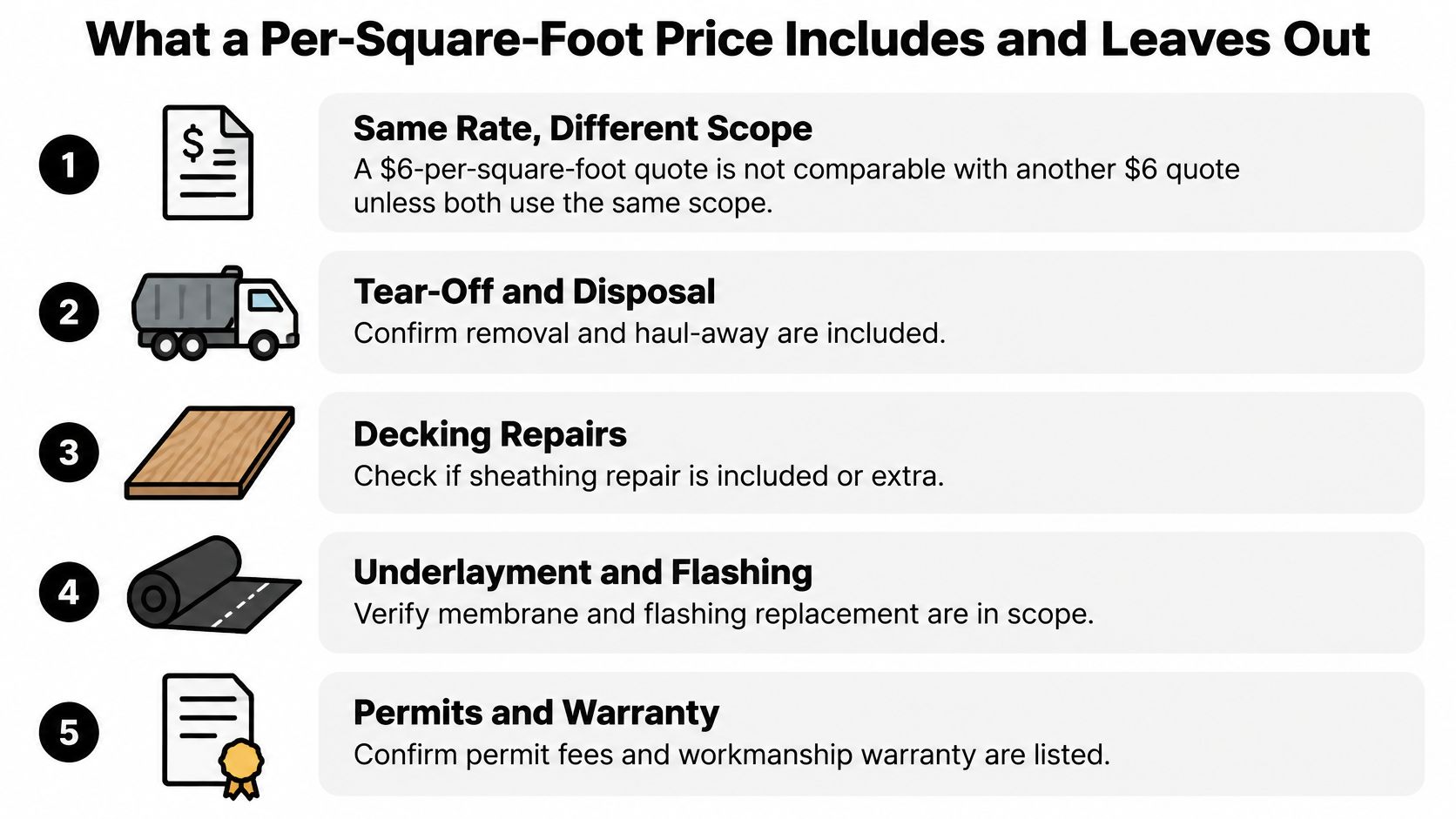
A complete replacement may include tear-off, disposal, underlayment, ice-and-water protection, flashing, pipe boots, drip edge, ridge caps, ventilation, permits, cleanup, and possible decking replacement. Leave three of those off and a cheap unit rate still produces an expensive closeout.
Decking is the line that breaks neat math
Rot, delamination, and spaced boards often stay hidden until the shingles are gone. A precise-looking estimate becomes a variable-cost project the morning the dumpster fills with the first layer. The quote should name a per-sheet decking allowance and the price to replace each sheet, not a shrug and "we'll see." Tie a risk reserve to roof age, visible sagging, active leaks, and whether the attic ventilates. Those are observable before bid day.
A comparison method that survives a lender file
- Ask for line items. A single multiplied rate cannot be audited. A line-item bid can.
- Match the measured area. If one bid used living area and the other used sloped squares, stop and reconcile quantity before you talk price.
- Mark tear-off and decking as included or as allowances. "Included" with no sheet price is not included.
- Read the accessory package one line at a time. Underlayment, ice-and-water, drip edge, pipe boots, step flashing, ridge vent, and permits are separate decisions even when they share a proposal.
The lowest unit price often means the thinnest scope, not the best buy. Line-item comparability beats any national average when you are deciding which contractor to hire. On a full rehab, that roof block should sit inside the same budget logic as the rest of the house renovation cost breakdown, so a cheap roof does not consume the kitchen contingency.
The lowest unit price may represent the least complete scope rather than the best value.
Our Rehab Cost Calculator produces a line-item repair budget with contingency, which is the format I want on a roof: base scope, named allowances, and a reserve you can defend to a lender.
Worked Totals for Common Roof Sizes and Materials
These totals apply a modeled asphalt rate and a modeled standing-seam rate to measured roof area. They are national scenarios, not contractor prices, and they use roof area, not living area.
| Roof area (sq ft) | Roofing squares | Asphalt at $10.62 | Standing-seam metal at $17.29 |
|---|---|---|---|
| 2,000 | 20 | about $21,240 | about $34,580 |
| 3,000 | 30 | about $31,860 | about $51,870 |
| 4,000 | 40 | about $42,480 | about $69,160 |
The 3,000-square-foot row will not match the published project totals to the dollar. Rounding the per-square-foot rates does that. The benchmark figures themselves are the ones to remember.
The capital gap and what resale actually returns
Smart American Living's 2025 Cost vs. Value write-up put the national modeled asphalt replacement at $31,871 for a 3,000-square-foot roof, about $10.62 per square foot, or roughly $1,062 per square. The comparable standing-seam metal project cost $51,865, about $17.29 per square foot and roughly $1,729 per square. That is about 63% more than the asphalt benchmark.
Modeled resale value was $21,501 for asphalt and $25,972 for metal. Cost recovery is about 67.5% for asphalt and 50.1% for metal. The more expensive roof does not hand you its full cost back at the next sale. On a fix-and-flip, using the asphalt number when the house will get metal understates repairs by more than $19,000 on a 3,000-square-foot roof.
Those scenarios covered 28 remodeling projects across 119 U.S. markets. They are a comparison point. Regional labor still moves the rate. If you are pricing metal, local permit rules and lead times belong in the same worksheet. Safeguard Roofing LLC's notes on Oregon metal roof permits and timelines show how jurisdiction and sequencing can stretch a metal job past the install day you circled on a calendar.
Build a total you can underwrite
- Start from measured squares and add waste for the material order. Labor may track the measured field more closely than the waste percentage, so do not blindly mark up the whole installed price by the waste factor.
- Multiply by a local rate for the material you will install, not the material you wish the seller had chosen.
- Add decking, permit, and disposal allowances as their own dollars. A unit rate that "includes permits" with no fee stated is a guess.
- Carry a contingency for hidden conditions. I would hold something like 10% to 15% until the deck is open on an older roof, then release what you do not use. That percentage is a planning habit, not a published national standard.
Pair the roof block with a disciplined material cost estimation pass for the rest of the rehab so one sloppy quantity method does not infect every trade.
Confirm Your Roof Budget Before You Sign
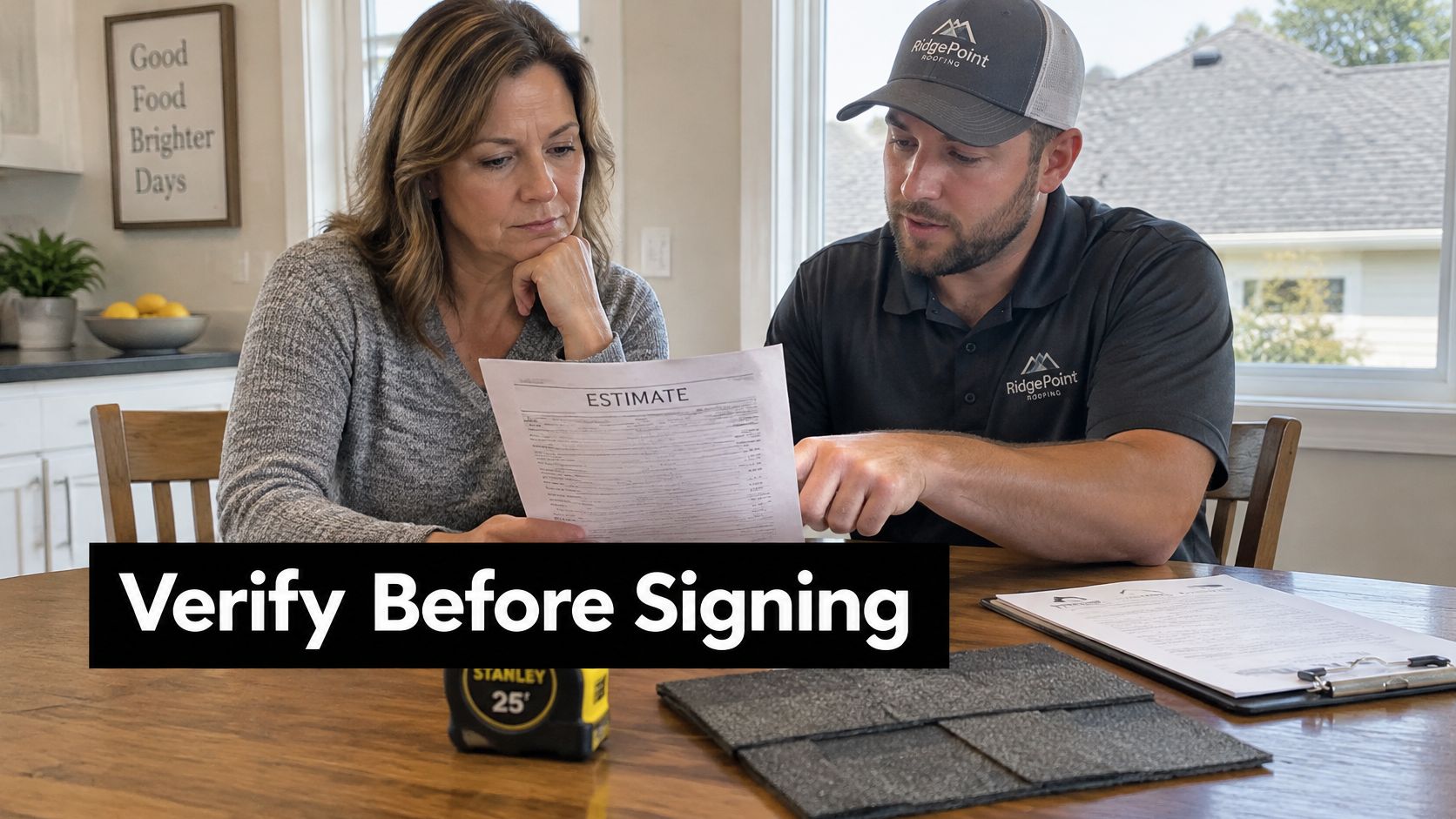
A square-foot rate becomes a budget only after you can rebuild it line by line. That matters because two roofs with the same measured area can carry different totals once pitch, access, tear-off, decking, permits, disposal, and accessories enter the bid. Run this check before you accept a number, including any number in this guide.
Lock quantity. Write down sloped area, roofing squares, and the waste percentage you are using for the order. If the bid's square count does not match, fix that before you negotiate price. Waste belongs in the material order, while labor may track the measured field more closely.
Pick a local band and adjust it. Start from the material row that matches the product, then move it for pitch, access, and market. A Northeast architectural job and a central Texas job should not share one cell.
Get at least two itemized bids. Use the same area, the same tear-off assumption, and the same accessory list. For roofing companies managing bid requests and customer calls, compare roofing answering services so lead handling does not depend on who happens to pick up. For your own budget comparison, keep the scope identical before comparing totals.
Force the soft lines into the open. Decking allowance, permits, disposal, and ice-and-water protection should each have a price or a stated "not included." Silence is not inclusion. A unit rate that says permits are included without naming the fee leaves the budget fuzzy.
Keep the hidden-condition reserve. Do not spend the decking contingency on a better ridge vent before the sheathing is visible. Older roofs can change once the old material is off, so the reserve should stay separate until the deck is open.
Set the full total next to cash and financing. PropLab's Rehab Cost Calculator produces a line-item repair budget with contingency, and the Fix and Flip Calculator shows profit, cash needed, and ROI. That works best once the roof is a real repair number instead of a placeholder. If the roof is a repair rather than a full strip, price that path with a separate roof repair estimate so you do not fund a replacement you have not scoped.
Any estimate in this article is a planning figure. It is not a bid and it is not an appraisal. AI output, including ARV calculations and valuations, is not a licensed appraisal, definitive valuation, or guaranteed forecast. The number you sign should be the itemized total from contractors who measured the roof you own.
Tags
About the Author
P
PropLab Team
Real Estate Analysis Experts
The PropLab team consists of experienced real estate investors, data scientists, and software engineers dedicated to helping investors make smarter decisions with AI-powered analysis tools.
Free account
Underwrite your next deal in under a minute
3 free analyses, no credit card. ARV, rehab, comps and exit strategy in one report.
