General
What Is a Pre Foreclosure Listing and How It Works
November 13, 2026
14 min read
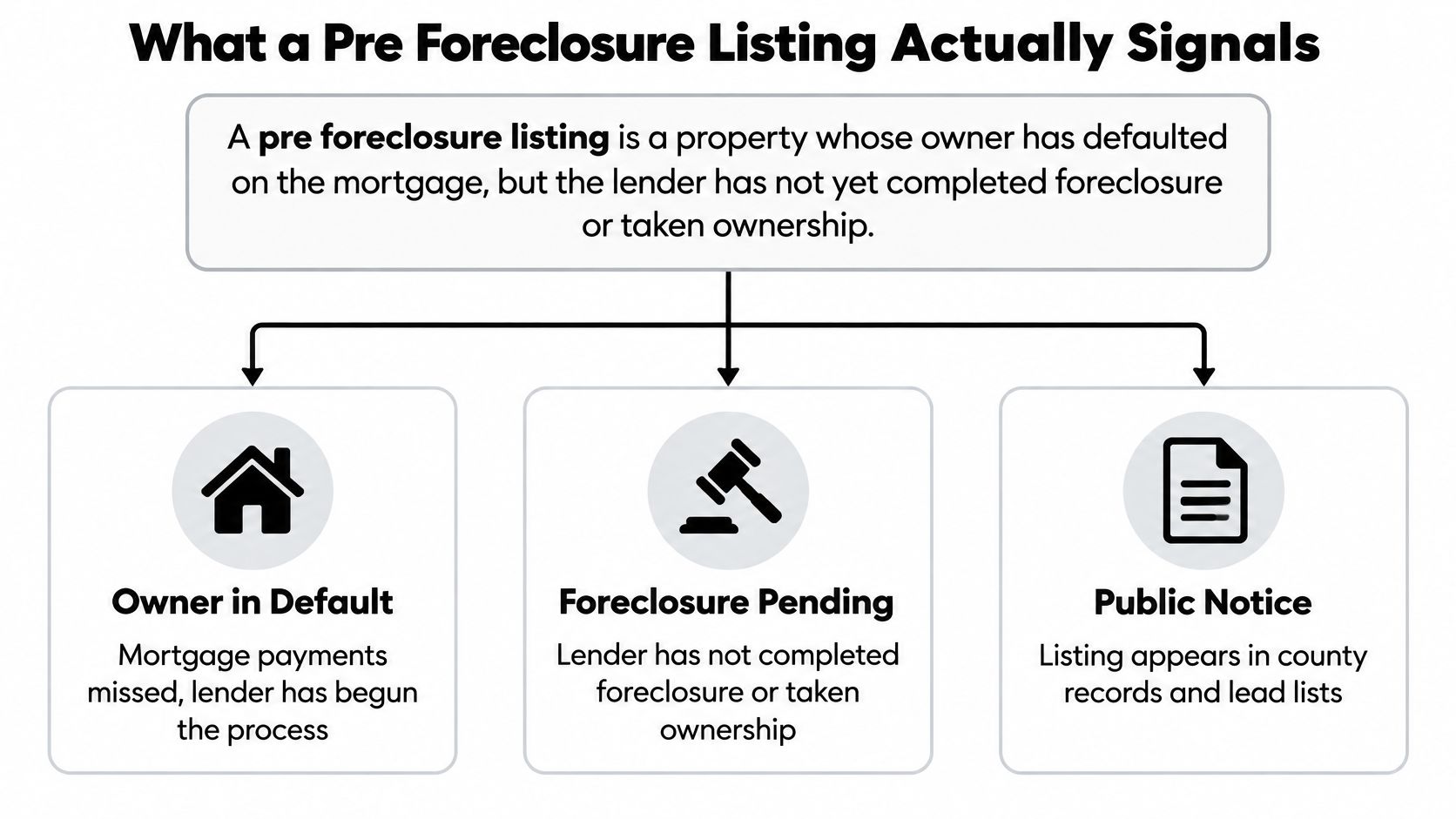
A pre foreclosure listing is a property whose owner has fallen behind on the mortgage, but whose foreclosure isn't yet complete, so the owner still holds title and the property isn't automatically for sale.
If the owner hasn't agreed to sell, what exactly are you looking at when a property website displays that label? Usually, you're seeing a public-record signal, not a seller's invitation to make an offer. Understanding that difference helps you avoid contacting the wrong party, assuming there's a discount, or budgeting for a closing that can't happen on your schedule.
What a Pre Foreclosure Listing Actually Signals
A pre-foreclosure listing identifies a property associated with mortgage default before the lender has completed foreclosure or taken ownership. The owner still holds title, which means the lender generally isn't the party you can negotiate a purchase with.
Say you find a house labeled pre-foreclosure on a property website. The photographs look attractive, but there's no listing agent and no asking price. Think of the label as a dashboard warning light: it tells you a problem has started, not that the car has stopped or that someone wants to sell it.
The document behind the label
ATTOM's foreclosure-data guide identifies common default-stage records as a Notice of Default, often used in nonjudicial foreclosure systems, or a lis pendens, meaning pending lawsuit, in judicial systems. Judicial foreclosure involves a court proceeding; nonjudicial foreclosure follows the applicable process outside a foreclosure lawsuit.
A property website may convert that recorded event into a searchable lead. That isn't the same as an owner or agent creating a sales listing.
Foreclosure stages and what each one means for a buyer
| Stage | Typical public record | Owner still holds title? | Buy from lender at this stage? |
|---|---|---|---|
| Pre-foreclosure | Notice of Default or lis pendens | Yes | No, the property is not lender-owned |
| Auction notice | Notice of trustee sale or auction notice | Yes, until the sale | Acquisition through foreclosure requires bidding at auction under state rules, not an ordinary lender purchase |
| Bank-owned (REO) | Completed foreclosure recorded, lender holds title | No | Yes, purchased from the lender |
REO means real estate owned, a term used for property a lender owns after foreclosure. An auction notice is different again: it announces a scheduled sale rather than establishing that the lender already owns the home.
A pre-foreclosure record is a reason to investigate, not evidence that a purchase is available.
Before treating the house as an acquisition opportunity, find the exact county document that triggered the label. The document type, parties, and subsequent filings tell you more than the website's category.
How Long the Pre Foreclosure Window Stays Open
There isn't a universal countdown from a pre-foreclosure label to an auction. Loan type, state procedure, and the borrower's own actions all stretch or compress the time available, which is why the same kind of filing can precede a quick sale in one county and a years-long delay in another.
Federal servicing rules generally block the first foreclosure notice or filing until the borrower is more than 120 days delinquent, as explained by Experian's pre-foreclosure guide. That threshold works like a mandatory waiting period before the legal clock can even start. It says nothing about when a sale will follow.
Servicing milestones aren't sale dates
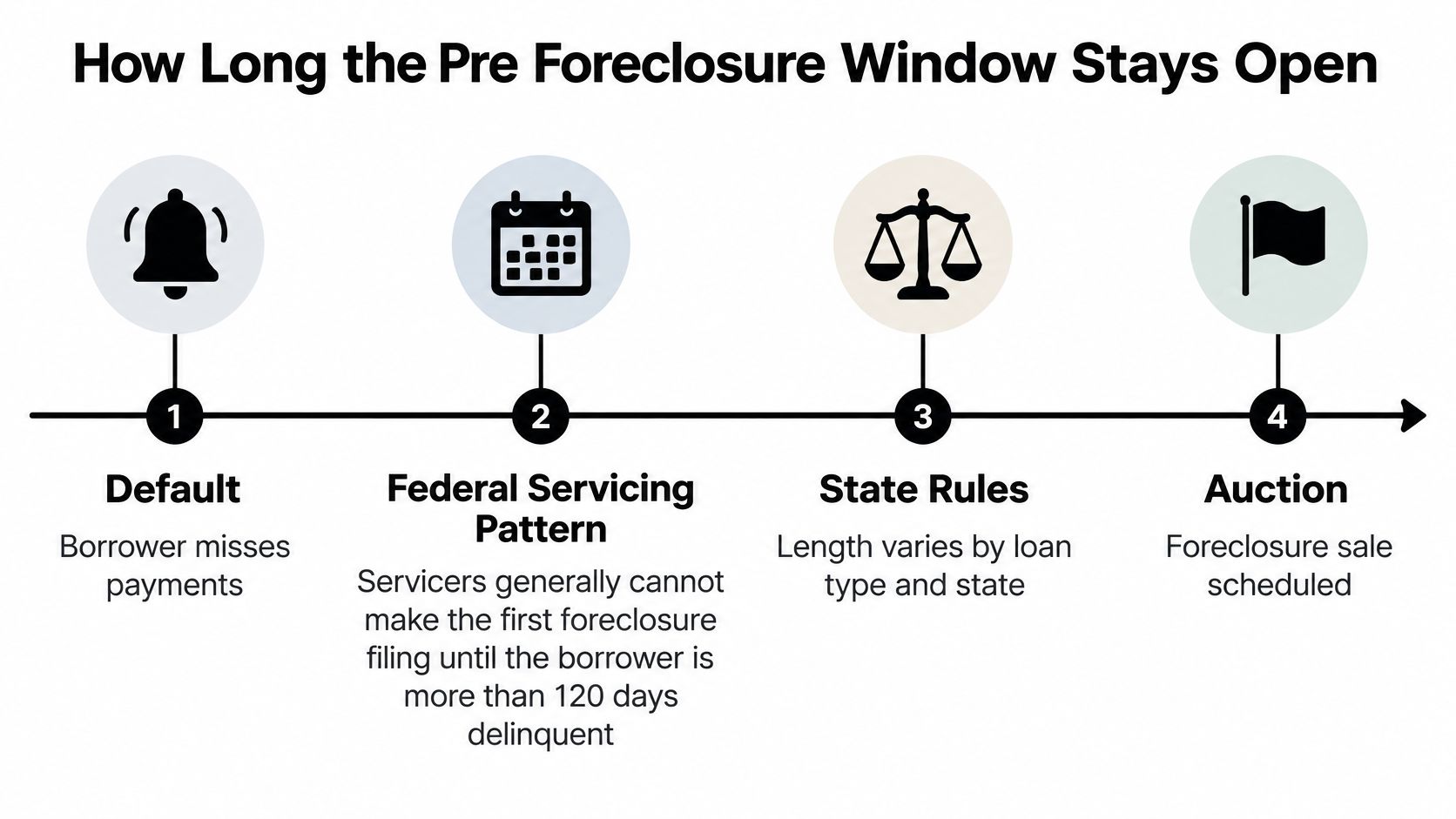
A pre-foreclosure record works like a snapshot taken at one stage of a longer process. The practical sequence runs from missed payments to a formal default-stage filing, through any required state proceedings, and ends at a scheduled foreclosure sale. Each stage carries its own paperwork and its own waiting periods, and none of them run on a fixed national schedule.
That sequence can also stop, pause, or restart. A repayment arrangement, loan modification, bankruptcy filing, or negotiated sale can interrupt it entirely, and a stalled case can resume months later. Loss mitigation, meaning efforts to avoid or reduce the losses tied to foreclosure, such as changing the payment arrangement, is one reason a single label can persist for a long stretch without any sale date being set.
A lead downloaded last quarter may describe a different situation today. The borrower might have entered a repayment plan, or the foreclosure may have advanced well past the filing you saw.
Timing rule: The recording date tells you when a document entered the public record. It says nothing about how much buying time remains.
National foreclosure filing totals blend default notices, auction notices, and completed foreclosures into one figure. Treating that figure as a count of open, purchasable leads overstates the pool.
Before estimating an offer, confirm whether a sale has been scheduled and which reinstatement or redemption rights apply. Reinstatement generally means bringing the loan current; redemption means recovering the property by paying the required amount under applicable law. A local foreclosure attorney can clarify which rights exist in that state and when they expire.
What Homeowners Can Still Do Before a Sale
Owner options before a foreclosure sale
| Option | Who must agree | What the owner keeps |
|---|---|---|
| Reinstate by paying past-due amount | No negotiated concession if an available reinstatement right is properly exercised | The home and existing loan |
| Loan modification | Mortgage servicer | The home, with changed loan terms |
| Conventional sale | Owner and buyer; no short-sale approval if proceeds cover all required payoffs and costs | Any equity remaining after debts and selling costs |
| Short sale | Servicer or loan owner and affected junior lienholders | No home; treatment of unpaid debt follows the approval terms |
| Deed-in-lieu | Servicer or lender, following the required review | No home; ownership transfers to the lender without an auction |
The Consumer Financial Protection Bureau's foreclosure-avoidance guidance explains that selling may be better financially and for credit than foreclosure when the home is worth more than the mortgage balance. The proceeds may repay the mortgage, cover selling costs, and leave the homeowner with remaining equity.
That doesn't make a discounted investor offer the best available choice. An owner with sufficient time and equity may prefer an ordinary market sale.
Keeping the home versus transferring it
Reinstatement addresses the overdue amount while preserving the existing mortgage, subject to the applicable requirements and deadline. A loan modification instead changes the loan terms with the servicer's agreement, potentially making continued ownership manageable.
A conventional sale transfers the property to a buyer and pays the secured debts at closing. A short sale also transfers the home to a buyer, but requires approval because the available proceeds won't satisfy the required debt payments.
A deed-in-lieu of foreclosure transfers the property to the lender rather than an investor. The homeowner must obtain approval, and the agreement should explain how any remaining debt will be handled.
For a buyer, these are competing outcomes, not obstacles to pressure an owner past. Ask whether the homeowner wants to explore a sale, give them room to consult a housing counselor or attorney, and don't suggest that accepting your offer is their only escape. A purchase conversation is useful only when selling fits the owner's goals.
Matching Your Offer to the Owner's Equity
The same pre-foreclosure record can lead to three different transactions depending on what the owner owes. Before pricing anything, place the property in one of these equity cases.
Likely path by equity case
| Equity case | Likely path | Investor implication |
|---|---|---|
| Sale price above payoff | Conventional sale, if proceeds also cover other liens and costs | A prompt closing may be possible; verify all required payments |
| Sale price near payoff | Conventional sale or short sale, depending on costs | Model both timelines and calculate net proceeds |
| Sale price below debt | Short sale, or deed-in-lieu as an owner alternative | Purchase requires short-sale approval; a deed-in-lieu isn't an investor acquisition |
Equity isn't the same as spendable closing proceeds. A price above the apparent mortgage balance may still leave a shortfall once other secured debts and transaction expenses are paid. The mortgage payoff is the first claim in line, but rarely the only one.
For owners who are upside down on a home loan, the proposed purchase must account for the approval process, not just the property's value. Agreeing on a price with the owner doesn't establish that the lienholders will accept it.
Price the approval path
Short-sale timing depends on which rules govern the loan. In one HUD-regulated pre-foreclosure sale program, the federal regulation governing those sales requires marketing through the MLS or another marketing resource for 90 days, or an applicable alternative period, before the borrower may consider offers. Other loans follow the lienholder's own review schedule. Treat the owner's acceptance as the start of the approval process rather than the end of the negotiation.
Build your offer from a defensible as-is value, repair scope, transaction costs, carrying costs, and exit strategy. Then test a separate delayed-approval scenario rather than using the same schedule as a conventional purchase.
- Obtain a current payoff. Don't price from the original mortgage amount or a website's estimated balance.
- Order a title commitment. This identifies title requirements and exceptions that must be addressed for the proposed insurance coverage.
- Confirm lien releases. A junior lien is a claim behind another lien in priority, and its holder may still need to cooperate.
- Allow for uncertainty. Approval delays, possession issues, and deferred maintenance can justify a lower maximum offer or a decision to pass.
In a negative-equity purchase, the required approvals determine whether the transaction can close. The pre-foreclosure label doesn't supply those approvals.
Misconceptions That Cost Investors Money
A useful investment review separates what the record establishes from what the buyer hopes it means.

- The owner is selling. A default record doesn't establish seller authorization. The homeowner may intend to keep the property and resolve the delinquency.
- The property must be a bargain. Financial difficulty doesn't establish a below-market value. An owner may have meaningful equity and other buyers willing to pay more.
- The house is vacant or neglected. Neither occupancy nor condition follows from mortgage status. Don't budget repairs or assume possession without checking.
- Pre-foreclosure means the same thing everywhere. State filing procedures differ, and marketing databases may group distressed properties too loosely. Identify the actual legal stage rather than relying on a category name.
More filings don't mean more ready-to-close purchases
ATTOM reported U.S. foreclosure filings on 367,460 properties in 2025, up 14% from 2024 but still 25% below 2019 levels, in its foreclosure market reporting. Those filings encompass different stages, so the increase shouldn't be read as an equivalent increase in available investor purchases.
Understanding the distinction between a short sale and foreclosure also prevents you from applying the wrong buying process. A negotiated purchase and a foreclosure auction involve different decision-makers and closing requirements.
Keep the distinction between a database label and a verified opportunity in mind when reviewing property explanations on video.
Growing activity may give you more records to examine. It doesn't remove the need to establish current status, seller willingness, and a workable transaction.
How to Verify a Pre Foreclosure Lead Before Offering
Start a property file that separates recorded facts, current confirmations, and estimates. Save document copies and note when each confirmation was obtained so an old assumption doesn't become an offer input.
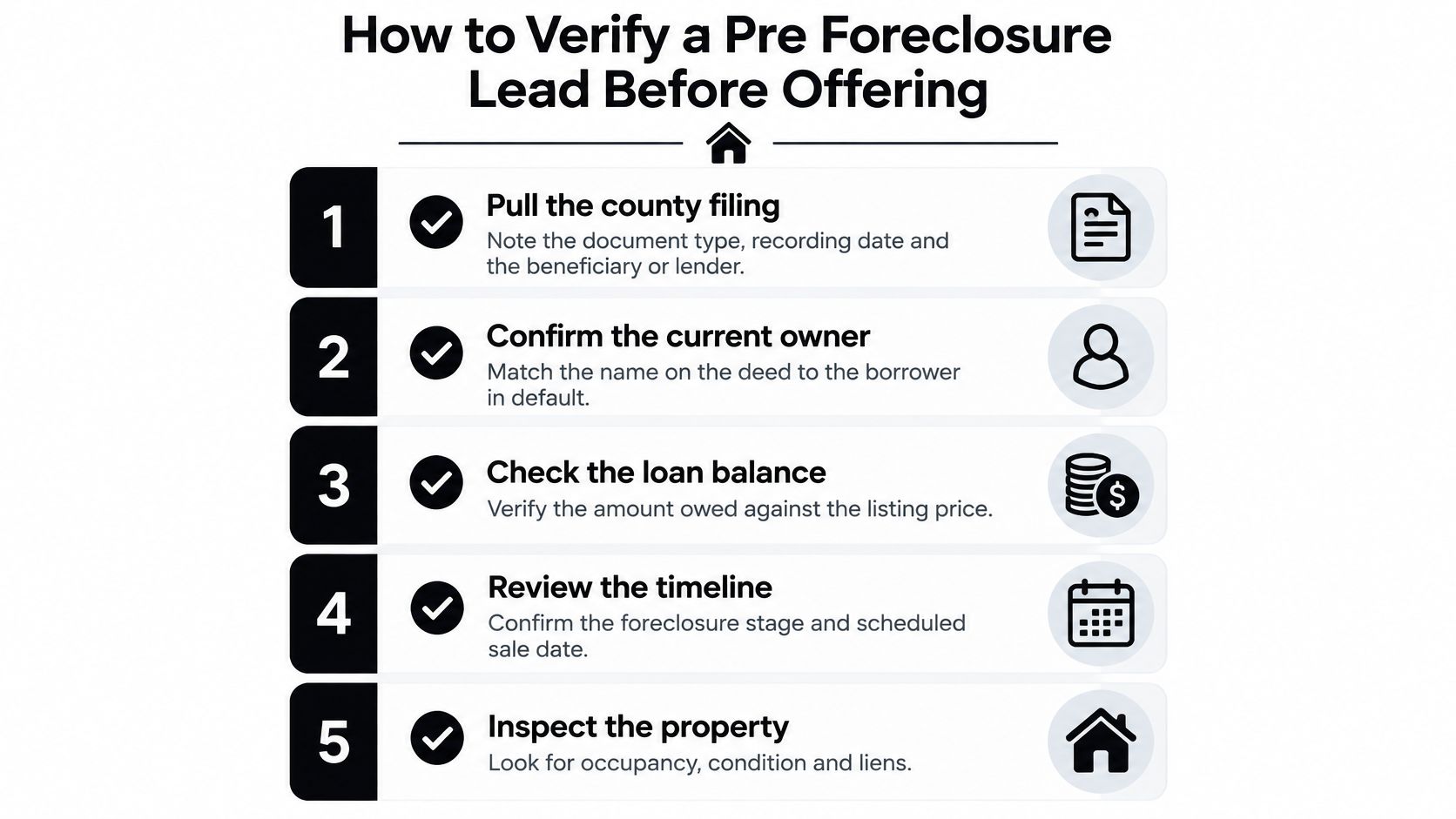
Use this visual as an initial screen, then complete the detailed checks below.
Check records and authority first
Pull the county filing. Record the document type, recording date, and named beneficiary or lender, then search for later documents affecting it. Our guide to mortgage public records explains how those records fit into property research.
Confirm the current owner. Match the deed to the borrower's information and investigate any subsequent transfer or death. If an estate, trust, or other representative is involved, establish who has authority to sign.
Request payoff and reinstatement figures. Obtain current figures through the servicer or appropriate authorized party, with the homeowner's authorization where required. A payoff satisfies the loan; reinstatement addresses the amount required to bring it current.
Search other claims. Have the title company examine junior mortgages, tax delinquencies, judgments, and other recorded encumbrances. Each unresolved claim can affect the proceeds or closing requirements.
Confirm timing and physical risk
Check bankruptcy status. If a bankruptcy case appears, ask counsel how it affects the proposed transaction. Don't assume an advertised auction or ordinary closing can proceed.
Verify the scheduled sale. Confirm the date and status through the responsible trustee, court, or other appropriate official source. Have local counsel identify applicable reinstatement and redemption deadlines.
Ask about existing workout arrangements. Establish whether the owner is pursuing a repayment plan, modification, short sale, or deed-in-lieu. Don't mistake an old default record for evidence that no arrangement exists.
Verify condition and occupancy. Arrange authorized access and a professional inspection before finalizing the repair scope; never enter without permission. Superior Home Improvement's Utah homebuyer inspection advice offers a practical preparation resource, though inspection planning doesn't replace title or legal review.
We pull property data from public records, tax assessments, and market data without requiring MLS access. Those inputs support preliminary analysis, but they don't replace current servicer confirmations or a title examination.
Offer discipline: Mark an unresolved input as unresolved. Don't turn it into a favorable assumption just to make the deal work.
Decide Whether the Lead Is Worth Pursuing
A lead is worth pursuing when you can explain both why the purchase works financially and how it can close. An attractive renovation spread alone isn't enough.
Use these decision questions before committing substantial time or money:
- Is the record current? The triggering document and later filings should support the status you're relying on today.
- Do verified costs leave room? The purchase must accommodate required payoffs, repairs, carrying costs, selling expenses, and a fair margin.
- Does the schedule fit your resources? Your capital and exit plan must tolerate the likely approval and closing path.
A lead that passes those checks merits a respectful conversation with the owner. A lead that fails needs a revised offer, a different schedule, or a pass, not optimistic inputs.
Choose a defensible next action
The owner controls whether to agree to a voluntary sale, and required lender approvals can become the longest part of the transaction. Don't commit to a closing date that depends on cooperation you haven't established.
Start by pulling the county record that created the listing and confirming its current status. Only then use a basic after-repair value, or ARV, calculation and a fix-and-flip analysis to test the numbers before approaching the homeowner. Your decision should rest on verified figures and a feasible closing path, not the listing label.
At PropLab, we offer free, no-account tools including the ARV Calculator, Rehab Cost Calculator, Fix and Flip Calculator, and Comp Finder to help you evaluate a verified pre-foreclosure lead. To run an analysis, paste a property address or an MLS, Zillow, or Redfin link, then compare the investment assumptions with your confirmed payoff, title findings, and available timeline before setting an offer.
Tags
About the Author
P
PropLab Team
Real Estate Analysis Experts
The PropLab team consists of experienced real estate investors, data scientists, and software engineers dedicated to helping investors make smarter decisions with AI-powered analysis tools.
Free account
Underwrite your next deal in under a minute
3 free analyses, no credit card. ARV, rehab, comps and exit strategy in one report.
