General
What Is an Absentee Owner? a Practical Guide for Investors
October 20, 2026
15 min read

An absentee owner generally owns a property without occupying it as a primary residence. In public records, the most practical screening signal is a mismatch between the owner's mailing address and the property's physical, or situs, address.
You're reviewing a county parcel record, and the tax bill goes somewhere far from the house you're researching. Before adding that property to your acquisition pipeline, you need to understand who owns it, how it's occupied, and whether anyone is actively looking after it.
Why Absentee Ownership Needs Context
An investor opens a county assessor's database and notices an out-of-state mailing address. The house looks like a possible acquisition target, so the investor marks it as a distressed lead.
That's a hypothesis, not a finding. Napa County's explanation of property addresses specifically notes that different mailing and situs addresses are common for business and absentee owners, including rental properties. The address tells you where official correspondence goes, not whether the owner has stopped maintaining the building.
The same flag can describe different properties
Consider these hypothetical possibilities. A tenant occupies the house while the owner lives elsewhere and employs a local manager. Alternatively, the owner uses it seasonally, inherited it recently, or holds it through a company with a separate business address.
Each situation calls for a different investigation. The rental raises questions about occupancy and management; the seasonal home raises questions about vacancy purpose; the inherited property raises questions about ownership authority and ongoing upkeep.
A useful starting file separates the parcel information from assumptions about its owner.
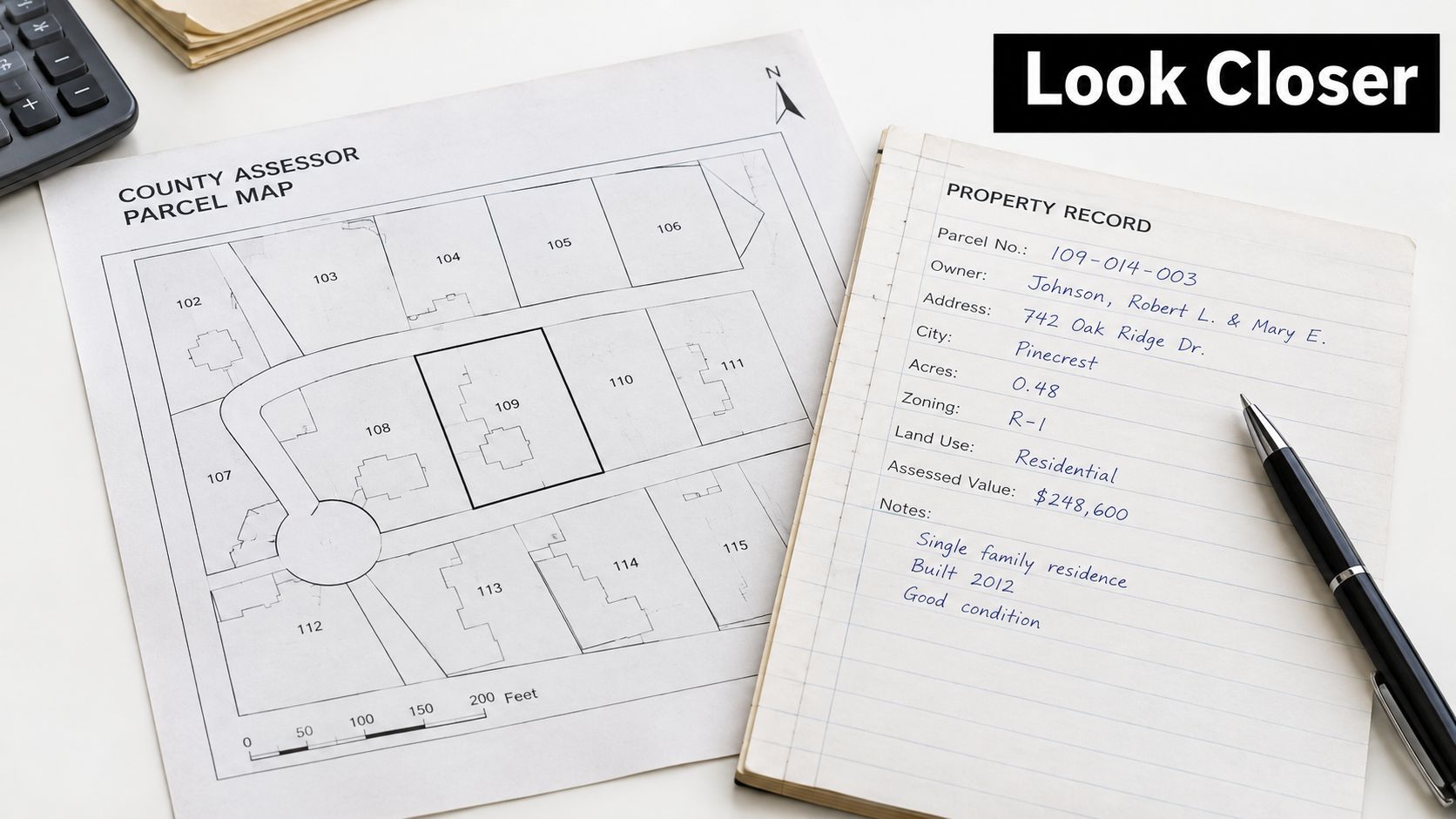
Replace the first impression with questions
Before classifying the lead, ask:
- Occupancy: Is the property tenant-occupied, seasonally used, vacant, or still unverified?
- Management: Is there evidence of someone handling repairs and compliance?
- Property friction: Are taxes overdue, violations unresolved, or maintenance visibly deferred?
These questions keep your research focused on observable conditions rather than the owner's location. They also help you avoid spending acquisition time on a well-run property just because its owner receives mail elsewhere.
Practical rule: An absentee-owner flag earns a closer look. It doesn't earn a distress label.
What Is an Absentee Owner
The useful answer to what is an absentee owner requires separating legal ownership from occupancy and management. The titleholder owns the asset, but another person may live there, maintain it, or handle its day-to-day operations.
This separation isn't a new administrative concern. Massachusetts archival land-record collections include property records involving loyalist absentees from 1776–1780 and absentee estates reviewed from 1781–1791. Those records illustrate the long-standing distinction between ownership and physical presence, rather than supplying a universal modern definition.
Separate the fields before interpreting them
The concept map below distinguishes the basic ownership relationship from the legal rules that may apply to a particular parcel.
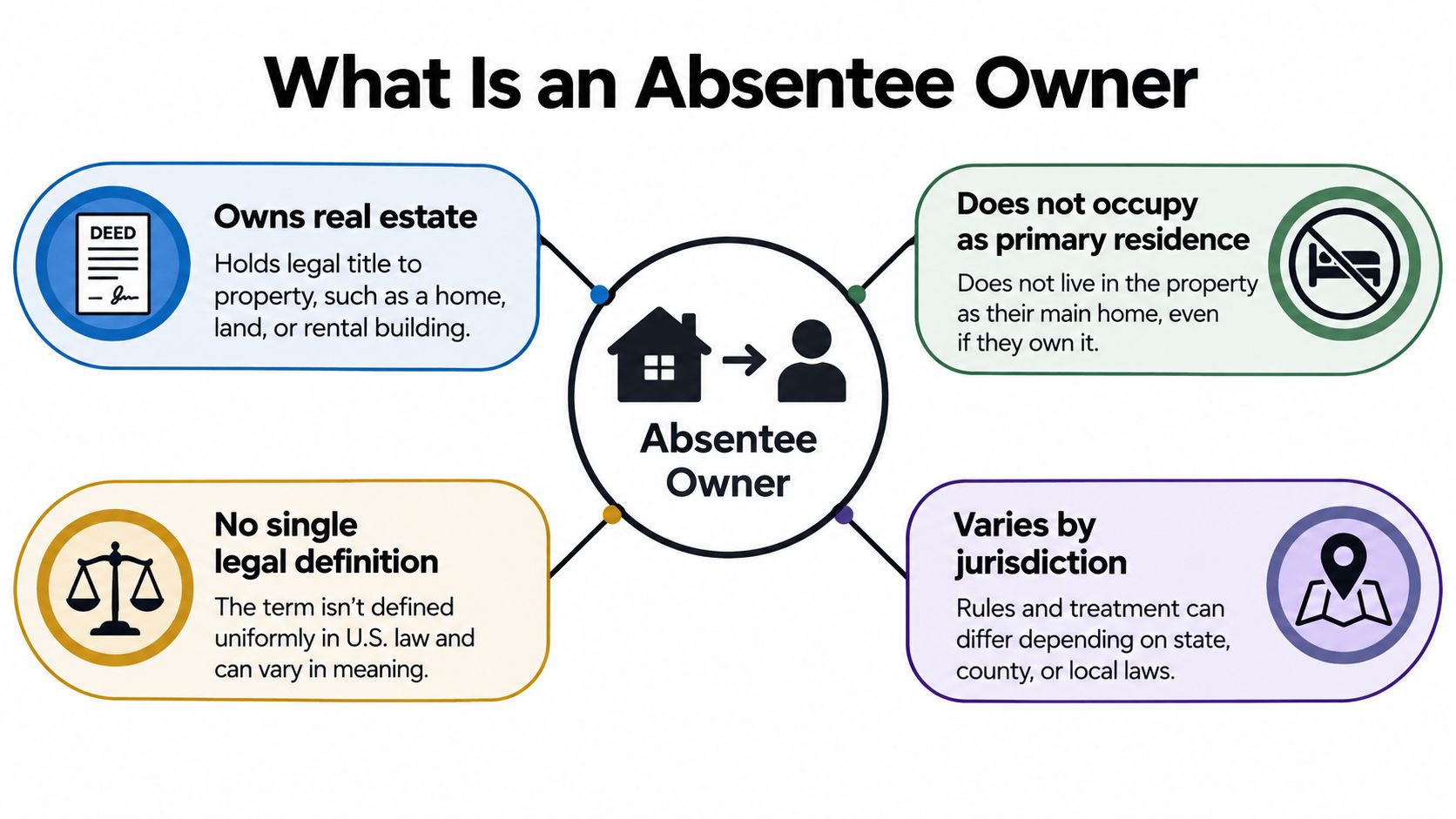
For practical research, keep these terms distinct:
- Titleholder: The person or entity that legally owns the property.
- Primary residence: The home the owner principally occupies.
- Situs address: The physical location of the parcel.
- Tax-mailing address: The destination for official property correspondence.
- Manager: The person or organization responsible for routine operations, if one exists.
Think of a property manager as an operator rather than an owner. In a hypothetical rental, the manager might arrange plumbing repairs, communicate with tenants, and coordinate inspections while the titleholder lives elsewhere. None of those activities requires the owner to occupy the house.
A screening definition isn't a legal conclusion
There isn't a single federal rule that defines absentee ownership consistently across tax, landlord–tenant, insurance, and municipal contexts. For a particular legal or compliance question, use the applicable jurisdiction's definition rather than a lead provider's category.
A mailing address also isn't a verified residential location. An individual may use an administrative address, while a corporation or trust may receive notices at an office that says little about who oversees the property.
Record the definition your list uses. Otherwise, a list based on geographic distance can get mixed with one based on non-owner occupancy or exemption status, even though those filters answer different questions.
Common Absentee Owner Profiles
Two properties can share an absentee-owner label while having almost nothing else in common. Classifying the owner helps you choose the next record to inspect instead of applying the same acquisition assumptions to every parcel.
Research on rescaling absenteeism examines materially different definitions, including owners outside a geographic boundary, landlords who don't occupy their rentals, and classifications tied to homestead exemptions. Those distinctions matter because changing the definition changes which properties enter your prospect list.
Absentee Owner Profiles at a Glance
| Owner Profile | What Address Mismatch May Indicate | What It Does Not Prove | Next Evidence to Check |
|---|---|---|---|
| Remote individual owner | Correspondence goes to another locality | Neglect, financial hardship, or sale intent | Occupancy, tax status, condition |
| Nonresident landlord | Owner and tenant occupy different homes | Vacancy or poor management | Rental registration, inspections, management contact |
| Entity owner | Notices go to an LLC, corporation, or trust address | That the people managing it are remote | Ownership documents, appropriate contact, local management |
| Second-home owner | Property isn't the owner's primary home | Abandonment or unwanted ownership | Seasonal-use indicators, maintenance, compliance |
| Inherited-property owner | Ownership may have passed to someone living elsewhere | That the heir wants or can authorize a sale | Transfer records, ownership authority, taxes |
| Professionally managed property | Operations may be delegated | That maintenance is adequate | Inspection history, unresolved violations, management records |
Profiles overlap rather than compete
A remote individual can also be a landlord. An inherited property can be held in a trust, and an entity-owned rental can have a nearby professional manager. Don't force these overlapping facts into a single label.
For consistency, use separate fields in your research file:
- Geography: Nearby, outside the area, or unverified.
- Occupancy: Rental, seasonal, vacant, owner-occupied, or unknown.
- Structure: Individual, entity, trust, or ownership requiring clarification.
- Operations: Owner-managed, professionally managed, or unknown.
The follow-up evidence should match the uncertainty. For a second home, focus on whether vacancy reflects ordinary seasonal use or an actual management gap. For an inherited house, establish who holds title and who can discuss a transaction before treating an apparent heir as the decision-maker.
For an entity owner, the business mailing address is a starting point for identifying the proper contact, not a shortcut to determining motivation. Your classification should describe what you know about the property, while leaving unanswered questions visibly unanswered.
Legal and Practical Investor Implications
Professional management deserves verification, not automatic reassurance. A remote owner may delegate operations effectively, but the existence of a management company doesn't establish that every maintenance or compliance issue has been resolved.
A Rochester study linking ownership records with building inspections reported code violations for 24.7% of all absentee owners and 38.2% for properties run by professional management companies. These are findings from that study, not a prediction that a particular managed property has violations.
Use research to direct scrutiny
The Rochester findings challenge a convenient assumption: a named manager isn't a substitute for checking inspection history. They don't justify the opposite assumption that professional management causes neglect, either.
The infographic separates the areas that warrant investigation from conclusions the ownership label cannot establish.
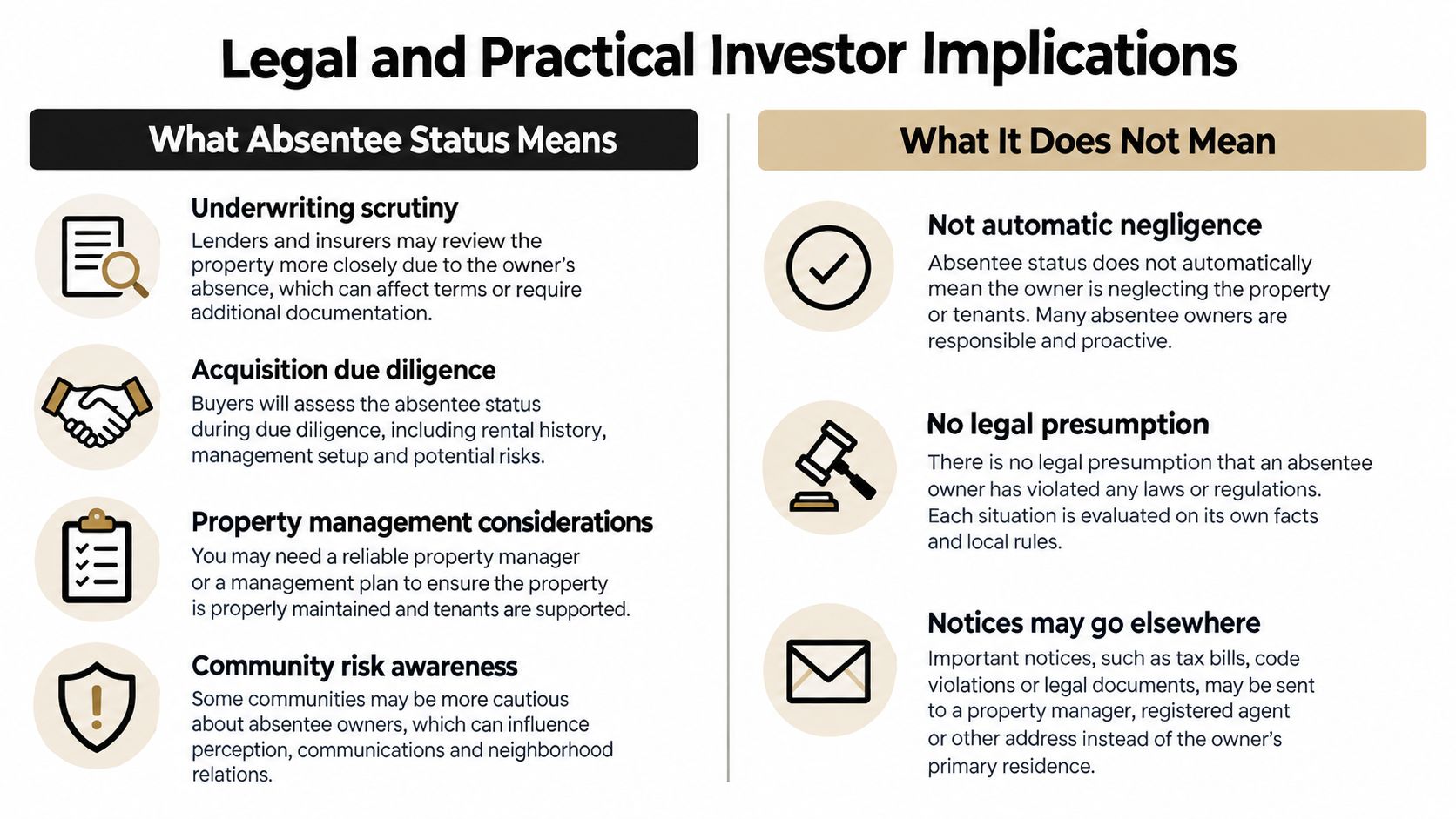
Local records should determine your response. An unresolved inspection matter deserves attention whether the owner lives nearby or elsewhere; a documented correction deserves recognition regardless of the ownership profile.
Before relying on a compliance assumption, check:
- Applicable obligations: Identify the local landlord, registration, inspection, or maintenance requirements relevant to the property.
- Current status: Distinguish an open matter from a corrected or closed one.
- Operational responsibility: Clarify who manages the building and who can provide supporting documents.
Keep acquisition strategy separate from value
Absentee status can influence which lead you investigate and how you locate the right contact. It shouldn't directly determine After Repair Value (ARV), your repair estimate, or your maximum offer.
Comparable sales, verified condition, repair scope, and market evidence belong in the valuation file. An owner's distant address doesn't justify reducing the property's value or assuming that the owner will accept a discount.
A group-level association can justify checking a record. Only property-specific evidence can support a property-specific conclusion.
There's also a community dimension to due diligence. Unresolved maintenance and code issues can matter to occupants and neighbors, not just to your acquisition budget. If you're considering a purchase, investigate what needs correction and whether your proposed operating or rehabilitation plan addresses it.
The investor's task is to identify actual obligations and costs, not to use absentee ownership as a legal presumption of wrongdoing.
How to Identify Absentee Owners in Public Records
Start with the parcel, not a name search alone. Your first objective is to connect the physical property, recorded owner, and correspondence address without confusing separate parcels or similarly named owners.
Use the address comparison as an initial workflow, then expand the file with independent records.
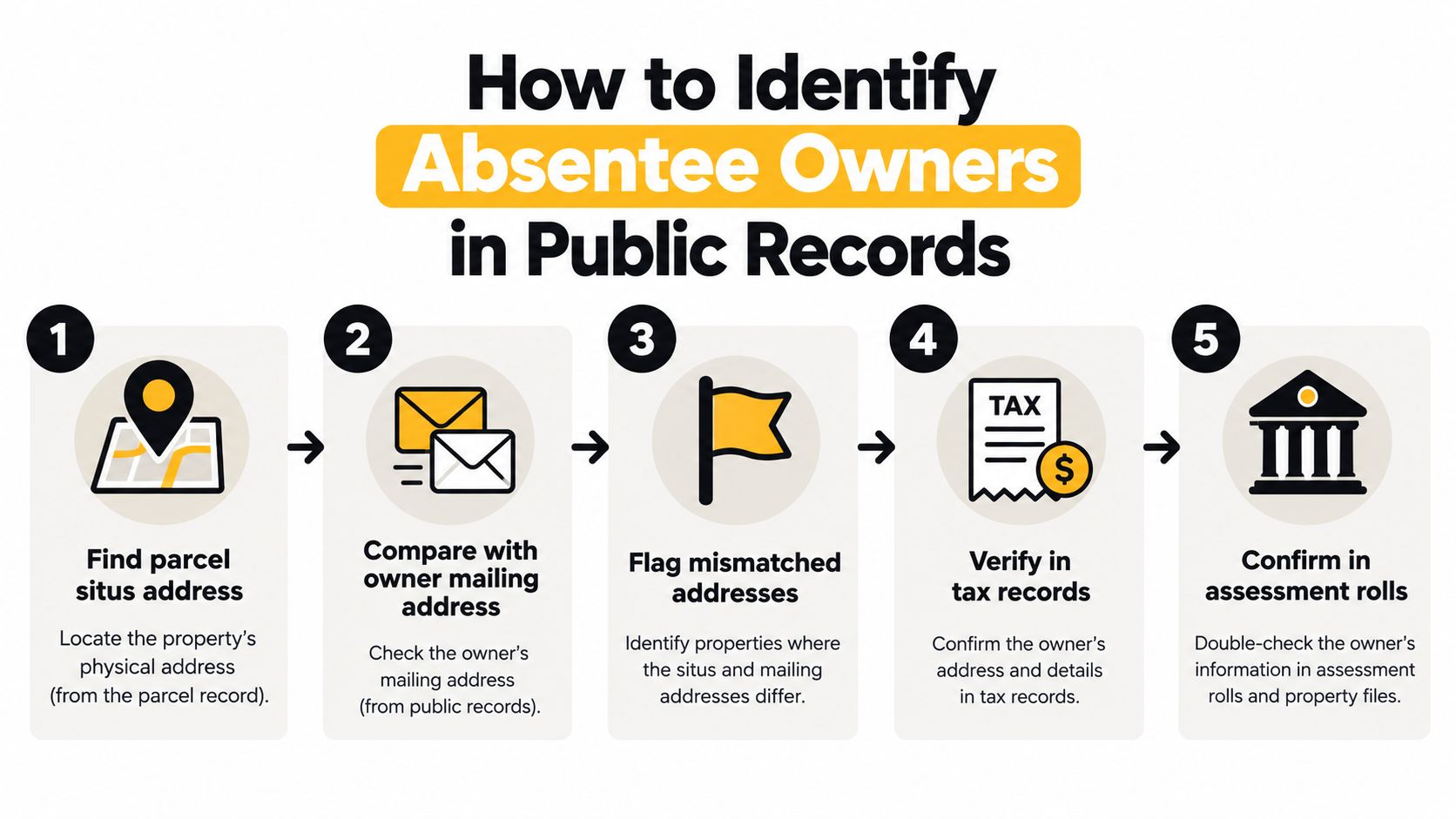
Establish the parcel and ownership record
- Confirm the parcel: Record the parcel identifier and situs address from the county assessor or parcel database.
- Compare address fields: Check the owner's tax-mailing address against the property location. Normalize obvious formatting differences before flagging a mismatch.
- Capture timing: Note when you retrieved the record and any update date displayed.
- Identify ownership structure: Preserve the recorded owner's exact name, then distinguish an individual from an entity or trust.
A recently retrieved page isn't necessarily a recently updated record. If the assessment entry and a recorded ownership document disagree, retain both and resolve the difference before selecting an outreach contact.
For a broader search process, use this guide to public-records property searches alongside the county's own databases.
Add records that answer separate questions
| Record or indicator | Question it helps answer | Important limit |
|---|---|---|
| Exemption or rental registration | How is occupancy represented administratively? | Doesn't establish current occupancy by itself |
| Tax account and lien records | Is there a documented financial obligation? | Doesn't reveal willingness to sell |
| Inspection and code records | Is there a recorded compliance issue? | Check whether it remains unresolved |
| Permits | Is work documented? | A permit alone doesn't confirm completion |
| Transfer history | How has recorded ownership changed? | Doesn't explain the owner's intentions |
| Lawfully available occupancy information | Is the occupancy classification supportable? | Availability and reliability require checking |
Treat missing information as unknown, not negative evidence. No visible permit entry, for example, isn't enough to conclude that the owner has deferred repairs. Likewise, a quiet exterior visit from a lawful public vantage point isn't sufficient to declare a home vacant.
This video provides an additional resource to consult alongside your record review.
Finish with a documented screening file. For every meaningful conclusion, retain the record reference, retrieval date, finding, limitation, and next verification action. That makes it possible for a partner or lender to distinguish your evidence from your interpretation.
Examples of Strong and Weak Lead Signals
The following scenarios are hypothetical, not transaction case studies. They show how corroborating evidence changes the appropriate next action without establishing that any owner will sell.
An occupied rental held by an LLC
The initial flag is a business mailing address outside the property's locality. Further review identifies a tenant-occupied rental and a local management contact, with no unresolved compliance matter found in the records checked.
That's a weak distress signal, even if the property fits your investment criteria. Ordinary acquisition outreach may still be reasonable, but don't approach the company as though it has abandoned the building or needs financial relief.
A vacant but maintained second home
The owner receives mail elsewhere, and the property appears to be used seasonally. Available records and lawful exterior observations don't identify a maintenance gap.
Vacancy needs interpretation here. A study of U.S. commuting zones from 1990–2020 measures absentee-owned homes using units vacant for seasonal or occasional use, illustrating why an occupancy-based measure differs from an address-based screen.
For sourcing, a vacant-property list can provide research candidates, but seasonal vacancy alone doesn't establish urgency. The next useful question is whether the property fits your acquisition strategy, not whether the owner must be tired of owning it.
An inherited house with corroborated friction
Now consider a house with a recorded ownership transfer, an off-site mailing address, overdue taxes, an unresolved code matter, and observable exterior deterioration. Multiple records support further investigation, although each still needs a current-status check.
Before discussing an offer, prioritize:
- Authority: Confirm who owns the property and who can negotiate.
- Obligations: Verify outstanding taxes, liens, and compliance matters.
- Scope: Obtain lawful access before estimating interior repair needs.
Evidence standard: Rank the quality of the corroboration, not the emotional appeal of the owner's story.
This is a stronger research lead than the other examples because it contains documented property friction. It still isn't proof of motivation, hardship, or a workable deal.
Outreach Strategies by Evidence Level
Your message should reflect what you've verified, not what your lead category suggests. Match the contact method and level of detail to the owner profile, the evidence available, and the applicable communication rules.
Low-confidence leads need neutral language
When you have only an address flag, begin with quiet research or a straightforward acquisition inquiry. Identify the property, explain your interest, and ask whether the owner is open to a conversation.
Don't claim that the house is vacant, neglected, or financially burdensome without support. For an entity-owned parcel, identify the appropriate public business contact rather than assuming that any person associated with the entity can discuss a sale.
A useful pre-contact check includes:
- Relevance: State why you're contacting this owner about this property.
- Support: Remove every assertion you can't substantiate.
- Channel: Confirm that your proposed mail, call, text, or email approach complies with applicable requirements.
- Privacy: Avoid requesting sensitive information before it's necessary.
Corroborated leads can support specific questions
If you've verified an unresolved property issue, ask whether the owner would consider a sale or another arrangement. Keep the message factual and restrained; a public tax or code record doesn't give you permission to speculate about personal hardship.
Mail Merge for Gmail's practical sales outreach walkthrough is a supplementary resource for organizing an outreach process. Pair general sales guidance with property-specific research and a separate compliance review.
For pipeline planning, this outbound lead-generation guide can support the broader workflow. Keep the research record separate from the contact log so someone reviewing the lead can tell what came from public documents and what the owner confirmed.
Follow-up timing should reflect the conversation and any requested next step, not an arbitrary pressure sequence. If an owner declines or asks you to stop, respect that response rather than treating stronger property evidence as a reason to push harder.
A Decision Framework for Real Estate Investors
A defensible acquisition hypothesis connects an owner profile, verified property circumstances, and independently evaluated economics. It doesn't start and end with a list filter.
For a wholesaler, the immediate issue may be ownership authority and a credible seller conversation. A fix-and-flip buyer needs a supportable repair scope, while a rental investor needs to understand occupancy and operations. Lenders and acquisition teams need a file that shows how the analyst reached the proposed value and offer.
Make the decision in separate lanes
- Classify: Describe the owner, occupancy, and management arrangement without guessing at motivation.
- Corroborate: Identify independent evidence of unresolved property friction, or document that it remains unverified.
- Underwrite: Evaluate comparables, condition, repairs, and obligations separately from the lead label.
- Contact: Choose a relevant, respectful approach that fits the evidence and the authorized decision-maker.
Keep the conclusion proportionate
Your final recommendation might be to investigate further, pursue ordinary acquisition outreach, request access, or set the lead aside. A decision not to pursue a well-managed property is a useful result, not failed research.
Public records can identify a question worth asking. They can't reliably reveal intent, personal financial hardship, or willingness to transact. The investment opportunity is the supported acquisition hypothesis, not the absentee-owner label.
Use county records to verify the ownership signal, then evaluate the property's economics separately. PropLab offers real estate underwriting tools for estimating ARV and rehab costs and preparing offer-ready reports; visit it to assess whether a researched absentee-owner lead supports an acquisition offer.
About the Author
P
PropLab Team
Real Estate Analysis Experts
The PropLab team consists of experienced real estate investors, data scientists, and software engineers dedicated to helping investors make smarter decisions with AI-powered analysis tools.
Free account
Underwrite your next deal in under a minute
3 free analyses, no credit card. ARV, rehab, comps and exit strategy in one report.
