General
What Is Hard Money Lender
October 17, 2026
16 min read

A hard money lender is a private individual, company, or investment fund that provides short-term, asset-based real estate financing, judging the property and repayment plan more heavily than the borrower's income or credit score. That trade-off can mean faster, more flexible funding, but it usually comes with higher rates, upfront fees, and a firm deadline to repay.
Your bank has just declined to finance a distressed property, and the seller expects you to close within a month. A private lender may still consider the deal, but it won't approve it because you can close quickly. It will want to know whether the property, renovation plan, and exit strategy can protect its money if the project goes off track.
Hard money is often described as “expensive but fast.” That misses the central risk: it's time-sensitive project financing. A deal can look profitable on paper and still become a loss if renovations drag on, the resale price falls short, or refinancing doesn't happen before the loan matures.
This guide explains how collateral-first underwriting works, how hard money differs from bank financing, and where it can fit in fix-and-flip and bridge deals. It also breaks down all-in borrowing costs, default risks, and a practical checklist for comparing lenders. If you're weighing a quick sale against an investor purchase, this overview of how to sell a house as-is for cash in can also help clarify the seller's side of a cash transaction.
The Quick Answer Most Investors Need
A hard money lender provides a short-term real estate loan secured mainly by the property. The lender weighs the collateral, the improvement or sale plan, and the way the loan will be repaid. Borrower finances still matter, but the property and project usually carry more weight than they do in conventional mortgage underwriting.
For an investor facing a tight closing deadline, hard money can provide financing when a bank's timeline or lending rules do not fit the deal. Fix-and-flip investors, buyers of distressed properties, developers, and borrowers waiting for another source of funds commonly use it as bridge financing. Loans often last about 6 to 18 months, and lenders commonly finance about 65% to 75% of the property's value. Reported market rates fall in the 8% to 15% range, while origination charges often run 1.5 to 5 points. Each point equals 1% of the original loan principal (Investopedia's hard money loan overview).
The deadline shapes the cost. If a renovation takes longer than planned, permits stall, or a sale or refinance is delayed, interest and other charges can continue while repayment becomes harder. A loan that looks affordable on its first-day terms may strain the project by the time it comes due.
Before applying, test the whole project like a calendar tied to a budget: can the expected sale or refinance repay the principal, cover financing costs, and leave your target profit if work or closing runs late? Include a cushion for schedule changes, not just the best-case timeline. A seller considering a cash offer can also review what it means to sell a house as-is for cash in.
How Hard Money Lending Works
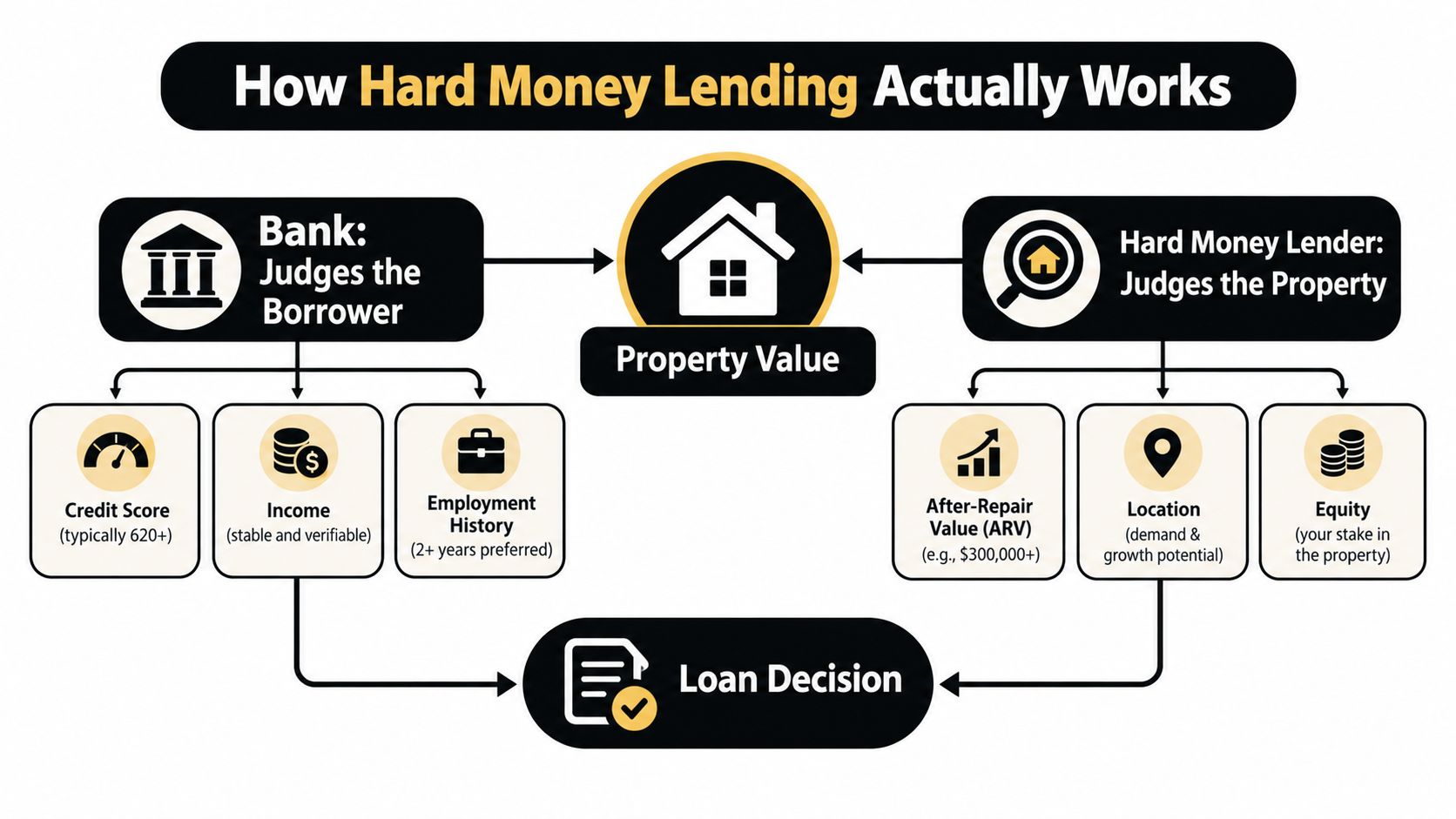
A property can look like a poor fit for a bank yet still support a workable investment loan. A bank tends to examine the borrower's income, tax returns, credit history, and debts. A hard money lender gives more weight to the property and project: what the asset is worth now, what it may be worth after repairs, and how the borrower expects to repay.
That focus gives investors another financing route for properties that fall outside conventional lending criteria or deals with tight closing schedules. The lender assesses the specific transaction rather than relying only on standard borrower requirements. Reviewing loan-to-cost calculations helps distinguish the amount borrowed from the full cost of buying and completing a project.
The collateral and the repayment plan
Loan-to-value (LTV) compares the loan principal with the property's value. The calculation is principal divided by value. A lower LTV means the borrower has more equity in the deal, giving the lender a larger cushion if a sale or foreclosure does not recover the full balance. Hard money lenders commonly fund roughly 65% to 75% of current property value, with terms varying by lender and deal (technical overview of hard money lending).
For a renovation, the lender may also assess after-repair value (ARV), the estimated market value after the work is complete. ARV is a projection, not money available to pay contractors or repay the loan. The estimate needs support from comparable sales, a realistic renovation budget, the property's marketability, and the borrower's ability to complete the work.
| Hard Money Loan Anatomy at a Glance | Typical Range | Why It Matters |
|---|---|---|
| Loan term | About 6 to 18 months | Sets the time available to sell or refinance |
| Property financing | About 65% to 75% of value | Determines how much equity the borrower must contribute |
| Interest rate | 8% to 15% | Affects the cost of holding the loan |
| Origination charge | 1.5 to 5 points | Adds an upfront cost based on principal |
The lender is weighing a practical question: if the planned repayment falls through, can the collateral offer a credible route to recovering the money? Borrowers should consider the loan as project financing tied to both asset value and a workable repayment schedule. Readers comparing higher-value property purchases can also explore these insights for high net worth buyers, while keeping in mind that lending decisions depend on the details of each deal.
Hard Money Lenders vs Traditional Banks Side by Side
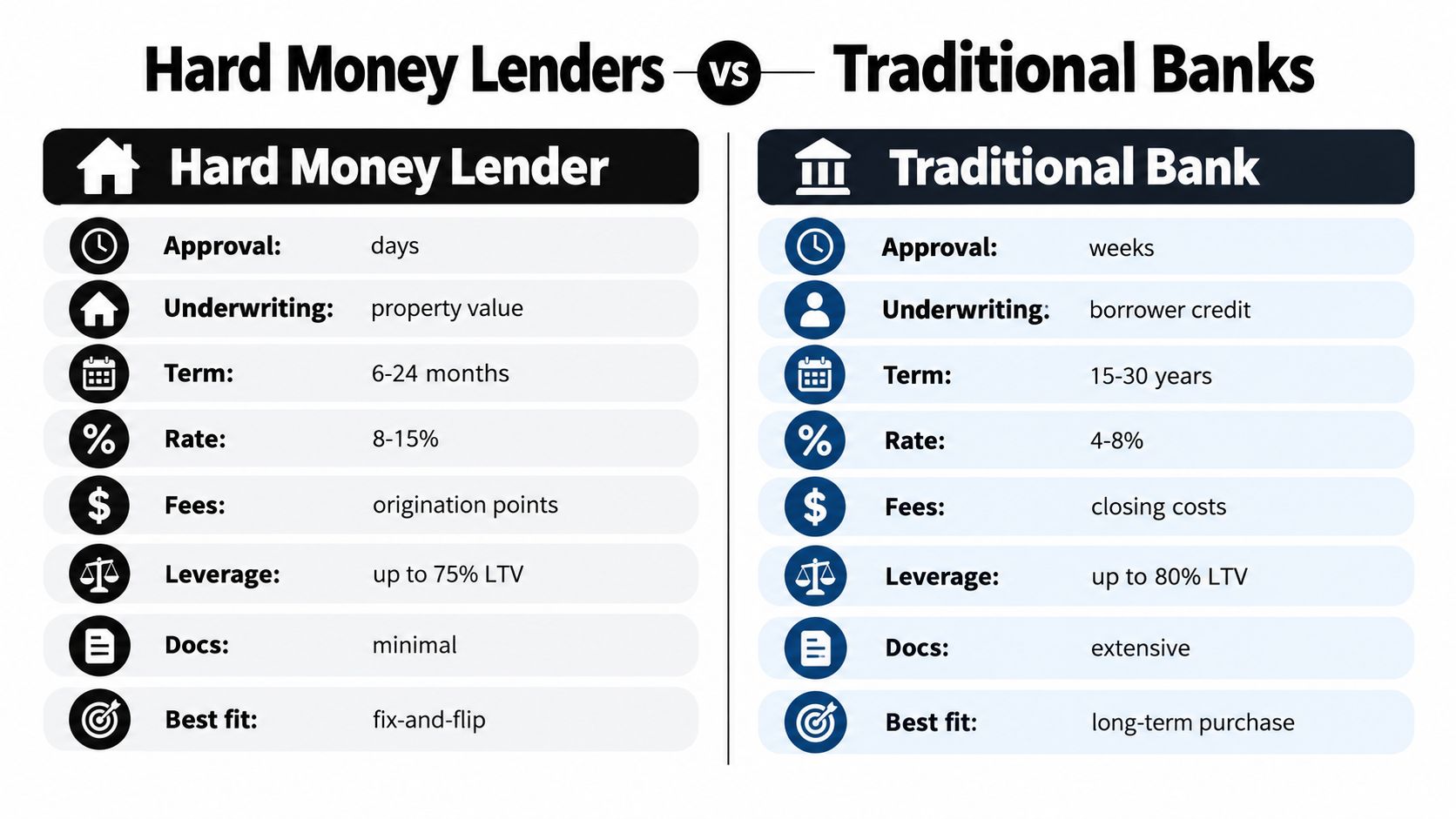
A renovation is ready to start, but the seller needs a quick close. A bank may offer a lower borrowing cost, yet its review can take longer and its rules may not fit the property. A hard money lender may decide more quickly based on the property and project, but the shorter term makes schedule delays expensive. The better choice depends on what the deal needs and how reliably it can repay the loan.
| Criterion | Hard Money Lender | Conventional Bank |
|---|---|---|
| Approval process | Often faster, with terms negotiated deal by deal | More documentation and a conventional review process |
| Underwriting focus | Property value, ARV, project plan, and repayment exit | Borrower finances and property eligibility |
| Typical term | Often short, commonly 6 to 24 months across market summaries | Often structured as long-term mortgage financing |
| Interest | Market descriptions commonly report 8% to 15% | Typically lower than hard money, depending on borrower and loan |
| Fees | Origination points, plus possible project-related charges | Closing and lender charges under bank terms |
| Loan-to-value | Often about 65% to 75% of value | Depends on borrower, property, and loan program |
| Documentation | Often less extensive than conventional underwriting | Usually extensive financial and property documentation |
| Best fit | Flips, bridge needs, and unconventional properties | Long-term purchases that meet bank requirements |
These are broad differences, not promises about an individual loan. A private lender still needs to review the property, title, work scope, and repayment plan. A quick close is possible, but the timing depends on the deal and the lender. A bank's longer review may be a sensible trade if the borrower qualifies and the purchase does not have a tight deadline.
For a simple comparison, consider two investors buying similar properties. One plans a short renovation and sale, and needs financing that can accommodate the property and project. The other plans to keep the property long term and has time to complete a bank's review. The first may value speed and flexibility; the second may benefit more from a bank's lower rate. In either case, a delayed sale or refinance can turn short-term financing into a costly schedule problem.
The Federal Reserve's April 2025 survey of bank lending practices reports tightened commercial real estate lending policies, including lower loan-to-value limits and higher debt-service-coverage requirements. That context can help explain why a project may not fit a bank's criteria, though each lender assesses its own application.
The two loan types can also serve different stages of one investment. An investor might use short-term financing to buy and improve a property, then apply for longer-term financing if the borrower and completed project qualify. Treat that refinance as a possibility to verify with lenders, not as guaranteed repayment. A sound comparison weighs the full cost and the time available to complete the plan.
Where Hard Money Loans Make Sense in Real Estate Investing
A fix-and-flip is the clearest example. An investor finds a property that needs work, estimates the purchase and renovation costs, and plans to repay the loan from resale proceeds. The lender may fund the acquisition and, depending on the terms, release renovation funds in stages. The investor needs enough equity to cover the gap between the loan and project cost, as well as a budget for costs the lender doesn't cover.

A bridge loan serves a different timing problem. An investor may need to buy a property before proceeds from another sale are available. Short-term financing can bridge the gap, but only if the expected sale or refinance can repay the loan before it matures. If the existing property takes longer to sell, the bridge can become a costly deadline rather than a convenient solution.
Points are an upfront charge
Suppose a borrower takes a $300,000 loan with a 2-point origination fee. One point equals 1% of the original principal, so the fee is $6,000 before interest (Investopedia's explanation of hard money loan costs). That charge is due under the loan's terms even if the project later encounters delays. Borrowers should find out whether fees are paid at closing, withheld from proceeds, or added to the balance.
Hard money may fit active investors, buyers of distressed properties, developers with a defined project, or a buyer who needs temporary financing. It usually makes less sense for someone seeking long-term buy-and-hold financing, where a conventional mortgage or a rental-property loan may better match the holding period. Buyers comparing investor financing with owner-occupant assistance should keep the purposes separate. This explanation of down payment assistance offers a useful contrast with short-term project lending.
A lender's ability to fund renovation costs doesn't guarantee that every contractor invoice will be paid immediately. Ask how draws work, what documentation the lender needs, whether inspections are required, and how a delay in releasing funds could affect the construction schedule.
For a visual overview of the kind of property work a project may involve, the following video provides additional renovation context.
The True Cost of a Hard Money Loan and Break-Even Math
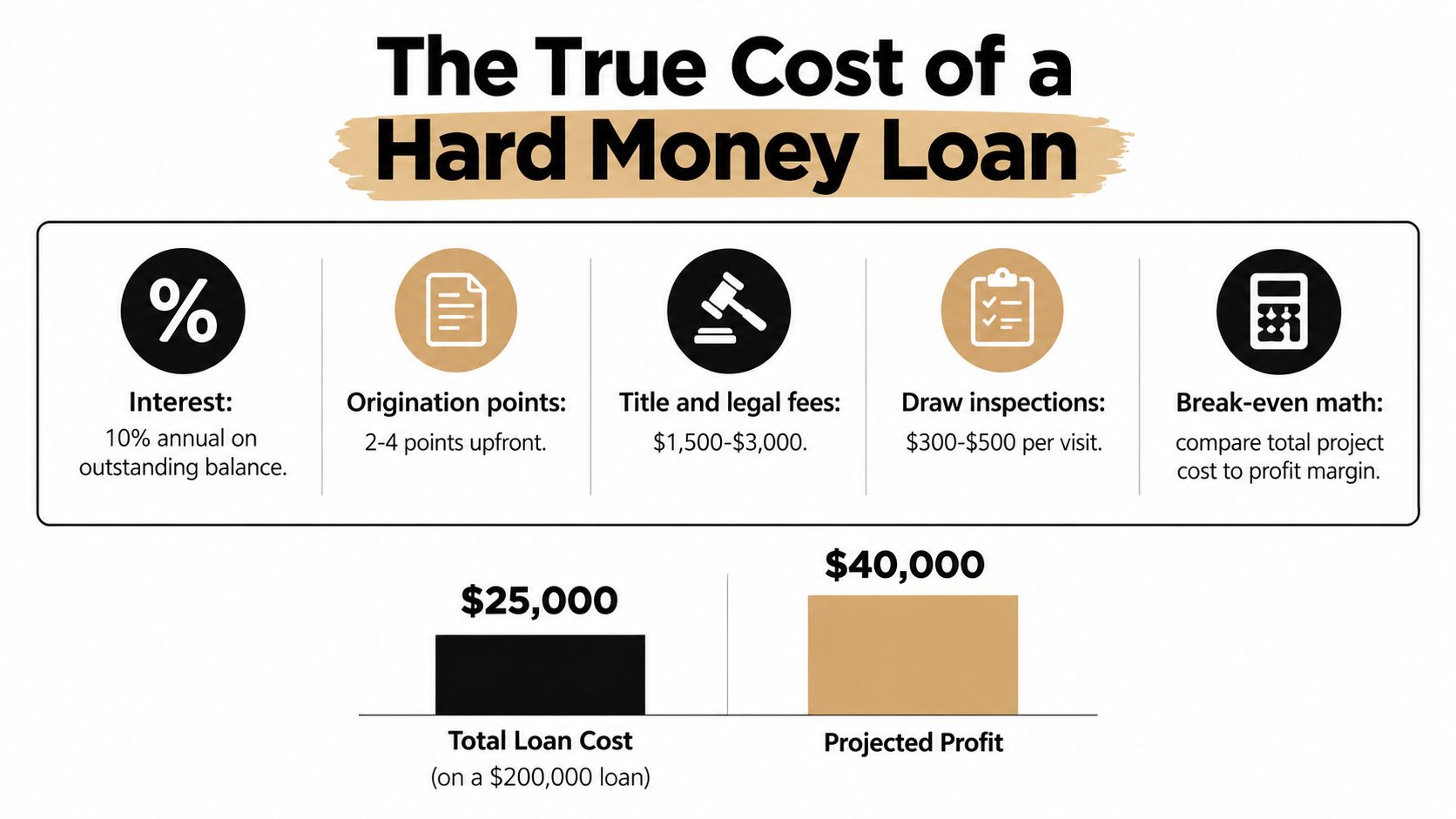
A project's financing cost depends on more than its interest rate. Origination points, title and legal charges, draw inspections, extension fees, late charges, and selling costs can all affect the final profit. Some loans also restrict early repayment or charge for it. The signed loan documents spell out which costs apply and when they are due.
A hard money loan may carry about 8% to 15% interest, roughly 2 to 5 origination points, and construction-draw inspections costing about $150 to $300 each (borrower cost and risk overview). For a new example, a $250,000 loan at 3 points means $7,500 in origination fees, before interest or other charges. If the project takes 12 months, interest continues to accrue throughout the hold. An extension fee may add to the bill if the sale or refinance closes after the loan matures.
Test the project against time
Start with a conservative sale-price estimate. Subtract the purchase price, renovation budget, financing expenses, transaction and selling costs, and target profit. What remains is the cushion for unexpected costs. The after-repair value, or ARV, is an estimate, not the cash you will receive: selling costs and project expenses still come out of the sale proceeds.
Next, test how the schedule changes the result. Compare exits at month 4, month 8, and month 12 as planning checkpoints, not promises about project duration. For each scenario, update interest, draw-related charges, and any applicable extension costs. A deal that only works with the earliest exit may not leave enough room for delays.
Practical rule: Request a written payoff schedule showing how interest accrues, which fees are due upfront, what an extension costs, and whether early repayment changes the amount owed.
A useful break-even question is: What sale price covers the loan payoff, all project costs, and my target profit? A detailed cost guide for flipping a house can help identify expenses that are easy to miss in an early estimate.
Risks, Red Flags, and the Default Mechanics Most Explainers Skip
A hard money loan is project financing tied to a deadline. The property secures the debt, but repayment still depends on a workable plan to sell or refinance before maturity. For example, a renovation that runs over schedule can leave an investor paying interest longer than expected, even if the property's value is sound.
“Asset-based” does not mean automatic approval. The lender still assesses whether comparable sales support the estimated value, whether the repair budget is credible, whether permits are in order, and whether the exit plan is realistic. A refinance is not guaranteed, so relying on one without a backup can turn a delay into a repayment problem.
A missed payment can put the property at risk
Default terms depend on the loan agreement and applicable law. After a breach, the lender may send a default notice and allow a limited time to cure it. If the borrower does not resolve the breach, the lender may pursue foreclosure. The documents and local rules determine which remedies apply. The property securing the loan is at stake.
The schedule can create trouble before a payment is missed. Unexpected repairs may use up the contingency budget, permits can hold up work, and weak resale demand may undermine the planned sale. If a refinance falls through near maturity, the borrower may have a loan coming due without a clear source of repayment. These are connected risks: delays can add financing costs, reduce the project's cushion, and make repayment harder.
Read the loan documents for terms that can accelerate or increase those costs:
- Cross-default provisions: Check whether a breach on another debt can trigger default on this loan.
- Default interest: Confirm how it is calculated, when it begins, and whether the agreement limits it.
- Extension terms: Check the conditions, fees, and approval process. Do not treat an extension as automatic.
- Prepayment restrictions: Confirm whether early repayment is permitted and whether a lockout or extra charge applies.
- Draw conditions: Find out what inspections and documents are required before renovation funds are released, and whether those steps could delay the work.
Before signing, trace the consequences of a schedule slip from start to finish: added interest, any extension charge, the maturity date, and the lender's remedies if repayment is late. That chain matters as much as the stated rate. A project can look profitable on paper yet fail if it has no time or cash cushion for delays.
How to Evaluate and Choose the Right Hard Money Lender
Compare the written terms, not a lender's verbal summary or marketing. Ask for the interest calculation, total points, third-party charges, draw fees, extension pricing, late charges, prepayment rules, and a sample payoff schedule. Then run the costs through the same break-even model for every offer.
Bring a clear deal package: purchase details, a renovation scope and budget, supporting comparable sales for the ARV, a timeline, information about the property's title and permits, and a specific sale or refinance plan. Include contingency planning. A lender needs to understand not only what happens if the project goes as expected, but also how you'll respond if it doesn't.
Questions to ask before signing
- Who is making the loan? Determine whether you're dealing with a direct individual lender, a lending company or fund, or a broker arranging a loan with someone else.
- How does funding work? Ask what conditions must be met at closing and what a borrower must submit to receive renovation draws.
- Which costs can change? Request details on interest accrual, inspection charges, extension fees, and default pricing.
- Can the key terms be negotiated? Discuss maturity, draw procedures, extension conditions, and prepayment restrictions before signing.
- How can I check the counterparty? Review its reputation and confirm applicable licensing and regulatory requirements for your jurisdiction and transaction.
The lowest advertised rate may not produce the cheapest loan if the lender charges more points, has slower draws, or imposes expensive extensions. Compare each lender's full payoff cost under the same schedule, including a delayed exit. For more detail on what lenders commonly request from borrowers, see this overview of hard money lender requirements.
Licensing, disclosure, and lending rules vary by jurisdiction and by transaction type. Owner-occupied residential deals may also bring mortgage requirements that don't apply in the same way to investment projects. Have a qualified real estate attorney review unclear provisions before you sign.
Putting It All Together and Making Your First Move
Hard money is specialized, collateral-driven bridge financing, not a substitute for a sound project plan. The deal must still work after interest, points, fees, and sale costs, and the lender's written terms matter more than the promise of a quick close.
Before pursuing a loan, stress-test your ARV and schedule. If the project can't absorb a 20% ARV haircut and a 90-day extension while still meeting your target profit, treat that as a warning that this financing lane may be too risky. Those are conservative tests to apply to your own deal, not guaranteed lender standards.
AI underwriting tools such as PropLab can help investors test ARV assumptions, estimate rehab costs, and prepare lender-ready deal materials before speaking with a lender. Use those estimates as inputs to verify, not as a replacement for project diligence.
PropLab helps real estate investors analyze ARV, estimate renovation costs, and prepare offer-ready reports to support deal review. Test your project assumptions and organize your lender package with PropLab.
About the Author
P
PropLab Team
Real Estate Analysis Experts
The PropLab team consists of experienced real estate investors, data scientists, and software engineers dedicated to helping investors make smarter decisions with AI-powered analysis tools.
Free account
Underwrite your next deal in under a minute
3 free analyses, no credit card. ARV, rehab, comps and exit strategy in one report.
