General
Wholesaling Real Estate: A Beginner's Guide to Contracts
October 10, 2026
18 min read
You've found a tired house that appears to be priced below comparable homes. The owner wants a straightforward sale, a local investor says they might buy it, and you're trying to determine whether there's enough room for everyone to benefit. You don't want to renovate the property or take out long-term financing, but you do need a contract, a defensible offer, and a compliant way to connect the opportunity with an end buyer.
That's the working reality of wholesaling real estate. The strategy can look simple from the outside, yet successful execution requires more than finding a discount. You need to understand contract assignment, distinguish your role from that of a broker, price repairs and resale costs realistically, and test whether the deal still works when your assumptions change.
Why Wholesaling Real Estate Matters
At 8 a.m., a wholesaler may be returning calls from owners who want a fast exit. By lunch, they are checking nearby sales, walking through repair assumptions, and testing whether a deal still works if those assumptions move. Later, they may be tightening contract language, confirming the agreement can be assigned where that structure is allowed, and matching the opportunity with investors whose criteria fit the property. The job centers on connecting a seller with a real problem to a buyer with a workable solution, then making sure the paperwork and pricing can support that handoff.
That matters because wholesaling real estate sits at the intersection of contracts, compliance, and valuation. A wholesaler usually secures a purchase agreement, holds a contractual position, and transfers that position to an investor before taking legal title. The fee comes from that transfer. Because the wholesaler is usually not funding the full purchase, completing the rehab, or holding the property for months or years, the model can open the door for someone with strong lead generation, analysis, and negotiation skills. The University of Oklahoma Law Review analysis explains why that distinction matters legally. It is a contract-assignment structure, and the rules around that structure can vary by state.
The liquidity connection
A motivated seller often values clarity, timing, and follow-through as much as the highest possible price. An investor may want a property that fits a rental, renovation, or redevelopment strategy but may not have time to source and negotiate every lead directly. The wholesaler helps bring those two sides together by organizing the facts, locking in a contractual opportunity, and presenting it to a buyer who can perform.
Only workable economics make that service valuable.
The seller needs to know who is signing the agreement and what may happen with that contract next. The buyer needs enough room for repairs, holding costs, resale risk, and profit. The wholesaler needs a fee that fits inside the spread without breaking the deal. That is why experienced wholesalers treat valuation sensitivity like a stress test. If the repair budget rises or the resale price softens, the offer still has to make sense.
Practical rule: A wholesale deal has value when the seller, wholesaler, and end buyer can all understand the transaction and its economics.
Repeatable systems matter too. A buyer list without current buying criteria is only a stack of names. A lead list without analysis is noise. A contract without a disposition path can leave a wholesaler exposed to deadlines, state compliance issues, and failed assignments. PropLab's AI underwriting fits here because fast offer math only helps when the assumptions are defensible and easy to explain.
Understanding the Key Concepts
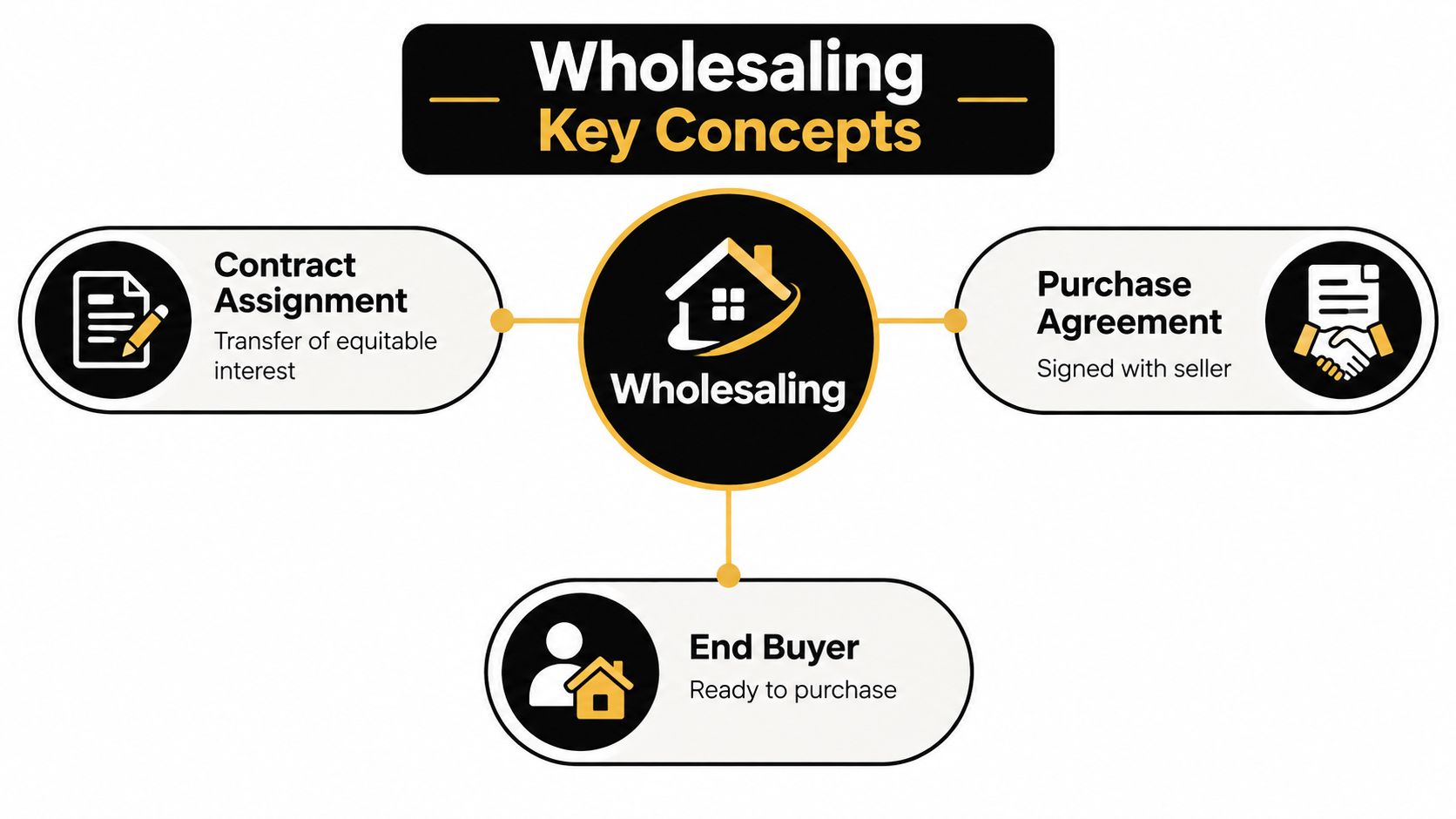
A new wholesaler usually gets confused at one point first. What exactly is being transferred? In a standard wholesale deal, the answer is the contractual interest, not the house itself. The wholesaler signs a purchase agreement with the owner, secures rights under that agreement, and then passes those rights to an end buyer before closing.
A simple comparison helps. It works like holding a reserved spot under agreed terms, then transferring that spot to someone else who wants it. The value sits in the contract terms, the timing, and the spread between the seller's price and the buyer's price, which is why clean paperwork and clear valuation matter so much.
The three parties and documents
- Seller: The owner signs the purchase agreement and gives the buyer rights under the listed terms, subject to the language in that contract.
- Wholesaler: The wholesaler analyzes the deal, negotiates with the seller, and lines up an end buyer. The contract has to allow assignment, or at least support the transaction structure being used.
- End buyer: The investor steps into the deal through the assignment and closes under the agreed terms.
The assignment agreement is the document that records that transfer from wholesaler to end buyer. The assignment fee is the wholesaler's compensation for creating and transferring that opportunity. If you want a plain-English walkthrough, review how assignment works in real estate, especially if you are still mixing up contract rights with property ownership.
That distinction matters for compliance, too. What you can market, what you must disclose, and which documents are appropriate can change by state, so experienced wholesalers treat the deal structure and the numbers as a matched set. A fast offer only helps if the contract can support the exit strategy and the valuation still works when assumptions tighten.
Before using any template, have qualified local counsel review the paperwork for the state and transaction type. For help organizing clauses and drafting starting language, LegesGPT - AI Legal Assistant can help, but it does not replace an attorney or title professional who understands local practice.
The following video offers another visual explanation of the assignment model:
Legal and Ethical Considerations
You get a seller to sign. You line up a buyer. Then the deal stalls because the state treats your marketing, disclosure, or negotiation steps differently than you expected. That is why wholesaling law is not just about whether the model exists in theory. The core question is what interest you hold, what you are advertising, and whether your actions cross into licensed activity in that state.
A wholesale deal works like a relay. The contract gives you a limited set of rights, and state law decides how far you can carry that baton before another rule applies. Analysts behind a 2026 review of wholesaler laws report that 23 states regulate real estate wholesaling through combinations of registration, licensing, disclosures, advertising limits, and cancellation rights. That does not produce one national playbook. It means your contract structure, your exit strategy, and your compliance process have to match the state.
Start with a simple compliance map before you market anything or ask anyone to sign:
- Licensing triggers: Check whether your planned outreach, negotiation, or fee structure could be treated as brokerage.
- Disclosure language: Confirm what the seller, buyer, or both must receive in writing about your role and your intent to assign.
- Cancellation rights: Note any required cancellation window and how it affects deposits, inspection timing, and closing deadlines.
- Marketing limits: Verify whether you can advertise the property itself, the contract, or only your equitable interest.
- Recordkeeping: Save disclosures, delivery records, signatures, consent, and every contract version.
These details change the economics of a deal, not just the paperwork. A wide cancellation period can weaken a buyer's appetite. A marketing restriction can slow disposition. A disclosure rule can affect how you present your fee. If your valuation is sensitive, even a legally compliant deal can stop working once timing slips or buyer demand softens.
The state examples make that concrete. Missouri requires written seller disclosure at least 14 days before closing, according to the cited review. Pennsylvania's 2024 legislation treated standard assignment wholesaling as licensed activity beginning in January 2025, and it includes a prominent disclosure plus a 30-day seller cancellation right, as described in reporting on state oversight. Oregon's rules, effective July 1, 2025, require residential wholesalers to register with the agency or hold a broker or principal-broker license, along with written disclosures to multiple parties and in advertising, according to the Oregon Real Estate Agency overview.
Ethics follows the same path. Say clearly that you may assign the contract. Do not present yourself as the owner if you are not. Give buyers enough detail to judge the opportunity on its merits. For a starting point on state-by-state research, review this state legality guide for wholesaling, then have local counsel confirm the rules before you rely on any contract or marketing approach.
Deal Flow Sourcing and Disposition Strategies
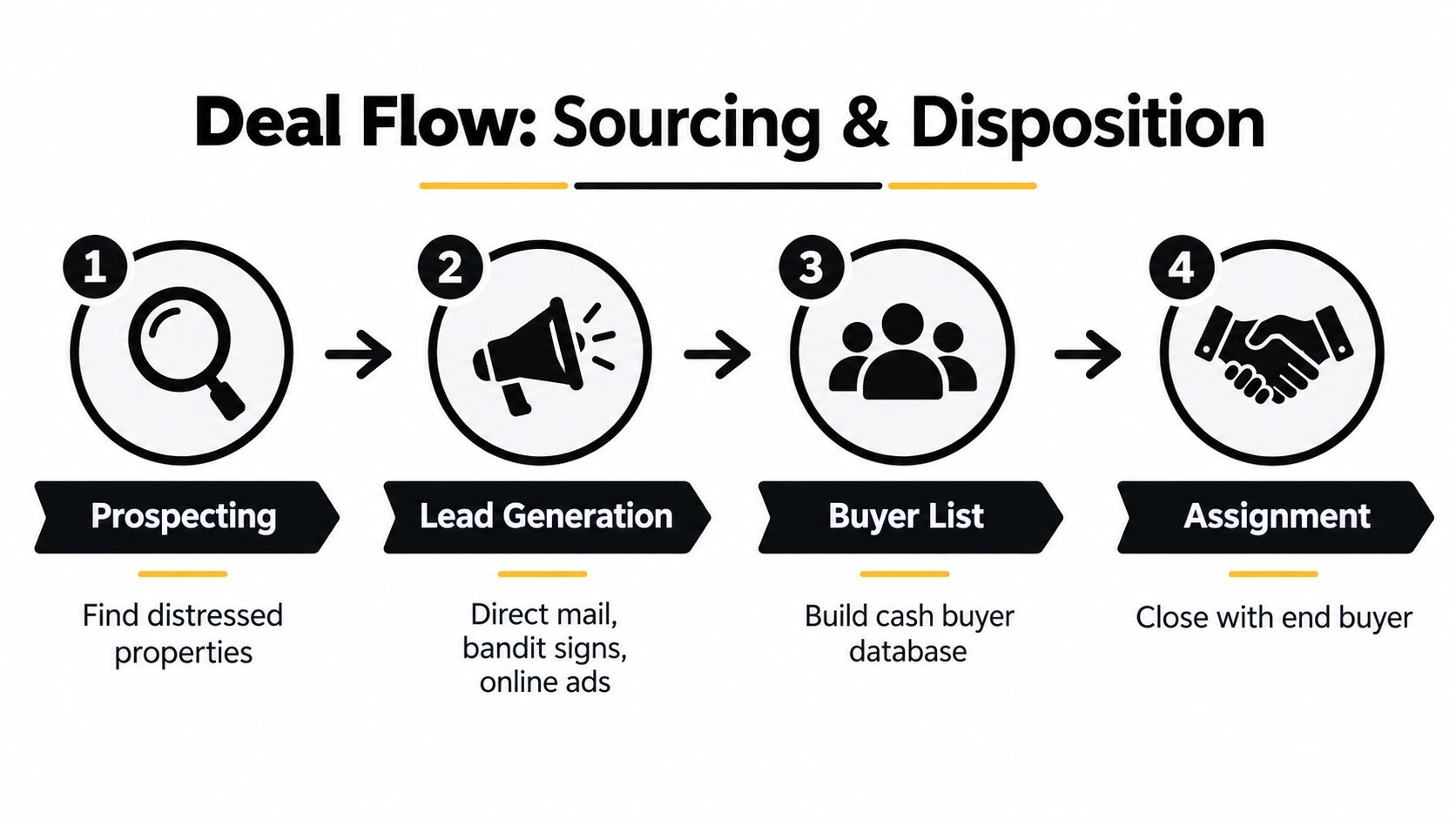
A wholesale operation needs two pipelines: one for properties and one for buyers. If you build only the seller side, you may secure contracts that nobody wants. If you build only the buyer side, you may have a list of investors without suitable opportunities.
Start with a defined market
Choose a manageable area and learn its property types, investor demand, rental patterns, and common renovation issues. Lead sources can include direct mail, online advertising, referrals, networking groups, and neighborhood research. The channel matters less than the tracking system behind it. Record the owner's motivation, property condition, expected timing, asking price, occupancy, and any known title or access concerns.
Respect solicitation, advertising, privacy, and licensing requirements in your market. A marketing message that sounds harmless in one state can create a problem in another if it appears to advertise property you don't own.
Qualify before contracting
A useful seller conversation answers practical questions:
- Why sell now? Motivation affects timing and negotiation.
- What condition is the property in? Ask about the roof, systems, water intrusion, layout, and permits.
- What outcome matters? Price, speed, convenience, certainty, or a specific closing date may all influence the agreement.
- What authority exists? Confirm ownership, decision-makers, liens, and any probate or divorce complications.
Then screen the buyer side before disposition. Build a buyer matrix containing preferred neighborhoods, property types, price ranges, renovation tolerance, rental criteria, proof-of-funds status, and closing preferences. A buyer who responds quickly but cannot explain the exit strategy isn't necessarily a qualified buyer.
Digital prospecting can support this process when it remains targeted and permission-conscious. Teams that need to build a pipeline with EmailScout can use structured outreach alongside local networking and referrals. The tool doesn't replace buyer qualification or legal review. It helps organize prospecting activity.
Once an agreement is signed, prepare a concise deal packet. Include the contractual position, permitted disclosures, photos or condition notes, comparable-sale rationale, repair assumptions, estimated costs, closing timeline, and assignment terms. Present facts and assumptions separately. That makes it easier for an end buyer to challenge a weak input without mistaking it for a hidden condition.
Valuation Basics ARV and MAO Explained
After Repair Value, or ARV, is the estimated market value of a property after the planned work is complete. Maximum Allowable Offer, or MAO, is the highest contract price that can support the buyer's costs, required return, and assignment fee under the chosen assumptions.
A headline resale spread can mislead. ATTOM's Q1 2025 home-flipping report reported a typical U.S. flip purchase at a median $250,000 and resale at $325,000, producing a $65,000 gross spread and a 25% gross return. The report also explains that this spread excluded rehabilitation, financing, holding, selling, and other transaction costs. Experienced flippers commonly estimate those excluded costs at approximately 20% to 33% of ARV, as stated in the verified market data.
Build the offer from the buyer's economics
A practical model starts with ARV, then deducts every material cost rather than applying an unexplained fixed percentage. The exact figures below are an illustrative example, not a market claim.
| Metric | Formula | Example Value |
|---|---|---|
| ARV | Estimated resale value after repairs | $300,000 |
| Rehab budget | Supported repair estimate | $50,000 |
| Selling and financing costs | Modeled transaction and capital costs | $45,000 |
| Buyer profit requirement | Required project return | $40,000 |
| Assignment fee | Wholesaler compensation | $15,000 |
| Maximum allowable offer | ARV minus all deductions | $150,000 |
The model is:
MAO = ARV − repairs − selling costs − financing and holding costs − buyer profit − assignment fee
The comp set determines whether the ARV deserves confidence. Use similar property types, locations, sizes, conditions, and recent transaction context. Sparse or mismatched comps should produce a wider range and more conservative offer, not a false sense of precision. PropLab's guide to calculating ARV provides another framework for organizing the analysis.
Test the downside
Change one assumption at a time. Lower the ARV, increase the rehab budget, extend the project timeline, or reduce the expected resale price. If a small shift eliminates the buyer's profit or assignment fee, the offer has little resilience.
The goal isn't to produce one impressive number. It's to show the seller and buyer how the number was built, which inputs are firm, and which ones require inspection, contractor pricing, title work, or better comparable sales.
Common Pitfalls to Avoid
You lock up a property at a price that feels low, send it to your buyers list, and expect a quick assignment. Then the contractor walks through, the repair scope doubles, your buyer starts asking harder questions, and the deal that looked profitable on paper turns thin fast. In wholesaling, problems usually come from weak assumptions, not from a lack of leads.
The first trap is treating a discount like proof of margin. A seller's asking price is only the starting point. Your end buyer still has to carry repairs, financing, holding time, resale costs, and profit requirements. If your numbers do not leave room for all of that, you do not have a workable spread. You have an option that may not survive inspection or underwriting.
Thin evidence creates expensive confidence
ARV errors often start small and end expensive. Two nearby listings with similar photos can feel persuasive, but wholesaling requires a tighter standard than visual similarity. A different block, inferior layout, unpermitted addition, awkward lot, or weaker buyer demand can pull value down. If the comp set is thin, say so plainly. A cautious range is better than a precise figure that cannot be defended.
Repair estimates create the same kind of hidden risk. New wholesalers often budget for paint, flooring, and kitchen updates while missing the systems behind the walls. Electrical, plumbing, structural movement, roof failure, drainage issues, environmental problems, permits, and code work can change the whole deal. Ask for access. Get contractor input when appropriate. Show your assumptions in writing so the buyer can see what is known and what still needs verification.
A fast offer helps only if the buyer can still defend it after inspection.
Disposition is another place where beginners confuse interest with execution. A cash buyer who replies quickly may still lack funds, lender approval, a rehab plan, or experience with the type of project you are assigning. Treat buyer screening the way a lender treats an application. Request proof of funds when appropriate, confirm the exit strategy, and ask whether the buyer has completed similar projects before. A verbal commitment is not a closing strategy.
Marketing can change the legal analysis
The contract matters, but so does how you present it. In some states, marketing language can shift the legal analysis from assigning a contract to advertising real estate you do not own. That distinction affects listing copy, text messages, buyer emails, social posts, and how you describe your position in the deal. If you are selling contractual rights, say that clearly. Do not write or speak as if you already own the property.
A few habits prevent many avoidable problems:
- Use deadlines: Track inspection, disclosure, assignment, and closing dates.
- Separate facts from estimates: Show which numbers come from records, contractors, inspections, or assumptions.
- Protect the relationship: Explain retrade conditions before they become a dispute.
- Plan a fallback: Know what happens if the first buyer passes or title issues appear.
Accelerate Your Deals with PropLab
A wholesaler often loses speed at the exact moment speed matters most. Three leads come in, each seller wants an answer, and every deal needs the same chain of reasoning. What are the best comps, how much work does the property need, what margin does the end buyer require, and where does that leave your assignment fee? A spreadsheet can store inputs, but it does not explain whether the comp set is thin, whether the condition assumptions are shaky, or how sensitive the offer is if ARV or repairs move against you.
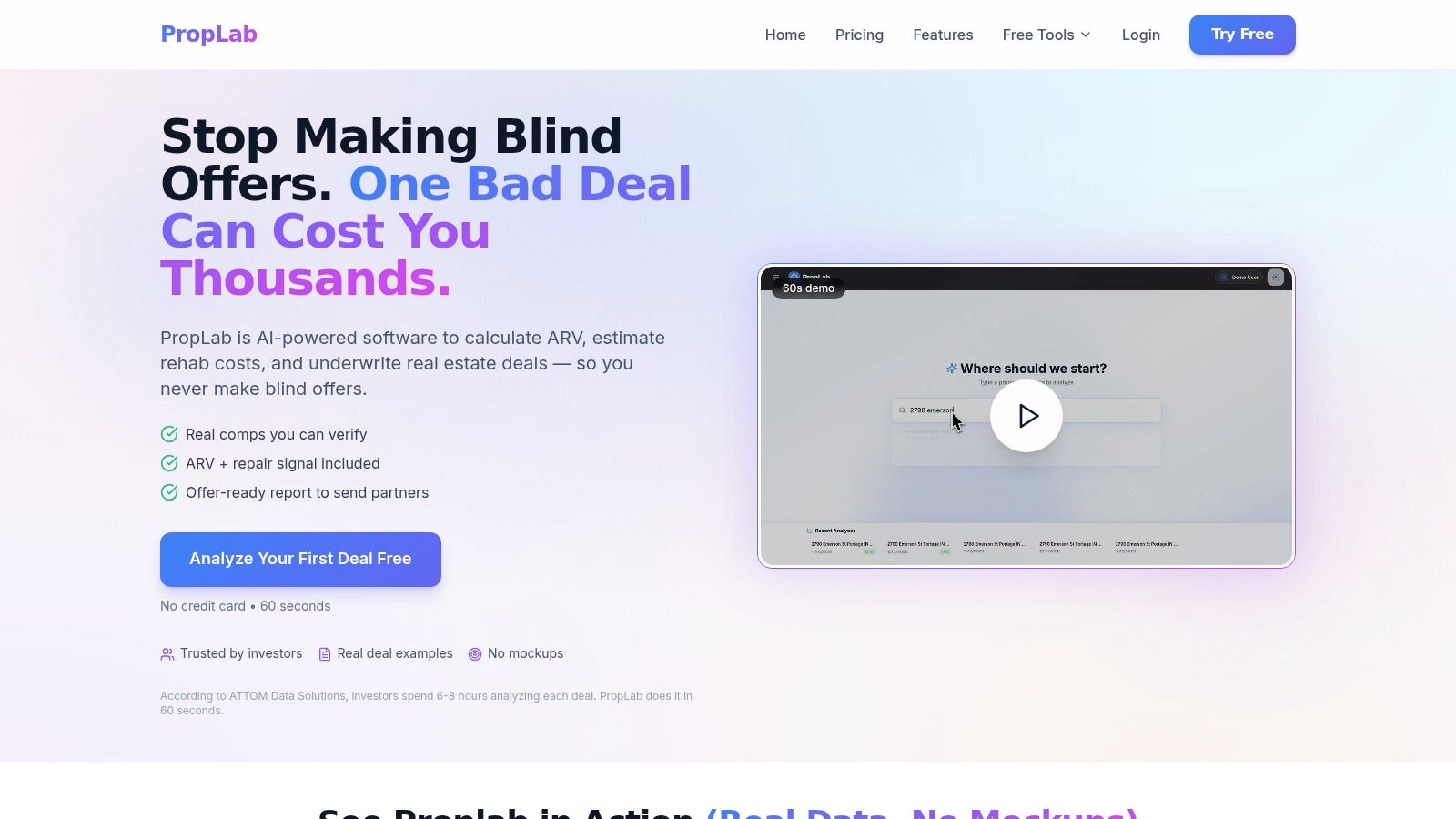
PropLab fits that workflow by helping you turn rough lead intake into a defendable underwriting file. It pulls public records, tax data, and market signals without MLS access, weighs comps by distance and recency, and produces an ARV, repair estimate, and Max Offer Price. For wholesaling, it gives you reasoning you can show to a buyer, lender, or partner instead of handing over a number with no trail behind it.
Use the output as an underwriting record
Treat the analysis like a pilot's checklist, not an autopilot. The software can organize facts and surface patterns quickly, but you still need to review the selected comps, inspect the condition assumptions, confirm the repair scope, and compare the result against what local buyers pay for that kind of project. That is especially important in wholesaling, where a fast offer only works if your buyer can follow the math and still trust it.
A practical use case looks like this:
- Compare several leads with one consistent underwriting method.
- Show an end buyer how ARV, repairs, holding costs, profit expectations, and assignment fee shape the MAO.
- Spot red flags early, before you spend more time negotiating with a seller.
- Share the same report with a partner, lender, or title contact so everyone is working from the same assumptions.
- Revisit the file when inspection findings, buyer terms, or compliance questions change the structure of the deal.
PropLab also offers a Daily Deals scanner that surfaces potential properties across 90+ major U.S. counties, according to the publisher's product information. Used well, that helps an acquisitions team build a queue for review. It does not replace state-specific compliance checks, seller verification, or property-level due diligence.
Conclusion and Next Steps
A wholesale deal only holds together when each part supports the next, like gears in the same machine. Your contract creates a controllable position. Your buyer list provides a realistic exit. Your underwriting tests whether the numbers can carry repairs, financing, holding costs, resale costs, the buyer's target return, and your assignment fee. State rules decide whether the way you market, disclose, and assign that deal is allowed where the property sits.
That is why your next step is not “make more offers.” It is building a repeatable operating method.
- Choose the jurisdiction: Map the state's rules on licensing, disclosures, advertising, cancellation rights, and assignments before you contact sellers or buyers.
- Prepare the documents: Use attorney-reviewed purchase and assignment agreements that describe your role and contractual rights clearly.
- Define the buyer: Record the investor's strategy, buy box, funding, timeline, and proof-of-funds status.
- Underwrite conservatively: Build ARV from relevant comps, and keep verified facts separate from assumptions.
- Model the MAO: Subtract repairs, carrying costs, selling costs, buyer profit, and your assignment fee.
- Run sensitivity tests: Review how the deal changes if ARV comes in softer, rehab runs higher, or the timeline stretches.
- Document communication: Keep disclosures, consents, contract versions, inspection terms, and closing instructions organized.
- Disposition transparently: Market only the contractual interest when permitted, and give buyers enough detail to evaluate the opportunity honestly.
This framework connects the mechanics of assignment with the compliance questions that vary by state. It also gives you a valuation process you can defend when a comp changes, an inspection uncovers new work, or a buyer pushes back on price.
A defensible offer is one you can explain, revise when new evidence appears, and present without misleading either side. PropLab helps wholesalers organize comps, repair assumptions, ARV, risk indicators, and Max Offer Price calculations into shareable underwriting reports. Visit PropLab to analyze potential deals with a repeatable workflow before you send your next offer.
About the Author
P
PropLab Team
Real Estate Analysis Experts
The PropLab team consists of experienced real estate investors, data scientists, and software engineers dedicated to helping investors make smarter decisions with AI-powered analysis tools.
Free tool
Get the ARV of any property in 30 seconds
Skip the spreadsheet. Enter an address and get an after-repair value backed by real comps.
