General
BRRRR Cash Out Refinance: How It Works, Costs and Timing
November 23, 2026
18 min read
You finished the rehab last week. The kitchen is in, the floors are down, and the lease starts on the first. The house looks worth more than you paid, but the cash you put into the purchase and the work is still locked inside the walls. A BRRRR cash out refinance is the step that is supposed to swap that short-term money for a long-term rental loan and hand some of that cash back so you can buy the next place.
The part people miss is what sets the check. The lender does not pay you back for what you spent on cabinets. The check follows the appraisal, then a loan-to-value cap, then the payoff and the closing costs. Two legal paths can get you to that check, and they do not return the same dollars.
What a BRRRR Cash-Out Refinance Does
Say you bought a tired one-unit rental with a hard-money loan, put the work in, and signed a tenant. The house now appraises well above your all-in cost, and your cash is still tied up. The cash-out refinance is the step that replaces that short-term loan with a long-term rental mortgage large enough to pay the old balance and send the leftover cash to you.
BRRRR is five stages in one cycle.
- Buy: You acquire a property below the value you expect after work, usually with cash, hard money, or a bridge loan.
- Rehab: You complete a defined scope so the house can rent and can be compared with finished sales.
- Rent: You place a tenant, collect deposits, and turn a project into a stabilized rental.
- Refinance: You replace the short-term debt with a permanent loan sized off appraised value and the lender's borrowing limit.
- Repeat: You use the cash that comes back as the down payment or the rehab fund on the next purchase.
The refinance sits in the fourth slot, and it is the slot that decides whether the cycle continues. Buy, rehab, and rent create the value. Only the new loan turns that value into spendable capital. If the new loan barely covers the payoff, you own a rental and you have no cash for the next contract.

Renovation cost is not the loan basis
Renovation cost is what you paid the contractor, the suppliers, and the carrying costs. Appraised value is what a licensed appraiser supports with comparable sales after the work is done. The refinance uses the second number, not the first. A $40,000 kitchen does not add $40,000 to the loan. It adds whatever the comps say that kitchen is worth, and then only the allowed percentage of that value becomes a loan.
This step is common, and it is not automatic. In 2024, 70,959 investor cash-out refinances were originated in the United States, according to federal Home Mortgage Disclosure Act loan-level data analyzed by Crowdfunded Wealth. Plenty of investors reach this door. Plenty also find the appraisal, the seasoning clock, or the rent will not support the loan they sketched on a napkin.
Before you call a lender, check whether the deal has reached this stage. The rehab is finished, a tenant is in place or the lease is signed, and the value is something a lender can verify with comps, permits, and a rent schedule. If one of those is still open, you are still in rehab or rent, not in refinance.
Refinance Timing Paths Compared
The wait before you refinance decides how fast your capital comes back, and it also decides which number the lender is allowed to lend against. Four paths show up in real files.
| Path | Typical Waiting Period | Loan Size Basis | Main Trade-Off |
|---|---|---|---|
| Delayed financing after cash purchase | Within 6 months of purchase | Documented investment plus eligible closing costs | Fastest return, but the loan is capped at what you put in |
| Early lender-specific refinance | About 90 days | Purchase price plus documented improvements at some lenders | Quicker capital, possibly lower leverage or higher pricing |
| Conventional cash-out after seasoning | Six months of title ownership | Current appraised value at the LTV limit | Standard pricing, but more hard-money interest while waiting |
| Conservative or rent-based refinance | 12 months or documented rent history | Current appraised value with lease records | Slowest capital return, most stable terms |
The six-month rule and the cash-purchase exception
Fannie Mae generally requires at least one borrower to have held title for six months before the cash-out refinance disbursement date. Finishing a renovation does not restart that clock, and a higher value does not waive it. You usually cannot walk from the final inspection straight into a standard conventional cash-out loan.
Fannie Mae does recognize a delayed-financing exception for qualifying cash purchases made within the previous six months. Under that exception, the new loan cannot exceed your documented initial investment in the acquisition, plus eligible closing costs, prepaid fees, and loan points. The loan still has to fit the applicable loan-to-value, combined-loan-to-value, and high-combined-loan-to-value limits based on the current appraisal. In plain terms, you may get your documented cash back sooner, but you do not get a loan based on the equity the rehab created.
What you trade when you wait
A faster refinance can cut months of hard-money interest and get you to the next purchase sooner. The price of that speed is often a smaller loan, a higher rate, or a value basis that ignores much of the new equity. A six-month conventional cash-out uses the current appraisal at the program's borrowing limit, which is usually the path that recycles the most capital, and you pay carrying costs for every month the short-term loan stays open.
Practical rule: Pick a path only after you have written the carrying cost for each extra month next to the loan size that path actually allows.
A 12-month or rent-history path is the slowest return of capital and often the cleanest file. The lease, the deposits, and a year of payments give the underwriter a stabilized rental instead of a fresh renovation. That stability can matter more than a slightly larger loan if your debt-service coverage is tight.
The cost of waiting is not abstract. Hard-money interest, taxes, insurance, and utilities keep running until the new loan funds. If those months eat the extra cash a higher appraisal would have released, the slower path is the worse path even when the rate looks better. Model the hold cost and the loan size together, then choose.
Lender Limits and Cash Left After Payoff
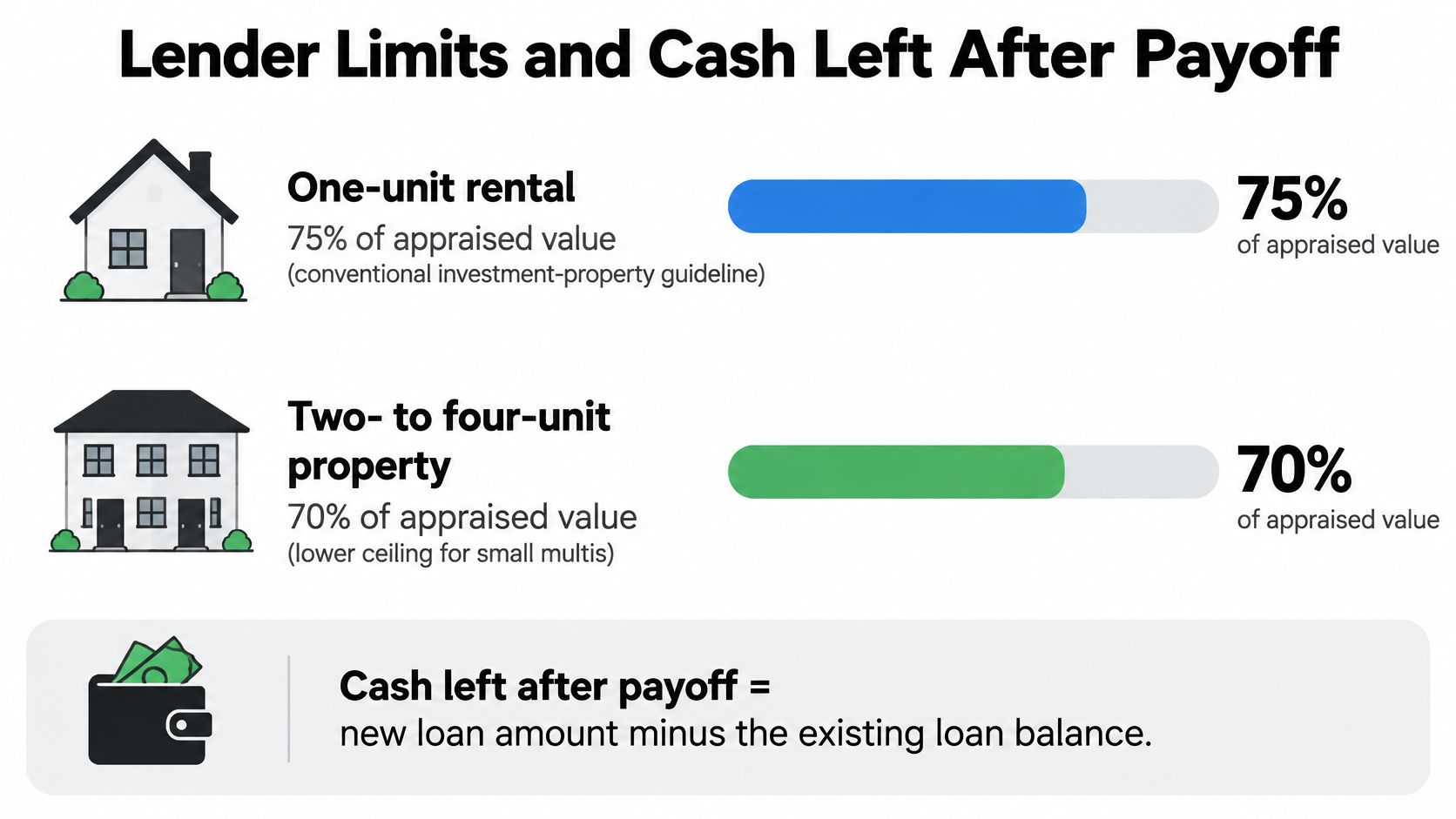
Every cash-out figure on your deal traces back to one input: the appraisal. Under the conventional investment-property guidelines most lenders use, the maximum cash-out loan is generally 75% of appraised value for a one-unit rental and 70% for a two- to four-unit property. That percentage sits on top of whatever value the appraiser supports, so a bigger rehab budget or a higher asking price across the street does not move it. If the loan-to-value math behind that ceiling is new to you, our guide to loan to value in real estate walks through the same calculation step by step.
The same appraisal, two property types
Watch what a single variable does to the same house. Take a property appraised at $300,000. A one-unit rental may support a maximum new first mortgage of about $225,000. A two- to four-unit rental at 70% supports about $210,000. Those are gross loan amounts, and gross is not what hits your account. Cash released is what remains after the old debt and the transaction costs come out.
| Property Type | Max LTV | Max New Loan | Gross Cash After Payoff and Costs |
|---|---|---|---|
| One-unit rental | 75% | $225,000 | $67,500 |
| Two- to four-unit rental | 70% | $210,000 | $52,500 |
If the existing payoff is $150,000 and transaction costs total $7,500, the one-unit deal releases about $67,500. The two- to four-unit deal releases about $52,500. Same appraisal on paper, and the unit count alone costs you $15,000 at the closing table.
What else comes out before you spend it
The $7,500 in that example is only the start of the subtractions. Existing liens get paid first. Escrows for taxes and insurance get funded at closing. Origination charges, discount points, and third-party fees often stack a few percent of the new loan on top of the figure you already wrote down. When you are checking whether the new payment even belongs on this property, mortgage refinance math explained is a clean way to separate rate, term, and cash-out from each other before you lock anything.
Appraisal movement hits the loan before any of those deductions. Every $10,000 change in supported value moves the maximum gross loan by about $7,500 at 75% loan-to-value. A softer comp set trims the loan by that amount, and the payoff does not shrink to match, so nearly all of it comes out of the cash you planned to recycle. That is why the appraisal, not the renovation budget, decides what this refinance releases.
Underwrite the deal with a conservative value, not the target after-repair value you used to justify the rehab. Write down the cash-left figure with payoff and costs already subtracted before you make your next offer. If that figure will not fund the next purchase, the property is a hold, not a repeat.
One BRRRR Deal Walked Through Cash-Out Math
Walk one all-cash deal both ways so the trade-off is in dollars, not slogans. The investor pays $195,000 in cash for the purchase and the rehab combined. There is no hard-money balance on this file. If there were, that payoff would come out before any cash counted as released.

The seasoned conventional path
After the rehab and a six-month hold, the appraisal comes in at $290,000. At 75% loan-to-value the new loan is $217,500. Closing costs on this file are $7,500, so the gross cash to the investor is $210,000. That is $15,000 more than the $195,000 that went into the property. Remaining equity is $72,500, which is the appraisal minus the new loan.
The extra $15,000 is not profit you can spend twice. It is cash back above basis, and the $72,500 stays in the house as equity you do not get at the closing table. Your next purchase is funded by the $210,000, not by the whole $290,000.
The delayed-financing path on the same numbers
On the delayed-financing path, the loan cannot exceed the documented $195,000 investment plus $7,500 in eligible closing costs. The loan is capped at $202,500. Net cash back is $195,000, exactly the amount put in. The appraisal can be $290,000 and the cap still ignores the equity the work created.
The conventional path extracts $15,000 above basis and leaves you with a larger loan to pay down over time. It also requires the six-month hold, so hard-money or opportunity cost runs while you wait. The delayed path returns capital as soon as the cash-purchase exception allows, and it stops at documented dollars. You do not pull created equity. You get your receipts back.
A short walk-through of how investors time that refinance sits here if you want the sequence beside the math.
The monthly check before you close
The new payment has to fit inside the rent with a debt-service cushion. Take the principal and interest on $217,500, add taxes, insurance, and any association dues, and compare that total with the signed rent. If the rent only covers the payment with nothing left for vacancy or repairs, the larger loan is the worse loan even though it returned more cash.
Cash back that breaks the rent is not a successful refinance. It is a rental you will have to feed.
This example is all cash on purpose. On a hard-money deal, subtract the payoff, any extension fees, and the interest due at payoff before you call the remainder "cash released." A $217,500 loan with a $180,000 payoff and $7,500 in costs does not hand you $210,000. It hands you $30,000.
Steps to Prepare and Close the Refinance
Treat the closing as a sequence. Skipping a step is how a finished kitchen still produces a loan that leaves the new equity behind.
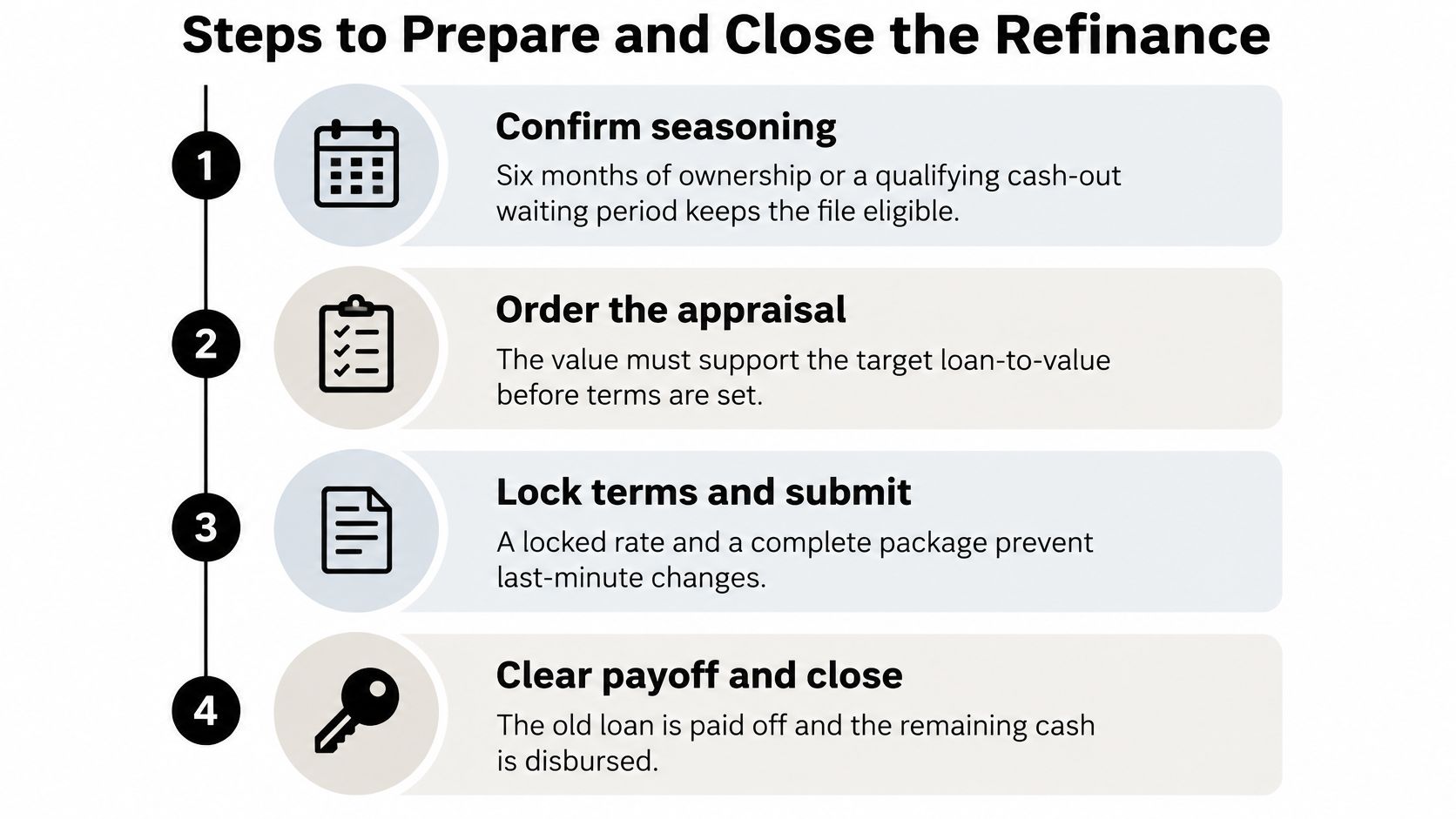
- Confirm title seasoning or delayed-financing eligibility. Six months of ownership, or a qualifying cash purchase, controls whether the lender may use appraised value or must cap the loan at documented investment. Count from the deed, not from the day the contractor finished.
- Finish permitted work and get final inspections or a certificate of occupancy. An open permit or a missing final can push the appraiser to value the house as incomplete, which cuts the loan even when the photos look done.
- Lease the unit and collect deposits. Stabilization is a signed lease, rent in the account, and reserves, not only a finished kitchen. A vacant, pretty house is still a project to many underwriters.
- Assemble rent support, reserves, and debt-service coverage. Many rental programs underwrite on market or actual rent against the full new payment. Have the lease, the insurance quote, the tax bill, and the reserve statements in one folder.
- Order the appraisal with a comp package that matches the finished scope. Give the appraiser the scope, the permits, and sales of houses in similar condition. Do not hand over your rehab budget and expect it to become the value.
- Model three timings, then pick one. Jaken Finance Group notes that some programs permit cash-out after roughly 90 days, others require three to six months, and more conservative programs may require 12 months or documented rent history. Run the 90-day, six-month, and 12-month paths with carrying costs, expected rent, DSCR, reserves, and that lender's value-basis rule.
- Close, pay off the short-term loan, and record the new mortgage. The old lender gets the payoff first. You receive what remains after costs, escrows, and any required reserves.
The slip that leaves equity in the house
Some programs size an early refinance on purchase price plus documented improvements rather than the new appraisal. That can be faster, and it can defeat the reason you renovated. If the basis is cost, the value you created never enters the loan. You paid for a rehab and financed a receipt pile.
Line up the file before the first lender call. You will want the deed, the closing statement from the purchase, invoices and lien waivers for the rehab, permits and finals, the lease and deposit receipts, insurance and tax figures, reserve statements, and a payoff letter on the short-term loan. Closing costs on the new loan deserve their own line, which is why a closing cost breakdown belongs in the model next to the payoff, not as a surprise at the table.
A complete package does not raise the appraisal. It stops the lender from lending on a smaller, safer story than the one you built.
Appraisal Risk and Protecting Your Value
A 7% gap between your expected after-repair value and the refinance appraisal drops a $250,000 property to $232,500. At 75% loan-to-value, that is roughly $13,125 less in gross loan proceeds. The same 75% on a value 10% light, at $225,000, cuts the loan by $18,750 from the baseline.
| Appraisal Scenario | Appraised Value | Change in Loan |
|---|---|---|
| Expected ARV | $250,000 | Baseline |
| 7% below expectation | $232,500 | -$13,125 |
| 10% below expectation | $225,000 | -$18,750 |
The renovation budget is already spent by the time anyone reads this table. The appraisal decides how much of it comes back. That holds on every timing path, because whether you refinance after a short seasoning period or through delayed financing, the lender multiplies a percentage by a number you do not control.
Why a "conservative" loan-to-value still fails
People treat 70% or 75% as the safety margin. It is only a margin on whatever number the appraiser signs. If that number was optimistic, a 70% loan on a soft appraisal can still miss the cash you needed. A smaller loan on tight, recent comps can recycle more cash than a 75% loan on a wish.
The causes are ordinary, and they show up even when every invoice was real.
- Weak comparable sales: The nearest finished sales are smaller, older, or in worse condition, so the appraiser will not stretch to your target.
- Incomplete permits: Open or missing permits make the appraiser discount work a buyer could be forced to legalize.
- Functional obsolescence: A chopped floor plan or a missing bedroom the market pays for will not be cured by new finishes.
- Condition mismatches: Your photos show a remodel, and the comps are partial updates, so the adjustment goes against you.
- Unsupported rent: A lease priced above what the local market brings does not rescue a thin payment if the income the lender will count comes in lower.
The appraisal feeds more than the value line. Lenders weigh the income side too, so a strong lease on paper only helps when the rent itself holds up.
Test the value before the lender orders it
Run a sensitivity table at several after-repair values. For each one, show loan proceeds, the new payment, closing costs, any prepayment penalty on the loan you are paying off, and the equity left in the deal. If only the top value returns your capital, you do not have a refinance plan. You have a hope.
An automated valuation can pressure-test comps and rent before that order. It is not a substitute for the report the lender will use. AI output, including ARV calculations and valuations, is not a licensed appraisal, definitive valuation, or guaranteed forecast. Use it to find the weak comp and the optimistic rent, then read how an appraisal differs from a tax assessment so you do not argue the file with the wrong number.
Decide Whether a Cash-Out Refinance Fits Your Next Deal
The rehab budget tells you what the house cost to finish. The appraisal tells the lender what it is worth, and that second number sets the cash released. Make the go or no-go call before anyone pulls credit: four checks, in order, and a miss on any one sends the deal back to rehab or rent rather than shopping for a cheaper purchase to distract from a refinance that will not clear.
Stabilized means leased and legal. You need a signed lease, a final inspection or certificate of occupancy, and rent deposits on file. A punch list and a verbal tenant are not stabilization.
The appraisal has to be defensible. Comps should match the finished scope in size, condition, and recency. If the target value only works with sales the appraiser will throw out, the target is not the value.
Cash left has to fund the next move. After payoff and closing costs, the remainder has to match what the next purchase requires. A few thousand dollars of "cash out" that cannot cover a down payment is not a repeat.
The payment and the calendar have to agree. Rent covers the new payment with a cushion, and the timing path you chose matches what you can carry while you wait. A larger loan on a longer hold becomes a loss when extra months of interest erase the extra cash.
Run the same deal through each path before you commit. Our BRRRR Calculator shows cash left in the deal and cash flow, and the free calculators on the site, including that one, require no account. Record the cash-left figure for the 90-day path, the six-month path, and the 12-month path, then put each beside its hold cost. Call a lender only after the winning path still meets the rent test.
If any check fails, go back to the unfinished scope, the missing lease, or the weak comps. A different house will not fix the one that still will not refinance.
PropLab underwrites the refinance before you are stuck in it. Paste an address and our BRRRR Calculator shows cash left in the deal and cash flow, so you can compare the fast path and the seasoned path in dollars. When you are ready to run the next property the same way, open PropLab and put the address in before you write the offer.
Tags
About the Author
P
PropLab Team
Real Estate Analysis Experts
The PropLab team consists of experienced real estate investors, data scientists, and software engineers dedicated to helping investors make smarter decisions with AI-powered analysis tools.
Free account
Underwrite your next deal in under a minute
3 free analyses, no credit card. ARV, rehab, comps and exit strategy in one report.
