General
Appraisal Versus Assessment: Which Number to Trust
November 9, 2026
15 min read
The most popular advice on appraisal versus assessment is also the most misleading. It says you'll be safe if you remember one number is for buying and the other is for taxes, then treat whichever number you find first as a rough stand in for value.
That shortcut fails investors in both directions. A low tax assessment isn't automatically a bargain, and a high assessment isn't proof of resale value. Both numbers can use the words market value, yet they're built for different decisions, on different dates, with different evidence and precision. If you don't reconcile the date, ratio, classification and physical facts behind a number, you can't use it to justify an offer, an ARV or a lender package.
Appraisal and Assessment Side by Side
Use this one sentence rule first. An appraisal is an independent opinion of what a property could sell for on the open market as of a stated date, while a tax assessment is an administrative value that sets the base for property tax bills.
That distinction sounds simple until you see both documents describe market value. They're answering different questions, so they follow different rules even when the phrase looks identical.
Appraisal Versus Tax Assessment at a Glance
| Factor | Appraisal | Tax assessment |
|---|---|---|
| Primary purpose | Estimate market value for a sale, loan or investment decision | Set the base for property tax bills |
| Who performs it | Licensed or certified appraiser hired by a lender, buyer or seller | Government assessor or mass appraisal staff |
| Valuation standard | Market value as of a specific date | Statutory rules, assessment ratios and mass appraisal models |
| Property inspection | Property specific, with condition and features observed | Periodic, often without a physical visit every year |
| Typical trigger | Purchase, refinance, sale or underwriting for an investment | Scheduled reappraisal cycle, new construction or permit activity |
| Main risk if misused | Stale comparable sales or unsupported adjustments | Assuming the assessed value equals the market value |
Under Fannie Mae's property assessment and valuation guidance, an appraiser analyzes applicable approaches, including the sales comparison, cost and income approaches, and reconciles the results instead of just averaging them, with the final value remaining within the range produced. A tax assessment, by contrast, may follow statutory rules, mass appraisal procedures, assessment ratios, exemptions, reassessment cycles or local caps that differ from current market conditions.
That's why an assessed value isn't automatically equivalent to an appraisal or likely sale price. For underwriting, tax records give you useful evidence and historical trends, but they can't substitute for a market supported valuation based on comparable sales, property characteristics, condition and the valuation date.
Practical rule: Before you compare two numbers, check which document you're holding and what date and purpose it was prepared for.
The assessor's job is consistency across a jurisdiction, not a transaction opinion for one house on one day. The appraiser's job is the opposite, one property, one effective date, one intended use. Mixing those roles is where most valuation errors start.
How Each Value Is Calculated
An appraisal doesn't start with a formula applied to every house on the street. It starts with evidence for a specific property, then the appraiser weighs that evidence and signs an opinion.
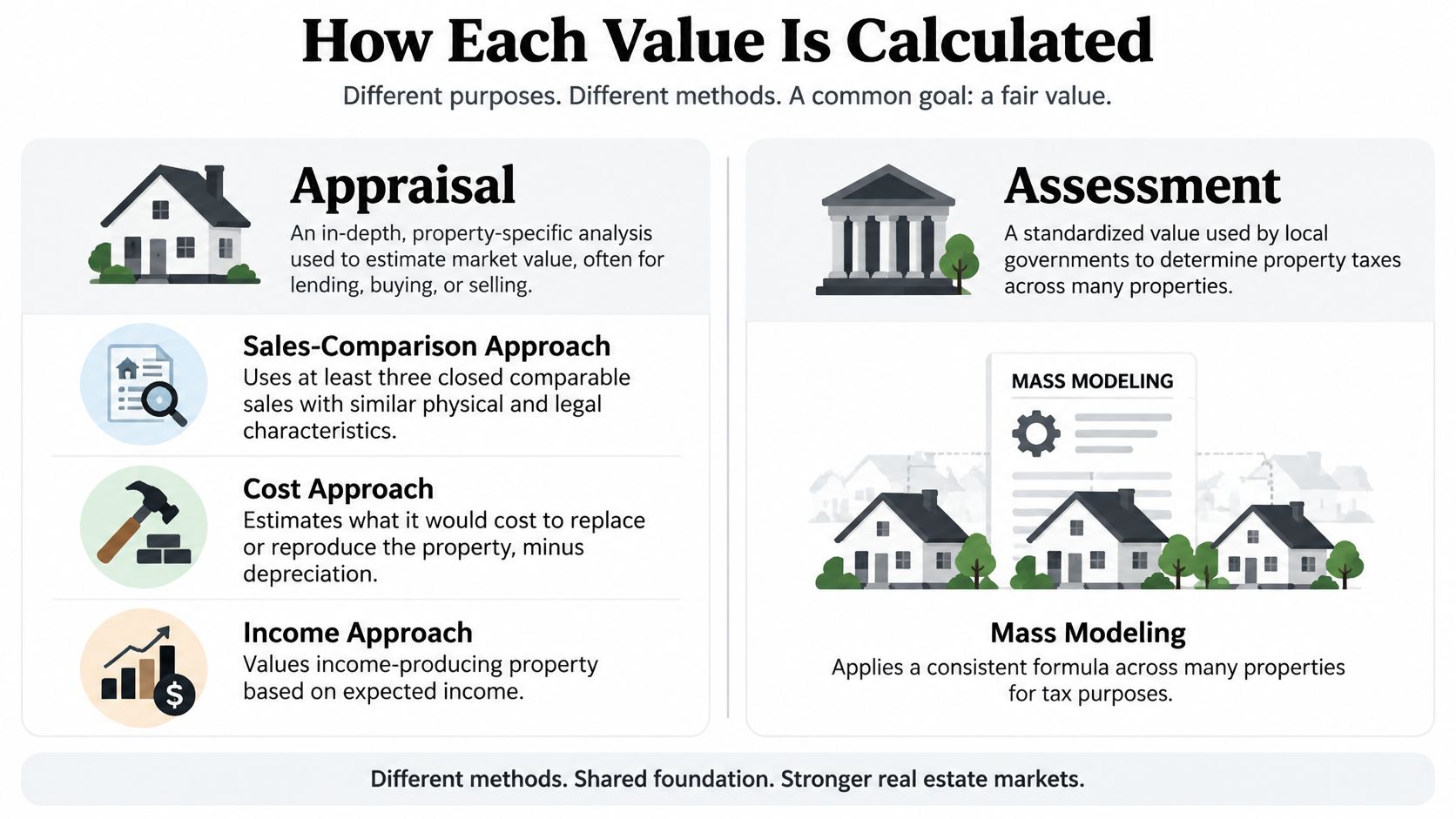
The comparison below separates the appraisal approaches from the mass modeling used for assessment.
The Three Appraisal Approaches
- Sales comparison approach: The appraiser compares the subject with closed sales of similar properties and adjusts for differences. This approach usually carries the most weight for a single family flip because it reflects what buyers paid.
- Cost approach: The appraiser estimates what it would cost to replace or reproduce the property, minus depreciation, plus land value. You'll see it help most with new or unusual property where good sales are scarce.
- Income approach: The appraiser values income producing property from expected income. This matters for rentals and commercial assets where buyers price cash flow, not just bedrooms and finishes.
Reconciliation isn't averaging. The appraiser gives more weight to the approach with the most reliable evidence and explains why, and the final opinion has to sit within the range the approaches support.
Adjustments and Professional Responsibility
Adjustments are where the work becomes property specific. A comparable sale is adjusted for location, size, quality, condition and features, and those adjustments should estimate how buyers and sellers price those differences in the market. A dollar for dollar match to construction cost won't prove how a buyer reacts to a dated kitchen or an extra bath.
That opinion carries a professional boundary you should notice when you read reports. Under Fannie Mae's property valuation framework, an appraiser develops an opinion of value using property data, comparable sales, local market conditions and amenities, while a data collector reports objective facts without providing an opinion of value. If no one with appraisal responsibility signed the opinion, don't treat the document as one.
Our guide to building appraisal comps that hold up in underwriting walks through how to document those adjustments instead of copying a price per square foot. That trail matters when a lender, buyer or partner asks why one sale got more weight than another.
How Assessment Calculation Differs
An assessor has to value large numbers of properties consistently for taxation. Staff typically use standardized mass appraisal models, sales data across many parcels and legally defined assessment dates, then apply any statutory percentage or classification rule the jurisdiction requires. The goal is uniform treatment across the tax roll, not a fresh negotiation opinion for your closing.
When you see any value, ask which approach produced it, which date it reflects, and whether any adjustments were applied.
That reading rule protects you with automated estimates too. A model output without an effective date, comp set and adjustment logic is a starting point for research, not evidence you can defend.
Timing and Triggers Behind Each Number
Say you order an appraisal for a purchase in March. The appraiser inspects the property, pulls closed sales around that effective date, and delivers an opinion for that transaction. If you try to refinance a year later after rates move and two nearby houses sell for less, the lender won't treat the March opinion as current, and neither should you.
An appraisal is also commissioned for a specific party and purpose. A seller's pre listing appraisal, a buyer's lender ordered appraisal and an appraisal for an estate can address the same house and still differ in scope, date and intended user. That's why a new buyer or lender usually orders a new one instead of inheriting yours.
The Assessment Clock Runs Differently
A tax assessment follows a legally defined assessment date and a reappraisal cycle set by the jurisdiction. Many places reappraise on multi year cycles, so the value on the tax card may reflect a market that no longer exists. Between cycles, staff may update models statistically without visiting every parcel.
IAAO standards, summarized in the Guide to Assessment Standards, state that annual assessment doesn't necessarily require annual physical examination, and that ratio studies can identify property groups needing priority review. In practice, that means your renovated kitchen, finished basement or deteriorating roof may not change the record when the work happens.
- A sale closes: Some jurisdictions reassess or reset values after a transfer, so the seller's old tax bill may not predict yours.
- A renovation or permit adds value: The appraisal for a refinance can reflect documented work now, while the assessment may wait for a record update or cycle.
- The market moves fast: Recent comparable sales move an appraisal quickly, while the assessment lags until staff recalibrate the model.
- A scheduled reappraisal arrives: The tax base resets across the area, sometimes sharply, even if your individual property didn't change.
Each event helps you in a different way. A permit history warns you that taxes may rise after you buy. A long gap since reappraisal tells you not to underwrite holding costs from the current bill alone.
Compare the appraisal date with your closing date, and the assessment date with the last reappraisal cycle, before you decide either number is current enough.
Timing is therefore not a footnote. It's the first filter for relevance, ahead of whether the number looks favorable.
Where the Two Values Diverge in Practice
Tennessee makes the ratio problem impossible to ignore. According to the Tennessee Comptroller's explanation of assessment versus taxation, residential property is assessed at 25% of appraised value, while commercial and industrial property are assessed at 40%.
Run that math on a house with a $400,000 market value. The assessed value is about $100,000 before tax rates are applied. That isn't evidence the house is worth $100,000, and it isn't a $300,000 equity discovery. It's a tax base created by statute.
The photograph below captures the practical setting where investors confuse the two, documents for different property types sitting side by side as if they're interchangeable.

When Appraisal and Assessment Point in Different Directions
| Scenario | Appraisal direction | Assessment direction | Investor takeaway |
|---|---|---|---|
| Residential property, $400,000 market value in Tennessee | Reflects $400,000 market value | Assessed at 25%, about $100,000 before tax rates | Assessed value is a tax base, not a price |
| Rising market, reassessment not yet due | Tracks current comparable sales | Lags behind current prices until the next cycle | A low tax bill is not a bargain signal |
| Distressed property in poor condition | Lower, reflects condition and repair needs | May stay higher until reassessed | Assessment can exceed current condition based value |
| Renovated property not yet reassessed | Reflects improvements if documented and comparable | Unchanged until the record is updated | Expect a possible tax increase after improvement |
| Sale that triggers reassessment | Reflects the transaction and market conditions | Reset toward the new sale context in some jurisdictions | Budget holding costs with the post sale assessment |
Notice the distressed property row. Investors often assume assessments are always low, but a house with deferred maintenance, interior damage or functional problems can appraise below its assessed value because the mass model didn't see the condition an appraiser observed. Paying assessed value in that case means paying for condition the property doesn't have.
The short video that follows reinforces how to read these gaps without treating either number as a shortcut.
The contrarian conclusion is direct. A low assessment can mean a statutory ratio, an old cycle, an exemption or missing property facts. A high assessment can mean stale condition data or a model built for uniformity. Neither proves what a buyer will pay after proper marketing.
When Both Numbers Can Mislead You
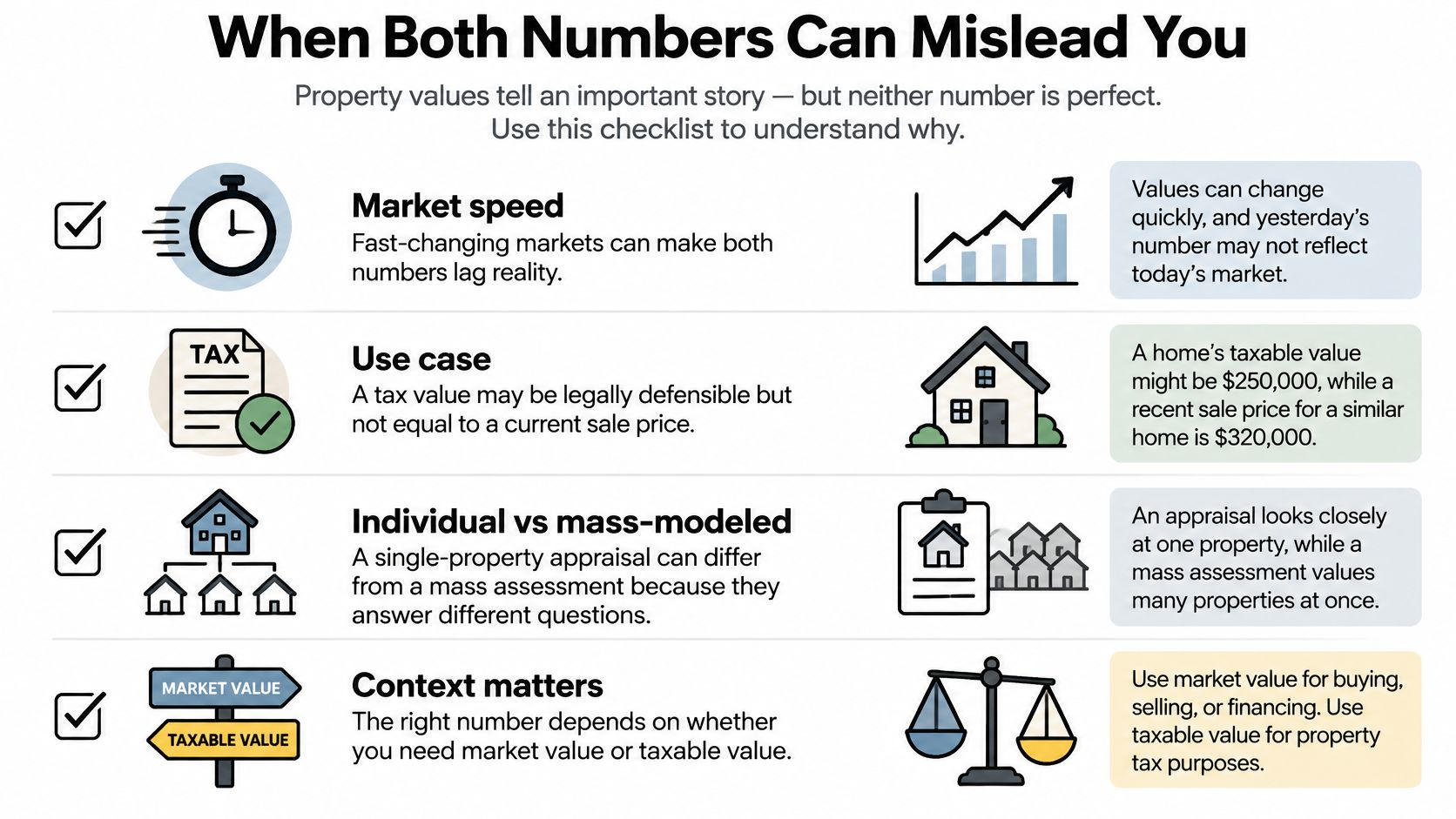
Don't ask which system is accurate in the abstract. Accuracy depends on market speed, use case, and whether the value is individual or mass modeled. An assessment can be consistent and legally defensible for taxation while still being stale for a flip or BRRRR decision you'll fund next month.
Thin activity weakens appraisals too. The Chase guide to assessment versus appraisal notes the Appraisal Institute reported appraisal volume averaged roughly 382,000 monthly transactions in 2024 and about 390,000 in 2025 year to date, while the current level of approximately 410,000 remained nearly 40% below the historical average of 679,000. Fewer transactions mean fewer fresh comparable sales, which makes unusual, distressed, renovated or rapidly shifting properties harder to value.
The checklist below turns those warning conditions into responses you can act on before committing capital.
Warning Conditions and Your Response
- Long reassessment interval: Assume the assessment lags the market. Get a current, property specific valuation and budget taxes from a likely reset, not the seller's bill.
- Major renovation missing from public records: Verify scope with permits, invoices and photos. Credit only documented work, and check the public record of house sales to confirm what transferred and when.
- Distressed or non arm's length comparables: Drop them from the comp set. A family transfer or foreclosure sale doesn't prove open market reaction.
- Thin sales activity: Widen the search radius and time window carefully, explain the weaker evidence, and label the result lower confidence.
- Sharp local price change: Add market condition adjustments to older sales or pull a fresh valuation before you lock an offer.
Automated estimates don't replace appraisers in these cases. They help when they show confidence scoring, comp recency, distance weighting, adjustment transparency and red flag review, so you can see when a single value source is outdated or mismatched to your decision.
Which Value Each Decision Needs
Start with the decision, not the document you happen to have. The right lead number changes when your question changes from what should I offer to what will I owe in taxes.
Which Value Each Decision Needs
| Decision | Number to lead with | Check before relying on it |
|---|---|---|
| Making an offer | Current market supported ARV from recent comps | Comps are recent, physically similar and verified |
| Calculating ARV for a fix and flip | Adjusted comparable sales with a visible trail | Adjustments reflect market behavior, not construction cost alone |
| Refinance or lender package | Lender ordered appraisal | Appraisal date and purpose match the loan request |
| Property tax budget | Assessed value multiplied by local tax rate | Assessment date, ratio and classification are confirmed |
| Holding costs after purchase | Tax history plus expected post sale reassessment | Reassessment rules and timing for the jurisdiction |
For an offer or ARV, comp quality decides whether your number survives scrutiny. Fannie Mae's comparable sales requirements require at least three closed comparable sales in the sales comparison approach, with similar physical and legal characteristics and neighborhood sales generally providing the best location signal. Adjustments must be market derived, not simple dollar for dollar construction cost offsets, and time adjustments are required when market movement clearly warrants them.
A Pre Offer Procedure You Can Repeat
- Pull the assessment record: Note its date, assessed value, ratio and classification. Confirm beds, baths, living area and lot facts, because a factual error can distort taxes and your comp search.
- Measure the lag: Compare that date with the last sale and last reappraisal cycle. If either gap is long, treat the assessed value as tax history, not market evidence.
- Build the comp set: Score sales by physical similarity, geographic relevance, recency and verified sale terms, not distance alone. Record each adjustment with its reason so another reviewer can follow your ARV.
- Run the red flag review: Check for missing renovations, non arm's length sales, thin activity and sharp price movement. Lower your confidence or widen your margin when those flags appear.
- Match each number to its decision: Use adjusted comps for offer and ARV, the lender's appraisal for financing, and assessed value times the local rate for taxes.
- Order a licensed appraisal when reliance matters: If a lender, buyer or court will rely on the value, don't substitute an automated estimate for that professional opinion.
We built our workflow around that separation. Our comps are weighted by distance and recency, include adjustment breakdowns, and come with confidence scoring, and every analysis generates a professional PDF report with all comps, adjustments and calculations that you can download, share with partners or send to lenders. That output is still not a licensed appraisal, definitive valuation or guaranteed forecast, so use it to underwrite and document your decision, then order an appraisal when the transaction requires one.
Owners face a related fork after the numbers are clear. If you're deciding whether to weigh selling against renovating your home, run the market value question and the tax question separately, because a renovation can raise resale appeal before it raises assessed value, and the reverse timing can squeeze holding costs.
If the assessment itself looks wrong, act inside the assessment system. Read how to challenge property taxes, then file a formal appeal with the local assessor or board before the deadline on your notice, using the same comparable sales and factual corrections you used in underwriting. Don't send an offer argument to a tax board, and don't send a tax card to a lender as proof of ARV.
The assessment answers the tax question. A current, property specific valuation answers the market question.
Keep those questions separate and appraisal versus assessment stops being a vocabulary quiz. It becomes a control on your offer price, your tax budget and the risk you carry between purchase and exit.
Use PropLab to separate tax data from market evidence before you offer, with distance and recency weighted comps, adjustment breakdowns, confidence scoring and a lender ready PDF for every analysis. Paste an address to build your ARV, repair estimate and max offer from verifiable comps, then order a licensed appraisal when your lender or buyer needs to rely on the value.
About the Author
P
PropLab Team
Real Estate Analysis Experts
The PropLab team consists of experienced real estate investors, data scientists, and software engineers dedicated to helping investors make smarter decisions with AI-powered analysis tools.
Free tool
Get the ARV of any property in 30 seconds
Skip the spreadsheet. Enter an address and get an after-repair value backed by real comps.
