General
How to Challenge Property Taxes Before the Deadline
October 23, 2026
15 min read

The assessment notice is sitting beside your laptop, and the proposed value looks closer to a renovated resale than the property you own. You're looking at a filing cutoff, unfinished repairs, and an expense line that may change your rental cash flow or acquisition math. Before paying someone to appeal, establish what the property was worth on the legally relevant date and whether a defensible reduction would justify the cost.
Why a Property Tax Notice Deserves a Fast Review
An assessment notice isn't just another document to hand your bookkeeper. It's a proposed valuation with a deadline attached. Waiting until the tax bill arrives may leave you trying to solve a valuation problem after the useful filing window has closed.
Learning how to challenge property taxes starts with identifying what you're challenging. A typical property-tax appeal contests the assessor's estimate of taxable value, not the tax rate itself. Your argument needs to explain why the property's value is wrong, rather than why the resulting bill feels unreasonable.
A short window changes the work
The Dallas County field experiment described in this working paper reports that proposed values were released on April 14, 2026, with protests due May 15, a 31-day window; filing was free, missing a scheduled hearing ordinarily caused dismissal without a penalty, and filing normally didn't expose owners to an increase above the proposed value.
That timetable is an example, not a national rule. The practical lesson is to separate the filing deadline from the time you'd like to spend researching. A worthwhile case can still fail if you spend the entire window perfecting the analysis.
Practical rule: Calendar the local deadline before deciding whether the assessment is worth challenging.
Review the number before delegating it
Start with the notice and the property record. Compare what the assessor appears to be valuing with what you owned during the relevant period.
- Identify the disputed value. Make sure you're reviewing the assessment being appealed, not an old figure or a different tax-year document.
- Check the property description. Flag discrepancies in size, improvements, quality, or condition for investigation.
- Find the local instructions. Confirm the filing method, required form, hearing process, and any separate evidence deadline.
- Assign responsibility. If a partner, manager, or representative will handle the appeal, name the person responsible for submission and attendance.
Don't hire help just because the proposed value increased. An increase can still be supported by the market, while an unchanged assessment can still be excessive. Treat the notice as a time-sensitive valuation assignment, then decide whether the evidence supports taking it further.
Rebuild Value as of the Valuation Date
The valuation date controls the argument. Today's asking prices, current repair needs, and your eventual resale target may answer different questions from the one the reviewing board is allowed to decide.
Public property-tax appeal guidance on comparable sales and supporting documentation provides a useful starting point. The important additional discipline is to connect each document to the property's condition and market value on the legally prescribed date.
Use this visual to organize that reconstruction.
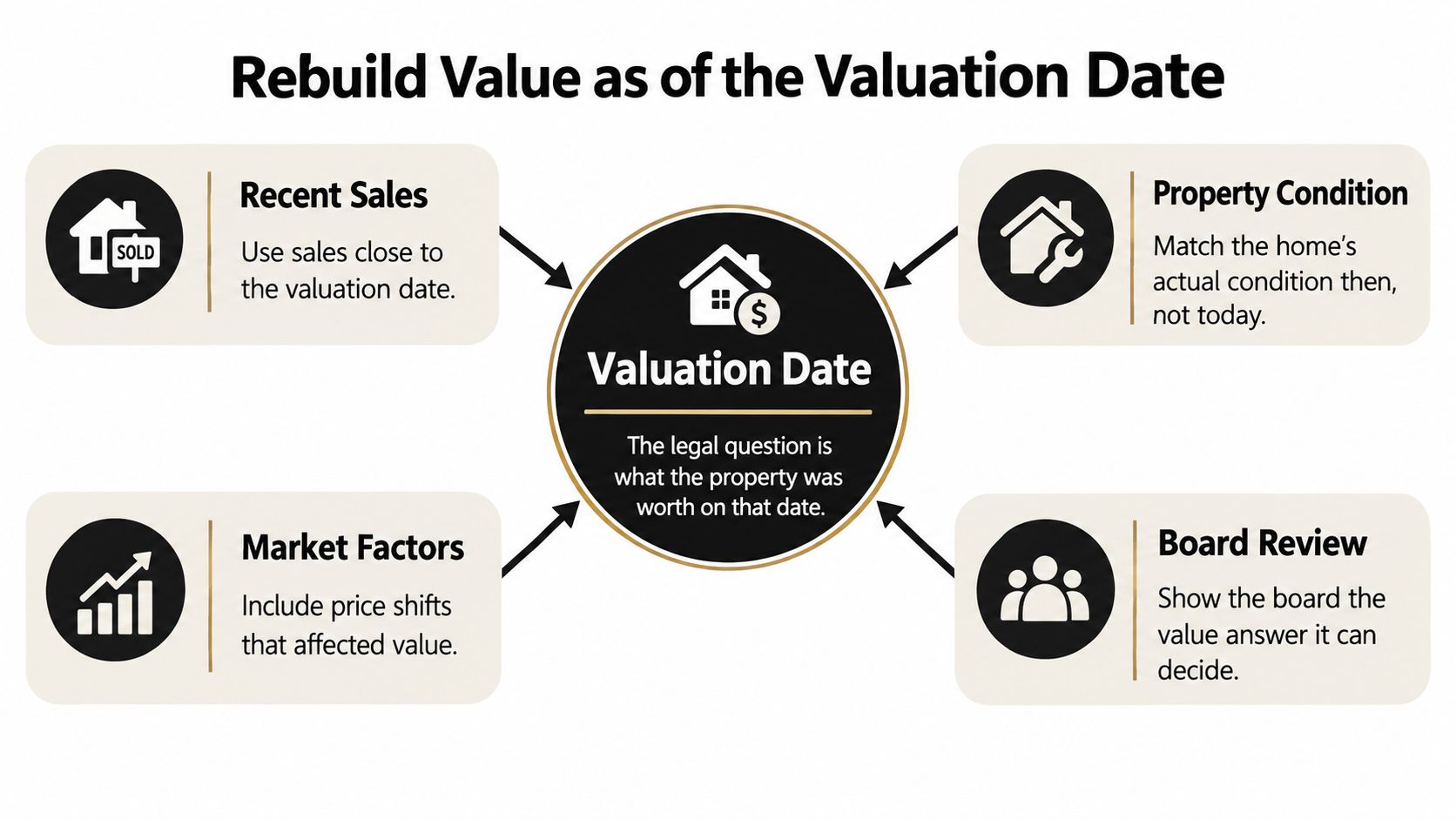
Separate what existed from what happened later
For a rehab property, build a dated chronology before building a valuation. Record when damage existed, when contractors inspected it, when work started, and when improvements became usable.
A renovation completed afterward shouldn't automatically become part of the earlier condition description. Equally, damage that occurred later doesn't establish that the property was impaired on the valuation date.
Later-created documents can sometimes help describe an earlier condition, but explain that connection. A contractor's estimate written after the valuation date needs supporting evidence that the underlying defect already existed. Don't expect the document's existence alone to establish timing.
Build a valuation-date evidence folder containing:
- Dated photographs. Identify the room, defect, and connection to the relevant date.
- Inspection and contractor records. Separate documented deficiencies from proposed upgrades.
- Permits and repair records. Show the sequence of work rather than presenting the finished property as its earlier state.
- Insurance and listing documents. Use descriptions that help establish habitability, damage, or marketed condition.
Reconstruct the market as carefully as the building
A nearby sale isn't automatically comparable just because it closed recently. Location, size, age, quality, and physical condition can make a seemingly convenient sale misleading.
The distinction between an as-is opinion and a renovated value is especially important for investors. Reviewing property valuation methods can help keep those purposes separate instead of allowing an acquisition model to substitute for the appeal's required value opinion.
Write the conclusion in date-specific language: the requested value reflects the property's documented condition and relevant market evidence as of the legal valuation date. That's a stronger position than saying the house is worth less today.
Assemble Comps Condition Proof and Unequal Assessments
Consider a hypothetical tired rental surrounded by renovated sales. The neighborhood matches, but the interiors don't. Submitting those transactions without explaining the difference may support the assessor's number more effectively than your own.
Build an appeal packet around distinct evidence categories, with a clear explanation of what each establishes.
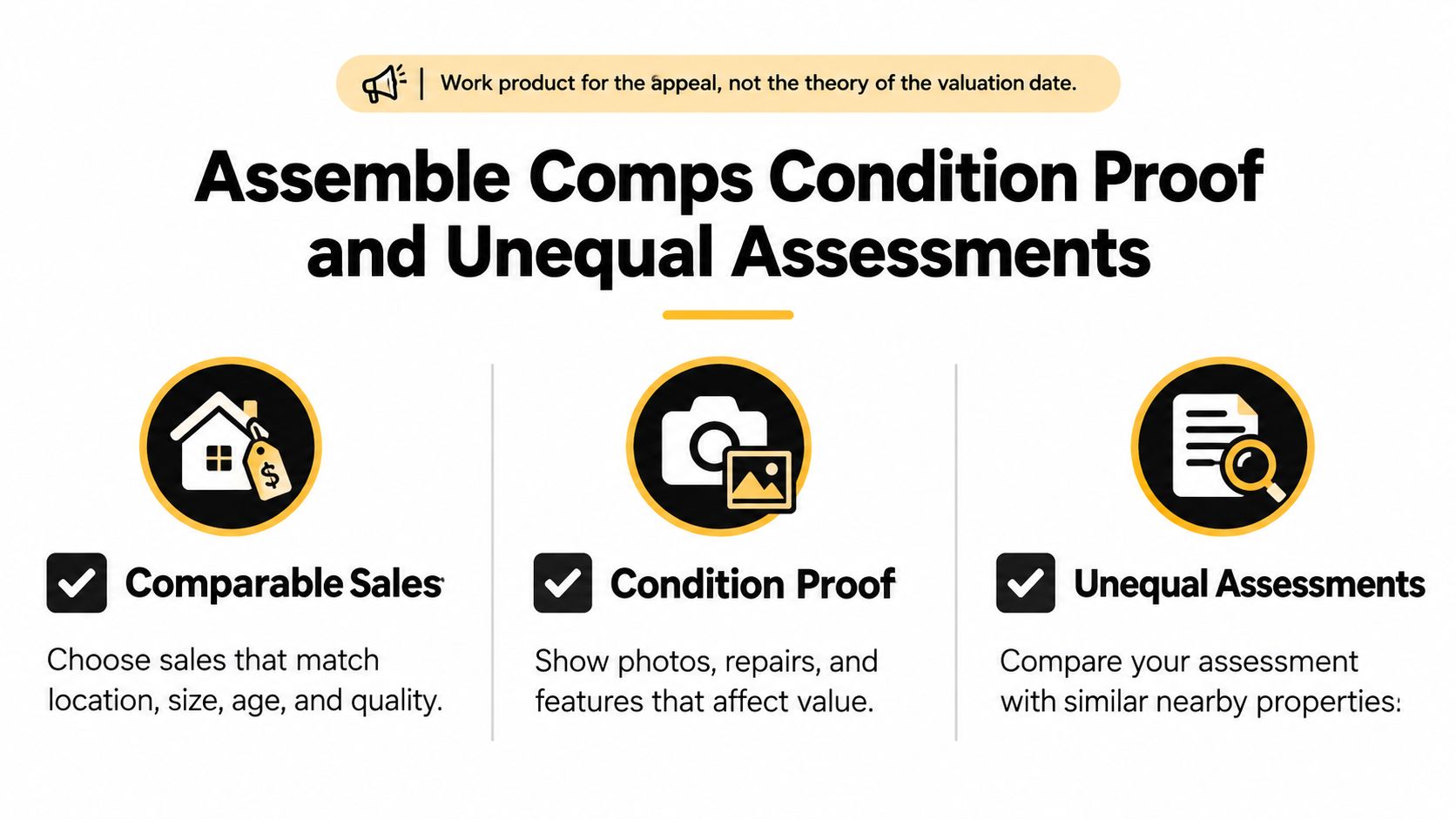
Adjust sales instead of attaching a stack of listings
For each selected transaction, show the sale price, relevant characteristics, differences from the subject, and your proposed adjustments. The real estate appraisal comps guide offers a framework for evaluating which properties belong in the comparison.
In the rental example, explain why renovated interiors warrant a downward adjustment to the comparable sale when estimating the subject's value. State the adjustment amount in the actual submission and show its basis. Don't invent a standard condition discount because it produces your preferred conclusion.
Keep repair cost separate from market-value impact. A contractor estimate documents anticipated work, but your analysis still needs to explain how buyers would account for that condition. Avoid subtracting the same deficiency through both a broad condition adjustment and a separate repair deduction.
Keep unequal assessment evidence distinct
A neighboring assessment isn't a completed sale. Use it to support an unequal-treatment argument where local rules allow that ground, rather than presenting it as direct proof of market value.
Historical results show why careful analysis matters: the University of North Carolina School of Government's Durham County study examined approximately 100,000 residential parcels, found appeal rates of 5.4% in 2016 and 4.2% in 2019, reported substantially higher participation among high-value properties, and found appraisal reductions in about 80% of appeals.
Those results aren't a forecast for your property. Nor does obtaining a reduction establish that the final value is correct.
Ask for the number your evidence supports, not the largest cut you can put on the form.
Before submitting, check that the packet contains:
- A requested value. State the conclusion and its effective date.
- An adjusted sales grid. Explain inclusion, exclusion, and material differences.
- A condition index. Connect each important defect to its supporting document.
- A separate equity comparison. Identify similar assessed properties and explain their relevance.
- A reconciliation. Explain why you gave stronger evidence more weight when indicators conflict.
A hearing officer shouldn't have to reconstruct your reasoning from attachments. Make the path from evidence to requested value visible.
Decide If the Appeal Is Worth the Cost
A credible valuation argument isn't automatically a good purchase of professional services. Before ordering an appraisal or signing a representation agreement, estimate the savings conservatively and compare them with the full cost of pursuing the case.
Use this initial calculation:
Estimated annual gross savings = supported reduction in taxable value × applicable local tax rate
Confirm that the rate and taxable-value basis match your jurisdiction's calculation. Then account for appraisal charges, retainers, contingent fees, filing costs, and the time you'll spend gathering records and attending proceedings.
When a Property Tax Appeal Pays for Itself
| Property situation | Evidence that usually matters | Professional help | Worth pursuing when |
|---|---|---|---|
| Owner-occupied home | Closely matched sales and documented condition | Self-filing or targeted advice | Conservative savings exceed the effort and fees |
| Small rental | As-is sales, repair evidence, comparable assessments | Limited valuation review where needed | The supported reduction improves cash flow after costs |
| Multifamily property | Property-specific valuation and operating documentation | Appraiser or experienced representative | The exposure justifies a more detailed assignment |
| Vacant or rehab property | Dated habitability, damage, and construction evidence | Condition-focused appraisal or procedural advice | The assessment materially misses the documented earlier condition |
Don't buy a win-rate promise
Reported outcomes vary sharply: the LegalClarity overview of property-tax appeal results describes nearly 248,000 Cook County appeals in tax year 2023, with 50.45% receiving reductions, and reported residential success rates of 61.59% without an attorney versus 46.86% with counsel; it also describes Seattle-area reporting in which fewer than 1% of homeowners appealed annually and roughly one-quarter succeeded.
That comparison doesn't establish that lawyers weaken cases. Different owners may bring different properties, evidence, and disputes to professional representatives. Use local experience to ask better questions, not to assign a borrowed probability to your appeal.
Before signing an engagement, resolve these points:
- Fee basis. Is compensation hourly, fixed, contingent, or a combination?
- Savings period. Are fees calculated from immediate savings or an assumed continuing benefit?
- Unsuccessful outcome. Which charges remain payable if the assessment doesn't change?
- Adverse review. Can the local process produce a higher assessment?
- Investor consequences. Could the result affect deductible expenses or assumptions used in underwriting?
Don't assume a reduction will persist indefinitely. If the case only pays for itself under optimistic savings, negligible time costs, and a lasting reduction, self-filing or standing down may be the better decision.
File on Time and Prepare the Hearing
A complete research folder isn't a filed appeal. Read the notice and local instructions for the required form, submission channel, valuation date, filing cutoff, and evidence requirements. Confirm whether you're requesting an informal review, a formal hearing, or another available procedure.
Keep proof of submission and verify that the appeal was accepted. Submitting early gives you room to address a missing attachment or other correctable problem without relying on last-minute assistance.
The filing sequence should stay simple.
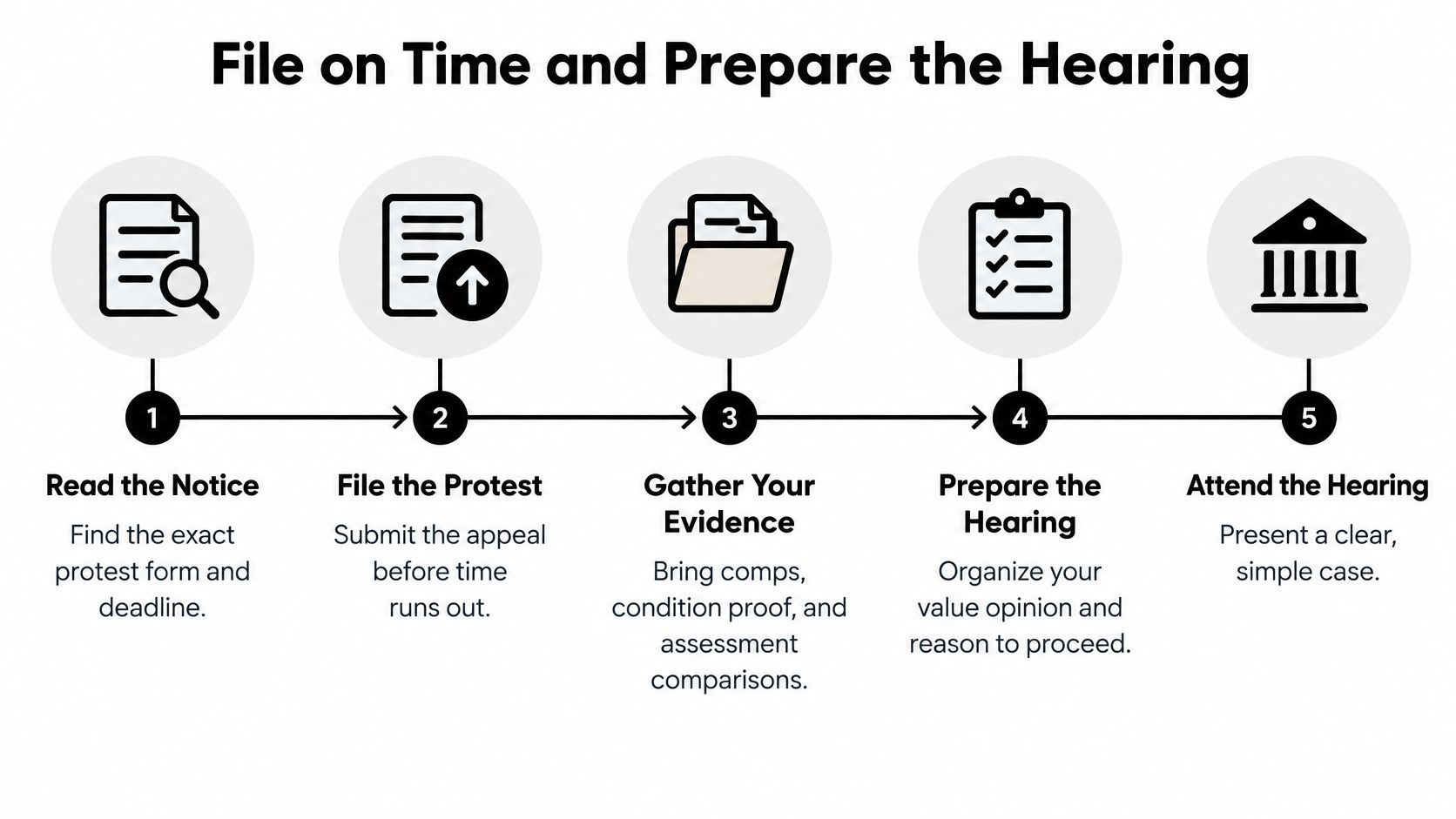
Write a cover letter that gives the reviewer a decision
Lead with the parcel identification, the assessment under review, and the requested value. Follow with a concise explanation of the strongest evidence and references to the relevant attachments.
Keep the letter focused:
- Requested finding. Identify the value you want adopted.
- Primary support. Point to the best adjusted sales rather than every transaction you collected.
- Condition support. Reference the dated records that explain material differences.
- Separate grounds. Identify unequal assessment distinctly if you're raising it.
For document-handling habits, FaxZen's guide to avoid common court filing mistakes is useful background on submission discipline. An administrative property-tax protest isn't necessarily a court filing, so follow the assessor's or board's instructions rather than importing another forum's requirements.
Rehearse the explanation, not a confrontation
Prepare a short opening in your own words: identify the property, state the requested value, explain the strongest evidence, and address the most important difference between your property and the assessor's apparent comparisons.
Bring the permitted paper and digital materials in matching order. Label exhibits so you can find a photograph, adjustment explanation, or assessment comparison without searching through unrelated records.
Hearing discipline: Answer the question asked, point to the supporting exhibit, and stop when the explanation is complete.
If someone challenges a comparable, explain why you selected it and how you handled the difference. If you can't defend the adjustment, acknowledge the limitation instead of improvising precision.
Calendar attendance separately from submission. The Dallas example illustrates that an inexpensive filing process doesn't make a missed hearing harmless. Investors managing several parcels should track deadlines and hearing obligations by jurisdiction, while keeping each property's evidence and requested value distinct.
Use Investor Tools Before You Hire Help
Choose the tool for the unresolved problem. You may need better sales data, a clearer adjustment analysis, a formal valuation opinion, or someone who understands the local procedure. Those aren't interchangeable services.
Keep the notice, calculator, and valuation evidence together while comparing your options.

Match the purchase to the gap
Hand-built public-record comps suit owners willing to inspect records and explain every selection. The advantage is control over the evidence. The trade-off is the work required to verify condition, transaction details, and meaningful differences.
An automated underwriting workflow can help organize candidate sales and expose assumptions. When comparing real estate valuation tools, prioritize visible adjustments, understandable comparable selection, and exportable supporting material over a polished headline estimate.
Automation doesn't resolve an incorrect effective date. A current estimate or an after-repair value can be useful for an acquisition decision while remaining unsuitable for the appeal you're preparing.
A licensed appraisal is worth considering when the disagreement requires a formal, property-specific value opinion. Before commissioning it, confirm the intended use, effective date, property condition being valued, and whether the scope fits the forum's requirements.
A tax representative or attorney addresses a different need. Ask about relevant local experience, representation requirements, fee terms, settlement authority, and who will attend the hearing.
Use the accompanying video as supplementary viewing, while keeping local filing requirements as your procedural authority.
Buy the missing capability
An organized residential comparison may be enough to support a self-filed protest where local rules permit it. A disputed multifamily valuation, uncertain legal issue, or difficult procedural setting deserves a different level of review.
Before paying for more work, identify what would change your decision:
- Missing market evidence. Improve the comparable set.
- Unclear condition impact. Seek support for the adjustment.
- A formal valuation requirement. Confirm the appropriate appraisal assignment.
- Procedural uncertainty. Obtain jurisdiction-specific advice.
For a portfolio, group the initial screening work without assuming every parcel needs the same service. The sensible purchase is the expertise needed to resolve the remaining issue, not the most expensive package available.
Avoid Common Pitfalls and Take the Next Step
A weak appeal often contains plenty of paperwork. The problem is that the paperwork doesn't answer the right question, support the requested adjustment, or arrive through the required process.
Stress-test the conclusion before committing more time. Could a neutral reviewer understand why your requested value is better supported than the assessment? If your answer depends on sympathy about the tax bill or an unexplained discount, the file needs revision.
Look for contradictions inside your own case
Check whether the packet describes the same property throughout. A renovated listing photo, an as-is condition argument, and an after-repair valuation can't be combined without explaining their different dates and purposes.
Don't automatically discard a sale because it closed after the valuation date, either. Check the jurisdiction's evidence rules and explain whether it sheds light on the earlier market, rather than treating the closing date alone as decisive.
Pay particular attention to these investor mistakes:
- Using the wrong value basis. Don't substitute your resale target for the value being appealed.
- Overstating certainty. A narrow-looking estimate isn't more credible if the condition evidence is weak.
- Counting relief before it's granted. Keep proposed savings separate from the current expense assumption.
- Changing the underwriting incompletely. If the tax assumption changes, revisit the offer and cash-flow analysis consistently.
- Borrowing another county's outcome. Local results don't establish what your evidence will achieve.
Make the next action a bounded assignment
The useful next step isn't to gather everything you can find. Open the notice, confirm the local deadline, write down the valuation date, and build or export an adjusted comparable set with condition notes.
Then make a decision based on the file you have. Self-file when the evidence is understandable and the procedure is manageable. Hire when a specific valuation or legal gap justifies the expense.
Stand down when the assessment is reasonably supported or the conservative savings don't cover the burden. A disciplined review can end without an appeal. The important result is a deliberate decision, not a protest filed merely because the notice was unwelcome.
PropLab helps investors organize public-record, tax, and market data into distance- and recency-weighted comps, adjustment breakdowns, and shareable valuation reports. Visit PropLab to build a comparison set for your initial assessment review, then check its effective date and condition assumptions before deciding whether to file, hire help, or stand down.
About the Author
P
PropLab Team
Real Estate Analysis Experts
The PropLab team consists of experienced real estate investors, data scientists, and software engineers dedicated to helping investors make smarter decisions with AI-powered analysis tools.
Free tool
Pull comps for any address
Comparable sales with adjustments, ready to defend in front of a seller or a lender.
