General
Public Record of House Sales: A Complete Investor Guide
October 16, 2026
19 min read
You're looking at a house that might work as a flip or a wholesale assignment. The seller has an asking price, maybe there's an old listing photo floating around, and a lead sheet says it sold “a while back.” That's usually the moment newer investors make a mistake. They underwrite from marketing instead of from the record.
A public record of house sales is the quieter layer underneath the pitch. It's where the county records the legal transfer itself, not the story around it. For an investor, that matters because deals fall apart when you don't know what the property transferred for, when title changed hands, or whether the last “sale” was even a market sale in the first place.
When you treat public records as a dataset instead of a trivia source, your comp work gets sharper. You stop asking only, “What's the latest price I can find?” and start asking better questions. Who transferred the property, under what document type, and does this belong in my valuation at all?
Why Every House Sale Leaves a Paper Trail
A deal can look simple on the surface. An address, an asking price, and a seller story still leave a lot unanswered. The core questions are quieter. Did the current owner buy recently at a very different number? Did the title move through a family transfer? Was the last “sale” a foreclosure-related filing or some other recorded event that does not behave like a clean comp?
County records answer those questions because ownership changes are usually captured in county-level recording systems. A deed or similar conveyance document is filed with the local recorder, clerk, or register of deeds, which creates a durable history of the transfer. Those records often preserve the transfer date, the parties, the legal description, the conveyance type, and sometimes the stated consideration or sale price, as shown in Riverside County's sale and transfer fields.

A public record is useful because it answers underwriting questions that listing portals usually miss.
- Ownership verification helps you confirm whether the person marketing the deal is tied to the current title trail.
- Prior sale dates and prices give you a baseline for how the property has moved over time.
- Chain of title clues help separate ordinary resales from gifts, foreclosures, related-party transfers, or internal entity moves.
A county transfer record is like the title file's receipt. It does not explain the seller's motivation, and it does not tell you whether the price reflects market pressure, distress, or a non-arm's-length move. It does tell you what was legally recorded, which is the right starting point before you use a number as a comp or feed it into a Max Offer.
The scale of recorded transfers is part of why this matters. The National Association of REALTORS reported 4.06 million existing-home sales in the United States in 2024, and each completed sale typically generated a county-level transfer record, according to the overview collected at Search Systems' public-record directory. That still leaves plenty of other recorded transfer types that investors run into.
For active buyers, the paper trail becomes the backbone for comp selection, repeat-sale research, and ownership verification. It will not fill every gap, especially in non-disclosure states or where recording lags behind the closing date. It does show what the county recorded, and that is where serious analysis starts.
What a Public Record of House Sales Contains
Start with the deed record, not the address card in your head. A public record of house sales is the county's record of a legal transfer, and that record is narrower than many newer investors expect. It is the receipt for ownership changing hands. It is not a polished comp sheet, and it is not a full property profile.
At the recorder level, the file usually centers on the transfer document and its indexed fields. The common pieces are the transfer date, the names of the grantor and grantee (seller and buyer), the legal property description, the conveyance or deed type, and, where the jurisdiction discloses it, the consideration or sale price. Those fields matter because they tie a parcel to an event that was legally recorded. That gives you a firmer starting point than an asking price, a broker remark, or a scraped estimate.
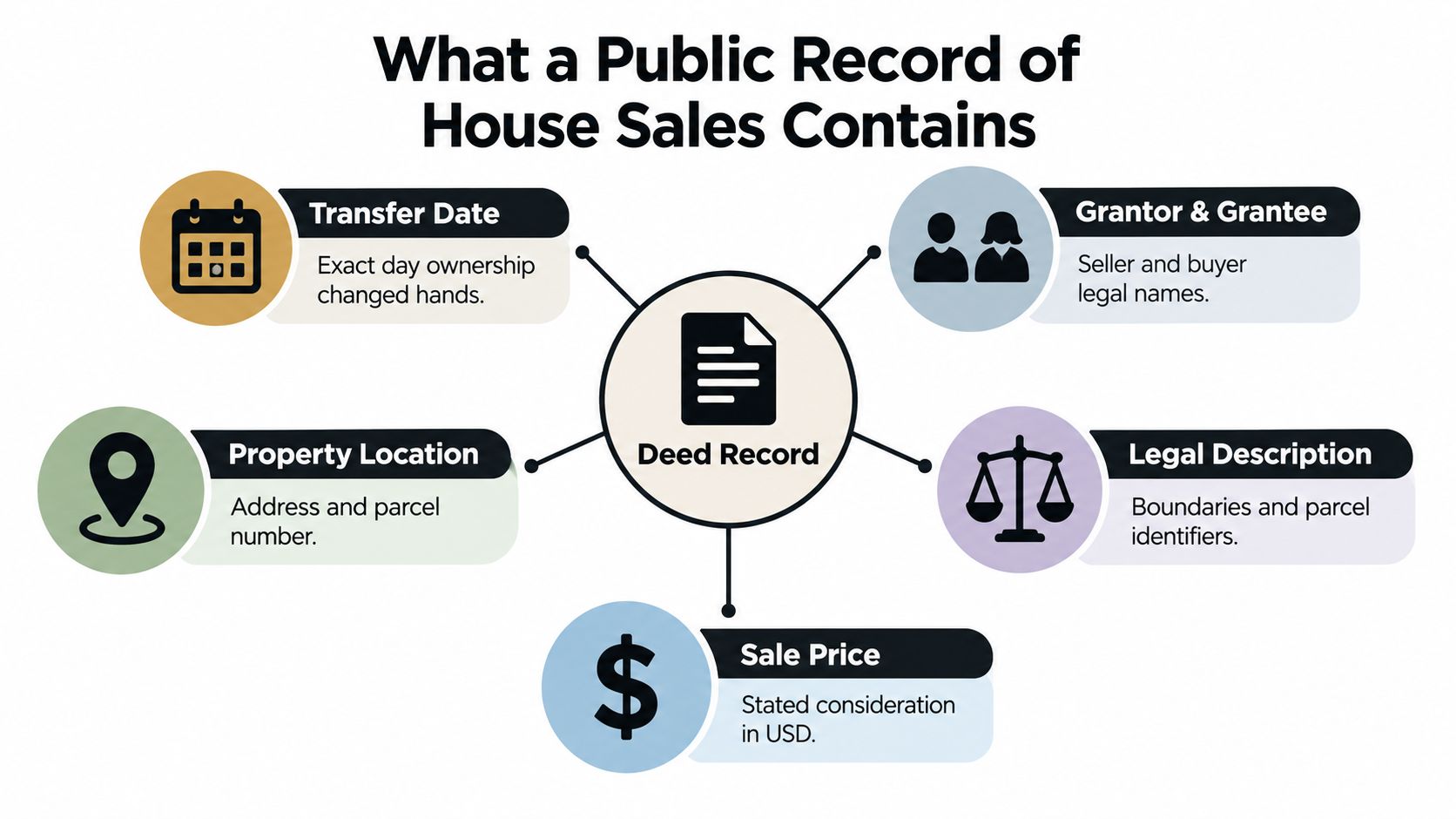
A county sale file can be more detailed than the deed summary you see on a search portal. Some jurisdictions publish sale and transfer fields such as conveyance month and year, transfer type, indicated sale price, adjusted sale price, and transfer fee. For an investor, that extra detail helps separate a clean resale from noise before the record ever becomes a comp candidate.
That is why it helps to read the record field by field, the way you would read a rent roll line by line.
| Field | What it tells you | Why it matters to investors |
|---|---|---|
| Transfer date | When ownership legally changed | Helps anchor timeline and comp recency |
| Grantor and grantee | Who transferred to whom | Flags related-party or entity transfers |
| Legal description | Parcel identity, not just street address | Reduces address-matching mistakes |
| Conveyance type | What kind of transfer document was used | Helps classify arms-length vs noisy records |
| Consideration | The stated price, if disclosed | Useful, but not automatically comp-worthy |
Two of those fields trip up beginners more than the rest. Legal description is the parcel's formal identity, which is why it can save you when street addresses change, duplicate, or get keyed inconsistently. Conveyance type is the filter for deed noise. A transfer can be recorded with a deed type that reflects a refinance cleanup, an internal entity move, a gift, or another non-market event. If you skip that field, you can end up treating clerical truth as market truth.
County variation is the other big wrinkle. There is no single national recorder database with one standard layout. Fields, naming conventions, indexing habits, image availability, and online search tools vary by jurisdiction, which is one reason raw public records often need cleanup before they are useful in analysis. If you want to see how investors and data teams turn county files into usable analysis inputs, this overview of property transaction data gives a practical example.
So the record gives you the bones of the sale. Your job is to decide whether those bones support valuation.
The Three Systems Every Sale Touches
You pull a sale, see a deed recorded, check the assessor, and the owner name still looks old. Then the tax bill goes to a different mailing address altogether. That does not mean the file is broken. It usually means you are looking at three different county systems that update on different schedules and serve different purposes. Serious investors learn to read them as separate layers before they ever treat a recorded sale as a comp.
Recorder, assessor, and tax collector
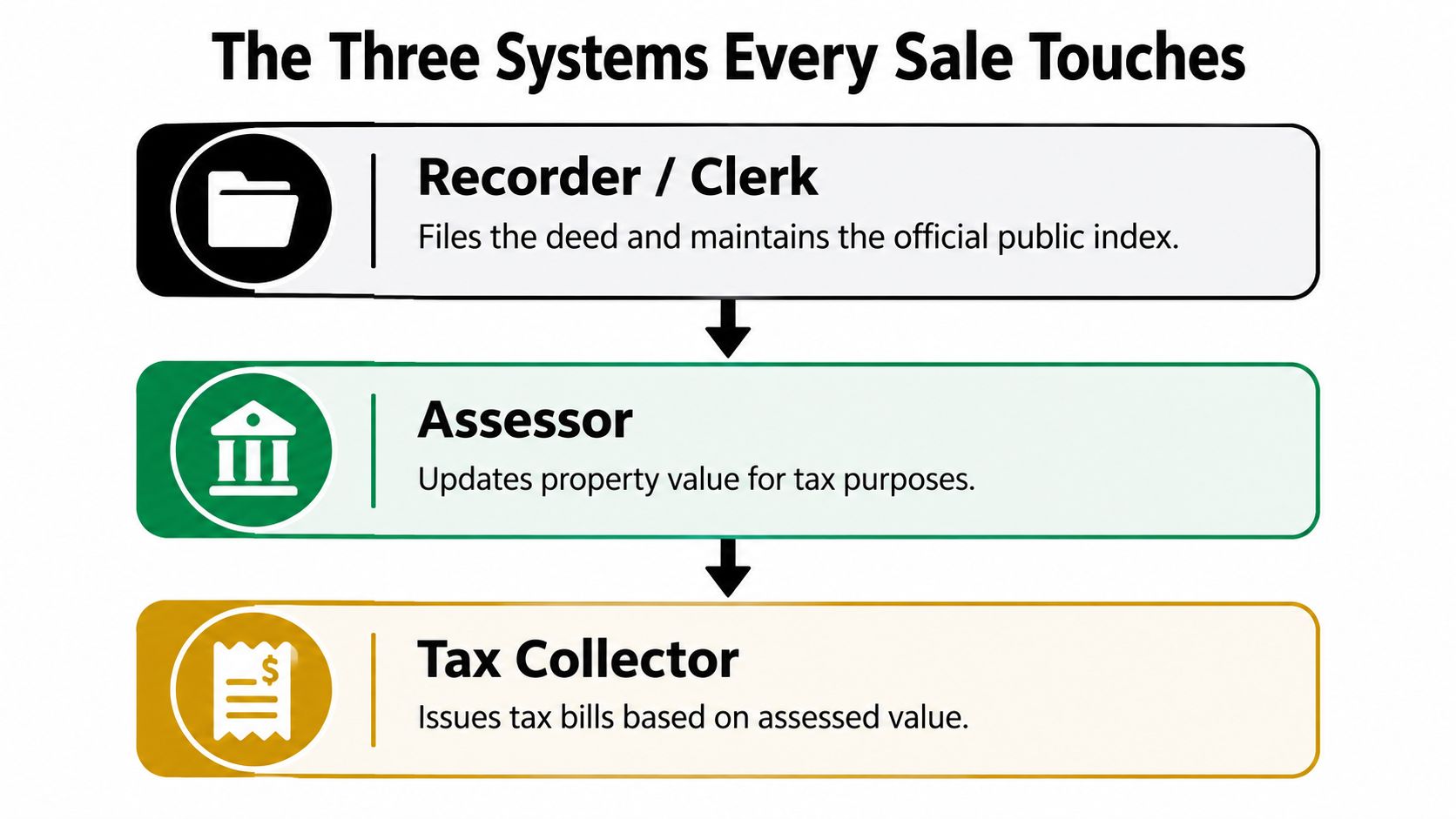
Start with the recorder or clerk. This is the legal paper trail. The office records the deed, indexes the document, and preserves the transfer history tied to the parcel. If you are testing whether a sale happened, who transferred to whom, or what document type was used, this is your first stop.
The assessor is working a different problem. That office maintains parcel characteristics and assigns value for tax administration. Those records help with square footage, lot size, use code, and other property details, but they are not a clean read on market value. In some jurisdictions, assessment rules create a wide gap between assessed value and current resale pricing. In others, the issue is timing. The sale has closed, but the assessor record has not caught up yet.
The tax collector adds a third layer. It shows who the county is billing, whether taxes are current, and where notices are being sent. For acquisitions work, that can help confirm ownership continuity, absentee patterns, or delinquency risk. It does not replace deed review.
A simple way to frame it helps. The deed answers whether title moved. The assessor record describes the property the county thinks it is valuing. The tax file shows how the county is charging that property.
Use each system for a different job:
- Use the recorder for transfer history, deed type, document images, and chain-of-title clues.
- Use the assessor for beds, baths, square footage, land size, use code, and assessed value context.
- Use tax records for delinquency, billing status, mailing address, and payment history signals.
Why these layers create noise for investors
These systems do not update in lockstep, and that lag creates bad comp decisions when an analyst treats one field as final truth. A newly recorded deed may appear before parcel characteristics refresh. A tax bill may still point to a prior owner for a while. Deed type can add more noise if the transfer was not arm's length.
History depth is another filter. Online coverage depends on what each county has digitized and indexed. Contra Costa County's online Official Records Index starts on January 1, 1986 according to the Contra Costa County Clerk-Recorder online index, while Los Angeles County's Recorder Division maintains most real-estate records dating back to 1850 on the Los Angeles County Registrar-Recorder/County Clerk records page. If an older transfer does not appear online, the right conclusion is often “not visible here yet” or “not digitized here,” not “it never happened.”
How to Access Public House Sale Records Step by Step
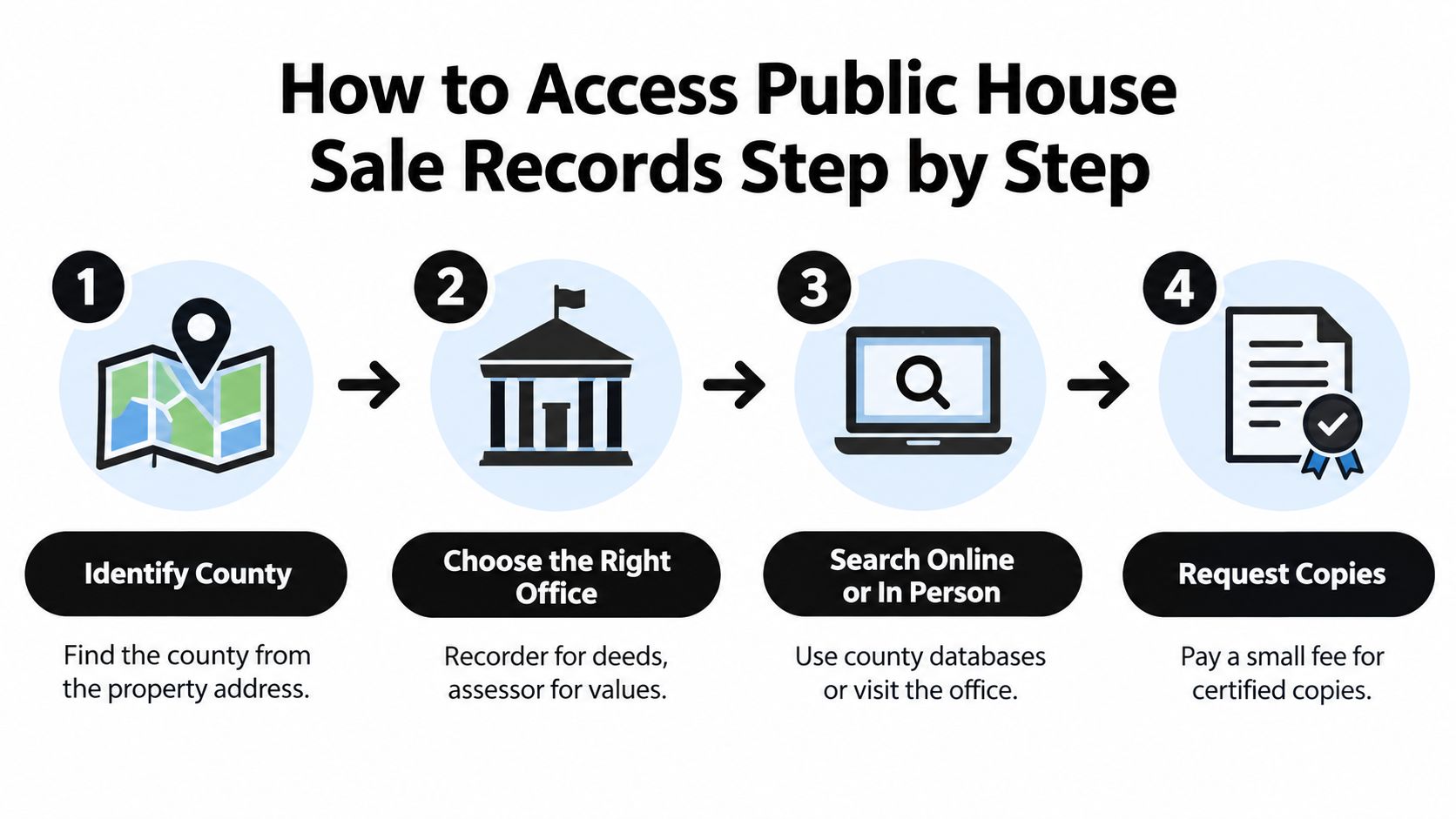
Pulling a sale record is usually simpler than people expect. Pulling the right sale record is where the work starts. The first move is always identifying the property's county, because county boundaries determine which recorder and assessor systems you'll need to search.
A practical access path
Use this sequence when you're working a live deal:
Find the county first.
Don't start with a national portal and hope for the best. The county tells you which offices control the official file.Choose the office based on the question.
If you need the deed, transfer date, or recorded parties, start with the recorder. If you need parcel characteristics or assessed value, start with the assessor.Pick the search method that matches the job.
Single property review usually starts with address or parcel search. Market research may call for bulk files where counties offer them.Request the image when the index isn't enough.
An index entry can suggest what happened. The deed image often confirms it.
What access looks like in the real world
Counties vary a lot. Some offer easy online search by address or APN. Some expose only index data online and charge for document images. Others require written requests or an office visit for older material.
That's why I'd separate your options like this:
- Direct county search works best for chain-of-title verification and exact deed review.
- Assessor lookup is better when you need parcel facts tied to the same property identity.
- Third-party aggregators are often the fastest place to begin if you're screening many leads and need a quick, unified snapshot before going deeper.
If you want a walkthrough of the practical lookup process, this guide to public records property search is a solid companion for investors who need to move from address to county records quickly.
Friction points that are normal
A few annoyances catch people off guard:
- Older document retrieval may be slower or require separate ordering.
- Index fields can be thin, especially online.
- Address matching breaks when the county keys records primarily by parcel or legal description.
When the address search looks wrong, switch to parcel number or legal description before assuming the record is missing.
That habit alone saves a lot of false negatives.
Why a Recorded Price Is Not Automatically a Clean Comp
You pull a recent sale from the county feed, see a price, and feel ready to plug it into your comp set. That is the moment many underwriting mistakes start. A recorded price is a field in a dataset. A usable comp is a filtered judgment about what that field represents in the market.
Public records capture many kinds of title movement, not just clean arm's-length resales. The same property can show up through new construction, investor purchases, family transfers, foreclosures, quitclaim deeds, trustee's deeds, and other non-standard conveyances. If you skip that distinction, you are mixing very different events into one bucket and calling all of them price evidence.
The first filter is transaction meaning
Start with the question a recorder's office does not answer for you: what happened here?
A quitclaim deed may reflect estate planning, a divorce settlement, trust administration, or an ownership cleanup between related parties. A foreclosure-related deed may matter a lot for chain of title and distress history, but it does not function the same way as a normal resale between unrelated buyers and sellers. Even a deed with a stated amount can be noisy if the consideration is nominal, partial, or tied to a non-market arrangement.
The practical screen is simple:
- Nominal consideration usually means the recorded amount is not a market-clearing price.
- Intra-family transfers belong in a separate bucket and are often excluded from comp work.
- Refinancing documents can sit close to transfer records in aggregated datasets, but they are not sale comps.
- Foreclosure-related deeds may help explain the asset's timeline, yet they need separate treatment from ordinary resale activity.
That process works like sorting raw invoices before building a profit-and-loss statement. The documents are real. The labels still matter.
Missing price does not mean missing transfer
Another trap is the blank sale-price field. In some jurisdictions, the public record shows that title transferred without giving you dependable consideration data. Serious investors do not fill that gap with confidence they have not earned. They classify the record as a valid transfer with unknown consideration and move on to stronger evidence.
That matters because an analyst who forces certainty into a weak record can contaminate the whole comp set. One bad transfer can pull your median down, distort your view of the submarket, and push a Max Offer off target.
Clean comps come from cleaned records
This is a data-quality job before it becomes a valuation job. The same habits used in formal data cleaning techniques apply here. Remove duplicates. Standardize names and document labels. Flag related-party transfers. Separate distressed events from open-market sales. Check whether the price field is usable before it ever reaches your ARV sheet.
If you are supporting an appraisal-style comp selection process, this guide to real estate appraisal comps helps frame the standard correctly.
A recorded sale price is an observation. A comp is a judgment.
That distinction is what keeps raw public-record noise from becoming a bad offer.
Turning Public Records Into ARV and Max Offer Inputs
A county transfer record doesn't produce an ARV on its own. It gives you one observation. The underwriting job is to decide how much weight that observation deserves after you account for timing, similarity, condition, and transaction quality.
Where repeat-sales analysis helps
One of the most useful ways to work with recorded transfers is repeat-sales analysis. The logic is straightforward. If the same property sold more than once, comparing those transfers can help isolate price movement while holding the property identity and location relatively constant.
That's the basic idea behind the Federal Housing Finance Agency's repeat-sales methodology, which compares repeat transactions for the same property and draws on mortgage transaction data plus additional county-recorder and FHA records, as described in the FHFA House Price Index FAQ. For investors, the lesson isn't that every repeated transfer is clean. It's that the same-property history can be valuable when you treat it carefully.
Why same-property history still needs judgment
A house that sold twice isn't the same economic product if the owner added square footage, took it through a heavy renovation, or sold under distress. Repeat-sales methods help, but they don't remove condition shifts, unusual consideration, or motivation differences.
That's why I'd use recorded transfers in ARV work as part of a weighted stack:
- Base layer is the verified transfer date and any disclosed recorded price.
- Adjustment layer accounts for property differences, known renovations, and neighborhood relevance.
- Market layer checks whether current sale activity supports or contradicts what older records imply.
From raw data to offer-ready numbers
Modern underwriting tools follow that same logic. They don't treat county records as finished answers. They treat them as raw material that must be filtered, weighted, and combined with current market signals.
One example is PropLab, which pulls public records, tax data, and market signals without requiring MLS access, then applies distance and recency weighting, adjustment breakdowns, confidence scoring, and a Max Offer Price derived from ARV minus repairs and built-in margins. That kind of stack mirrors how disciplined analysts work manually. The software just compresses the workflow.
If your ARV came from unfiltered transfers, your Max Offer is carrying hidden error from the first line of the analysis.
The clean habit is simple. Start with the recorder-side fact pattern, pressure-test the transaction, then let it earn its place in the valuation.
A Repeatable Investor Workflow for Public-Record Comps
A new lead lands with three nearby sales, one deed marked “gift,” and a recent renovation that is missing from the tax file. A reliable workflow keeps those records from reaching the comp set before they have earned that role. The process should be repeatable enough for every lead and strict enough to protect the valuation from noisy evidence.
Step one, pull the transfer history
Begin with the subject property, then collect nearby parcel transfers from the recorder side. At this stage, build a raw evidence pool rather than choosing final comps. For the subject, record prior transfer dates, party names, document types, and any disclosed consideration. For nearby properties, gather enough local activity to see how the neighborhood trades, instead of relying on the first records displayed by an app.
Step two, classify each transfer
Give every transfer a basic label before comparing prices.
- Market-looking transfer remains in the review pool.
- Questionable document type is flagged for closer examination.
- Clearly non-arm's-length event is excluded from comp use.
Deed labels create noise because a recorded transfer may reflect a gift, family change, entity restructuring, foreclosure-related event, or another transaction that does not represent open-market value. A record can still help even when it is excluded from comps. It may explain ownership changes, reveal a quick resale, or show why the apparent “last sale” should not anchor value.
Step three, add parcel and tax context
After filtering the transfer history, add assessor-side characteristics and tax details. Compare the physical product, not just the street address. Parcel size, building characteristics, improvement profile, use code, and recorded condition clues can separate a useful comp from a nearby property with a different buyer appeal.
Tax-side information also provides diligence context. Billing status, delinquency, and owner mailing patterns may affect negotiations or signal questions that require separate verification. These fields support underwriting, but they do not replace transaction-level evidence.
Step four, check for recording lag
Public records can be legally accurate and still arrive late for underwriting. County processing and digitization delays can range from several weeks to months, and recent transfers may not appear in aggregated property databases until the county record becomes available, with timing varying by local process, as explained in RentCast's explanation of public-record timing and county reporting delays.
The newest visible record is not always the newest market evidence.
If the county reports slowly, reduce the weight given to “latest sale” labels. Cross-check current listings, pending activity, and neighborhood signals, then build ARV and MAO from the filtered history alongside those current indicators. Public records supply the transaction backbone. Analyst judgment decides which records belong in the valuation.
Edge Cases Investors Run Into
Clean suburban resales rarely cause the hardest public-record problems. The difficult files are the ones with missing prices, unusual deed types, related-entity transfers, or a visible history that seems out of step with neighborhood activity. Each exception changes how much weight the record deserves in a comp set or Max Offer.
When the latest sale may not be latest
A county record can be accurate and still arrive late for underwriting. Processing and digitization timing varies by county, so a recent transfer may not yet appear in an aggregated database. Treat the visible “latest sale” label as a starting point, not proof that the market has stood still. Cross-check current listings, pending activity, and other neighborhood signals before relying on the recorded history. RentCast's property-data documentation provides related context on property-record coverage and timing.
Missing prices in non-disclosure areas
A blank consideration field is not permission to invent a sale price. Mark the transaction as undisclosed and rely on stronger evidence for valuation. A practical fallback stack includes:
- Assessor-side values for context, not as a replacement for the sale price
- Transfer fees or related filing clues when local rules make them useful
- Adjacent market evidence from comparable nearby sales with disclosed prices
The goal is to separate a known transaction from an unknown consideration amount. That distinction keeps an incomplete record from becoming a false comp.
LLC moves, quitclaims, and other noise
LLC-to-LLC transfers are common in investor-heavy markets. They may represent a genuine sale, but they can also reflect entity restructuring, title cleanup, or another non-arm's-length event. Quitclaim deeds require similar caution because they often document a transfer without establishing open-market value.
A public record confirms that something was recorded. It does not, by itself, establish what the property is worth today. Investors who apply that filter produce cleaner offers and make fewer costly assumptions.
If you need to move from county records to underwriting, PropLab combines public records, tax data, and market signals for ARV, rehab estimates, and Max Offer calculations. It can support deal screening, comp review, and reports that show how the offer number was developed.
About the Author
P
PropLab Team
Real Estate Analysis Experts
The PropLab team consists of experienced real estate investors, data scientists, and software engineers dedicated to helping investors make smarter decisions with AI-powered analysis tools.
Free tool
Pull comps for any address
Comparable sales with adjustments, ready to defend in front of a seller or a lender.
