General
Final Underwriting Review: A Step-by-Step Deal Checklist
October 2, 2026
17 min read
You're one signature from closing. The lender has issued terms, the title company has a date, and the purchase contract is no longer theoretical. Then the final file review uncovers a new deposit, a title exception, or an appraisal that only works under the most generous comparable. The deal that looked comfortably profitable can become a thin-margin project before anyone sends the wire.
That's why a final underwriting review should be treated as a change-detection exercise. You aren't just checking whether the original documents are present. You're identifying everything that changed between initial approval and clear-to-close, then deciding whether those changes affect value, collateral, liquidity, eligibility, or the lender's exit.
Why the Final Pass Matters More Than the First
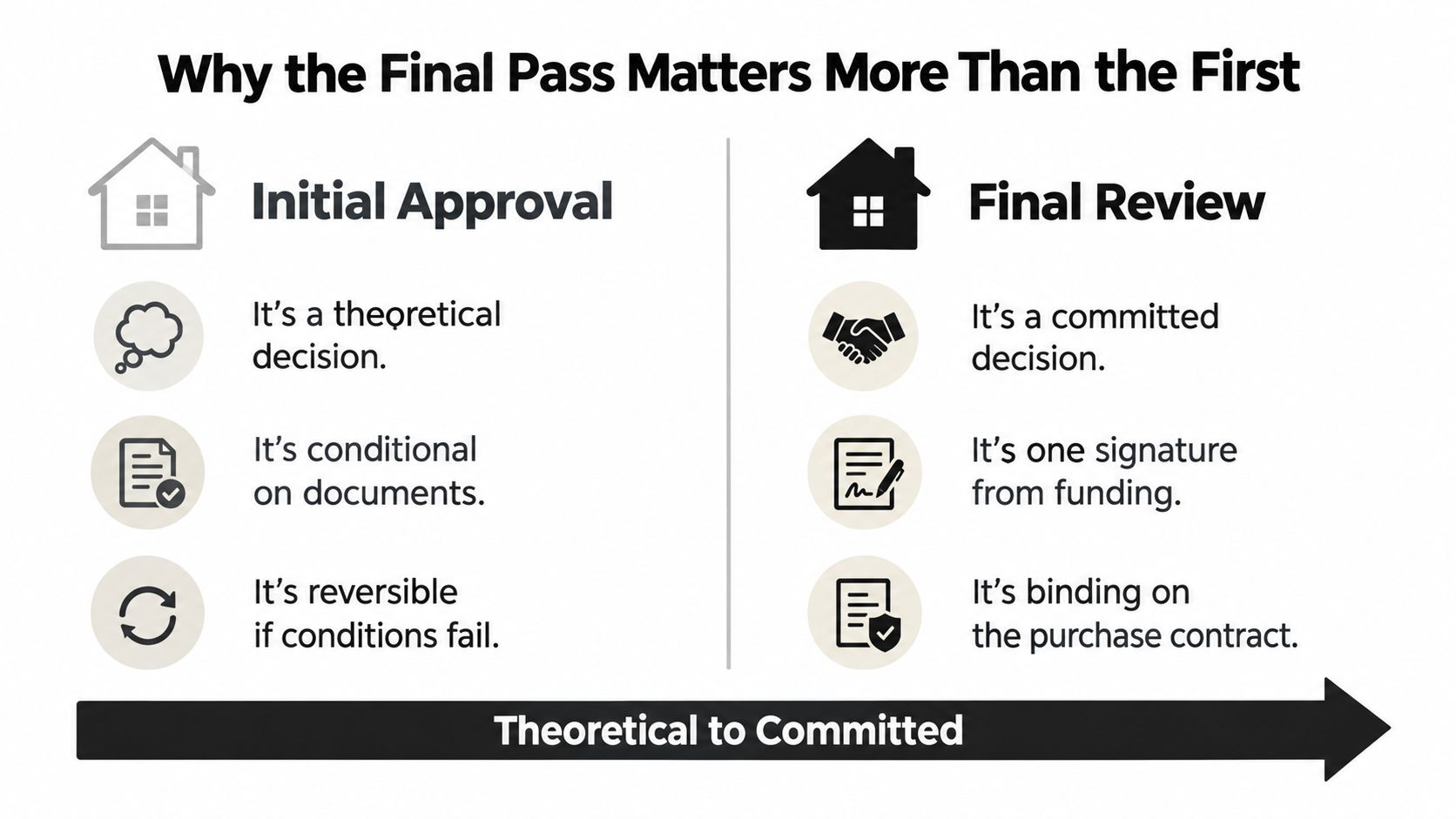
Initial approval answers a broad question: does this borrower and this proposed deal appear financeable based on the information available? The final underwriting review answers a harder one: is the exact transaction still financeable today, with the exact property, numbers, documents, and risks now in front of the lender?
That distinction matters in acquisitions. At the beginning, a flip file may contain an estimated repair budget, preliminary comps, an expected insurance premium, and a borrower balance that hasn't yet been refreshed. By closing, each input should be replaced with evidence. The appraisal is complete, the title search has progressed, borrower documents have been updated, and the lender is checking whether every approval condition has been satisfied.
Mortgage industry guidance places the final review close to clear-to-close, after borrower documents, the appraisal, and title work are complete. It commonly occurs shortly before closing, while federal TRID requirements create a legally enforced timing window around delivery of the Closing Disclosure. PenFed's explanation of the mortgage underwriting process describes why late changes can trigger additional review, including new debt, credit applications, or other financial changes.
The failure modes that surface late
The last mile catches problems that a preliminary screen often can't see:
- Appraisal sensitivity: The appraiser supports a lower value than the original ARV analysis, or the lender sizes the loan using the more conservative value.
- Rehab-cost drift: A contractor opens walls and finds structural, plumbing, electrical, or environmental work that wasn't in the original scope.
- Title exceptions: A lien, probate issue, ownership transfer, easement, or unreleased obligation prevents clean lender clearance.
- Insurance gaps: The final binder excludes the actual construction exposure, contains a coverage issue, or can't be bound before closing.
- Liquidity changes: Refreshed statements show changed reserves, unexplained deposits, new obligations, or funds that aren't seasoned or available for the transaction.
These aren't administrative details. In 2023, lenders denied about 9.4% of home purchase mortgage applications, with denial rates of 13.6% for FHA loans and 7.9% for conventional conforming loans, according to Redfin's summary of mortgage underwriting denial data. The figures describe the broader approval system, not just the final pass, but they show why the closing-stage gate deserves more than a signature check.
Practical rule: If an input changed after approval, don't defend the original deal. Recalculate the deal using the new input.
Fannie Mae's post-closing quality-control requirements reinforce the same discipline. Lenders must review final loan terms, transaction details, and closing documents for completeness, accuracy, compliance, and alignment with the underwriting decision, as set out in its guidance on post-closing quality-control review. For an acquisitions lead, the operational lesson is simple: the final review is where theoretical approval becomes committed capital.
Locking the Inputs Before You Open the File
A clean final review starts before the lender opens the package. Treat the comps, ARV, repair scope, and MAO as one connected dataset, not four separate checkboxes. If one input moves, the others may need to move with it.
Build one working file containing the following:
- Locked comparable set: Record the selected sales, property characteristics, dates, distances, and reasons each comp remains relevant.
- ARV derivation: Show how the comparable evidence supports the projected finished value, including adjustments for condition, size, layout, location, and features.
- Final contractor bid: Use line items, quantities, allowances, trade categories, exclusions, and a stated contingency rather than a rounded repair estimate.
- MAO calculation: Include the purchase price logic, repairs, holding costs, selling costs, financing costs, and required profit under the lender's program.
The order matters. First, confirm that the comp set still reflects the market and that nobody has swapped difficult comps for more favorable ones. Next, confirm that the contractor's signed scope is still the scope the property needs. Then reconcile the ARV and MAO so the offer price is based on the same assumptions the lender will review.
A common failure is independent drift. The ARV rises because a more optimistic comp was added. Repairs stay at the original estimate even though the contractor added work. The MAO then gets recalculated from the higher ARV while carrying the old cost basis. Each individual change can look explainable. Together, they can erase the margin.
Use a document preparation workflow for real estate files to standardize naming, version control, and supporting exhibits. The tool or process matters less than the rule: one approved version of each input, with the date and source visible.
What the lock should prove
The file is ready for final underwriting only when you can answer these questions without searching through email:
- Which comps support the ARV, and why are they still the best available evidence?
- What work is included in the contractor's bid, and what work is excluded?
- Which holding and selling costs did the MAO formula use?
- Do the borrower's funds, the lender's proceeds, and the closing statement reconcile?
- What changed since initial approval, even if the change appears favorable?
If the answer to the last question is “nothing,” verify that conclusion. Files rarely stay static from application to closing. A documented no-change confirmation is more useful than an assumption that nobody touched the deal.
Re-Verifying Comps and ARV at the Last Mile
ARV isn't a permanent number. It's the output of a comp set, and the comp set can become less reliable while the loan moves through approval.
Start by pulling the comparable data again from the same MLS or data source used for the original analysis. Check each sale's status, closing date, condition, size, and location. Look for relistings, price changes, failed contracts, unusual concessions, or other signals that a sale may not represent a clean market indication.
Then search for new closed sales and meaningful pending activity within the same competitive area. A newly closed property can change the range even if it isn't a perfect match. It may reveal that buyers are paying more for the subject's condition, or that the original valuation depended on an unusually strong outlier.
The triggers that stop a rubber stamp
A final review should pause when:
- The updated ARV moves materially from the original underwrite.
- A key comparable went under contract after the original report and has not yet closed.
- A new closed sale supports a meaningfully different value range.
- The appraiser selected a different property set or made adjustments that weaken the original conclusion.
- The lender's sizing rule uses the lower of the appraised value and the derived ARV.
That last point catches experienced investors. You can preserve the same ARV in your own worksheet and still receive a smaller loan if the appraisal comes in lower and the lender uses the conservative figure. Loan proceeds, cash-to-close, interest carry, and the required reserve may all change even though your spreadsheet still displays the original ARV.
For a practical framework on selection and adjustment logic, use this real estate appraisal comps guide. The purpose of the final pass isn't to produce a prettier valuation. It's to determine whether the valuation survives a skeptical review by someone who wasn't involved in creating the original offer.
ARV is only as strong as the evidence behind it. If the evidence changed, the ARV needs a fresh decision, not a copied cell.
Separate value confidence from value optimism
A high ARV supported by several similar, recent sales is different from a high ARV supported by one distant or heavily adjusted property. Mark that difference in the report. The lender needs to understand not only the selected value, but also how much judgment it required.
If the evidence is weaker, reduce the loan exposure, renegotiate the purchase, increase the equity contribution, or walk away. Keeping the original price just because the contract is signed turns a valuation question into a capital problem.
Stress-Testing the Rehab Budget and MAO
A rehab budget is a variance contract. It should tell the lender and the acquisitions team what work is expected, what evidence supports the estimate, and what event would force a new decision.
Rounded estimates fail at final review because they conceal the source of risk. A credible bid separates demolition, framing, roofing, plumbing, electrical, HVAC, finishes, site work, permits, cleaning, and project management. It also distinguishes fixed prices from allowances. An allowance isn't proof of cost. It's an unresolved assumption.
Older properties deserve extra scrutiny because concealed conditions can change the scope quickly. Pay attention to missing sewer documentation, polybutylene or galvanized plumbing, knob-and-tube wiring, foundation cracks, mold, roofs with multiple layers, and additions that may not have the required permits. These conditions don't automatically kill a deal. They do make the original budget less trustworthy.
Recalculate the deal, don't just update the budget
When a line item changes, update the entire capital stack:
MAO = ARV × lender factor, or lender-specific formula, minus repairs, holding costs, selling costs, financing costs, and desired profit.
The familiar 70% approach may be relevant to some investor formulas, but it isn't universal. Use the lender's actual sizing method and document any difference between the investor's acquisition formula and the lender's underwriting formula.
Run a downside case using a lower ARV assumption and the revised repair budget. The point isn't to predict the market perfectly. It's to see whether a softer exit and a more expensive project leave enough room for financing, carrying costs, and the required return.
Seller credits, closing-cost concessions, repair escrows, and delayed disbursements also belong in the equity calculation. A credit may reduce cash needed at closing, but it may not reduce the lender's view of the total project cost. An escrow may protect the lender while creating a cash-flow problem for the borrower.
| Variance Trigger | Threshold | Action at Final Review |
|---|---|---|
| Total rehab budget increases | Material increase from the approved scope | Rebuild the MAO and request lender approval |
| Individual trade expands | Significant increase in a single line item | Obtain a written explanation, revised bid, and funding impact |
| New trade category appears | Work was absent from the original scope | Pause clearance until the need, cost, and timing are documented |
| Concealed condition is discovered | Condition affects safety, structure, systems, or insurability | Re-underwrite the collateral and confirm insurance availability |
| Downside case loses required margin | Revised assumptions no longer meet the acquisition hurdle | Renegotiate, add verified capital, or pass |
The most useful budget review is not the one with the most line items. It's the one that identifies which costs are supported, which are uncertain, and who bears the loss if the estimate is wrong.
Flagging Risk Between Initial Approval and Final Review
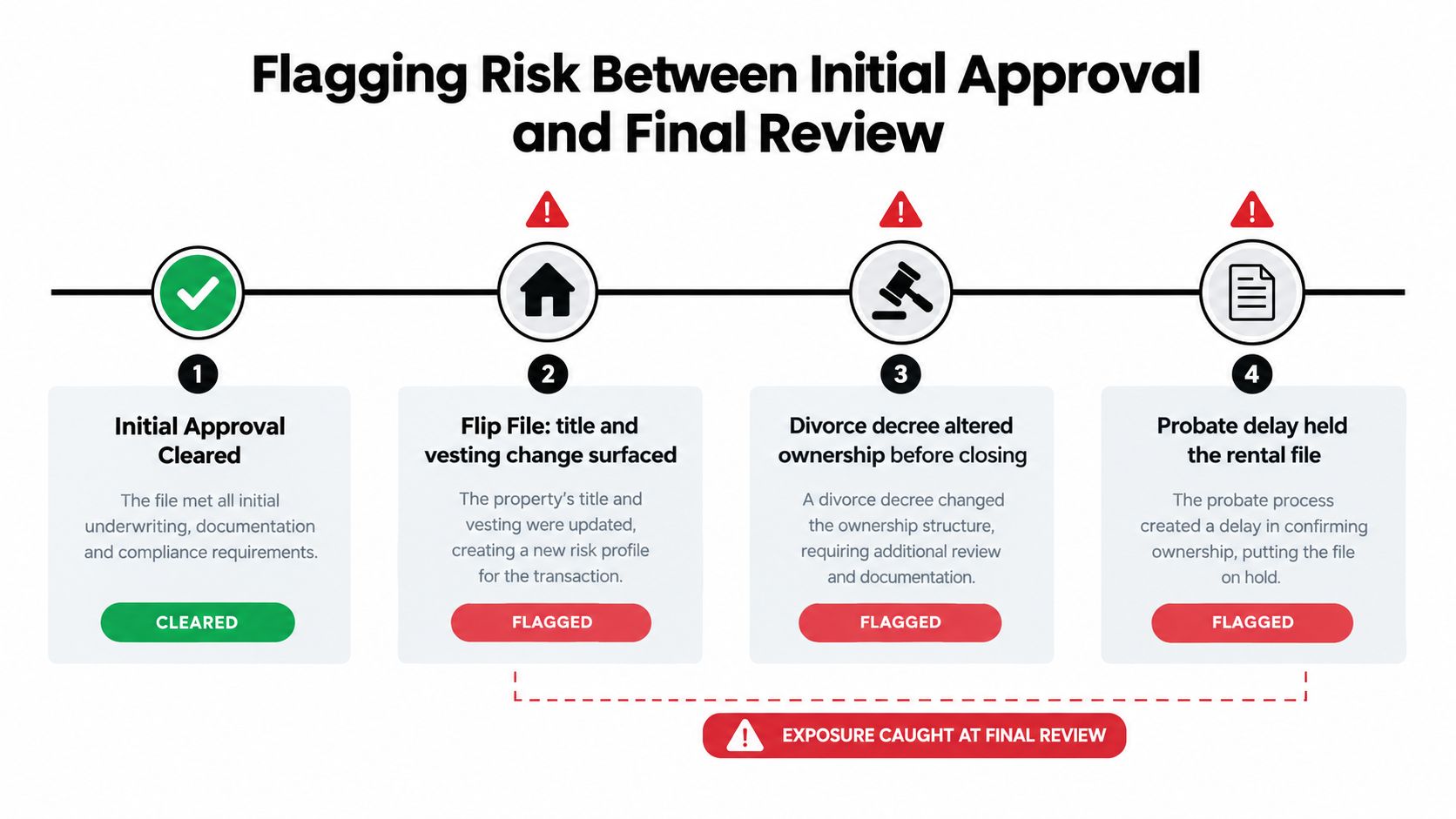
A flip file can clear initial approval and still fail at the closing table because the transaction itself changed. The following scenarios are representative of the files that deserve a deliberate final pass.
The title problem
A rental acquisition appears straightforward until the updated title commitment shows an unreleased lien. In another file, a recent transfer raises questions about vesting. A divorce decree, probate opening, added easement, or ownership change can affect who has authority to sell and whether the lender receives the expected lien position.
The decision isn't to hope the title company resolves it before funding. Request the underlying documents, confirm the required releases or court authority, and send the revised title package to underwriting. If the exception can't be cleared or insured, the correct decision is to pass or reschedule closing, not wire into uncertainty.
The borrower update
A refreshed bank statement shows a large deposit that wasn't present in the original file. Another statement shows higher credit-card balances, a new installment obligation, or reduced reserves after the borrower paid earnest money and other costs.
The size of the change matters, but the source matters just as much. Ask for a paper trail for new funds, reconcile the balance to the sources-and-uses schedule, and update liabilities and reserves. The lender may request a condition, re-underwrite income or debt, or reduce proceeds. Treat unexplained liquidity as an unresolved condition until the documentation supports it.
The insurance interruption
A hard-money flip may have a new policy quote, but the binder doesn't reflect vacancy, construction, builder's risk, or the actual scope of work. A rental may have a hazard policy that lapses before closing, or a flood-zone change may require a different underwriting decision.
The action is direct. Confirm the binder is active, the named insured and entity are correct, the property address matches the contract and title file, and the coverage aligns with the planned use. If the carrier won't bind acceptable coverage, stop the closing rather than assuming the policy will be fixed after funding.
The appraisal and collateral problem
An appraiser may require repairs, identify a condition issue, or rely on comparable sales that closed below the original ARV basis. A market that has softened recently can also make the original exit assumption less defensible.
The likely outcomes are a revised loan amount, an additional condition, a repair escrow, a new appraisal review, or a decision to decline. Don't label every appraisal difference an error. First determine whether the original analysis missed information the appraiser correctly identified.
These late-stage checks reflect a broader shift toward monitoring risk as information changes, rather than treating underwriting as a one-time sign-off. The ECB has identified credit underwriting as a supervisory priority and plans a dedicated thematic review for 2026, as described in its supervisory statement on sound credit underwriting. For real-estate files, the practical translation is to ask what changed in the deal, the borrower, and the collateral since the first decision.
Producing the Lender-Ready Final Report
The lender should be able to understand the decision without reconstructing your file from email attachments. Put a one-page executive snapshot first, then attach exhibits in the same order as the underwriting questions.
Build the executive snapshot
Include:
- Property address and purchase price
- Requested loan amount and financing terms
- As-is value and ARV
- Final rehab budget
- MAO and the assumptions behind it
- Expected hold period
- Exit strategy
- Borrower equity and verified sources of funds
- Open conditions
- Recommended decision, yes or no
Use consistent dates, consistent property descriptions, and consistent rounded figures throughout the report. If the application says one repair total and the contractor bid says another, explain the difference directly. A clean report doesn't hide uncertainty. It labels it.
Attach evidence in decision order
The supporting package should normally contain:
- Executed contract and addenda
- Title commitment and resolution of Schedule B-II items
- Insurance binder
- Entity formation and authorization documents
- Scope of work and final contractor bid
- Comparable analysis and ARV support
- Borrower sources of funds, including the requested bank-statement history
- Loan application with matching figures
- Closing disclosure or settlement figures when available
- Written explanations for every material variance
A valuation report sample for real estate underwriting can help establish a readable structure for the value section. Whatever format you use, place the conclusion near the front and the proof behind it. Underwriting leads don't want to hunt for the number that controls loan sizing.
Make the final offer match the decision
The final offer or term sheet should state the purchase price, financing terms, earnest money, inspection and financing contingencies, and closing date. Those terms need to match the risk you just identified. If title clearance is unresolved, preserve a title contingency. If the appraisal is sensitive, don't remove the financing protection just because the initial approval was issued.
A lender-ready report is not a sales document. It is an audit trail showing that the proposed loan still makes sense after the evidence was refreshed.
The Pre-Close Ritual That Catches What Others Miss
The last review should happen as a repeatable ritual, not as a frantic search for missing attachments on closing morning. Run it on every file in the final stretch, assign an owner to each check, and record the result in the file.
Start with the money. Confirm that the funding wire instructions came directly from the title company through a verified channel and that the wire amount matches the final settlement figures. Reconcile lender proceeds, borrower equity, credits, fees, reserves, and any repair escrow. If the figures don't balance, pause the wire.
Then confirm the collateral and authority:
- Insurance: The binder is active through closing and reflects the property's actual occupancy, construction, and coverage requirements.
- Title: The commitment is current, vesting is correct, and unresolved exceptions have a documented path to clearance.
- Entity documents: The borrowing entity, signer authority, operating agreement, and resolutions are current and consistent.
- Contract: The executed agreement, addenda, assignment language, credits, and closing date match the final package.
- Disclosures: Required signatures are collected, dated, and filed.
- Property status: The final walkthrough hasn't revealed damage, removed fixtures, new leaks, or unfinished work that changes the collateral.
A practical final walkthrough checklist from Trademaster Construction is useful for the physical inspection side of this process. It doesn't replace underwriting, title, or funding reconciliation, but it helps ensure the property condition is checked with the same discipline as the paperwork.
Red flags that stop advancement
Expired letters of intent, stale payoff statements, undisclosed liens, missing certificates of occupancy, signature delays, mismatched entity names, and last-minute changes to wire instructions should never be treated as harmless friction. Each one needs an owner and a resolution before the file advances.
The ritual works because junior staff can follow it and senior staff can audit it. The checklist isn't the control. The control is requiring evidence for every item and making the decision explicit when evidence is missing.

A deal is ready to close when the final numbers reconcile, the title and insurance risks are resolved, the borrower's funds are verified, and the property still supports the lender's decision. If one of those conditions isn't true, the professional response is to re-underwrite, add a documented condition, renegotiate, reschedule, or pass.
PropLab helps investors turn comps, ARV, rehab assumptions, and MAO into offer-ready underwriting reports with supporting analysis and red-flag visibility. Use PropLab to build a consistent deal package before the final underwriting review, then invite your lender or partner to review the same verified inputs.
About the Author
P
PropLab Team
Real Estate Analysis Experts
The PropLab team consists of experienced real estate investors, data scientists, and software engineers dedicated to helping investors make smarter decisions with AI-powered analysis tools.
Free tool
Stop guessing rehab costs
Get a line-item renovation estimate from the property details — no contractor walkthrough needed.
