General
Forest Properties for Sale: How to Value and Buy One
November 8, 2026
14 min read
The usual advice for buying woodland is to compare price per acre and look for mature trees. That's a weak starting point. A cheap tract can carry expensive access problems, restricted harvesting rights, or timber that costs more to extract than a buyer expects.
When you compare forest properties for sale, separate what you're buying from what you're merely looking at. The useful comparison is land value plus recoverable standing-timber value, adjusted for obligations and risk. Scenery matters, especially for recreation and resale, but it won't establish legal access or pay a logging contractor.
Where Forest Properties for Sale Are Listed
Start with forestry brokers, rural land agents, and owners, not just the portals you use for houses. The U.S. Forest Service's National Woodland Owner Survey describes approximately 691 million acres of U.S. forestland excluding Interior Alaska, with about 412 million acres privately owned by more than 10 million corporations, families, individuals, and other private groups.
That fragmented ownership calls for a broad search. A family selling a recreational tract may use a local agent, while a timberland seller may circulate offering materials through specialist brokers. Treat listing channels as different ways to find candidates, not interchangeable sources of comparable prices.
Listing sources and what to verify first
| Source | What You Usually Find | Verify First |
|---|---|---|
| Forestry and land brokers | Timber-rich tracts with cruise reports | Date and scope of the cruise report |
| Regional listing services | Mixed rural parcels, some with timber | Recorded acreage against the deed and survey |
| Timber companies and institutional sellers | Large blocks, sometimes sold with harvest contracts | Existing harvest contracts and their terms |
| Owner-direct and off-market sales | Family-held parcels, sometimes advertised below market | Full title chain and boundary survey |
| County tax-delinquent or public auctions | Parcels from unpaid taxes or public sales | Back taxes, liens and applicable redemption period |
A seller's channel also changes the questions you should ask. Request inventory maps and harvest schedules from a timberland seller. With a family parcel, ask who maintains the entrance road, whether neighboring owners use it, and where the seller believes the boundaries lie. Those answers aren't proof, but they identify documents you need.
Auction properties require a different approach. Obtain the sale terms and have counsel explain what interest transfers, what obligations survive, and whether redemption rights apply before you bid. Don't assume the auction price represents the total acquisition cost.
Build a repeatable search routine
Set alerts by county, acreage band, and intended use. Keep a tracking sheet with asking price, claimed acreage, access description, timber documentation, and missing records.
For each promising listing:
- Request the cruise date. Ask whether the inventory covers the entire tract and whether cutting has occurred since.
- Separate description from measurement. Mature hardwoods is a description, not merchantable volume.
- Ask for documents early. Request the deed, available survey, parcel map, and recorded restrictions before arranging a lengthy trip.
Use our guide to purchasing vacant land to organize the broader acquisition checks. Before touring, reconcile the advertised acreage with the deed and available survey. A county parcel viewer helps locate the property, but it doesn't settle a boundary disagreement.
Rights, Access and Title to Verify Before Offering
A lower price per acre can mean impaired utility, not better value. A tract without dependable legal access may be less useful than a smaller property with documented entry rights and workable roads.
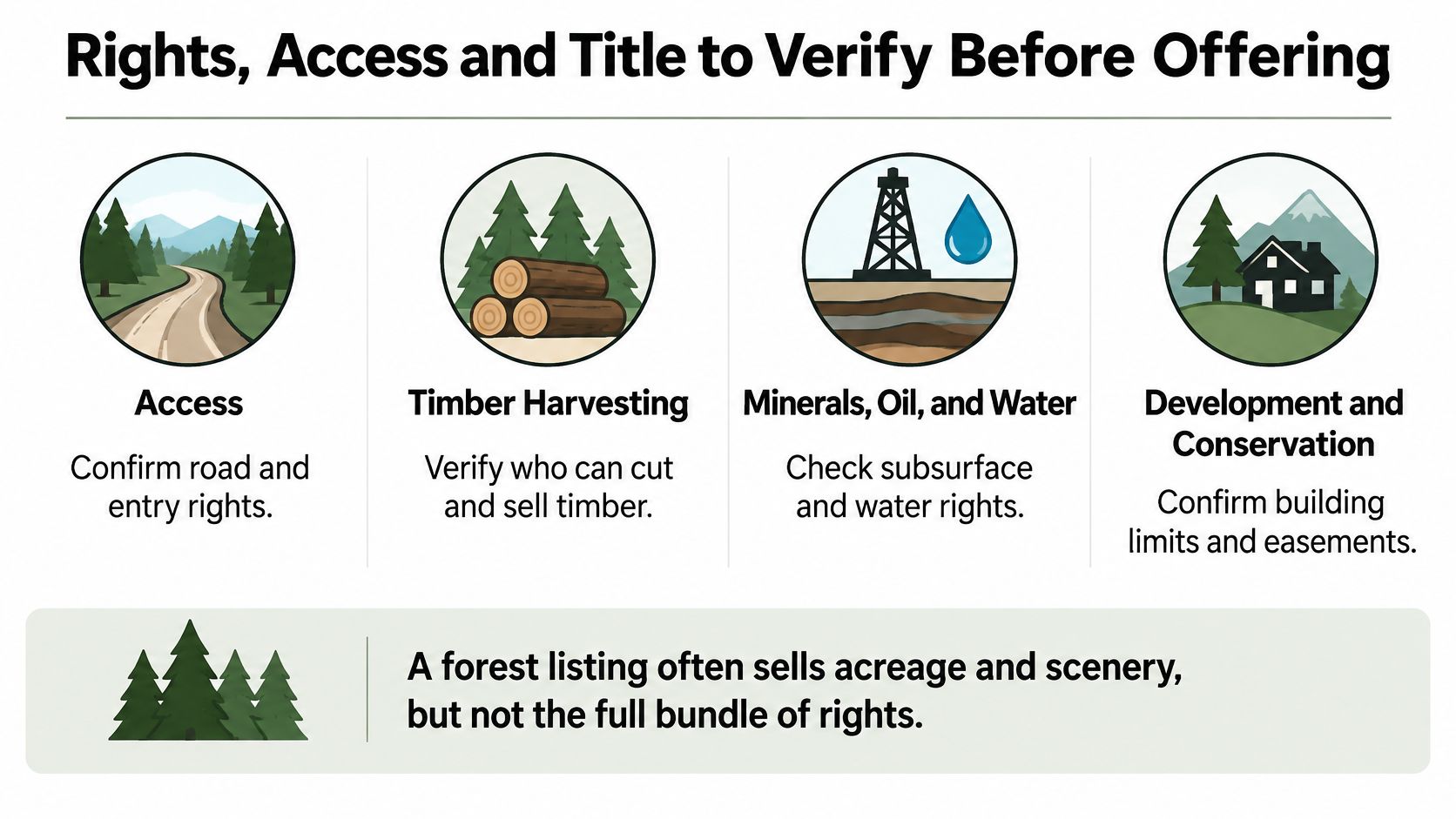
The U.S. Forest Service's discussion of forest property rights explains that access, timber harvesting, recreation, minerals, oil, water, development, and conservation rights can be separated. Conservation easements can permanently restrict active uses. You need to know which rights convey, which someone else controls, and which obligations follow ownership.
Use this checklist to distinguish the acreage from the rights attached to it.
Rights matrix for income, liability and proof
| Right | Can Produce Income | Can Create Liability | Confirm With |
|---|---|---|---|
| Legal road access | Enables harvest and sale | Maintenance costs and disputes | Recorded easement and maintenance agreement |
| Timber rights | Harvest revenue | Existing harvest contract limits control of the cut | Contract terms and cut-area map |
| Mineral and oil rights | Royalties if the buyer owns applicable rights | Surface disruption from another rights holder | Deed, reservations and recorded mineral instruments |
| Water rights | Authorized operational use or sale | Permit obligations and cutting restrictions near water | Water permits and buffer maps |
| Hunting or recreation lease | Lease income | Liability and termination obligations | Signed lease and insurance certificate |
| Conservation easement | Possible tax benefits, subject to eligibility | Permanent limits on active uses | Recorded easement deed and restrictions |
Don't confuse a visible road with a right to use it. Have a lawyer determine whether recorded access covers your intended traffic, including logging trucks, contractors, and guests. Obtain the maintenance agreement and identify responsibility for culverts, washouts, gates, and shared repairs.
A severed mineral estate also deserves more than a checked box. Counsel should explain any surface-entry rights and how they could affect a cabin site, recreation lease, or resale.
Match the rights to your intended use
Pull the title history, request prior surveys, and reconcile exceptions in the title commitment. Our chain-of-title guide explains how ownership records help identify interests requiring further investigation.
Then write a short list of rights your plan needs. A retreat needs reliable entry; a timber investment needs control over harvestable trees; a rental needs permitted guest use and suitable insurance.
Buying rule: Don't pay for an income stream until you've established that the seller can transfer the right to earn it.
Budget for operating equipment only after confirming access and terrain. Campus EV's electric utility vehicle buying tips can help you assess a property-management vehicle, but vehicle capability isn't a substitute for legal entry or a serviceable road.
Zoning, Tax and Environmental Limits That Change Value
Say a buyer purchases woodland intending to build a cabin, then discovers that the applicable working-forest rules don't permit the proposed residence. The buyer still owns the trees and land, but the intended project is no longer a sound basis for the price.
Confirm the use before paying for its potential. Obtain the county zoning map, ordinance provisions, and written guidance for the specific parcel. An agent's statement that nearby owners have cabins doesn't establish permission on your site.
Land-use status and the checks that matter
The categories below identify what to investigate, not a promise of local approval.
| Land-Use Status | Typically Allows | Check Before Offering |
|---|---|---|
| Working forest zoning | Timber harvest and forest management | Forest practices rules and harvest notice requirements |
| Rural residential zoning | Home or cabin, subject to approval | Setbacks, septic feasibility and well yield |
| Agricultural zoning | Grazing, barns and farm buildings | Agricultural exemption criteria and building limits |
| Forest or agricultural use-value tax program | Preferential assessment while qualifying use continues | Potential rollback tax if the use changes |
| Floodplain or wetland area | Restricted development and disturbance | FEMA flood zone and wetland delineation |
| Protected species habitat | Operations subject to habitat protections | State wildlife agency guidance on surveys and seasonal restrictions |
Ask the assessor how the property is classified and what happens if you change its use. Request a written explanation of any potential deferred or rollback tax exposure rather than assuming the seller's current bill represents your future expense.
Tax benefits associated with conservation need separate review. Allied Tax Advisors' guidance to avoid conservation easement tax pitfalls is useful preparation for a discussion with your tax adviser, not a reason to capitalize an unconfirmed deduction into your offer.
Test the proposed building site
Use FEMA flood maps and the National Wetlands Inventory for screening. Where streams, wet ground, or mapped features raise questions, obtain professional site review and, where appropriate, a wetland delineation. Screening maps don't replace a parcel-specific determination.
For a cabin or rental, investigate septic approval, soil conditions, well feasibility, and utility installation before assigning residential value. An attractive clearing isn't necessarily a buildable site.
Our guide to land-use regulations provides a framework for organizing these restrictions. Assign no value to a proposed use that isn't allowed, and treat an uncertain approval as a contingency rather than an accomplished improvement.
How to Value Standing Timber Apart from Land
A forest tract contains assets with different economics. Bare land remains after a harvest; standing timber represents trees whose value depends on species, quality, marketability, extraction costs, and timing.
The FAO's forest valuation guidance emphasizes adjustments for species, location, and topography, with sustainable harvest flows grounded in available standing stock. Don't turn acreage into timber revenue using a generic per-acre assumption.
This process keeps measured timber separate from the underlying real estate.
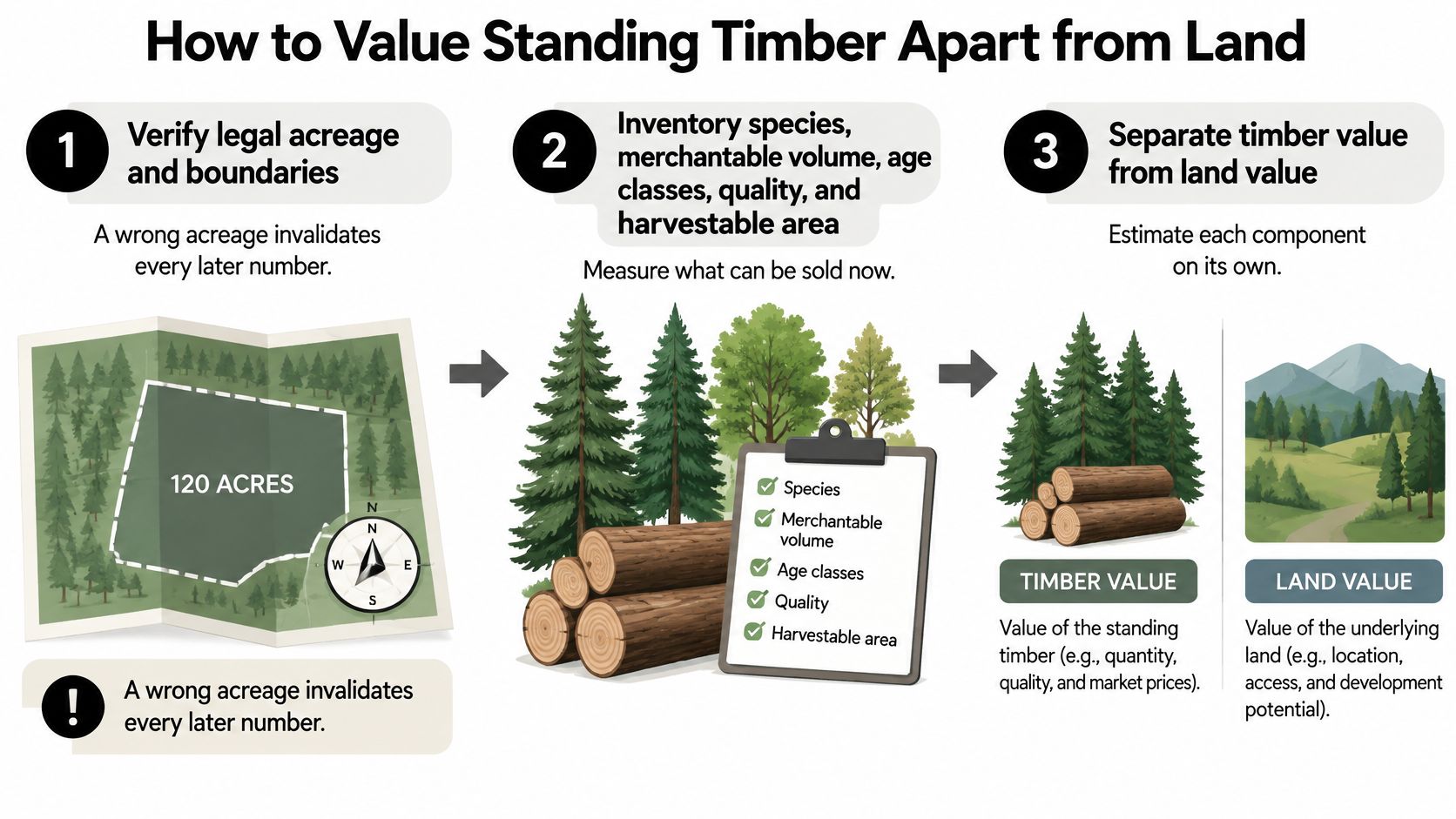
Build the timber estimate from saleable material
Verify legal acreage and boundaries. Give the consulting forester the deed, survey, and tract map. An inventory based on the wrong boundary can include trees the seller doesn't own.
Inventory what can be harvested. Request species, merchantable volume, age classes, quality, and accessible harvest area. Have the forester distinguish saleable material from immature stands and identify exclusions.
Don't apply an average timber value across inaccessible slopes, riparian buffers, protected habitat, or restricted cutting zones. A wooded acre and a commercially harvestable acre aren't equivalent.
Obtain relevant delivered prices. Match log prices to species, grade, product, and likely destination. A lumber price requires a processing model before it can support a standing-tree valuation; finished material isn't interchangeable with logs.
Deduct the costs between tree and buyer. Include logging, extraction, road work, loading, transport, processing where applicable, and compliance. Get contractor input for the actual terrain rather than borrowing costs from a tract with easy roadside access.
The residual after these deductions supports stumpage value, not the full delivered price. Dollar Land Store's explanation can help you understand your land's timber value before discussing the inventory with a forester.
Combine the components without double-counting
Discount future harvest cash flows. Separate material ready for sale from stands requiring further growth. Include management and regeneration costs where relevant, and use a discount rate that reflects timing and uncertainty.
Run low, base, and high cases. Change merchantable volume, delivered prices, harvest costs, and the discount rate. Then add a separately supported bare-land value to each timber estimate.
Use comparable forestland transactions to establish the land component. Don't treat a tax assessment as a market appraisal, and don't add timber value to a comparable sale price that already includes similar standing inventory without adjusting it.
A finished worksheet should show what the land is worth, what the standing trees contribute, and which assumptions could change the offer.
Ask for a post-harvest view as well. If your plan requires an early cut, evaluate the property you'll own afterward, including regeneration needs, road condition, and recreational appeal. Harvest proceeds aren't pure profit if you've ignored the work required after the trucks leave.
Stress-Testing Wildfire, Insurance and Carbon Risk
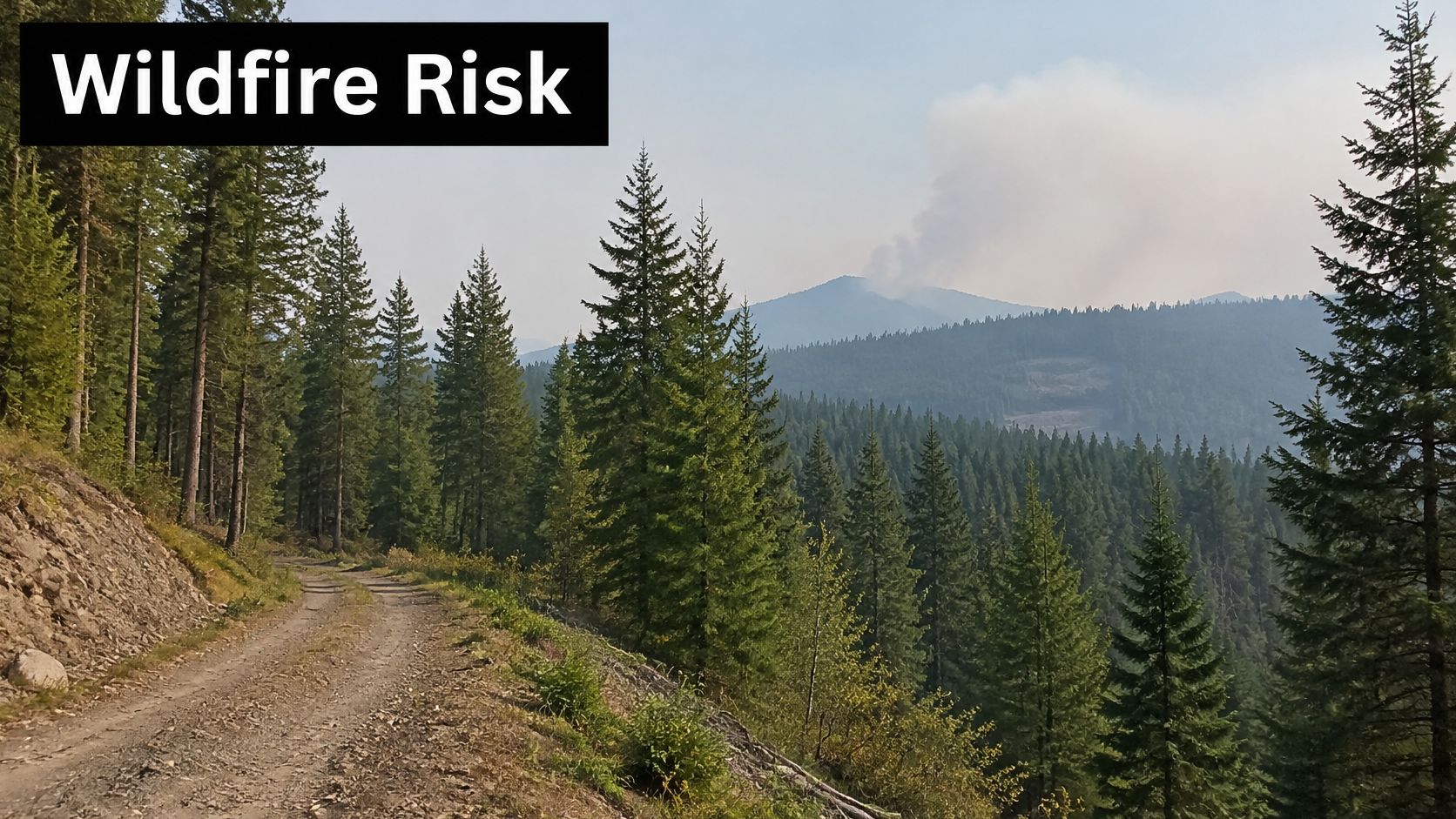
Standing trees aren't a guaranteed income stream. A 2025 analysis reported by Phys.org found that rising wildfire risk and volatile timber prices could reduce Pacific Northwest forestland values by as much as 50% and encourage earlier harvesting.
That finding isn't a blanket discount for every woodland parcel. It is a reason to test whether the acquisition survives damage, delayed revenue, and higher ownership costs.
Inspect the access network and surrounding fuels with loss exposure in mind, not just the planned harvest.
Stress cases that move forest value
| Case | What changes the value | How to treat it |
|---|---|---|
| Ordinary harvest | Base merchantable volume and delivered log prices | Core case used to size the offer |
| Fire-damaged salvage | Lost merchantable volume, damaged young stands, cleanup and road costs | Reduce recoverable value; don't use headline inventory |
| Insurance | Availability, premium, exclusions and deductible | Holding expense; reject if required protection is unavailable |
| Carbon credits | Eligibility, pricing, verification costs and contractual obligations | Uncertain upside, not guaranteed value |
| No-harvest conservation | No cut revenue, continuing holding costs | Downside reference, not a guaranteed resale floor |
Obtain insurance indications for the exact ownership plan. A policy covering a cabin or general liability may not insure standing timber, lost harvest income, or every cleanup obligation. Ask the broker to identify covered assets, exclusions, mitigation conditions, deductibles, and limits in writing.
For salvage, ask a forester what could remain commercially usable and how quickly it would need to move. Don't assume damaged trees retain ordinary value or that contractors and mills will be available on your schedule.
Keep carbon outside the core repayment plan
Before assigning carbon income, verify eligibility, project expenses, monitoring duties, harvest restrictions, and responsibility if stored carbon is lost. Treat a seller's carbon estimate as an unproven opportunity until an appropriate project review supports it.
Use the accompanying video as additional viewing, not as a substitute for parcel-specific advice.
Risk test: If the purchase only works with an undamaged harvest, inexpensive insurance, and successful carbon enrollment, the price leaves you too little room.
Keep land, standing timber, improvements, and cleanup liabilities on separate worksheet lines. That lets you change a loss assumption without pretending every part of the property loses or retains the same value.
Finance the Purchase and Set the Offer
The financing decision is whether you and the lender can support the same purchase with defensible assumptions. A loan approval doesn't establish that the seller's timber estimate is correct, and a substantial down payment doesn't repair weak economics.
Prepare a concise acquisition file before requesting terms. It should let a lender, attorney, and appraiser understand what transfers, how the property will generate cash, and which conditions must be satisfied before closing.
Assemble an evidence-based financing package
- Commission the acquisition cruise. Require a report identifying the inventory, methods, harvestable area, and material limitations. Give the lender the complete report rather than a broker's summary.
- Resolve documentary exceptions. Have counsel review the title commitment and relevant instruments. Order a survey when acreage or boundary discrepancies remain material.
- Request ownership records. Obtain recent tax bills, harvest records, leases, operating agreements, and management expenses. Ask for enough history to distinguish recurring costs from unusual work.
- Approach forestland lenders. Present a repayment plan that matches the property's income timing. Ask how the lender treats harvesting, timber releases, appraisal requirements, and reserves.
Require the appraisal to distinguish land from standing timber and explain its valuation basis. Also compare loan terms beyond the interest rate, including amortization, maturity, prepayment provisions, and restrictions on cutting. A harvest-dependent repayment plan needs terms that permit the harvest you've modeled.
Set the ceiling before negotiating
Start with supported land value and residual timber value. Deduct acquisition-specific obligations, necessary road work, identified tax exposure, and other costs not already included in the valuation. Don't deduct the same expense twice, particularly when the forester has already included it in stumpage calculations.
Maintain a separate liquidity reserve for deductibles and uncertain expenses. Not every reserve is a reduction in appraised value, but it still changes the cash you need and the price you can afford.
Write a contingent offer that gives you time to complete the cruise, verify access, resolve title exceptions, confirm permitted use, and obtain a suitable loan commitment. Have counsel specify document-delivery deadlines, inspection rights, and how earnest money is handled if a condition fails.
Walk away when the evidence can't support the intended use or repayment plan. Negotiating a modest discount won't compensate for an obligation you can't quantify or a right the seller can't convey.
At PropLab, we bring public records, tax assessments, and market data into property analysis without requiring MLS access. Visit PropLab to organize comparable-sale analysis for your next acquisition, and pair that work with a consulting forester's cruise and legal review before setting an offer on forestland.
About the Author
P
PropLab Team
Real Estate Analysis Experts
The PropLab team consists of experienced real estate investors, data scientists, and software engineers dedicated to helping investors make smarter decisions with AI-powered analysis tools.
Free tool
Get the ARV of any property in 30 seconds
Skip the spreadsheet. Enter an address and get an after-repair value backed by real comps.
