General
Purchasing Vacant Land: A Practical Investor Walkthrough
October 5, 2026
20 min read
A lot appears on a county map late at night. The photos show a quiet road, mature trees, and enough acreage to make the asking price look almost too reasonable. Then the practical questions start: Can you legally reach the parcel? Can you build the intended use? How far away are power, water, and sewer? Will the soil support a septic system, or are you looking at an attractive piece of ground with no workable exit?
That gap between the listing price and the cost of making land usable is where most vacant-land deals succeed or fail. Vacant land isn't just a cheaper form of a house. It's a feasibility conversion problem. You're buying the right to investigate, improve, entitle, hold, and eventually sell or develop a site.
A useful historical perspective is that vacant land has never been a niche category in urban markets. A widely cited urban land study found that vacant land represented an average of 15% of a city's land, while an earlier estimate for large U.S. cities placed the share at 20.7%. The same research describes substantial vacant-parcel footprints in cities including Philadelphia and Detroit, which shows why location, access, zoning, and future land use matter more than acreage alone in the Brookings urban land study.
Starting the Search for the Right Parcel
The first parcel I investigate usually looks better online than it does in the underwriting file. An auction page might show a wooded lot beside a paved road, but the county GIS reveals a narrow strip with no legal frontage. An owner-financed listing may advertise a low price per acre, while the legal description shows that the parcel was split from a larger tract and relies on an easement nobody has produced.
Where the workable deals surface
Different channels expose different types of inventory:
- County tax rolls and GIS maps: These help identify ownership, parcel shape, assessed history, adjoining land, and tax status. They're discovery tools, not proof that the property is available or buildable.
- MLS land filters: MLS listings tend to contain better photography, broker remarks, and disclosures, but the description can still omit utility distance, access defects, or failed site work.
- Auction platforms: Auctions can surface tax-delinquent or distressed parcels, but bidding pressure often encourages buyers to focus on the headline price instead of the conversion cost.
- Owner-financed classifieds: These listings may offer flexible terms and direct seller access. They also require careful verification of title, taxes, legal access, and the seller's authority to convey.
- Local land brokers: A specialist may know which parcels have failed before, which roads are maintained privately, and which zoning interpretations local officials commonly accept.
The early filter is deliberately unglamorous. Confirm that the parcel is being offered at the advertised price, compare the listing acreage with the county record, trace the boundaries on GIS, and inspect the shape rather than relying on the photo. A parcel can be technically large but functionally useless if its buildable area is broken up by a floodplain, steep slope, conservation restriction, or required setback.
Check access before falling in love with the setting. A visible road isn't enough. You need public-road frontage or a recorded easement that reaches the parcel, and you need to understand who maintains a private road. A practical vacant property research workflow can help organize the initial record review, but it can't replace confirmation with the county recorder and planning office.
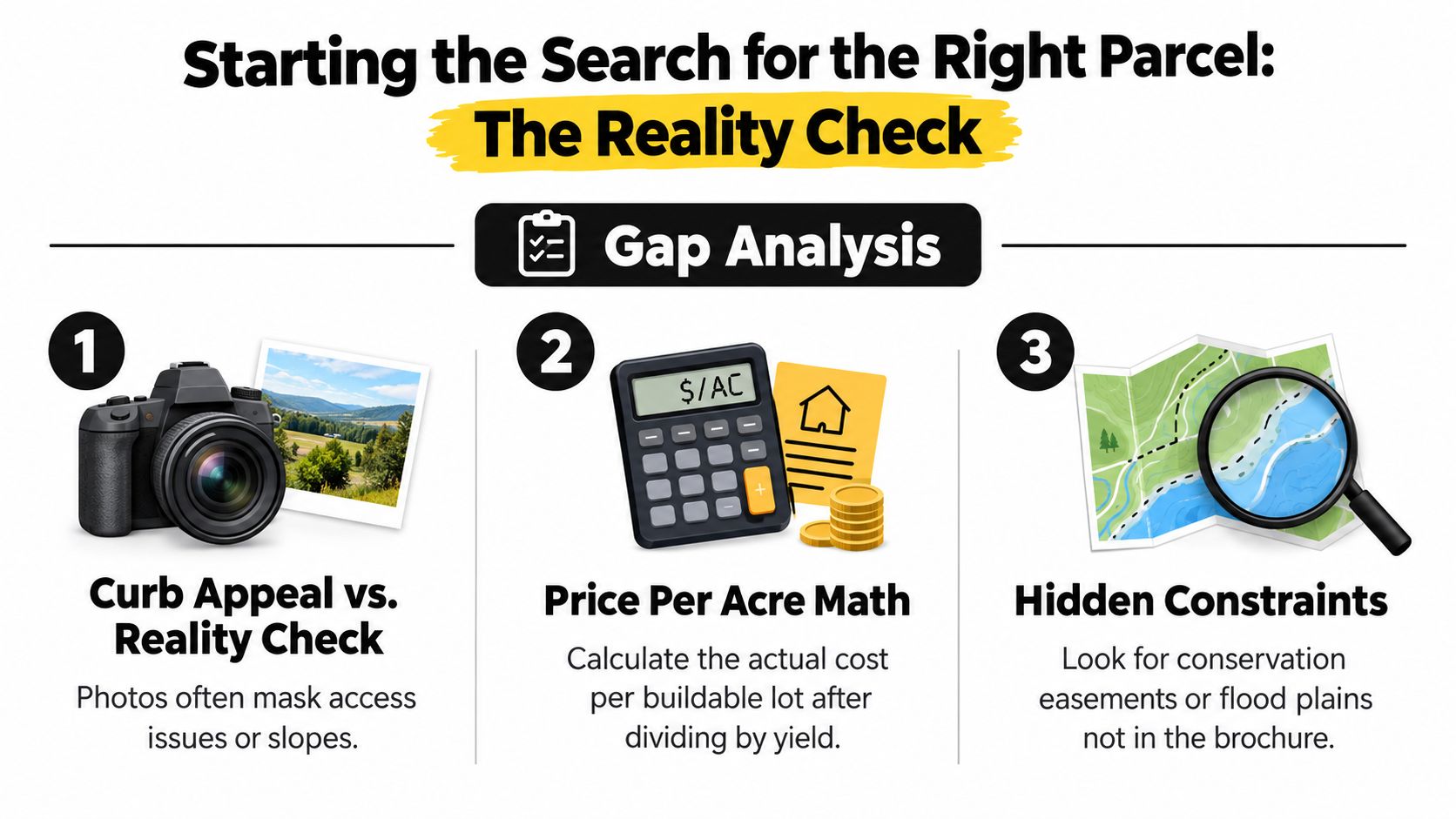
The red flags are usually visible before a formal inspection:
- No usable address: A map pin or nearby road name doesn't establish legal access or a serviceable building location.
- A recent split from a larger tract: The split may have created access, frontage, setback, or utility problems that weren't present in the original tract.
- A price far below nearby land: The discount may reflect a failed perc test, missing easement, unpaid taxes, flood exposure, or a zoning limitation rather than a seller's mistake.
- Vague legal descriptions: “Approximately” acreage and informal boundary language deserve a survey and title review before serious negotiation.
If the intended use involves a nontraditional dwelling, research the rules before assuming the parcel can support it. A practical Firm Foundations container home guide can help frame construction questions, but the county still controls whether that use is permitted, what foundation standards apply, and which utility or occupancy requirements must be met.
Running the Due Diligence Gates Before You Commit
A raw-land purchase should move through gates, not optimism. Each gate answers a different question, and a failure at one stage should stop you from spending money on the next stage.
Title comes first
Order a title commitment and review the chain of ownership through the county recorder. The review should identify unreleased mortgages, liens, judgments, tax claims, access easements, mineral reservations, and restrictions that don't appear in the marketing description. An easement can exist even when it isn't obvious from the driveway or fence line, and an old mortgage can remain a closing problem until the seller proves it was released.
The title commitment also tells you what the title company won't insure without an exception. That distinction matters. A seller may say, “Everybody uses that road,” but customary use isn't the same as an insured, recorded right to cross it.
Survey and zoning answer different questions
A survey confirms where the parcel sits on the ground. It should reconcile the legal description with the corners, acreage, frontage, encroachments, and visible improvements. Don't rely on an old fence stake or a seller's hand-drawn outline. The fence may not follow the boundary, and the parcel may not contain the area the listing implies.
Zoning answers what you may do with the land. Confirm the base zoning, overlay districts, minimum lot dimensions, setbacks, density, height limits, frontage requirements, and permitted uses. Separate uses permitted by right from those requiring a variance, conditional-use approval, or rezoning. The land-use regulations guide is useful for framing the questions, but the controlling answer comes from the local ordinance and a written response from the planning authority.
Access, environment, and soil close the physical-use gaps
Legal access and physical access aren't interchangeable. Walk the route, identify gates and bridges, check road maintenance obligations, and confirm that emergency vehicles can reach the proposed building area. If the route crosses another owner's land, obtain the recorded easement and review its width, permitted uses, maintenance duties, and termination language.
Environmental review should reflect the parcel's history and setting. Check floodplains, wetlands, habitat restrictions, drainage patterns, and prior agricultural or industrial use. A parcel may be attractive from the road yet have a much smaller usable envelope because of wet areas or protected resources.
If septic is part of the plan, make the perc or soil evaluation a closing condition. A failed perc test can make a lot effectively worthless for the intended use, while boundary and access defects can create permanent resale problems as explained in this vacant-land buying guide. The practical acquisition workflow commonly uses a 30- to 90-day contingency period to complete title, survey, zoning, access, environmental, and septic checks, with estimated combined diligence costs of about $3,000 to $10,000 in one land-buying guide on vacant-land due diligence.
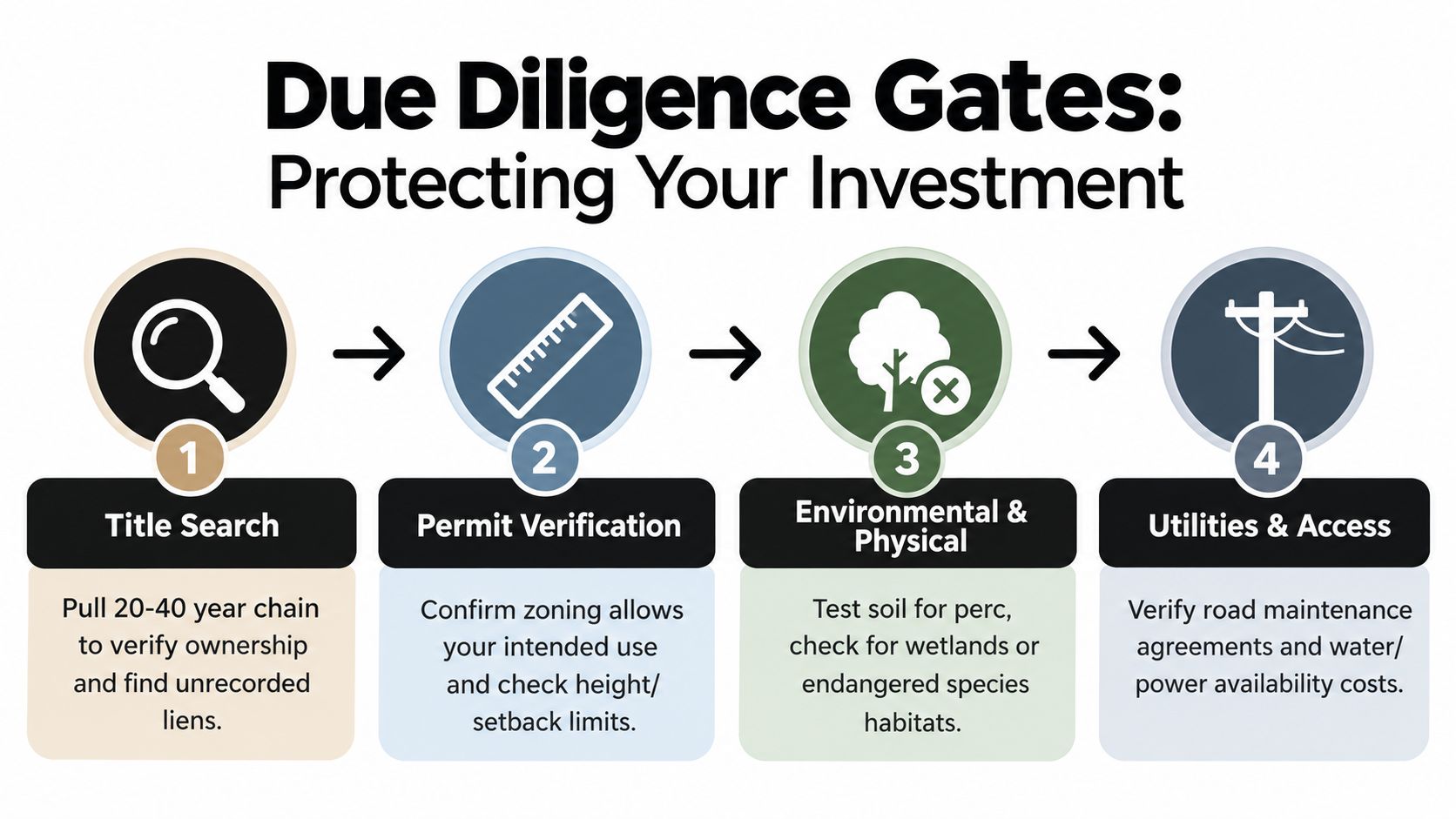
The sequence protects capital. Don't pay for an engineered septic design before confirming title and zoning. Don't commission detailed construction plans before you know that access and the intended use are legal. A contingency isn't a formality. It's the mechanism that lets you investigate without converting every unknown into sunk cost.
Uncovering the Full Cost Stack of Raw Land
The listing price is only the first line item. Add the driveway, power extension, water or sewer connection, grading, clearing, and entitlement fees before you establish a usable basis for the parcel.
Start at the road. A rural lot may need a driveway or road cut, culvert, drainage work, grading, and tree removal before construction equipment can reach the site. Price utilities separately. Electric service may involve a line extension, transformer, trenching, and service drop. Water may require a tap, well, pump, storage, or treatment system. Wastewater may mean a sewer connection or a septic system, with soil testing and design costs.
Flood exposure can also change the budget before site work begins. Check it early with a flood zone determination workflow, before estimating grading, drainage controls, or insurance.
Build a quote file, not a wish list
Collect written estimates wherever possible. Ask the electric utility to identify the service point and explain who pays for any extension. Ask the water or sewer provider for connection requirements and available capacity. Have a driveway contractor inspect the entrance, and use a septic designer or soil professional to assess site-specific feasibility.
| Cost Layer | Typical Range | What Drives the Number |
|---|---|---|
| Access and driveway | Site-specific quote | Road frontage, grade, culverts, drainage, permits, and private-road obligations |
| Electric service | Utility estimate required | Distance to service, line extension, transformer, trenching, and capacity |
| Water | Well or provider quote | Aquifer conditions, drilling depth, tap availability, pressure, and treatment |
| Wastewater | Septic or sewer quote | Perc result, soil conditions, system type, sewer distance, and design requirements |
| Grading and clearing | Contractor estimate | Slope, trees, rock, drainage, erosion controls, and building pad location |
| Entitlement and impact charges | Jurisdiction-specific | Rezoning, variances, conditional approval, impact fees, and required studies |
| Carrying costs | Ongoing budget | Property taxes, insurance, maintenance, association charges, and financing |
The table is a diligence checklist, not a substitute for bids. It keeps the purchase price from becoming the entire underwriting basis. Property taxes continue while the parcel is vacant, and the rules can differ by jurisdiction. Review the practical considerations in Dollar Land Store tax help.
A multi-acre parcel can look inexpensive on a price-per-acre basis and still fail the feasibility test. A long driveway, distant power, a well, engineered septic system, substantial clearing, and grading may push the all-in basis above the price of nearby serviced lots. At that point, the raw parcel is an unfinished project competing with completed alternatives.
Entitlement deserves its own line item. Rezoning, a variance, or conditional-use approval may require consultants, hearings, revised plans, and extended control of the property. Carrying costs continue during that period. If you cannot estimate each major cost within a defensible range, you are not underwriting the deal yet. You are guessing.
Valuing Land When There Are No Houses to Compare
A vacant parcel needs vacant-land comparables. A house comp doesn't tell you what an unserved site is worth, because the house already contains access, utilities, approvals, improvements, and a known use.
Begin with county auditor or recorder transfers in the same township, municipality, or zoning class. Filter for parcels with similar acreage, shape, frontage, access, and development potential. Use closed sales, not asking prices. A listing expresses a seller's expectation. A recorded transfer shows what a buyer paid.
Turn sales into a usable range
Calculate a price-per-acre band from the most relevant sales, then adjust for the characteristics that change usability. A parcel with direct public-road frontage should not be treated as equivalent to one reached through a narrow easement. Similarly, a site with a passing perc test, nearby utilities, and a clear building envelope deserves separate treatment from raw land with uncertain conversion costs.
For development land, acreage alone can mislead. Translate the parcel into buildable adjusted units, such as likely lots, pads, or permitted structures, but only after checking zoning, setbacks, access, stormwater requirements, and environmental constraints. A larger parcel with poor yield can be worth less than a smaller, better-shaped site.
| Attribute | Subject Parcel | Comp A | Comp B | Adjustment |
|---|---|---|---|---|
| Location and zoning | Record actual municipality and zoning | Same or different district | Same or different district | Adjust for permitted use and market depth |
| Acreage and shape | Verify by survey or county record | Compare usable configuration | Compare usable configuration | Adjust for functional, not just gross, area |
| Road access | Public frontage or recorded easement | Document access type | Document access type | Adjust for legal and physical usability |
| Utilities | Confirm availability and distance | Verify service status | Verify service status | Adjust for connection uncertainty and cost |
| Soil and environmental limits | Perc, wetlands, flood exposure | Review available evidence | Review available evidence | Adjust for buildable envelope |
| Sale credibility | Closed transfer | Closed transfer | Closed transfer | Exclude unclear or distressed transactions |
Discard comps that are stale, cross a meaningful market boundary, lack the subject's frontage, or reflect a very different development path. Auction sales can distort the upper or lower end because urgency, limited inspection, or bidding behavior may dominate the result.
A national land survey cited in a land-market guide reported a median land price of about $7,200 per acre at the close of 2024, with residential land representing 20% of surveyed transactions as summarized in this land-market guide. That figure is a broad reference point, not a valuation for a specific parcel. Local access, entitlement status, and utility feasibility still control the underwriting.
Current market reporting also describes a segmented market. The same reporting says land prices per acre slipped 0.5% year over year in the first quarter of 2026, while inventory remained 23.6% below pre-pandemic levels, a combination that doesn't justify assuming every parcel is appreciating in this 2026 land-market analysis. The useful conclusion is narrower. A parcel with legal access, feasible utilities, and a policy-compatible use may be resilient, while a remote or encumbered parcel can remain illiquid even when general land commentary sounds optimistic.
Financing Options for Vacant Land Buyers
Financing raw land is less standardized than financing a house. Lenders have fewer physical improvements to secure, appraisals rely heavily on thin comparable evidence, and a parcel without access or a viable use may have little liquidation value.
Compare the risk you retain
Cash offers speed and control. You can negotiate a longer investigation period without waiting for a lender's approval, and you avoid an appraisal that fails to recognize the parcel's intended potential. The trade-off is concentration risk. Cash doesn't make a bad site cheaper, and it can make buyers less disciplined because there's no lender forcing a review.
Seller financing can work when the seller owns the land free and clear and understands the parcel's limitations. It may reduce the immediate cash requirement and simplify timing, but it doesn't remove diligence. Confirm title, tax status, access, zoning, and utility feasibility independently. A seller's willingness to finance may reflect convenience, not confidence in the land.
Specialty land loans and credit-union programs may suit buyers who want to preserve liquidity. Approval usually depends on the parcel's location, access, intended use, borrower profile, down payment, and documented exit. Some lenders will not consider land without road frontage, a viable perc result, or power near the lot line.
| Path | Typical Down | Approval Speed | Best Use Case |
|---|---|---|---|
| Cash | Full purchase funds | Fastest, subject to title and closing | Strong diligence, competitive offer, or uncertain appraisal |
| Seller financing | Negotiated with seller | Depends on seller and documentation | Clear title, cooperative seller, manageable conversion plan |
| Specialty land loan | Lender-specific equity requirement | Slower and more conditional | Buildable parcel with documented access and feasible use |
| Partner or private capital | Negotiated contribution | Depends on underwriting and agreements | Larger conversion project with a defined exit |
Don't confuse a loan approval with site feasibility. A lender may accept the collateral while rejecting your intended construction budget, or approve the land while requiring you to fund all access and utility work separately.
Borrowers should also separate land financing from owner-occupied or rural housing programs. A resource covering USDA loan credit requirements for buyers can help clarify borrower-side questions, but eligibility doesn't automatically mean a raw parcel purchase is financeable. Confirm whether the program supports the specific land transaction, construction structure, occupancy plan, and lender product.
The most durable financing plan matches the exit. A buyer planning to build needs a path from land acquisition to construction funding. A buyer planning to resell needs enough liquidity to carry the parcel while finding someone willing to complete the same feasibility conversion.
Closing the Deal Without Last-Minute Surprises
An accepted offer starts the most important part of the transaction. The contract should give you a defined contingency period, access for inspections and surveys, permission to contact authorities and utilities, and a clear right to cancel or renegotiate if a material condition fails.
Keep the file moving in a fixed order
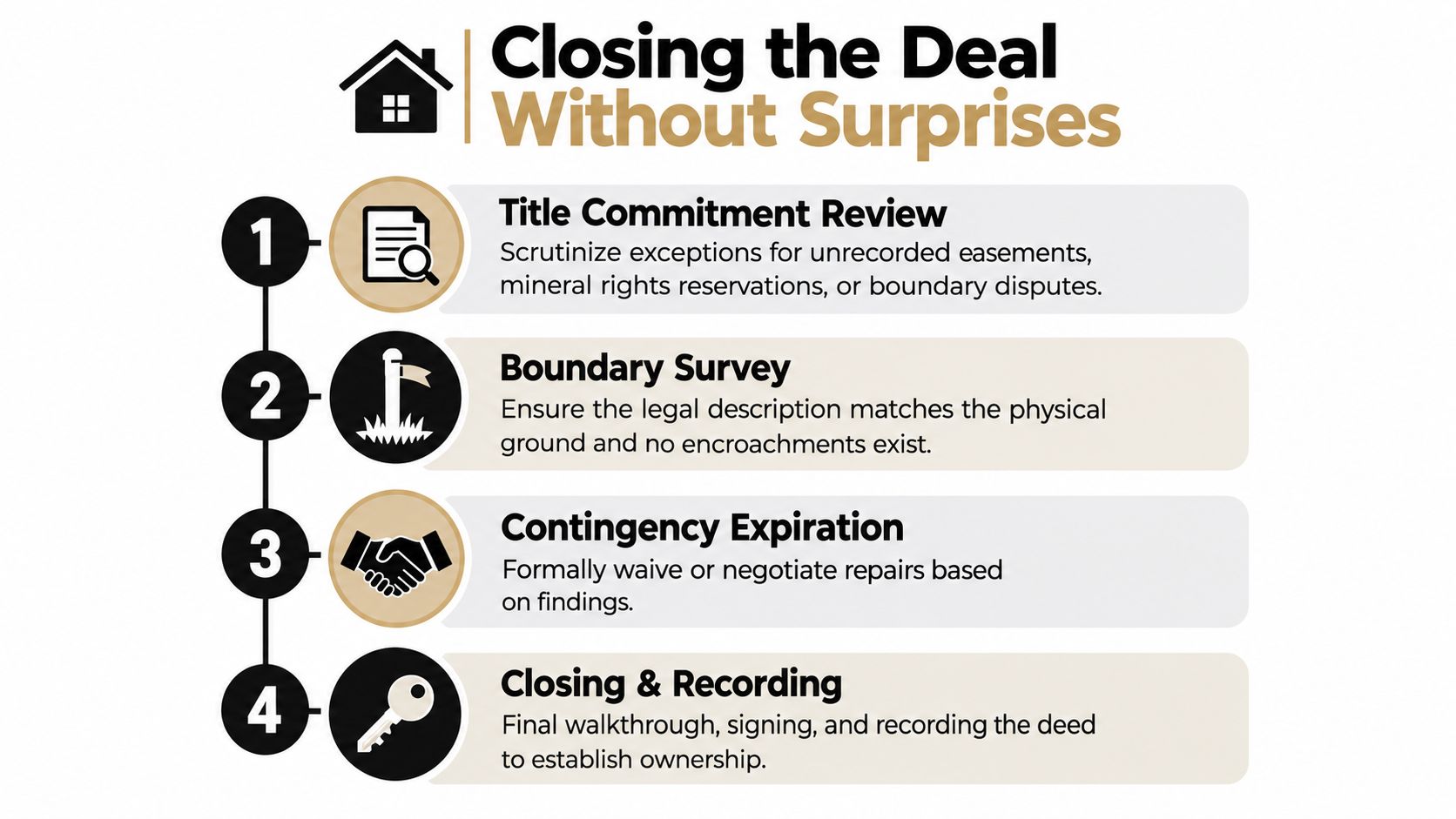
Review the title commitment as soon as it arrives. Pay particular attention to exceptions for unrecorded easements, mineral reservations, boundary disputes, old mortgages, tax claims, and restrictions that limit the intended use. If the title company requires a release, affidavit, survey, or corrective instrument, resolve it before the closing appointment is close enough to create pressure.
Order or update the survey and compare it with the legal description. A final field check should confirm that the pins, access route, visible encroachments, and proposed building area match the assumptions used in your offer. A seller's recollection is not a substitute for surveyed boundaries.
Reconfirm zoning, flood exposure, and access near the end of the contingency period. Ordinances, map interpretations, and utility responses can change the feasibility analysis even when the parcel itself hasn't changed. If financing is involved, get the appraisal, loan conditions, insurance requirements, and funds-to-close figures finalized before waiving the relevant contingency.
Walk the land again
The final walk matters even when there's no house to inspect. Check that the access road is open, the gate still works, drainage hasn't changed, equipment or debris hasn't appeared, and the route you relied on is physically passable. If a neighbor has blocked a route or a storm has damaged a crossing, you want to know before you release your hold.
Closing funds usually arrive by cashier's check or wire according to the settlement agent's instructions. Budget for recording fees, transfer taxes, title charges, survey costs, and prorated property taxes. Verify wiring instructions independently using a trusted phone number, not an email thread that could have been altered.
Two problems repeatedly appear late. A new lien can be filed after the initial title search, or a seller-side divorce or probate issue can prevent the correct party from signing. Structure earnest money so it remains refundable during the agreed contingencies, and require clear title as a condition of closing. If the seller can't deliver marketable title, your contract should give you a defined remedy rather than forcing you to negotiate from the closing table.
Choosing Your Post-Purchase Path
Once you own the parcel, the conversion decision becomes unavoidable. The strongest exit isn't always construction. Sometimes the evidence supports holding, and sometimes the honest conclusion is that reselling the land as-is protects more capital than forcing a weak development plan.
Build now
Building makes sense when access is legal and practical, the intended use is permitted, utilities are priced, and the site can support the proposed improvements. The next work includes final plans, permits, contractor bids, site preparation, utility connections, and a schedule that accounts for approvals and construction conditions.
Land underwriting changes at this point. You're no longer evaluating only a parcel. You're evaluating a completed asset against improved-property comparables, construction risk, carrying costs, and the time required to reach occupancy or sale. A parcel can be cheap and still produce a poor project if the finished value doesn't absorb the conversion stack.
Hold and resell
Holding can work when the property has a credible future catalyst, such as improving access, infrastructure expansion, or a policy-compatible use. The cost is ongoing exposure. Property taxes, liability coverage, vegetation control, association charges, and financing continue while the buyer waits for liquidity.
The future buyer may also ask the same questions you asked. If you haven't resolved access, utilities, or buildability, you're likely passing uncertainty forward rather than creating value.
Build to rent, build to sell, or exit as-is
A rental or build-to-sell project converts the parcel into a different asset class. Underwriting shifts toward construction cost, achievable rent or sale price, operating expenses, financing, and the local supply of finished properties.
Reselling as-is is rational when the conversion math fails, the approval path is uncertain, or the highest-value use depends on facts you can't verify. A clean file containing the survey, title work, zoning confirmation, utility responses, environmental findings, and soil results can still improve the resale conversation, even if you decide not to build.
| Path | Upfront Capital | Recurring Carry Cost | Time to Liquidity | Primary Risk |
|---|---|---|---|---|
| Build now | High, including plans, permits, site work, and construction | Financing, taxes, insurance, and project overhead | Longer, tied to approvals and construction | Cost overruns, delays, and finished-value risk |
| Hold and resell | Moderate, depending on unresolved feasibility work | Taxes, insurance, maintenance, and possible financing | Uncertain and market-dependent | Illiquidity and a future buyer rejecting the same constraints |
| Build to rent or sell | High, with operating or sale underwriting | Construction carry, financing, and eventual operating costs | Tied to completion and absorption | Misjudged rents, sale value, construction, or demand |
| Resell as-is | Lower than development, but may include cleanup and documentation | Taxes, insurance, and maintenance | Potentially faster if priced realistically | Discount caused by unresolved conversion risk |
A parcel with strong access and nearby utilities usually offers more post-purchase flexibility than a remote site with unresolved easements or soil questions. But flexibility isn't value by itself. The correct path is the one where the cost, approval burden, carry period, and exit price are supported by evidence.
Before making an offer, use a parcel-level underwriting workflow that keeps the asking price, feasibility costs, comparable sales, contingencies, and exit assumptions in one place. PropLab can help organize public-record and market data into an offer-ready analysis, while site-specific professionals still need to verify title, zoning, environmental conditions, utilities, and soil.
If you're evaluating a vacant parcel, visit PropLab to organize comparable sales, property data, and offer assumptions before you commit capital. Use the analysis to identify the land's likely value, document unresolved risks, and decide whether building, holding, or reselling is the most defensible exit.
About the Author
P
PropLab Team
Real Estate Analysis Experts
The PropLab team consists of experienced real estate investors, data scientists, and software engineers dedicated to helping investors make smarter decisions with AI-powered analysis tools.
Free account
Underwrite your next deal in under a minute
3 free analyses, no credit card. ARV, rehab, comps and exit strategy in one report.
