General
Las Vegas Auctions Homes: How to Find and Bid Safely
November 18, 2026
15 min read

You're looking at a Las Vegas auction number that sits far under the houses on your block, the deposit is already in checking, and the registration clock is the only thing that feels urgent. That urgency is how buyers treat a hammer price as the whole cost.
A low winning bid is not a low acquisition cost. Surviving liens, people who still live there, and a payment deadline that can hit the same day all have to be priced into the maximum bid before you register. If any of those items is still a blank, you don't have a bid. You have a guess.
Las Vegas auctions homes reach the block through different sales, and each sale leaves a different stack of obligations with the buyer. Name the sale first. The discount comes second, and only if the math still works.
Las Vegas Auction Types and What Survives the Sale
Four routes put a Las Vegas property on the block, and each one leaves a different stack of claims attached to the buyer. Before you look at price, name the instrument that started the sale. The obligations you inherit depend on it.
| Auction route | Who runs the sale | Bidding and payment rules | What can survive the sale |
|---|---|---|---|
| Trustee foreclosure sale | Trustee under the deed of trust | Highest cash bidder wins; title passes by trustee's deed without warranty | Senior liens may remain |
| HOA lien sale | HOA or its agent under the lien notice | Cash bids; verify the notice terms before registering | First-mortgage holder may foreclose later; junior charges can remain |
| Clark County tax auction | Clark County Treasurer | Bidder registration required before sale day; cash, cashier's check or money order | Government liens and encumbrances may survive; the prior owner may hold a statutory right to protest after the sale |
| REO listing after failed auction | Lender after reserve is not met | Standard offer and financing paths | Lender-managed title and disclosures; often more access |
On a trustee foreclosure sale, Nevada practice is cash to the highest bidder, and the Nevada Real Estate Group foreclosure guide notes that a trustee's deed without warranty passes only the interest held by the foreclosed grantor. Liens senior to that deed of trust may remain. You bought the borrower's position, not a wiped-clean house.
An HOA lien sale is a different instrument. The association or its agent sells under the lien notice. A first-mortgage holder can still foreclose later, and unpaid taxes, garbage charges, and other junior claims can still wreck the economics even when they look small on a spreadsheet.
Say you win a house at $180,000 because the notice looked cheap next to nearby listings. A senior lien of $220,000 was never wiped. You now owe more than a similar house would have cost with ordinary title, and you still have repairs. That is why the survival column of the table matters more than the bidding column: every line in it is a number that belongs inside your maximum bid, not a surprise for after the gavel.
A Clark County tax auction is run by the treasurer from a published parcel list that can shrink before sale day. Date every printout, and confirm each parcel is still on the list before you register. An REO listing appears when a lender's reserve is not met and the property comes back as bank-owned, usually with more access and a normal offer path. A practical way to find a foreclosed home is to start from the recorded trustee's sale notice, the HOA lien notice, the treasurer's parcel list, or the lender's REO sheet, then write the recording date on the file.
Before you register: name the foreclosing instrument in one sentence, then list every claim that could survive it. If you can't name the instrument, you aren't ready to bid.
Build Comp Ranges From Post-Crisis Auction Data
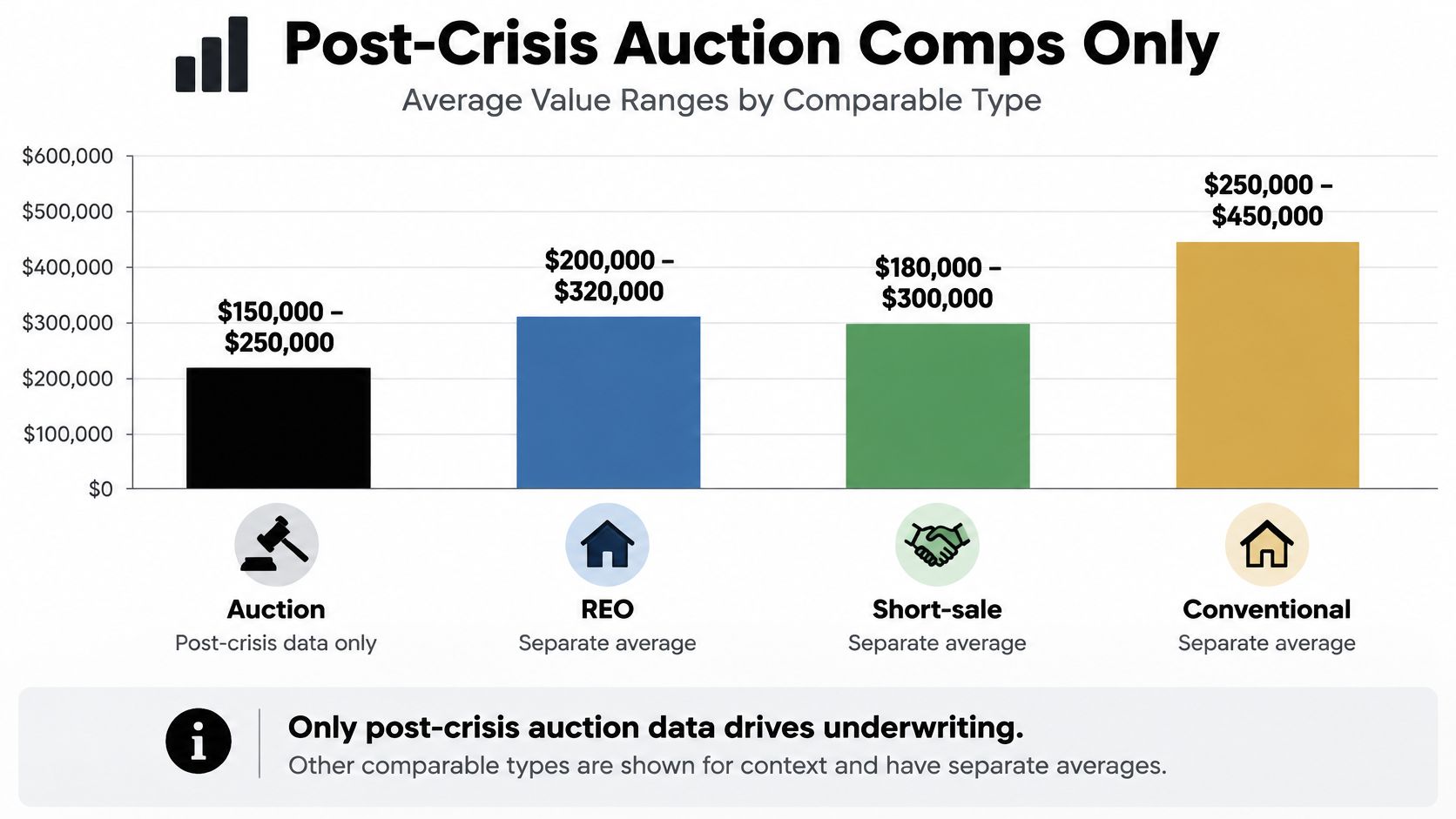
Auction, REO, short-sale, and conventional sales never belong in one average. Only post-crisis auction sales should set the range you bid against.
| Period | Measure | Value |
|---|---|---|
| March 2011 | Median auction price | $93,500 |
| March 2011 | Median foreclosure sale price | $106,500 |
| March 2011 | Median traditional sale price | $108,500 |
| March 2011 | Median short sale price | $120,000 |
| First half 2018 | Foreclosure auctions scheduled per month | 235 |
| Q4 2018 | Foreclosure auctions scheduled per month | About 69 |
| 2011 versus 2019 | Distressed share of Las Vegas Valley resales | Almost 73% versus 3.3% |
In March 2011, the Las Vegas Review-Journal reported a median auction price of $93,500, against $106,500 for foreclosure sales, $108,500 for traditional sales, and $120,000 for short sales, in a month when banks foreclosed on 2,099 homes. Those four medians sat in the same market and still refused to line up. A 2011 discount is a history lesson, not a 2026 expectation.
The later Las Vegas Review-Journal account shows how fast the pipeline shrank: foreclosure auctions were scheduled 235 times per month in the first half of 2018 and about 69 times per month in the fourth quarter, while distressed transactions were almost 73% of Las Vegas Valley resales in 2011 and 3.3% in 2019. Crisis comps describe a market that no longer exists.
How to build the range
- Pull at least three recent sales on the same block, not the whole ZIP.
- Adjust each sale for condition and for whether it was vacant or occupied.
- Tag every sale as auction, REO, short-sale, or conventional. Don't blend the tags.
- Set the comp range from auction-tagged sales only, then test that range against the bid ceiling before you register.
A clean walk-through of real estate comp analysis keeps those tags from collapsing into one pretty average. I would rather bid from three ugly, correctly tagged sales than from ten retail closes that never saw an auction.
Calculate a Maximum Bid That Covers Hidden Costs
The ceiling is a subtraction, not a feeling. Start with a conservative stabilized value, then subtract verified repairs, holding and financing costs, resale costs, legal and title costs, and the contingency and profit you require. Whatever is left is the most you can bid.

The published minimum bid is a floor. It is not the acquisition cost. Work the rows in order, and stop the moment a row can't be filled with a number.
| Cost item | Where to verify | Treatment in the bid ceiling |
|---|---|---|
| Minimum bid components (taxes, penalties, interest) | County parcel list and auction notice | Floor for the acquisition cost, not the total |
| Municipal, sewer, sanitation and assessment charges | Municipal and county records | Add in full to acquisition cost |
| Surviving senior liens and encumbrances | Independent title search and payoff verification | Add in full; if unquantified, do not bid |
| Repairs with unseen interior | External inspection and permit history | Conservative estimate plus contingency; use a written allowance if no line-item estimate |
| Holding and financing costs | Loan terms and expected timeline | Monthly carry multiplied by realistic months held |
| Eviction and possession costs | Occupancy status and local legal counsel | Add if occupants remain; use counsel's quote, or do not bid |
| Resale, legal and quiet-title fees | Agent quotes and title counsel | Subtract from stabilized value |
| Investor contingency and profit | Investor's own target | Subtract last; raise when interior is unseen |
Why each row lowers the ceiling
Minimum bid components (delinquent taxes, penalties, interest) only tell you what the county or trustee will accept to open the sale. Municipal, sewer, sanitation, and special-assessment charges sit on top of that floor and get added in full. A surviving senior lien is the same: add the payoff, or don't bid. Hoping it "goes away at recording" is how a cheap hammer price becomes the most expensive house on the block.
You usually can't walk the inside before a tax auction or a trustee sale. Price repairs from the exterior, the permit history, and a blunt allowance for what you couldn't see. Retail comps with fresh paint don't belong in this file. Use sales adjusted for condition and for occupancy.
If someone still lives there, eviction and cash-for-keys belong in holding costs, not in a footnote. Demolition and code-compliance work are the lines investors skip, then discover after the locksmith. Where counsel wants a quiet-title or corrective-title action, put that fee and the protest window into the exit timeline so you aren't forced to sell into a clouded title.
If any surviving claim can't be quantified, the ceiling is not final, and you should not bid.
Finance and Insure the Purchase
On the tax-auction path, the purchase is a cash execution. Financing after the gavel is a story people tell themselves. Confirm the payment form and the deadline on the notice before you register, then write a funding plan that names the source, the amount, and the deadline for every check.
Four paths, in order
Cash is the default. Fund the full bid and the registration deposit from money you can hand over without a lender's yes. Keep a separate reserve for repairs and carry. If that reserve is the same dollars as the bid, you don't have a reserve.
A bridge loan comes second, and only after title is clean. A private or hard-money lender will want a title report and a property that can be insured. Arranging the bridge before the search is how people show up with a term sheet and no wire. I would not sign a bridge term sheet on a file that still has an unnamed senior lien.
A post-sale conventional mortgage is third, and it is fragile. A normal loan needs the house to be insurable and habitable. Run an insurance-availability check before you bid, using the exterior inspection and the permit history. If a carrier won't quote because of roof, electrical, or an open code case, don't underwrite a refinance that can't close.
REO is the path that uses a mortgage. When you buy the bank-owned listing instead of the auction, standard offer and loan timelines apply. That is often the honest choice when your capital is a pre-approval rather than cashier's checks.
The written plan should fit on one page: deposit source, balance source, repair reserve, and the date each must be liquid. If any line says "I'll figure out the loan after I win," cross the address off.
Auction Discounts Versus REO and Listing Prices
An auction "discount" measured against ordinary listing prices is the wrong comparison. Measure it against what you still have to survive after the bid.

Foreclosure inventory is real, and it is small. Realtor.com research places the Las Vegas–Henderson–North Las Vegas foreclosure share of listings at 1.3% and the metro median listing price at $474,950, while ATTOM's July 2026 report estimated roughly one foreclosure-related filing for every 1,394 housing units in Las Vegas. Most houses are not distressed. Treating every auction file as bargain inventory is how people bid retail money for wholesale problems.
What the headline price leaves out
After the bid, three things show up that the listing photo never priced.
- Limited interior access. You fund repairs without a reliable inspection, so the unknown-condition reserve has to be large enough to be wrong.
- Formal eviction. If occupants remain, you pay to get possession, and the hold time starts on day one.
- A failed reserve. If the lender's number isn't met, the house can come back as REO. You didn't "lose" it. You avoided buying it blind.
The REO listing is often the better trade even when the price looks less dramatic. You typically get inside, you can use a normal loan, and the lender is already pushing title and disclosures. You trade a theatrical discount for a file you can close.
| Factor | Auction purchase | Post-auction REO listing |
|---|---|---|
| Headline price | Lower minimum bid, often well below listing price | Higher, closer to the listing market |
| Interior access | Usually none before bidding | Typically available before purchase |
| Financing | Cash by the notice deadline | Standard offer and loan paths |
| Title and disclosures | Buyer runs title search; surviving liens remain with buyer | Lender-managed title and disclosures |
| Occupants and eviction | Buyer may need formal eviction if occupants remain | Possession terms are set in the lender's contract, so price them before you offer |
| Best when | Funds ready, repair uncertainty low, title clean | Financing needed or condition unknown |
Choose the auction when the cash is already liquid, repair uncertainty is low because you've seen enough of the building to budget it, and title is clean enough to insure. Choose the REO when you need a loan or you still don't know the condition. Set a walk-away price before sale day and compare that net with what a listing purchase would clear after repairs. The best opportunity is sometimes the bank-owned listing, not the gavel.
Vet Every Parcel Through Four Gates Before You Bid
Run every shortlisted parcel through four gates, in order, and stop at the first failure. A pass on a later gate doesn't rescue a miss on an earlier one.
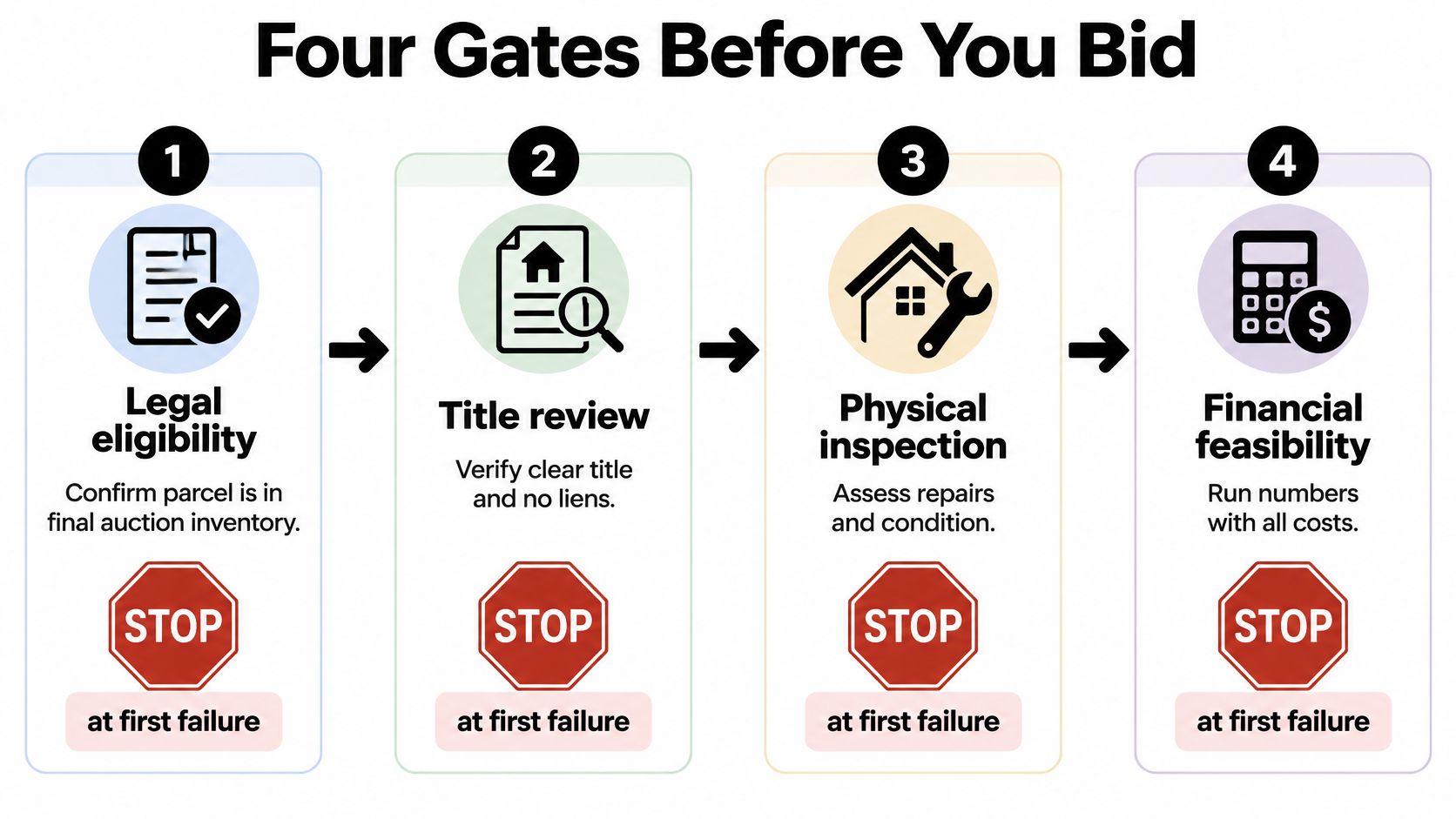
Gate 1 is legal eligibility. Clark County's treasurer FAQ states that properties generally become eligible after three consecutive fiscal years of delinquency, and parcels can be removed before sale. Confirm the parcel is still on the final inventory the morning you bid. Output: a dated screenshot of the final list with the parcel number circled.
Gate 2 is economic viability. You need a positive spread after the minimum bid, repairs, carrying costs, resale expenses, title work, and contingency. The Clark County Treasurer FAQs warn that some government liens and other encumbrances may survive, so the minimum bid is not the acquisition cost. Output: the written ceiling, with every blank either filled or marked "do not bid."
Gate 3 is physical feasibility. Walk the exterior. Pull permit history. Note flood or environmental exposure. Write a conservative assumption for every room you couldn't enter, and order an independent title search covering liens, bankruptcy, probate, code violations, zoning, and access. Don't trust the auction list alone. Output: a one-page condition memo a contractor could price.
Gate 4 is execution readiness. Register, hold funds in the form the notice requires, and confirm who can sign. Payment deadlines can be same-day or next-business-day, and an unpaid winning bid may be re-auctioned. A quitclaim deed is what gets recorded, so budget a quiet-title path where counsel wants one. Output: a funding checklist with names, amounts, and the clock.
What to track, and what usually fails
Keep a pass-rate dashboard: parcels screened, parcels that survived title review, parcels that survived the valuation stress test, bids submitted, wins, completed payments, and properties that reached resale or rental. That log separates "I looked at a lot of auctions" from "I finished purchases."
People fail in the same four ways. They assume the minimum bid clears every lien. They paste retail comps into the model with no condition or occupancy adjustment. They skip demolition and code-compliance cost. They bid without immediately liquid funds. Our Comp Finder shows recent comparable sales for any address, and the free calculators (ARV, rehab cost, 70% rule, fix and flip, BRRRR, wholesale, and Comp Finder) need no account, so the stress test doesn't wait on a login. Pair that with a real estate due diligence checklist so the gates stay in order.
This week, write the walk-away price for your top address and check it against all four gates. If one gate fails, the address is done.
PropLab turns a pasted address into comps, an ARV, repair signals, and a max offer you can compare with that walk-away price before you register for a Las Vegas auction. You can run the numbers from public records without MLS access, then export a report for a partner or a lender. Start with the address you're tempted to bid on at PropLab.
About the Author
P
PropLab Team
Real Estate Analysis Experts
The PropLab team consists of experienced real estate investors, data scientists, and software engineers dedicated to helping investors make smarter decisions with AI-powered analysis tools.
Free account
Underwrite your next deal in under a minute
3 free analyses, no credit card. ARV, rehab, comps and exit strategy in one report.
