General
Lien on the House: What It Is and How to Check
November 11, 2026
14 min read

You found a house priced under the neighborhood, and the seller still owes the roofer for a job finished last spring. That unpaid bill can stick to the house, not just to the person who hired the crew. Before you treat the asking price as spendable equity, you need a plain picture of what a lien on the house does, who gets paid from a sale, and which risks a public search never shows.
What a Lien on a House Actually Means
Say you're the buyer on that well-priced house. The roof looks new. The seller says the contractor will "get paid at closing." Until that debt is settled, the house itself stands behind the bill.
Think of the claim as a hold placed on the deed. It's a notice that the property can't change hands cleanly until the debt is handled. The legal name for that hold is a lien on the house: a legally enforceable claim against the property that secures repayment of a debt.
Most owners already live with one and barely notice. A mortgage lien is the common case. The lender records an interest in the home, and the borrower generally can't transfer clear title until the debt is paid or the lien is released. If the borrower defaults, that recorded interest also gives the lender a path to foreclosure, subject to state law and required procedures.
The claim stays with the property, not the person. Buy it without a payoff and a release, and you can inherit the debt.
A first mortgage normally ranks ahead of later-recorded mortgages and many other voluntary claims. Tax liens and certain statutory claims can still jump ahead under local law. As of June 30, 2025, banks covered by the Office of the Comptroller of the Currency serviced approximately 10.8 million first-lien residential mortgage loans representing $2.7 trillion in unpaid principal balances. Those first liens are the baseline, not the whole story.
Three questions decide whether the price is real. Which claims are on the property? Who gets paid first? What proof shows each one is gone before you write the offer?
Types of Liens on a House Compared
| Lien type | Typical holder | Usual cause | Typical priority | Usually cleared at sale? |
|---|---|---|---|---|
| Mortgage lien | Bank or lender | Home purchase or refinance loan | First lien is senior to later liens | Yes, paid from proceeds |
| Property tax lien | City or county | Unpaid property taxes | Often senior to mortgages | Yes, must be paid to close |
| Mechanic's lien | Contractor or supplier | Unpaid work or materials | State statute sets the rank | Usually cleared by payment, waiver, or bond |
| Judgment lien | Creditor | Court judgment against the owner | Usually junior to earlier recorded liens | Yes, satisfied from proceeds |
| HOA lien | Homeowners association | Unpaid dues or assessments | State law and the HOA documents set the rank | Usually paid from proceeds |
| PACE lien | Local PACE program | Clean-energy loan repaid through property taxes | Often similar to a tax lien | Usually paid off at sale |
| Federal tax lien | IRS | Unpaid federal tax debt | Set by the date the IRS files its notice | Yes, paid or released at closing |
The useful split is voluntary versus involuntary.
A voluntary lien is one the owner agreed to. A purchase mortgage, a refinance, and some Property Assessed Clean Energy (PACE) financing fall here. You usually have a loan payoff path, a servicer, and a number you can request in writing.
An involuntary lien is one a creditor or a government creates. Unpaid property taxes, a contractor's claim for materials, a court judgment, HOA assessments, and an IRS notice can appear without the owner telling you. The roof example is the classic surprise. The owner paid the general contractor, a supplier still wasn't paid, and the claim landed on the house.
That split changes your phone calls. Voluntary claims usually start with a payoff letter. Involuntary claims start with a recorder search, a court index, or a tax office, because the seller may not know the balance.
State rules move the edges of the table. Mechanic's lien deadlines, HOA lien power, and PACE seniority aren't the same in every state, so treat each row as a typical pattern and confirm the local statute before you rely on it. A property-tax claim is a different animal from a mortgage, which is why a side-by-side of a tax lien versus a tax deed belongs in the same folder as this list.
How Lien Priority Decides Who Gets Paid
A foreclosure sale works like a payout line. Each creditor stands in a set position, collects in turn, and the seller keeps whatever is left after valid liens and transaction costs. Under standard practice, a first-position mortgage is paid before junior mortgages, and sale proceeds follow recorded priority. A purchase contract doesn't extinguish those claims by itself, so closing needs a payoff, a release, or title-insurance underwriting.
That order is the whole ballgame for a buyer. Projected equity is only real if it survives the waterfall, so you run the claims in priority order before you trust the number on a seller's estimate.
A sale that looks fine until the math
Take a property expected to sell for $300,000, with $220,000 in senior debt, $25,000 in junior debt, $30,000 in delinquent taxes, and $20,000 in foreclosure or disposition costs. Residual equity before other adjustments is only $5,000.
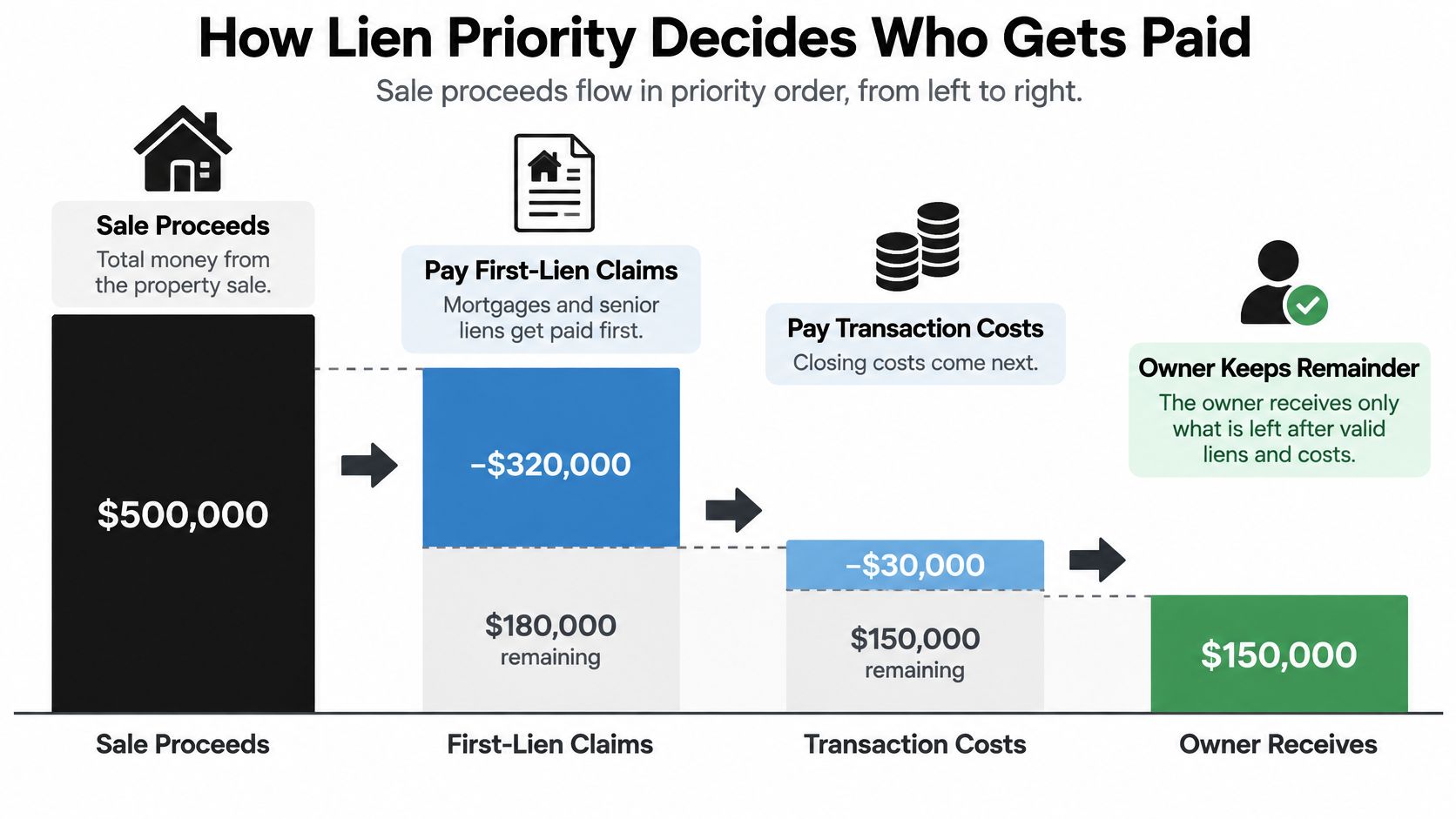
| Layer | Amount | Remaining |
|---|---|---|
| Gross sale price | $300,000 | $300,000 |
| Delinquent property taxes (statutory priority) | $30,000 | $270,000 |
| Senior mortgage payoff | $220,000 | $50,000 |
| Junior debt | $25,000 | $25,000 |
| Disposition costs | $20,000 | $5,000 |
| Residual equity to owner | n/a | $5,000 |
Taxes come off first in this model because a statutory claim can outrank the mortgage. The senior loan takes the next large slice. Junior debt and selling costs then leave a thin remainder. If your offer assumed the seller had $80,000 of equity, the waterfall says otherwise.
When a later claim jumps the line
Recording date sets the default order, and then statute overrides it. Property-tax claims and many PACE assessments collect ahead of an older mortgage. The CFPB's 2024 PACE financing rule states that PACE financing typically receives priority similar to a real-property tax lien, so amounts due may be paid from foreclosure proceeds before other mortgage debt, even when the mortgage predates the PACE lien. Some state statutes subordinate PACE instead, so confirm the local rule before you model it.
Say foreclosure value is $250,000, with $190,000 of first-lien debt, a $35,000 PACE balance, $12,000 in delinquent property taxes, and $18,000 in selling and legal costs. If the PACE and tax claims are senior, the shortfall is $5,000 before any junior liens, utilities, or extra interest.
Practical rule: Subtract statutory-priority claims from projected proceeds before you set a maximum offer. Treat them as a first draw on the sale, because they change what the seller can actually net, and sometimes whether insurable title can be conveyed at all.
A title report should name mortgage liens, judgment liens, tax liens, mechanic's liens, HOA claims, and any recorded release. Match recording dates, original amounts, current payoffs, per-diem interest, and attorney fees, and ask whether the claim survives the sale. If several creditors are already in line, a plain walk-through of navigating creditor claims against your home helps you see which fights belong at the closing table and which belong in court.
How to Check a Property for Liens Step by Step
A single website search isn't a lien check. Work the public record in order, and keep a copy of what each office gave you.
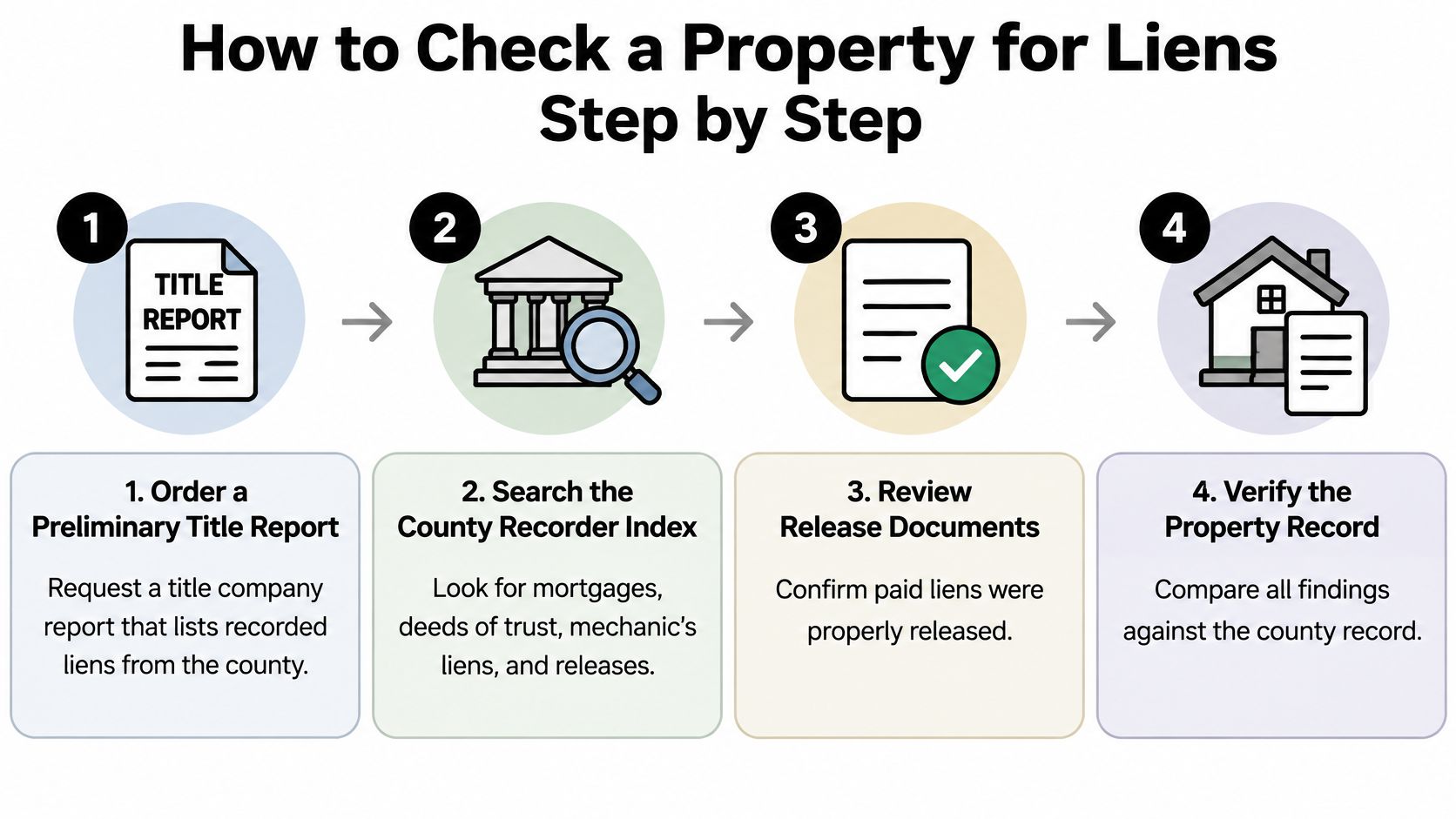
Order a preliminary title report. A title company pulls recorded claims from the county and puts them in one commitment. That report is your master list, not a guarantee. Keep the commitment, its effective date, and every exception schedule.
Search the county recorder index. Look up the owner name and the legal description for mortgages, deeds of trust, mechanic's liens, and releases. Names get misspelled and parcels get split, so search both. Save the recording date, book and page or instrument number, original amount, and beneficiary for each hit.
Pull the municipal tax certificate. Order it by parcel number, and ask for delinquent taxes plus special assessments. A mortgage payoff won't include a city balance the recorder never indexed. Keep the certificate and the payoff good-through date.
Search court indexes. Check state and county courts for judgments and pending suits against the owner. A judgment that isn't yet in the recorder's mortgage book can still attach. Print the case caption, the judgment amount, and the filing date.
Ask the PACE administrator or assessor. Request any clean-energy or special-assessment balance tied to the parcel. These amounts often ride with the tax bill. Keep the written balance and the payoff instructions.
Request written payoff statements. Contact each lienholder for the current balance, per-diem interest, and fees. A recorded original amount is history, not today's number. File each payoff letter with its expiration date.
Match every lien to a release. A paid claim with no recorded satisfaction is still open on paper. Flag anything without a matching release or satisfaction. Keep both the lien and the release side by side.
Hand the full packet to title counsel. The title company, or your real estate lawyer, should say which items must be paid to close and which can be insured around. Outside the U.S., the same job falls to local specialists. Conveyancing lawyers in Singapore clear title before completion the way a county title company does here. Keep their written list of must-pay items with your offer file.
What a Lien Search Can Miss
A clean-looking search is evidence. It isn't proof the property is ready to close.

Fannie Mae's servicing guide on title defects requires a mortgage to be a valid, subsisting lien and the property to be free of superior encumbrances. It also tells servicers to take reasonable steps to correct defects and, where possible, resolve them during foreclosure. Its classifications include an "unrecorded mortgage" that isn't properly reflected in the chain of title, plus foreclosure delays or cancellations caused by title issues.
Hidden risks with a face on them
- Paid, never released. The owner paid the mortgage in 2019. The lender never recorded a satisfaction, so the index still shows an open loan.
- Never recorded at all. A private note was signed and funded, but nobody took it to the recorder. The index is silent, and the lender still has a contract.
- Heir or spouse, not a lien form. A probate estate or a divorce decree gives someone a claim through the chain of title, not through a mortgage stamp.
- Filed, not yet indexed. A supplier records a mechanic's lien the afternoon you search. Your morning printout misses it.
- City balance off the deed book. Utility arrears or code-enforcement charges can sit with the municipality and never appear in the recorder index.
- Wrong legal description. A typo attaches a claim to the neighbor's parcel, or hides one that belongs on yours.
What document proves a lien was released, and who pays if the public index is wrong?
Treat the review as a verification workflow, not one database lookup. Budget for payoff statements, release copies, title-company review, and curative work before you lean on a projected resale price. A title policy is the backstop for what the index got wrong, and it only helps if you read the exceptions.
The recording desk is where a lot of these gaps start. Watching how a document gets indexed makes the misses less abstract.
How Liens Get Released and Removed
Paying a creditor and clearing the record are two different events. Title stays clouded until a release or satisfaction is recorded.
| Lien type | How it is released | Who provides proof |
|---|---|---|
| Mortgage | Payoff at closing, then recorded release | Lender |
| Property tax | Payment and receipt or tax certificate | Tax collector |
| Mechanic's lien | Payment, signed waiver, recorded release, or bond | Claimant |
| Judgment lien | Satisfaction of judgment filed in court | Creditor |
| HOA lien | Payoff of assessments and paid-status letter | HOA or management company |
| PACE lien | Payoff and release filed with the recorder | PACE program administrator |
Payoff is not the release
A wire receipt shows the creditor got money. The county still shows the claim until someone records a satisfaction, a release, or a tax clearance. Put the recorded document on the closing checklist, not just the payoff confirmation. If the release can't be recorded before you fund, ask the title company for an indemnity or an escrow holdback sized to the claim.
Mechanic's claims have more than one exit. Pay the claimant and get a signed waiver. Record a bond that moves the dispute off the property and onto the bond. Or challenge a late or invalid filing in court. Deadlines differ by state, so don't assume a claim expired because the work feels old.
Judgment creditors file a satisfaction with the court after payment. HOAs should issue a paid-status letter and record a release of their assessment lien. A wrongfully filed claim can be contested and removed by court order, again on a state timetable.
A title policy typically excepts known liens and disclosed defects. Anything the search found must be paid and released, or written as an explicit exception you negotiate before closing.
Request the recorded release before you schedule funding. A promised "we'll send it next week" is not a cleared title.
Confirm the Lien List Before You Make an Offer
Don't submit an offer figure until the lien list is complete.
Build it in four parts, then subtract.
- Recorded claims. Every item on the title report, with type, recording date, unpaid balance, and beneficiary.
- Latent risks. A paid loan with no release, a probate or divorce claim, or a mechanic's filing that may not be indexed yet.
- Statutory seniors. Tax, PACE, and similar claims that come off the top of projected proceeds.
- Closing costs. Payoffs fees, transfer costs, and any cure work the title company priced.
Projected sale proceeds minus that full list is the ceiling for your offer. A rehab budget doesn't absorb a senior tax claim.
Write the requirements into the purchase contract. You want current payoff figures, per-diem interest, a release commitment from each holder, and a holdback or indemnity for any release that isn't recorded at closing. A payoff quote isn't a release, so the number waits until the release route for each claim is clear.
Pair the title packet with a real estate due diligence checklist so inspections and lien payoffs don't live in separate inboxes. While you wait on the title company, our free calculators cover the offer math beside the lien list. Those are the ARV Calculator, Rehab Cost Calculator, 70% Rule Calculator, Fix and Flip Calculator, BRRRR Calculator, Wholesale Calculator, and Comp Finder, and they require no account. They won't find a missing release. They will stop you from pricing the house as if the liens weren't there.
Request the preliminary title report this week. Reread the lien list, payoffs included, before you send the offer.
PropLab pulls public records, tax assessments, and market data so you can see what a listing price leaves out before you bid. Paste an address and get comps, an after-repair value, rehab estimates, and a max offer you can adjust once the lien payoffs are in. Start that check at PropLab before the next offer goes out.
About the Author
P
PropLab Team
Real Estate Analysis Experts
The PropLab team consists of experienced real estate investors, data scientists, and software engineers dedicated to helping investors make smarter decisions with AI-powered analysis tools.
Free account
Underwrite your next deal in under a minute
3 free analyses, no credit card. ARV, rehab, comps and exit strategy in one report.
