General
Liens Against Property: Types, Priority and How to Check
November 10, 2026
17 min read

You found a house priced well under what the comps suggest it should sell for after a clean rehab. The photos show a tired kitchen, the seller wants a fast close, and the gross after-repair math looks comfortable. Then the title commitment lands, and the exceptions list a mortgage, an old judgment, a contractor claim, and an association balance that is larger than the face amount on the recorded document. Those liens against property don't behave like a repair line item you can shave in negotiation. Each one is a claim on the property itself, and the dollars you can keep depend on priority, the current payoff, and the release evidence a title company will accept.
Lien Types Against Property at a Glance
A lien is a legal claim recorded against a property to secure an unpaid debt. It can stop a sale or a refinance even when the owner insists the bill is wrong. A filed notice doesn't mean the government, a contractor, or an association walks in and takes the house that week. It publicizes a claim that has to be paid, released, subordinated, discharged, or otherwise resolved before anyone can deliver clean title.
Six types show up again and again. Mortgages are the one most buyers already expect. Mechanic's liens, judgments, taxes, and association claims often appear only after someone searches.
| Lien type | Typical claimant | Attaches to | Priority tendency |
|---|---|---|---|
| Mortgage | Lender | Financed real estate | Usually first if recorded first |
| Federal tax lien | IRS | All property and rights of the taxpayer | Ranks from the filed notice, with statutory exceptions |
| State or local tax lien | State, county, or city | Real estate | Often ranks ahead of a later private mortgage |
| Mechanic's lien | Contractors, subcontractors, suppliers | Improved real estate | May relate back to the start of work |
| Judgment lien | Court judgment creditor | Real property in the county | Ranks from the recording date in that county |
| HOA lien | Homeowners association | Individual unit or lot | Some states give a limited super-priority slice over a mortgage |
Why the tax row is not a rare event
Federal tax liens are a live underwriting item, not a textbook leftover. CNBC's report on IRS lien filings notes that the IRS filed more than 214,000 notices of federal tax lien in fiscal year 2025, a 9% increase from the prior fiscal year and a 36% increase from fiscal year 2022. That volume is still below the pre-pandemic range of roughly 400,000 to 500,000 annual filings, and well under the approximately 1.1 million notices filed in fiscal year 2010. A notice isn't the same thing as a seizure. It establishes or publicizes the government's claim, subject to rules on recording, competing liens, exemptions, and discharge. Unlike a roof bid, that claim can survive a price talk with the seller.
Use the table as a search checklist
Each row has its own office and its own proof of release. A county recorder index won't show every city tax balance, and a mortgage payoff letter won't clear a contractor. If the property was recently rebuilt, pair this scan with understanding construction liens in Hawaii so you see how a construction claim is created and released in one state before you assume every state works the same way.
Before you order a search, write down which of the six types could plausibly hit this address. Inherited, distressed, and chronically delinquent properties deserve every row. A straightforward owner-occupant sale with one lender may only need the mortgage and tax rows checked hard.
How to Search Public Records for Liens
A useful search starts with who owns the land and works outward to every claim that might ride with it. Priority can turn on lien type, recording date, attachment date, and statutory exceptions, and on whether the claim hits the land, the improvements, or both. Under the Texas Property Code, a mechanic's lien can take priority over an earlier mortgage in some circumstances, and the improvement can be sold separately while the land stays encumbered. Connecticut gives certain mechanic's liens precedence based on when the work began, while later liens can sit behind an existing encumbrance. Gross ARV can look fine while recoverable equity is much thinner after senior claims, foreclosure costs, unpaid taxes, attorney fees, and required releases.
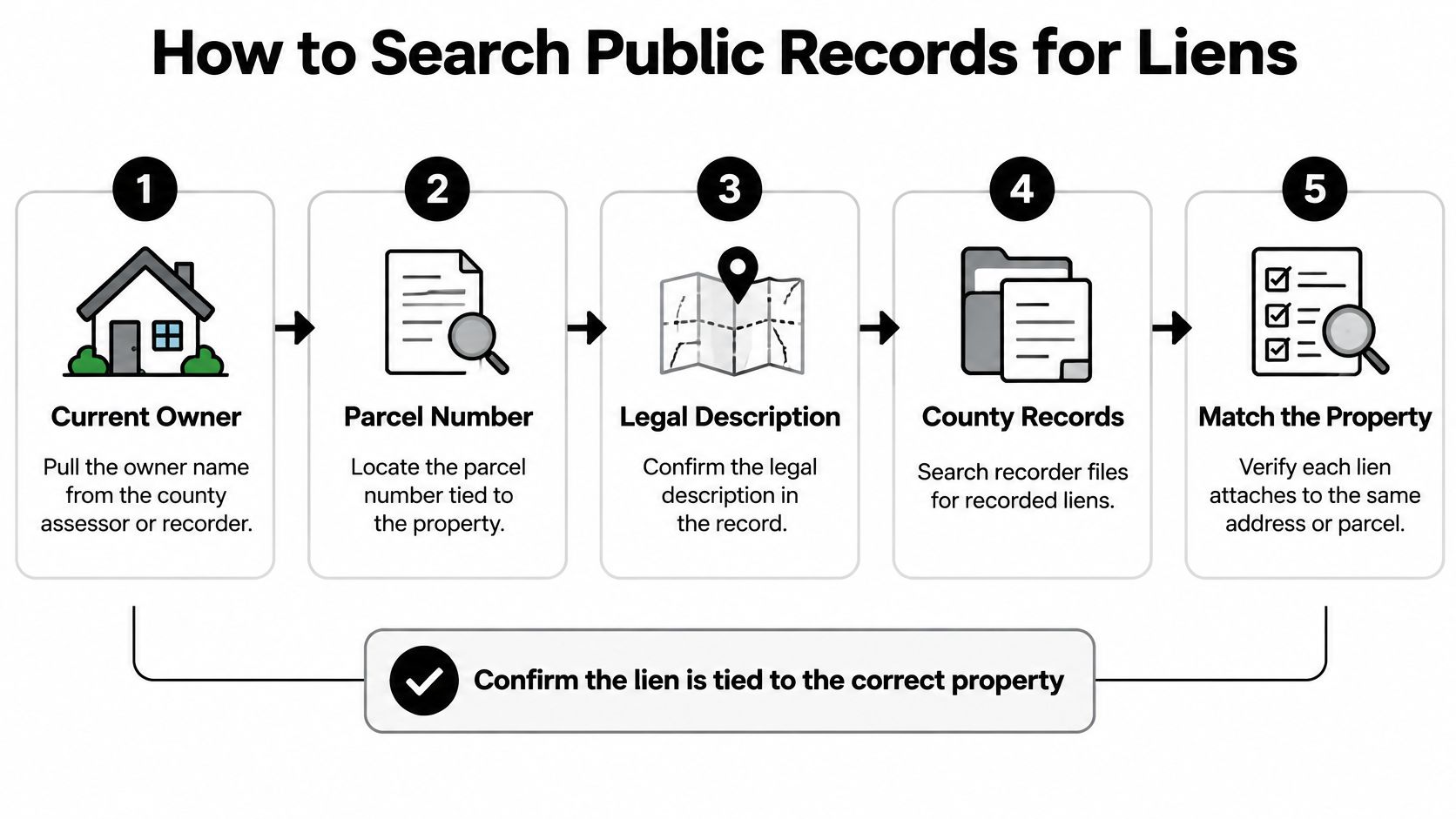
Run the offices in this order
- Pull the current owner name, parcel number, and legal description from the county assessor or recorder so every later hit can be matched to this lot, not a similar name down the street.
- Search the county recorder index by owner and by parcel for mortgages, mechanic's liens, and recorded releases.
- Search for federal tax liens where the owner lives and where the property sits, because the notice has to be filed in the relevant recording office.
- Search the county court judgment index for judgment liens against the owner, then confirm any that were also recorded against the land.
- Check city and county tax records for delinquent property taxes and code liens that a name search can miss.
- Request the HOA ledger and any association lien filings, since the recorded amount is often stale.
- For every hit, look for a satisfaction, release, or amendment. A lien still on the index may already have been paid.
- Write down the attachment date and the recording date for each claim. Rank can follow either one.
| Lien type | Where to search | Search key |
|---|---|---|
| Mortgage | County recorder index | Owner name and parcel number |
| Federal tax lien | Recorder where the taxpayer lives and where the property sits | Owner name, because the notice names the taxpayer |
| State or local tax lien | County tax collector and recorder | Parcel number |
| Mechanic's lien | County recorder, plus court dockets for filed suits | Parcel number and owner name |
| Judgment lien | County court judgment index and recorder | Owner name |
| HOA lien | Association ledger and county recorder | Parcel number and association name |
Turn hits into an underwriting file
Separate the recorded amount from the current payoff. Mark each claim senior or junior only after you have both dates. Note the document that will prove release, whether that is a recorded satisfaction, a certificate, an estoppel, or a bond. A conservative lien-resolution reserve belongs in the deal file. Subtracting every face amount, or ignoring them, both misstate equity.
Practical rule: The search is finished only when each lien has a status and a proof-of-release plan, not when the index printout is in your inbox.
If you want a wider map of assessor, recorder, and court sources before you open a specific county site, this public records property search walkthrough shows how those offices fit together.
How Lien Priority Decides Who Gets Paid
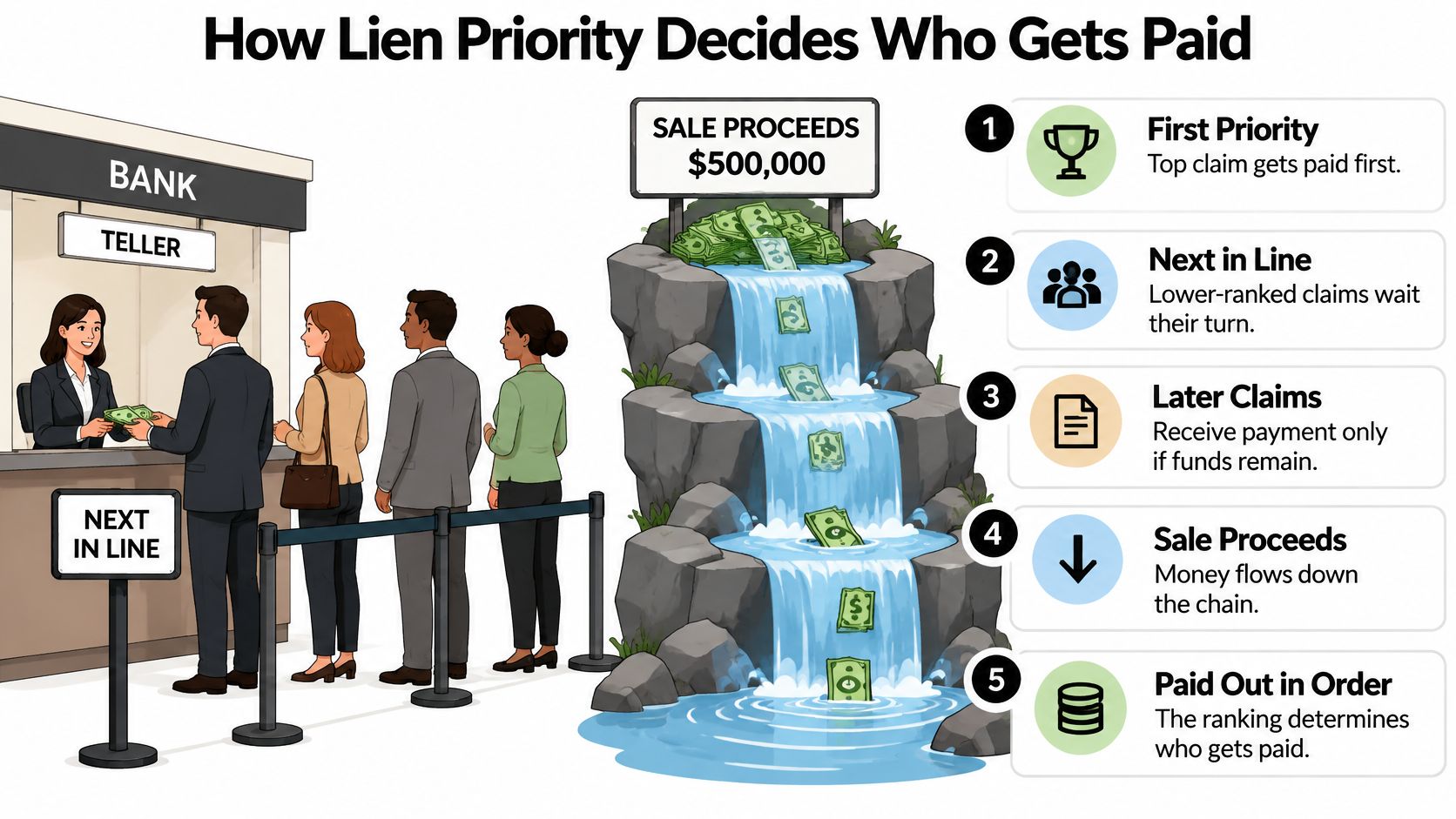
Think of sale proceeds as a line at a bank teller, or as water moving down a series of basins. The person at the front of the line is paid in full before the next person sees a dollar. If the pot runs out, everyone behind them leaves with nothing from that sale, even if their bill is legitimate.
That ordering matters in foreclosure, bankruptcy, or any distressed sale that produces less cash than the total owed. A buyer or lender has to search the recording offices and verify status before closing or funding. An open federal claim can hurt marketability, collateral value, refinancing, and the seller's ability to hand over clear title.
The federal tax test is about the notice, not the debt alone
In the United States, a federal tax lien arises when assessed taxes go unpaid, and it reaches the taxpayer's property and rights to property, including property acquired later. The lien and the Notice of Federal Tax Lien are not the same document. The notice gives third parties constructive notice, and it is generally what the IRS needs in order to establish priority against specified competing creditors. Under Internal Revenue Code §6323, as explained in IRS Publication 1468, a previously perfected purchaser's interest, security interest, mechanic's lien, or judgment lien can outrank the federal tax lien if that notice was not filed first.
A foreclosure by a senior lienholder may discharge a federal tax lien in some judicial or nonjudicial sales. It may also leave the lien in place, or shift it onto the sale proceeds. Notice and sale procedure decide which result you get. Title counsel and foreclosure counsel should confirm the stack. Don't assume a sale wipes every claim.
A stacked payoff, in dollars
Say a property produces $250,000 net at sale.
- First priority: a $180,000 mortgage is paid because it was perfected and recorded ahead of the later claims. $70,000 remains.
- Next in line: a $25,000 mechanic's lien that relates back to work started before the tax notice is paid. $45,000 remains.
- Later claim: a $40,000 federal tax lien, junior because the notice came after those perfected interests, takes $40,000.
- What is left: $5,000 for the owner. That is not the equity the listing price suggested.
Map the full priority stack before you count liens or subtract face amounts from ARV.
Mechanic's Liens and Renovation Risk
In April the framing is already in the walls, and the owner is still arguing about a change order. The investor's ARV math treats that unpaid invoice as a small line item. A mechanic's lien does not work that way.
A mechanic's lien attaches to the improved real estate, not only to the person who hired the crew. It works like a claim stapled to the house: the owner can dispute the bill personally while the land stays encumbered. An unpaid contractor, subcontractor, or supplier can cloud title, block a refinance, or stall a sale until someone produces a payoff and a release.

These claims are uncommon on any single house and common among the people who file them. A Federal Reserve Bank of Philadelphia study found 426 mechanic's liens filed against 398 single-family properties over ten years, less than 0.1% of single-family properties in that market, with about 80% filed by general contractors and the rest by subcontractors. Filing windows and enforcement windows are short, and both vary by state. Miss the local deadline and the claimant can lose the right to enforce. Hit it, and the claim can sit on title long after the drywall covers the work.
A renovation that turns into a title problem
Walk a flip in time order. In March the owner pays for demolition and a dumpster. In April framing starts, and the owner stops paying the framing subcontractor after a dispute over change orders. The subcontractor has a short window set by that state's statute, not by the invoice date the owner remembers. The sub files inside the window. The owner keeps showing the house. The investor's first look at the claim is the title search, weeks after the framing is already in the walls.
The face amount on that claim is not the cost that hits recoverable equity. Priority on these claims can reach back to the start of the work rather than the day the affidavit was recorded. A lender who searched title before funding can still end up behind unpaid labor. Payoff is whatever the claimant will accept to release, which can include extras the listing never showed. Without a signed waiver or a recorded release, that dollar figure is still able to come out ahead of the flip profit the ARV spreadsheet assumed.
If the claimant also files bankruptcy, or the owner does, the property claim and the personal debt can move on different tracks. Mechanics lien guidance from LifeBack Law Firm is a useful read on how a construction claim can interact with a bankruptcy case.
Recently renovated and contractor-heavy houses deserve the closest search. Match the lien file to each payment milestone, including subs the owner says were "included in the GC's price." If a milestone has no waiver and no recorded release, treat that invoice as still able to hit the land. Price the deal off priority, the current payoff, and the release you can record, not off the face amount subtracted from gross ARV.
Tax and HOA Liens That Survive a Sale
A common assumption is that a sale, a foreclosure, or a hard negotiation with the seller clears every claim. It doesn't. Some liens ride through a transfer until a specific payoff, discharge, or statutory procedure removes them. Association claims are the ones investors most often treat as small and then discover are not.
National property-record figures reported by Cotality show 250,951 HOA liens in 2025, up 41.7% from 177,260 in 2022. HOA foreclosure filings rose 46.1% over that span, and about one in nine HOA liens progressed to a foreclosure filing. The number on the recorded document often leaves out later assessments, late fees, legal expenses, and enforcement costs. State law, not the listing agent, sets how much priority an association has against a mortgage, including any super-priority slice. Unpaid HOA or condo charges can also be pre-existing title defects that a basic ownership search doesn't make obvious.
A ledger that eats the margin
Say the recorder shows a $4,200 association lien. By the week of closing the ledger is about $9,500 once late fees, attorney costs, and two more assessment cycles are added. On a thin flip, that gap is the profit. Ask for a current ledger and an estoppel, estimate how long the association takes to issue a payoff, and price both the dollars and the delay. Flag the association claim apart from an ordinary judgment. A judgment creditor and a board with foreclosure rights are not the same risk.
Federal tax claims are the second trap people wave away. Because the lien can reach property the taxpayer acquires after it arises, buying "after the notice" doesn't automatically put you outside it. Whether a foreclosure extinguishes the lien, leaves it on the land, or pushes it into proceeds depends on notice and the type of sale. Morgan & Morgan explains tax liens in the bankruptcy setting, which is a different question from whether a foreclosure sale cleared the property. Read the two outcomes separately. For the property-tax version of this problem, compare a tax lien versus a tax deed before you treat a county claim like a private judgment.
Can you close, renovate, and resell while an HOA lien is still open? Sometimes, and only after you have read the governing documents, the state priority rules, the association's payoff procedure, and whether foreclosure has already started. Model closing delay and resale marketability, not only a one-line deduction from profit. If the buyer's lender won't fund over the exception, the open lien is a failed exit, not a smaller check.
Clearing Liens Before Closing or Refinancing
Every lien needs a route off the property, and every route needs a document a title company will rely on. Face value on a search printout is not that document.
| Lien type | Usual clearing route | Proof you need |
|---|---|---|
| Mortgage | Payoff at closing from sale proceeds | Payoff letter and recorded release |
| Federal tax lien | Payoff, discharge, or subordination | Certificate of release or discharge |
| Mechanic's lien | Payment, release, or bond to indemnify | Recorded release or approved bond |
| Judgment lien | Satisfaction of judgment | Filed satisfaction recorded in the county |
| HOA lien | Pay the ledger or complete the association payoff | Current ledger and estoppel letter |
Bond, waiver, then reserve
A bond to indemnify against a lien substitutes a surety's obligation for the property. Once the bond is approved, served, and recorded the way that state's statute requires, the claim is held against the bond and the land can transfer. The bond has to identify the property and the lien, meet the statutory amount, and come from an authorized surety. Skipping the notice step can leave the cloud exactly where it was.
Renovation files need controls before anyone argues about priority. The IRS Internal Revenue Manual describes the general federal ordering rule as "first in time, first in right," with statutory exceptions and protected creditor classes. Mechanic's liens sit mostly under state law, and their rank may relate back to commencement or inception of the work rather than the day the affidavit was recorded. In some jurisdictions that puts unpaid labor or materials ahead of a later mortgage, even when the lender searched title before funding.
For a fix-and-flip, tie a lien waiver to each payment milestone, confirm every contractor and subcontractor who touched the job, and check that state's filing deadlines and preliminary-notice rules. A recorded claim doesn't prove the claimant will recover the full amount. It can still block conveyance, force a lawsuit, delay a refinance, and cut net proceeds.
Size the reserve from the current payoff plus legal and closing costs to release or bond the claim, not from the number printed on the original filing.
A deal is ready to schedule only when every lien has a route, proof, and a reserve. If one senior claim has none of the three, the closing date on the contract is a wish.
Confirm Clear Title Before You Buy or Fund
Proceed only when every senior lien has a payoff or release route, every junior claim is priced into the purchase, the recorded releases or equivalent proof are in hand or set to record at closing, and the reserve covers what is still open. Your spreadsheet is not that confirmation. The title company or closing attorney is.
- Give each lien from the search a status: paid, releasable at closing, bonded, or unresolved.
- Compare the reserve with current payoff ledgers and estoppels, not with the original face amounts.
- Re-run the recorder and the court indexes shortly before funding. A new filing can land between the first search and the wire.
- Recalculate recoverable equity after the priority stack, cure costs, and the reserve. If that number doesn't support the offer, the ARV was never the offer.
- If any senior claim still lacks a route, stop or renegotiate. Don't fund and hope the exception gets removed later.
A clean chain is what you are buying, not just a building. Walk the recorded history with a chain of title review so a missed owner or an unreleased deed of trust doesn't sit outside the lien list you already built.
PropLab pulls property data from public records, tax assessments, and market data, and you don't need MLS access to start. Paste a property address, or any MLS, Zillow, or Redfin link, and the report comes back with comps and the math. Every analysis also generates a professional PDF that includes the comps, adjustments, and calculations, ready to download, share with partners, or send to lenders. Use that report to see whether the price still works after you have priced the liens. Then verify every lien, tax, and release at the county before you treat the deal as clear. Fund or buy only when clear title, or a funded reserve that clears it, is confirmed by the title company or attorney.
PropLab helps you underwrite the deal around those liens by calculating after-repair value, rehab cost, and an offer you can defend with comps. Run the address, then take the PDF to your title company and your lender before you waive contingencies. Start with the property you're looking at now on PropLab.
About the Author
P
PropLab Team
Real Estate Analysis Experts
The PropLab team consists of experienced real estate investors, data scientists, and software engineers dedicated to helping investors make smarter decisions with AI-powered analysis tools.
Free account
Underwrite your next deal in under a minute
3 free analyses, no credit card. ARV, rehab, comps and exit strategy in one report.
