General
Valuation Explained: Real Estate Methods for Investors
October 9, 2026
14 min read
You're standing in the driveway of a property with peeling paint, an outdated kitchen, and a roof that may need attention. The seller wants an answer today. You've looked at a few nearby sales and have a rough idea of the finished value, but one question keeps stopping you: what is this property really worth, and how much can you safely offer?
That uncertainty matters because valuation drives every later decision. If your After Repair Value, or ARV, is too high, the error flows directly into your renovation budget, profit projection, financing plan, and Max Offer Price. A sound valuation isn't a single impressive number. It's a reasoned estimate built from the right method, relevant evidence, visible adjustments, and a confidence level that reflects the quality of the data.
The Investor's Problem With Numbers
A new investor often loses a deal in one of two ways. They either offer too aggressively because a nearby renovated property looks expensive, or they walk away because they can't defend the finished value well enough to justify the purchase. Both decisions can come from the same mistake, treating valuation as a guess that must somehow become certain before action is possible.
Consider a house that needs a substantial renovation. One nearby sale has a modern kitchen and a strong resale price. Another is smaller but sits on a better street. A third appears comparable online, but its closing details and interior condition are unclear. Averaging those prices might produce a neat answer, yet the average could conceal the very differences that determine whether the deal makes money.
Professional valuation starts with a more disciplined question: which evidence is relevant to this property, this strategy, and this point in the market? The traditional sales-comparison and hedonic approaches treat price as the result of measurable characteristics such as size, lot, condition, location, age, amenities, and capital improvements. The underlying logic developed through Kelvin Lancaster's characteristics approach in 1966 and Sherwin Rosen's formal hedonic-price framework in 1974, as described in this overview of hedonic valuation.
Practical rule: A valuation is only as defensible as the evidence and assumptions someone else can reproduce.
For an investor, that means retaining more than a final ARV. Keep the selected sales, the reasons for including or excluding each one, the adjustments, the weighting logic, and the factors that reduce confidence. If the evidence is thin, the responsible response isn't to add decimal places. It's to widen the possible value range and reduce the price you're willing to pay.
That shift turns valuation from a prediction contest into an underwriting control. You aren't trying to prove that the property will sell for one exact amount. You're deciding what price protects your capital if the optimistic scenario doesn't materialize.
Understanding the Three Approaches to Value
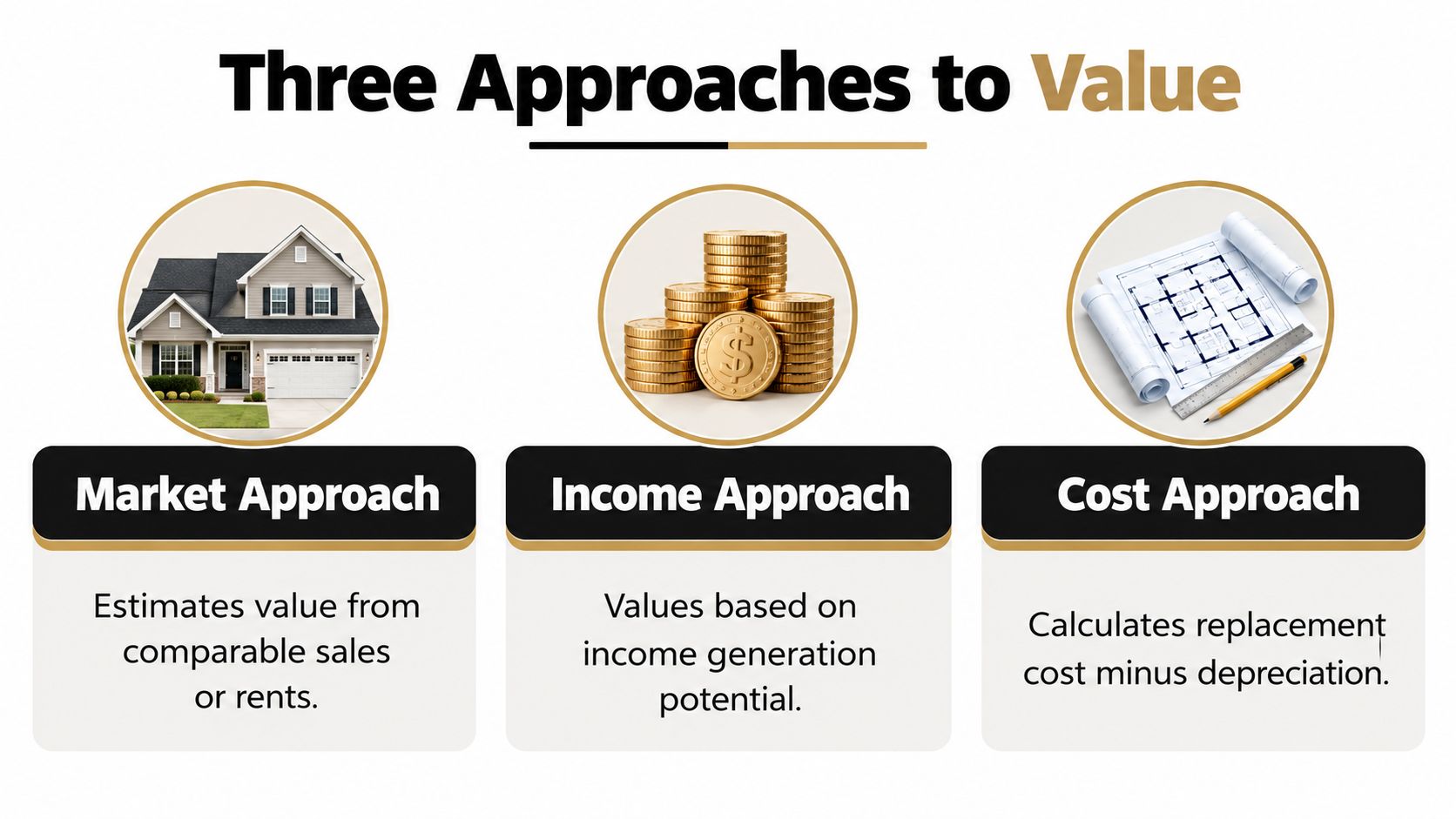
Professional standards recognize three principal approaches to real-estate valuation, market, income, and cost. Each answers a different question, so the right choice depends on the property and the investment strategy, not on a universal formula. The Royal Institution of Chartered Surveyors guide to valuation methods describes the approaches and their distinct applications.
The market approach
The market approach infers value from comparable sales or rents. For a fix-and-flip, this is usually the primary method because the exit price depends on what buyers have recently paid for renovated properties with similar characteristics. The analyst compares the subject property with closed transactions and adjusts for meaningful differences in size, condition, design, location, lot, amenities, and timing.
This approach is strongest when the market contains several genuinely comparable transactions. It becomes less reliable when the properties differ materially or when the available sales are old, geographically dispersed, or difficult to verify.
The income approach
The income approach values a property by converting expected future income into present value through capitalization or discounted-cash-flow logic. It matters most for rentals and BRRRR strategies, where sustainable rent, vacancy, operating expenses, and the selected yield or capitalization rate influence the investment value.
A rental can have attractive resale comparables and still fail the income test. If the expected rent doesn't support the operating costs, debt structure, and required return, the property may not work as a rental even if its physical market value appears reasonable.
The cost approach
The cost approach estimates what it would cost to create an equivalent property, then accounts for depreciation and obsolescence. It can help test replacement economics, unusual properties, or whether a proposed renovation is excessive relative to the asset.
Construction cost alone doesn't establish market value. Buyers don't automatically pay the full amount an owner spent on improvements, especially when the work exceeds neighborhood expectations. Use cost as a cross-check, not as a substitute for observed buyer behavior.
A practical underwriting model chooses one primary approach based on the deal strategy and uses another as a check where the data supports it. If the approaches diverge sharply, investigate the assumptions. Don't average conflicting outputs just to create a more comfortable number.
The following video offers another visual explanation of the core valuation concepts.
How Comparable Sales Drive Your Estimate
The sales-comparison approach treats market value as an inference from recent, arm's-length transactions involving properties with comparable physical, legal, and economic characteristics. A defensible comp set requires more than one nearby address. It should contain closed sales that are recent, geographically relevant, verifiable, and sufficiently similar, as explained in the RICS standard on comparable evidence.
Start with the subject property
Before searching for sales, describe the property you're valuing as precisely as possible. Record the gross living area, lot size, bedroom and bathroom count, year and style of construction, current condition, expected finished condition, parking, amenities, tenure, and any legal or functional issue that could affect buyer demand.
Separate the as-is condition from the after-repair condition. A distressed property may resemble a renovated comp in layout and location, but its current price reflects deferred maintenance while the future sale price reflects the completed scope. Mixing those states creates an inflated ARV.
Rank evidence by quality
Closed sales deserve more weight than asking prices because a listing reflects a seller's expectation, while a closing reflects a negotiated transaction. Give priority to properties that match the subject's physical characteristics, buyer pool, and market segment.
A useful review process asks:
- Verify the transaction: Confirm that the sale closed and investigate unusual circumstances that could make it atypical.
- Compare the neighborhood: A short distance doesn't guarantee similar buyer demand. Boundaries, school access, traffic, views, and street quality can change the relevant market.
- Check timing: A sale from a different market condition may require a time adjustment, even when the property looks similar.
- Normalize characteristics: Account for living area, lot size, condition, design, amenities, tenure, and other features that influence price.
- Document exclusions: A sale can be physically close yet unsuitable because of unusual financing, a major legal difference, or a renovation level that doesn't match the subject.
Make adjustments explicit
Adjustments shouldn't exist only as an unexplained final number. If one comp has a larger lot, superior finish, or better location, state how that difference affects its relevance and estimated contribution to value. The exact adjustment may require local judgment, but the logic should be clear enough for a partner or lender to challenge.
For a deeper walkthrough of comp selection and analysis, use this guide to real estate appraisal comps. The objective isn't to find a perfect twin. It's to assemble a portfolio of evidence, weight the most comparable transactions more heavily, and show where judgment enters the estimate.
When the comps disagree, don't hide the disagreement by using a simple average. Sparse or inconsistent evidence should lower confidence and widen the valuation range. That uncertainty must carry into the offer, because an overstated ARV can eliminate the contingency and profit margin you thought you had.
Building Your ARV and Maximum Offer Price
After selecting and adjusting the comps, translate the evidence into an ARV that supports an actual purchase decision. The familiar structure is:
Maximum Offer Price = ARV minus rehab costs minus desired profit margin
The arithmetic is simple. The underwriting is not. Every dollar added to ARV increases the apparent amount you can pay, while every underestimated repair or omitted project reduces the protection around your return.
Separate the inputs
Build the model so each assumption can be inspected independently. Your ARV should show the selected comps, adjustments, and relative weighting. Your rehab budget should distinguish visible work from uncertain items such as concealed damage, structural concerns, mechanical systems, and permit-related requirements.
Roof condition illustrates why a broad rehab allowance can be dangerous. If the inspection suggests a tile roof problem, review a specialized tile roof replacement guide to understand the scope categories that may affect your estimate. The resource doesn't replace a contractor's bid, but it can help you identify questions before finalizing the budget.
Your profit margin also needs a clear definition. Decide whether it represents the return you require for capital, time, execution risk, and the possibility of a slower sale. Don't treat it as whatever remains after optimistic assumptions.
Let confidence change the offer
Suppose the comp set is highly similar and the renovation scope is well documented. You may be comfortable underwriting near the base ARV. If the sales are stale, spread across different submarkets, or inconsistent in condition, the base estimate deserves less authority. Use a downside scenario and reduce the amount you're willing to offer rather than pretending the uncertainty has disappeared.
A report should preserve the comp set, adjustment logic, weighting rationale, confidence score, and final MAO. That record lets a partner reproduce the conclusion and makes it easier to identify which assumption changed when the deal no longer works.
For a structured way to connect ARV, repairs, financing, and profit assumptions, use the PropLab fix-and-flip calculator. Whether you use that calculator, a spreadsheet, or another underwriting system, the principle remains the same: the MAO is only as reliable as its weakest major input.
Why Valuation Is a Range Not a Point
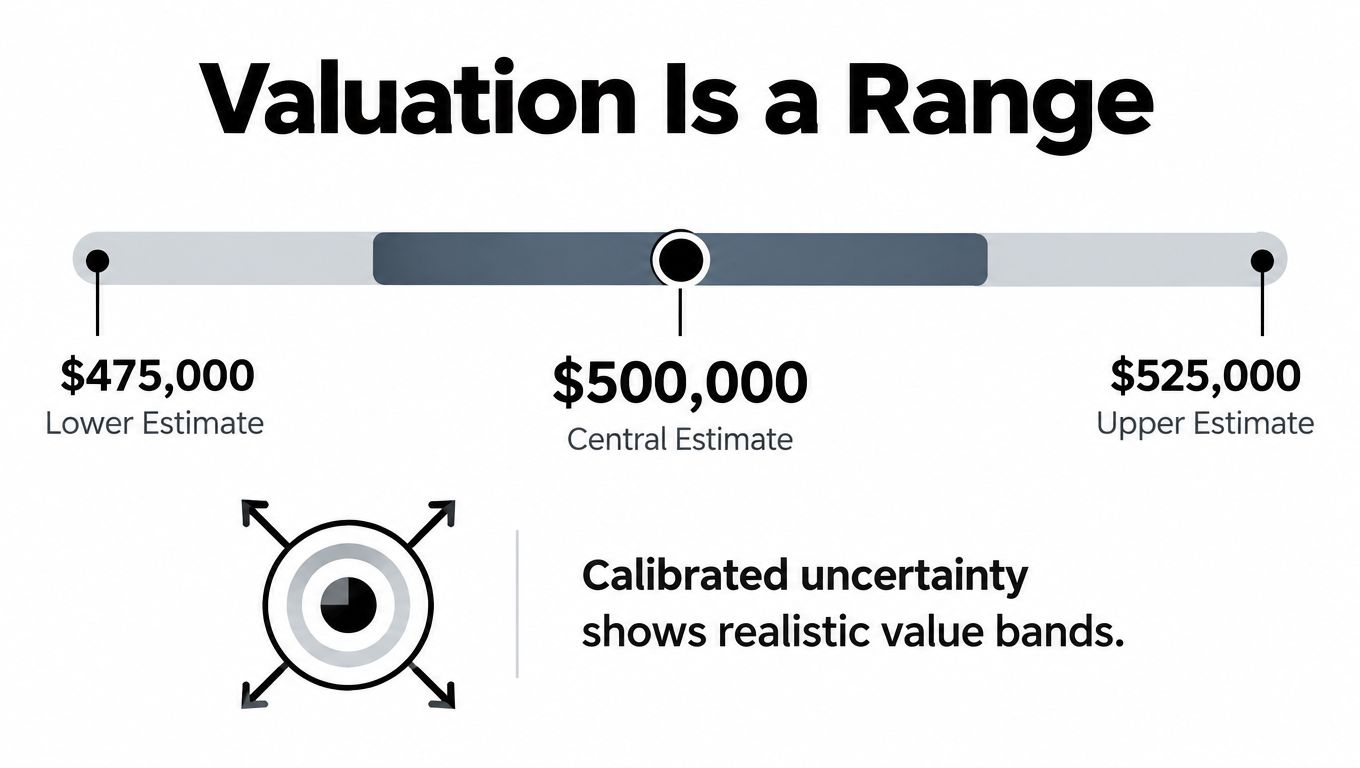
A single valuation figure creates false confidence. It suggests that the market has revealed a precise answer when the evidence may only support a band of plausible outcomes. Valuation explained properly means showing both the estimate and the uncertainty surrounding it.
Research using 51,570 Oslo apartment transactions found that AI-based uncertainty quantification identified risky investment opportunities more effectively than human evaluation and produced better simulated profit margins and purchase ratios. The same research found that location, predicted price, and property size accounted for 81.3% of estimated uncertainty, as reported in the study on uncertainty quantification in real-estate investment.
What creates uncertainty
A valuation becomes less dependable when the evidence doesn't closely match the subject. Watch for:
- Sparse comps: Few relevant closed sales leave more room for judgment.
- Stale transactions: Older sales may reflect different buyer demand or financing conditions.
- Geographic spread: Properties from separate submarkets may not share the same pricing behavior.
- Heterogeneous stock: Large differences in condition, layout, age, or finish make adjustments harder to defend.
- Unclear data: Missing details about renovations, concessions, or transaction circumstances weaken the comparison.
The result should include a base case, a downside case, and an upside case. The range isn't an invitation to choose whichever outcome supports the purchase. It's a way to connect evidence quality to the margin of safety.
Decision rule: The weaker the comp evidence, the less your offer should depend on the optimistic end of the range.
That rule also improves communication with capital partners. A lender or investment manager can see whether the risk comes from location, property condition, market liquidity, or an uncertain renovation assumption. Teams that need help coordinating acquisition decisions can review guidance on how to hire an investment manager, particularly when underwriting responsibilities are expanding beyond one person.
A computer-generated estimate doesn't remove uncertainty. It can measure and communicate uncertainty more consistently, but unusual properties and weak data still require human review.
Manual Methods Versus AI Analysis Tools
A spreadsheet makes the underwriting visible. An investor can list each comp, record adjustments, test scenarios, and see how a change in ARV affects MAO. That transparency helps partners challenge assumptions. Manual work becomes harder when the search expands, records need normalization, comparable sales require consistent weighting, and every property needs a report built in the same format.
Automated valuation tools reduce that workload by processing larger transaction sets and applying repeatable rules. A 2023 review of automated valuation research found that machine-learning methods outperformed traditional regression across more of the comparative cases examined, although regression performed better in some cases. The finding supports automation's potential, not blind trust. A model can still be poorly calibrated for a particular neighborhood or property type.

Compare the workflow
| Method | Useful for | Main limitation |
|---|---|---|
| Manual spreadsheet | Transparent assumptions and custom scenario testing | Slow research and inconsistent data handling |
| Traditional AVM | Fast estimates from structured property data | May offer limited explanation for unusual results |
| Machine-learning workflow | Nonlinear relationships, comp ranking, and repeatable analysis | Depends on data quality, local fit, and explainability |
| Human review | Exceptions, condition issues, and market context | Time-intensive and vulnerable to individual bias |
PropLab is one example of an AI-powered underwriting platform, and its guide to AI for real estate investment explains how these models work in practice. The platform uses public records, tax data, and market signals without requiring MLS access. It produces ARV estimates, rehab estimates, comparable-sale adjustments, confidence scoring, and a calculated MAO in an offer-ready report. Investors can inspect the supporting evidence and red flags instead of treating the output as a standalone answer.
The practical workflow combines these methods. Use automation to locate and organize evidence, a spreadsheet or report to test assumptions, and human review for unusual properties or weak inputs. A confidence score should change the offer's margin of safety. If the estimate is uncertain, the investor should rely less on its upside and more on evidence that survives scrutiny.
Bringing It All Together for Your Next Deal
A useful valuation process gives you several checks instead of one answer. First, choose the approach that matches the strategy. A flip usually depends on market evidence from renovated sales. A rental or BRRRR analysis needs sustainable income evidence. Cost analysis can test whether the planned work makes economic sense, but it can't establish buyer value by itself.
Next, build the evidence carefully. Use closed and verifiable transactions, compare the subject property's physical and legal characteristics, adjust for meaningful differences, and record why each comp received its weighting. Don't let a convenient nearby sale outweigh a more comparable transaction just because it supports a higher ARV.
Then connect the estimate to the decision. Calculate MAO from ARV, rehab costs, and the required profit margin, while keeping uncertain repair items visible. If the valuation range is wide, the offer should reflect that risk. A deal that works only at the optimistic ARV is not durable enough for a partner, lender, or investor who expects disciplined underwriting.
Finally, use technology with the right expectations. Machine-learning tools can identify nonlinear patterns and process evidence quickly, but their output still depends on relevant data, geographic fit, explainability, and review. A confidence score is useful when it changes your behavior. It becomes cosmetic when you display it but continue offering as though every estimate were certain.
The operating principle: Treat valuation as a system of checks and balances, not a calculated price tag.
Before you make the next offer, ask what supports the ARV, what could undermine it, which repairs remain uncertain, and how much room remains if the downside case occurs. That habit protects the margin before the property reaches the closing table.
PropLab helps investors turn comparable sales, repair assumptions, confidence signals, and profit requirements into a clear ARV and Max Offer Price. Visit PropLab to evaluate your next deal with a more transparent underwriting workflow and offer-ready reporting.
About the Author
P
PropLab Team
Real Estate Analysis Experts
The PropLab team consists of experienced real estate investors, data scientists, and software engineers dedicated to helping investors make smarter decisions with AI-powered analysis tools.
Free tool
Pull comps for any address
Comparable sales with adjustments, ready to defend in front of a seller or a lender.
