General
Comp Choice Omaha NE: How to Pick Sales That Hold Up
November 19, 2026
13 min read

A closed sale can look like a perfect match and still misstate value. In Omaha, a new-construction closing and a resale closing two blocks apart may belong to different buyer segments, so treating them as interchangeable can leave a comp set hard to defend to a lender or partner. New homes generally sell at higher prices than existing homes, but that gap should not be applied as a blanket adjustment to a resale.
The same issue appears among existing homes. Two three-bedroom ranches on one street, sold six weeks apart, can support different values if one has a finished basement, a seller credit, or a renovation. Comp choice in Omaha, NE is a screening problem before it's an adjustment problem. A sound screen narrows the set to a few supportable sales. A weak one forces adjustments to compensate for mismatched properties, making the final value less reliable.
Separate new construction from resale unless the subject competes directly with both. Then assess the differences that buyers would weigh, including condition, finishes, and concessions. Rising prices can also make an older closed sale look stronger than it is: its location may fit, while its date no longer reflects current conditions. Keep the segment and sale timing in view before relying on a price, then verify that each selected comp supports the value you assign.
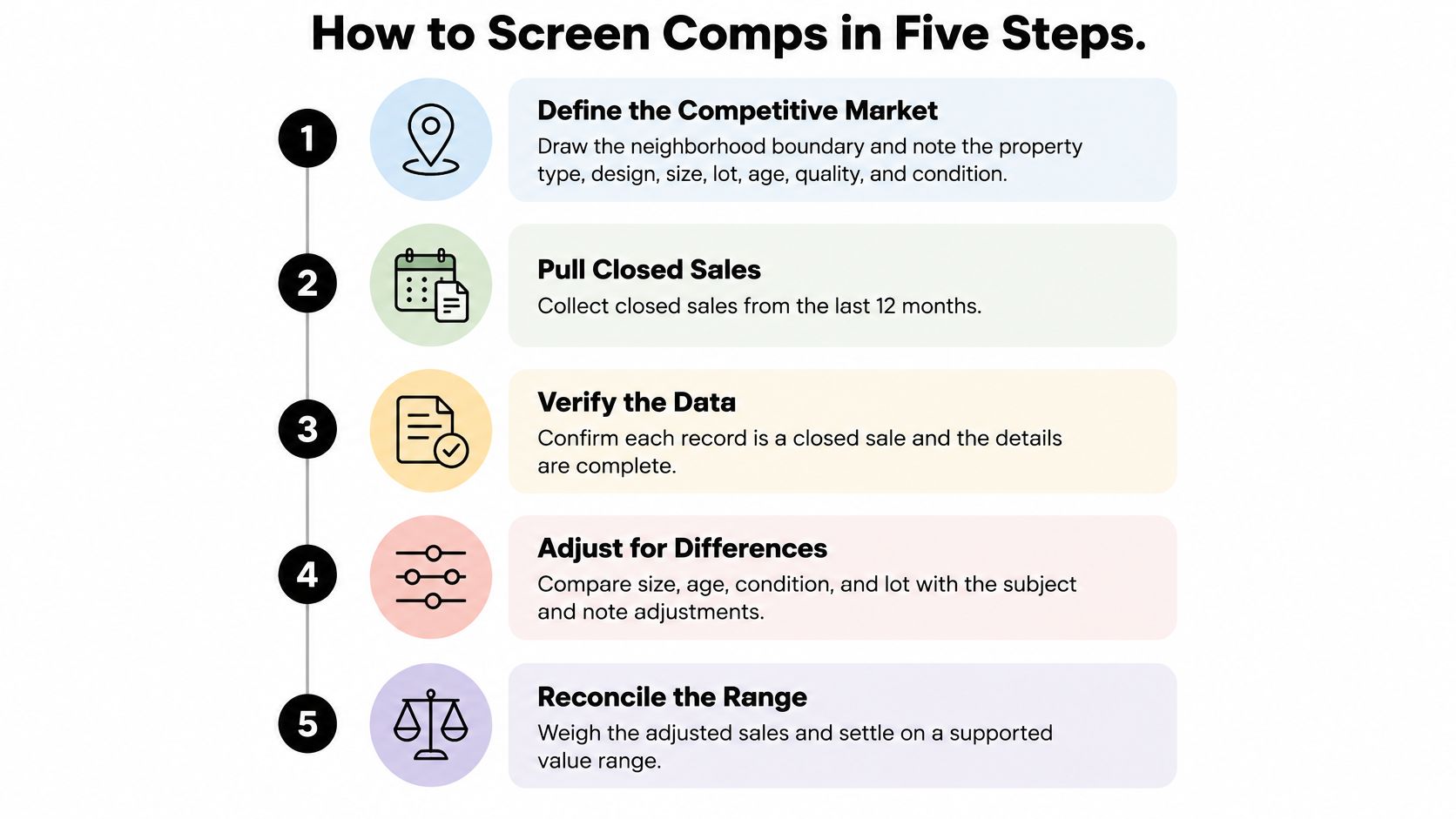
How to Screen Comps in Five Steps
Screening runs in a fixed order, and every shortcut taken early turns into an adjustment you can't support later. Work all five steps even when the answer feels obvious after the second one.
Define the competitive market first. Draw the neighborhood boundary, then write down the subject's property type, design, gross living area, lot size, age, quality and condition. That list is the target every candidate gets measured against. The usual slip is opening a map search and letting the radius decide what the market is.
Pull closed sales, not listings or pending contracts. A listing records what a seller hopes for; a closed sale records what a buyer paid. Start with the prior 12 months and widen the window only when fewer than three usable sales survive the screen.
Rank candidates by marketability. Marketability means a buyer would consider both properties for the same purchase. Same design, same era, same finish level and similar maintenance beats a shorter drive every time. The slip here is sorting by distance and calling the top five results comps.
Keep three primaries and document the rejects. Every excluded sale gets a written reason: wrong era, unadjusted basement finish, a non-arms-length transfer, a two-story sitting among ranches. Rejected candidates are what let you answer the question of why the most obvious sale isn't in the set.
Adjust for time last. Market conditions come after location, size, condition and site, never before. A time adjustment needs closed sales in the same segment that show the movement. A generic appreciation rate is not evidence.
A nine-month-old sale that needs two adjustments is a better comp than a one-month-old sale that needs six. Count the adjustment lines before you pick the newest file on the printout.
The mechanics come from the same standard lenders work from. Fannie Mae's comparable sales guidance requires at least three closed comparables in the sales-comparison approach, states that no universal distance limit applies, and notes that the best sale is not necessarily the newest (Fannie Mae Selling Guide, B4-1.3-08). That last point is the one that saves deals. Recency feels objective; it isn't. It's one variable in a screen that has eight.
Criteria That Make a Comp Usable in Omaha
A sale earns its place by matching the traits buyers pay for, not by sitting close to the subject. Run every candidate down the same rows so a mismatch shows up as a failed row rather than a vague feeling about the house.
| Criterion | What to match | Why it matters |
|---|---|---|
| Neighborhood | Same competitive market boundary | A sale across a boundary may reflect a different market |
| Property type | Same product type and design | Mixed styles distort the indicated value |
| Gross living area | Close to subject size | Size is one of the strongest drivers of price |
| Lot size | Similar site size and usability | Larger or unusable lots shift value |
| Age and quality | Same construction era and finish level | Age and finish often move value more than distance |
| Condition | Same renovation level | Unadjusted condition gaps stack up quickly |
| Sale date | Closed within 12 months where possible | Older sales can understate value in a rising market |
| Sale type | Arms-length, no distress or non-market terms | Non-arms-length sales mislead the benchmark |
Two mismatches end most Omaha sets early. A finished basement on the comp against an unfinished subject adds a feature the subject doesn't have, and the adjustment needed to correct it is large and subjective. A split-level compared with a ranch draws a different buyer pool, no matter how close the two houses sit.
Match the row, not the map. A sale that fails age and condition is worse than no sale at all, because it drags the indicated value toward a house nobody in this market is bidding on.
A 1950s bungalow matched to a new build on the same block fails three rows at once, and no single adjustment fixes it. A distressed transfer fails the sale-type row and stays out regardless of how recent it is, while a sale from a few months back can beat one from last week when it matches on more rows. Print the table, score every candidate across all eight rows, and keep a one-line note on each failure. Rejected candidates belong in the file as backup, not in the trash.
Location Rules Beyond the One-Mile Radius
Say the subject is a 1970s ranch on a tree-lined street and two candidates sit within two miles. The first is 0.6 miles away, on the far side of a four-lane arterial, in a pocket of 1990s two-stories with different lot depths and a different school assignment. The second is 1.8 miles out, same era, same footprint, same street pattern, closed three months ago with a comparable finish level. The farther sale is the comp. The closer one shares a zip code and nothing else.
Distance is still worth recording, just not as a filter. Measure straight-line distance and report it the way an appraisal grid reads, miles plus direction, so the file says 1.75 miles northwest rather than "nearby." That gives a reviewer the geometry without implying the mileage set the value.
Three situations test the rule hardest:
- Metro-edge subjects. Where subdivisions thin out, the nearest usable sale may sit several miles away. Widen the search instead of forcing a weak local match.
- Brand-new subdivisions. The only closings are a few months old and often builder sales, so bring in an established neighborhood nearby for context rather than filling the set with one builder's price sheet.
- Physical dividers. A river, an interstate or a rail corridor ends a market. Two sales at equal distance from the subject can land on opposite sides of that line and behave nothing alike.
Keep distance on the sheet as a fact, then justify each sale by the boundary it sits inside and the marketability it shares with the subject. A comp that crosses a meaningful boundary needs a reason to be there, and "it was close" isn't one.
Existing Homes Versus New Construction in Omaha
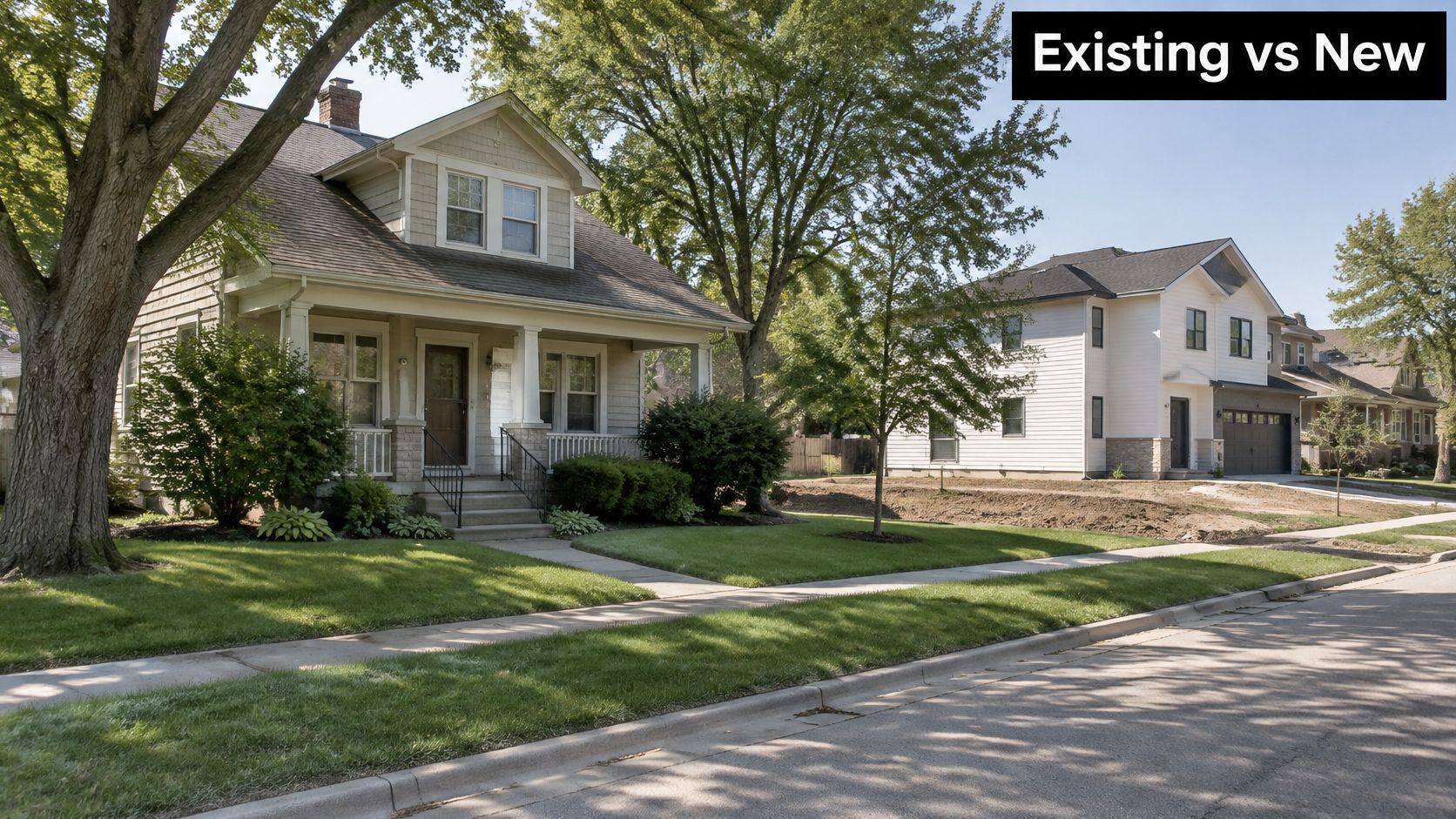
Existing homes and new construction can sell in the same metro area while serving different buyer segments. In August 2026, Omaha recorded 989 existing-home closings, down 7.5% year over year, and 121 new-construction closings, down 18.2% (Omaha.com market report). Those counts describe separate pools of sales, not interchangeable evidence of value.
| Segment | Closed sales | Median closed price |
|---|---|---|
| Existing homes | 989 (down 7.5%) | $330,000 (up 8.2%) |
| New construction | 121 (down 18.2%) | $434,990 |
The median gap signals a mix difference, not an adjustment to apply automatically. New builds may include lot premiums, current-code construction, warranty coverage and builder-selected finish packages. A 1960s ranch does not become equivalent to a new spec home because both are nearby, and a broad metro median can conceal that mismatch.
For a remodeled 1960s ranch, three nearby 2020s spec-home closings may look like a strong match on distance and recency. They can still misstate value because their construction era, features and buyer appeal differ. Build the primary comp set from remodeled ranches of a similar era within the same market boundary. Record the spec homes as rejected, with construction era and finish package as the reasons.
Adjust for differences in lot or finish only when paired sales support the adjustment. If the evidence cannot isolate what buyers paid for a feature, an unsupported dollar adjustment creates false precision. A closed sale can be recent and nearby yet still point to the wrong value when segment mix is ignored.
For investors weighing new-build or modular options, whether modular homes are good investments covers trade-offs in cost, financing and resale behavior. Keep that decision separate from comp selection: use the median to describe its segment, and comparable closed sales to value the subject.
Sale Recency and Price Trends That Shift Value
| Year | Median sale price (Jan-Mar) | Year-over-year change |
|---|---|---|
| 2022 | $257,333 | Baseline year |
| 2023 | $280,500 | 9.0% |
| 2024 | $296,667 | 5.8% |
| 2025 | $304,333 | 2.6% |
| 2026 | $320,596 | 5.3% |
That run adds up to $63,263, or about 24.6%, from 2022 to 2026 (Hastings Tribune report on Omaha prices). The path matters more than the total. Growth ran 9.0%, then 5.8%, then 2.6%, then 5.3%. A soft year doesn't make an older sale safe, because a quiet stretch often follows a large jump, and the older price still sits below today's level. The longer arc says the same thing: an April 2019 median of $196,768 against a later median of $324,098 works out to a 64.7% nominal increase in the same source.
On a deal with a thin spread, margin can disappear quickly. A 2.6% time error on a $300,000 value is $7,800 of profit that doesn't exist, and it usually gets discovered after the rehab is spent.
The limit is scope. A citywide rate is too blunt for one neighborhood or one property type, so derive the adjustment from closed sales in the same segment with the same era, style and boundary. Sequence it properly: newest matching closed sales first, then a test of whether the movement they show supports an adjustment, then the adjustment itself.
The point isn't precision for its own sake. Whether you're deciding to renovate before selling or sell as-is, the number being protected is the spread, and keeping more of your net proceeds depends on pricing against today's segment rather than last year's metro average. It also helps to know which direction the submarket is heading; a supply and demand analysis of the immediate area tells you whether tightening inventory supports the trend your comps imply. PropLab's comp sets are weighted by distance and recency, with adjustment breakdowns and confidence scoring, which shows quickly whether a time adjustment has support.
When the best match closed ten months ago, the file needs three things: the closing date, the movement observed in that segment over those months, and the adjustment amount with the evidence behind it.
Verify Each Comp and Sign Off the Set
A closed price is a claim, not a fact, until you know what produced it.
Name the Record, Not the Category
For every selected sale, name the exact source: Douglas County deed records, county tax records, the MLS, the listing agent, the builder, or the appraiser's file. "Public records" is a category, not a citation, and it can't defend a number under review. Fannie Mae's sales comparison guidance requires the appraiser to analyze all relevant closed sales, contract sales and listings and to identify specific, reliable data sources rather than gesturing at a broad category (Fannie Mae Selling Guide, B4-1.3-07).
Run the Arms-Length Check
Arms-length means neither party was under pressure and the price reflects the property alone. Confirm concessions, financing terms, condition, physical characteristics and the circumstances of the sale. The failures repeat in every market: a distressed transfer used as the benchmark, a concession that inflates the recorded price, a condition gap left unadjusted, and a stack of small adjustments that adds up to a number nobody can defend.
Say a house closes at $330,000 with a $12,000 seller credit toward the buyer's closing costs. The comparable price is about $318,000 before any other adjustment. A set built on the headline figure overvalues the subject by that amount plus whatever the credit was masking.
A concession is a discount wearing a sale price. Find it before it finds your ARV.
Normalize in Order, Then Weight the Range
Work through condition, quality, size, site, location and timing in that order, and stop adding lines as soon as the remaining difference is small. Fewer large, supportable adjustments hold up better than eight small ones that each look reasonable alone. Reconcile into a weighted range instead of a simple average, so the strongest comps carry the most weight and the weakest ones can't set the value.
County data is the backbone of this, but it needs interpretation; this guide to the public record of house sales explains what those records do and don't tell you about a transaction.
The Sign-Off Test
- Every primary comp clears every row. Neighborhood, type, size, lot, age, condition and sale type, with no row left unaddressed.
- Each rejection carries a sentence. If you can't write the reason, the sale wasn't screened, it was only skipped.
- The time adjustment cites segment evidence. Closed sales in the same neighborhood and product type, not a metro growth rate.
- The value comes out as a range. A single number with no spread usually means the adjustments were forced to agree.
A passing set might be three sales from the last year in the same segment, two inside the boundary and one nine months old that needs fewer adjustments than the newer alternatives. If the set fails, widen the search, drop the weak sales, or wait for more closed data before making an offer. Older sales stay valid in thin inventory, but the file has to explain the market change behind any adjustment.
PropLab pulls public records and market signals for any Omaha address and returns a comp set weighted by distance and recency, with adjustment breakdowns, confidence scoring and red flags on condition, so you can see where a value holds and where it doesn't. The same report nets estimated repairs against ARV to produce a Max Offer Price before you write anything down. Run your next address through PropLab and hold the comp set against the criteria above before you commit a dollar to the deal.
About the Author
P
PropLab Team
Real Estate Analysis Experts
The PropLab team consists of experienced real estate investors, data scientists, and software engineers dedicated to helping investors make smarter decisions with AI-powered analysis tools.
Free tool
Pull comps for any address
Comparable sales with adjustments, ready to defend in front of a seller or a lender.
