General
Real Estate Investment Underwriting Explained Step by Step
October 18, 2026
17 min read
You've found a property that looks promising. The seller's price seems workable, the listing photos suggest a manageable renovation, and a nearby renovated home sold for more. You're ready to make an offer, but you're not sure whether the apparent profit is real or just a collection of optimistic assumptions.
That's where real estate investment underwriting earns its place. Before you commit money, you need to separate what you can verify from what you're guessing, then decide how much uncertainty you can afford.
What Real Estate Investment Underwriting Actually Does
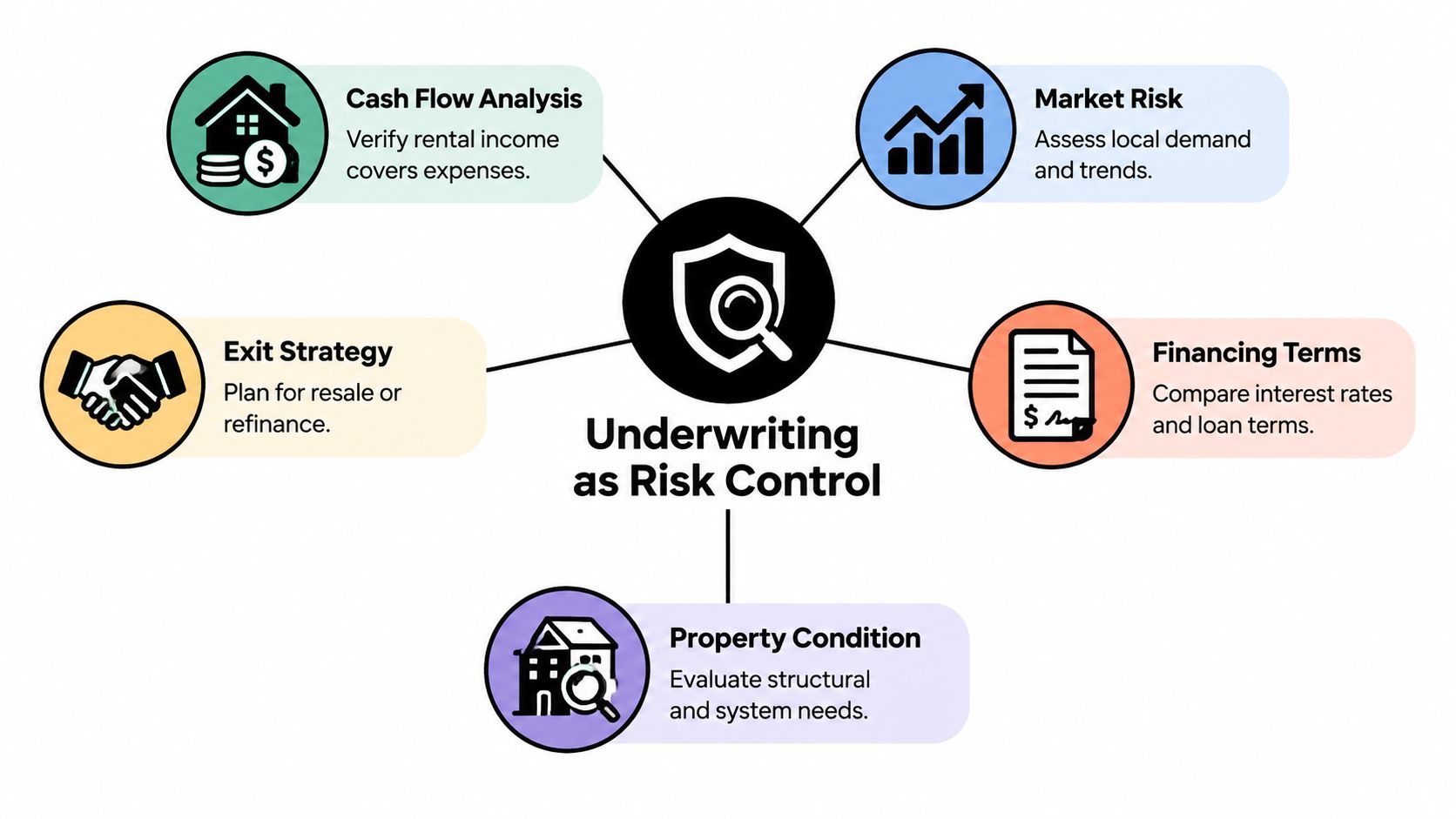
Underwriting is a risk-control process, not just a calculation of potential profit. You're checking whether the property, financing, and execution plan still fit together when something goes wrong.
U.S. interagency real estate lending guidance calls for measurable standards addressing loan amounts, repayment terms, borrower equity and net worth, property cash flow, debt-service coverage, and stress testing. It also requires consideration of secondary repayment sources, such as guarantees. For an investor, the lesson is straightforward: an attractive property value doesn't automatically make the financing safe.
Think of underwriting as checking a loaded vehicle before a difficult trip. The destination matters, but so do the fuel supply, load, mechanical condition, and your ability to handle a breakdown.
The components belong in the same decision framework.
Start with the intended exit
A flipper needs a defensible resale outcome. A rental investor needs sustainable operating income. A wholesaler needs a contract price that leaves room for the eventual buyer's costs and return.
Before you evaluate a sourced property, write down the intended strategy. Then gather evidence in distinct layers:
- Property and market: Establish what you're buying, its condition, and who would purchase or rent it.
- Project costs: Define the renovation, transaction expenses, and expected holding period.
- Capital structure: Confirm debt terms, required equity, and available reserves.
- Exit and downside: Test whether the proposed sale, refinance, or rental operation remains feasible under less favorable conditions.
Keep facts and assumptions separate. A contractor's written scope is evidence; your expectation that construction will finish quickly is an assumption. A completed comparable sale is evidence; an anticipated resale premium needs justification.
Check the investor as well as the asset
Consider a hypothetical dated house with a plausible renovation opportunity. Even if its finished value supports the purchase, the investor may lack enough liquidity to carry it through a delay.
Your analysis should therefore answer both “Can this property work?” and “Can I fund and execute this plan?” An offer-ready file should include supporting documents, unresolved questions, and clear conditions for proceeding, not merely a favorable bottom-line estimate.
Building a Defensible ARV Through Better Comps
After-repair value, or ARV, is an estimate of what the property could sell for after the planned work is completed. The important phrase is planned work. You can't borrow the value of a beautifully renovated comparable while budgeting for a basic cosmetic refresh.
A good comparable is a property the same buyer would reasonably consider instead of yours. Distance helps describe that relationship, but it doesn't establish it.
Freddie Mac explains that the former one-mile guideline isn't a reliable substitute for neighborhood boundaries; comparable selection should reflect genuine substitutes in the same market area. Its guidance on neighborhoods, market areas, and market conditions also says time adjustments should measure market movement from the comparable's contract date, rather than merely its settlement date, to the appraisal's effective date.
Compare buyer choices, not just map pins
Consider a hypothetical property on a quiet residential street. A nearby sale fronts a busy road and has an awkward layout, while a slightly older sale farther away offers similar access, design, and finishes.
The farther sale may be more informative, provided you can support the market and time adjustments. Don't automatically favor it either. Explain why buyers would treat it as a substitute.
Use the following workflow as an organizing aid, not a fixed radius or recency requirement.
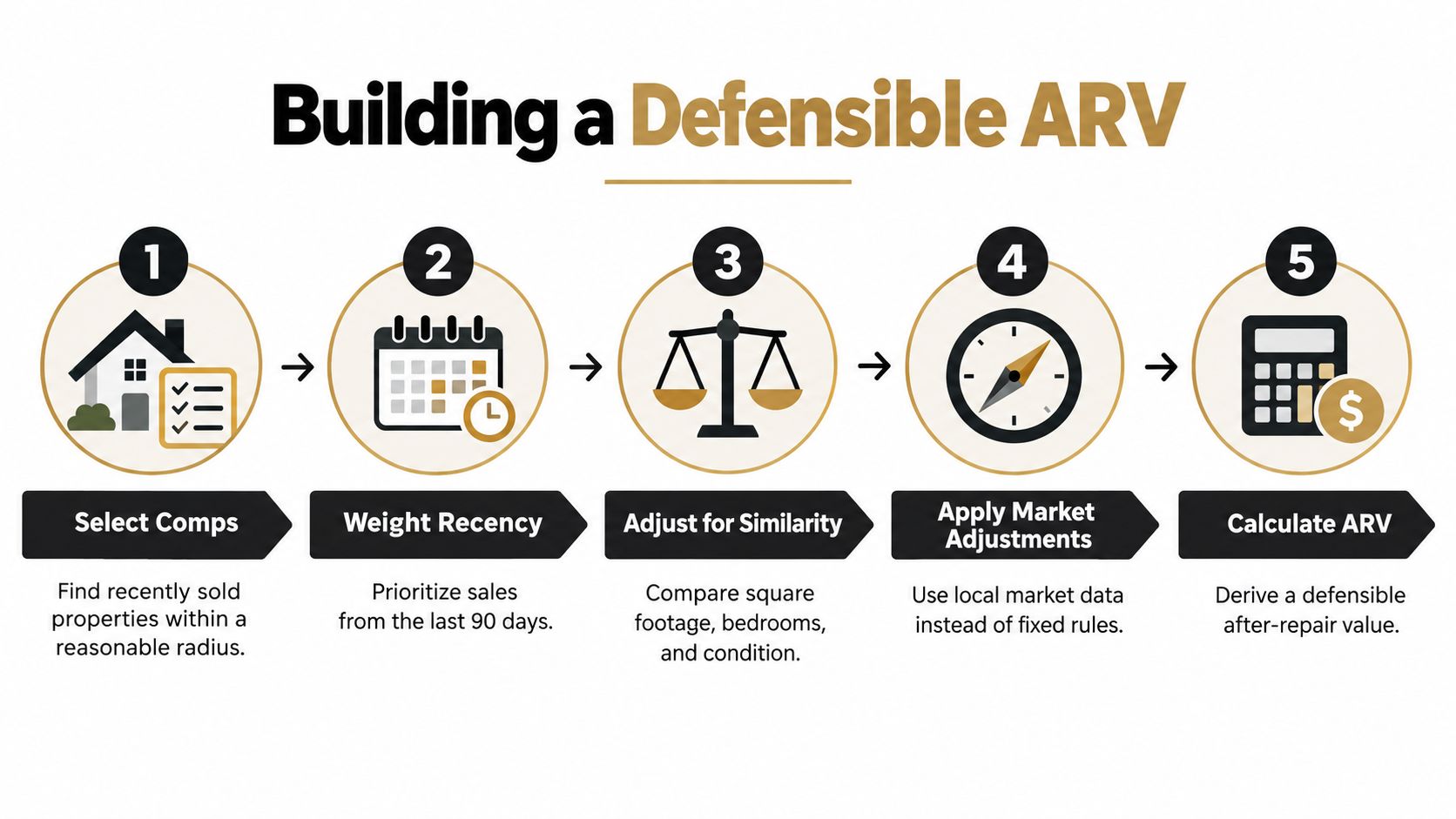
Record each comp's contract date, proximity, condition, layout, relevant location differences, and adjustment evidence. A real estate comparables template can help keep those judgments visible instead of burying them in an average.
Express confidence without false precision
Use high, moderate, or low confidence as an internal assessment, not a statistical guarantee. Explain the rating through substitution quality, recency, verified renovation details, and consistency across adjusted values.
The Mortgage Bankers Association reported that contract prices exceeding appraised values reached about 20% at the March 2022 peak, compared with a historical norm of roughly 5%–7%, in its discussion of valuation challenges. That's a reminder not to treat an agreed price as proof of value.
Valuation discipline: Report a supported range and explain what could make the lower end more realistic.
Carry that range into your offer analysis. Don't apply an unexplained discount because the evidence feels weak.
Estimating Rehab Costs Without Burning the Budget
A renovation budget should describe the work you intend to buy. “Update the house” isn't a scope, and a contractor's quick verbal estimate isn't a complete acquisition budget.
Organize the estimate so another person can see what's included, what's excluded, and what still needs inspection.

Separate visible work from unresolved exposure
Start with categories, then build line items beneath them:
- Cosmetic work: Specify paint, flooring, cabinets, fixtures, and the finish standard needed to support your comps.
- Building systems: Obtain appropriate assessments of electrical, plumbing, and heating or cooling needs. Don't treat unknown condition as evidence that replacement won't be necessary.
- Structural and exterior work: Identify inspection questions involving foundations, roofing, drainage, envelope condition, and site improvements.
- Project administration: Include applicable permits, professional services, demolition, disposal, and inspection requirements.
- Contingency: Reserve capital for uncertainty that remains after investigation, rather than using a cushion to excuse an incomplete scope.
For each line item, record the work description, quantity basis, quote or estimating source, exclusions, and payment timing. The rehab cost estimation guide provides a useful place to develop that estimating discipline.
Follow each scope change through the model
Suppose a hypothetical house initially appears to need flooring and paint. During due diligence, an inspection identifies a plumbing concern, and your contractor explains that addressing it requires opening finished surfaces.
The added work isn't limited to plumbing. Your revised scope must consider access, restoration, sequencing, and any effect on completion timing. Update the acquisition analysis before negotiating, rather than hoping to recover the difference at resale.
Use this video alongside your written scope review.
Keep construction costs separate from financing and carrying expenses so you don't count them twice. Also distinguish optional upgrades from work required to achieve the assumed exit.
A contingency reserve pays for uncertainty. It shouldn't become permission to approve every upgrade suggested on site.
Finally, check cash timing. Even a fully budgeted project can be difficult to execute if contractor payments become due before loan draws are available.
Calculating Maximum Offer Price the Right Way
Maximum allowable offer, or MAO, is the highest acquisition price that satisfies your return requirements and risk limits under stated assumptions. It's a ceiling, not the amount you should automatically offer.
An ARV-minus-repairs calculation is incomplete if it leaves out the expenses between acquisition and sale. A percentage-based shortcut can be useful for preliminary screening, but its multiplier bundles assumptions you should eventually unpack.
Replace the shortcut with explicit deductions
For a flip, use a transparent structure:
MAO = Expected sale proceeds before selling costs − rehab − acquisition costs − selling costs − holding costs − financing costs − required profit
Use consistent accounting. If loan interest appears under financing costs, don't include it again under holding costs. If a contingency is already inside rehab, don't subtract the same reserve elsewhere.
Consider the dated house from your acquisition pipeline. You've established an ARV range and an itemized renovation scope. Deduct the costs of buying, funding, carrying, and selling it, then reserve your required profit.
Run that calculation using both the supported central value and the defensible downside value. If the seller's price works only at the optimistic end, you haven't established a resilient offer ceiling.
MAO Inputs by Deal Strategy
| Input | Fix-and-Flip | Wholesale | BRRRR |
|---|---|---|---|
| Value basis | Supported finished resale value | End buyer's supported exit value | Stabilized value acceptable for refinance |
| Rehab | Scope needed for retail resale | End buyer's expected scope | Scope needed for rental operation |
| Financing | Acquisition and project debt costs | Buyer's financing assumptions, plus your applicable costs | Initial funding and expected permanent debt |
| Holding costs | Construction and disposition period | Buyer's execution period and applicable contract costs | Renovation, lease-up, and refinance period |
| Return requirement | Required project profit | Buyer's return plus assignment compensation | Cash flow and acceptable retained equity |
| Binding constraint | Downside profit and available cash | Buyer feasibility and assignment terms | Coverage, refinance proceeds, and liquidity |
A wholesaler's ceiling must leave room for the buyer's economics and the assignment compensation. Don't confuse the buyer's maximum price with your maximum contract price.
For BRRRR, or buy, rehab, rent, refinance, repeat, a resale-style deduction formula alone won't resolve the purchase decision. Determine whether rent supports the expected debt and whether you can tolerate the equity remaining in the property after refinance.
Your final ceiling should satisfy every relevant constraint. A price that meets the profit target but exceeds your available capital still doesn't work.
Stress Testing the Deal Before You Make the Offer
A profitable base case is a starting point, not an approval. The harder question is whether you can tolerate a plausible combination of weaker income, higher expenses, and a delayed exit.
Debt deserves particular attention. The GAO found average origination loan-to-value ratios of 56% for bank CRE loans during 2012–2017, compared with 65% for comparable commercial mortgage-backed securities loans, in its review of commercial real estate lending. The practical implication is that debt structure changes how much adverse movement an owner can absorb.
Separate sensitivity from combined downside
A sensitivity test changes an assumption while holding others constant. A scenario test changes related assumptions together, such as slower leasing alongside higher carrying expenses.
The graphic illustrates those directions of stress; treat its figures as hypothetical scenarios, not market benchmarks.
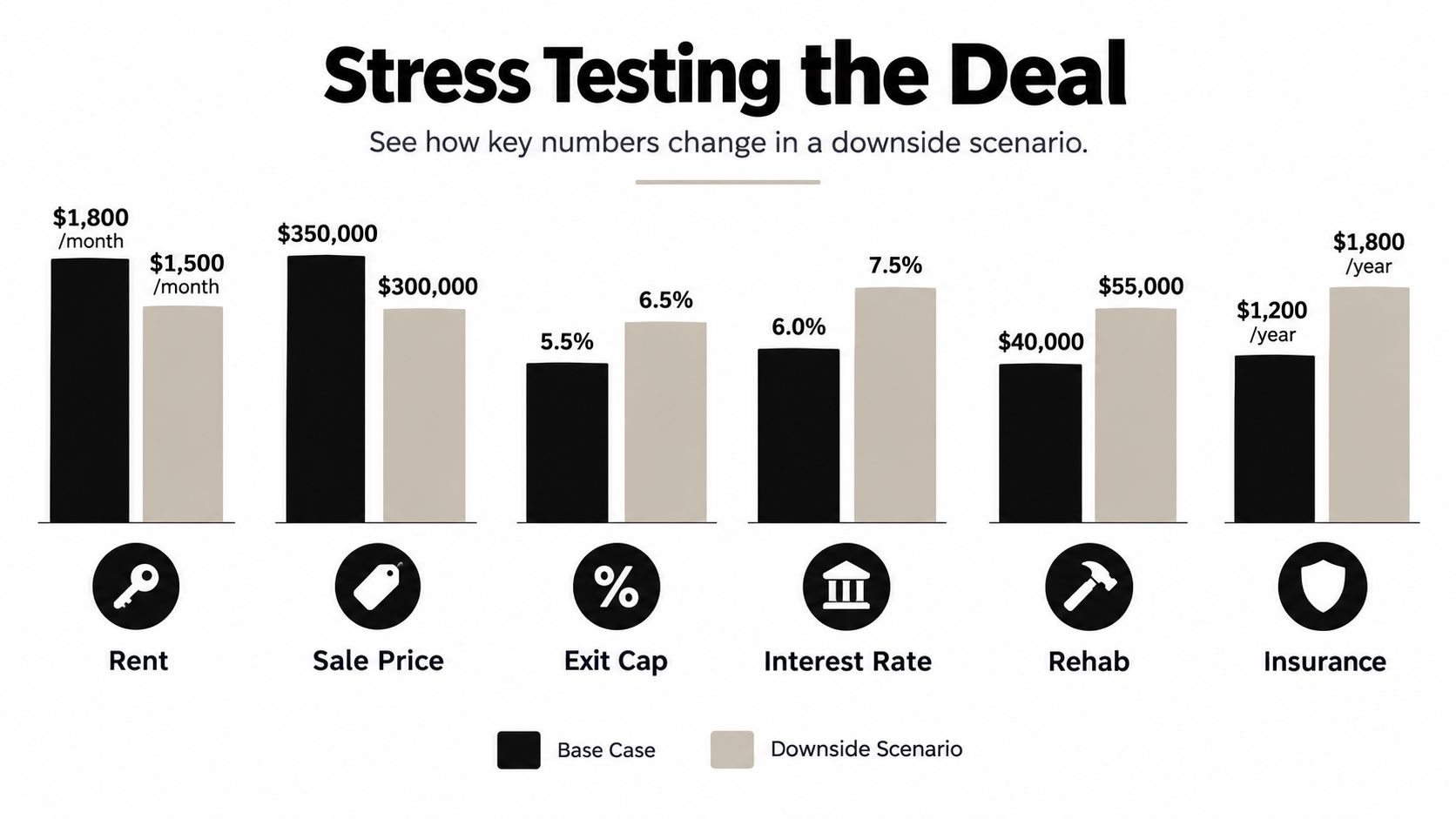
| Variable | Base-case treatment | Downside treatment | Recalculate |
|---|---|---|---|
| Rent and vacancy | Evidence-supported leasing | Lower collections or slower occupancy | Operating income and debt coverage |
| Sale price | Supported comp range | Defensible lower valuation | Net proceeds and project profit |
| Exit capitalization rate | Supported exit assumption | Higher required yield | Income-based exit value |
| Interest and refinance | Quoted or documented terms | Higher cost or reduced proceeds | Debt burden and retained equity |
| Rehab and timing | Itemized scope and schedule | Added work or delayed completion | Cash needs and carrying expenses |
| Insurance | Current suitable quote | Repricing, larger deductibles, or unavailable coverage | Cash flow and reserve needs |
Look for combinations that depend on favorable conditions. Floating-rate debt, aggressive appreciation, and an uncertain construction scope deserve testing together, rather than in isolation.
Underwrite insurance before setting the ceiling
Insurance isn't just a historical expense to copy from the seller's statements. Ask whether suitable coverage is available for your ownership, renovation, and operating plan.
The Urban Land Institute's commercial real estate insurance underwriting guide identifies more than 50 property-level data points that can influence insurance underwriting and notes that missing inputs are often replaced with typical assumptions. That makes incomplete property information a decision issue, not merely paperwork.
Request a current quote, review exclusions and deductibles, and distinguish insured losses from costs you'd retain. Test renewal uncertainty and hazard-related capital work where relevant.
Offer boundary: Find the purchase price and debt level you can support under the downside, not just the combination that produces the most attractive projected return.
Red Flags and KPIs That Separate Good Deals From Bad
A high projected return won't resolve an unverifiable rent roll, questionable title, or uncertain renovation feasibility. Some issues require revised assumptions; others require professional investigation before you proceed.
Treat the following as due-diligence prompts, not automatic diagnoses:
- Unsupported income: Reconcile the rent roll with leases, collections, concessions, and actual operating records.
- Property or legal uncertainty: Ask qualified professionals to investigate title concerns, missing permit documentation, structural questions, or soft-story exposure where applicable.
- Financing mismatch: Identify repayment dates, extension conditions, guarantees, and refinance assumptions that don't match the execution schedule.
- Unresolved coverage: Obtain clarification when exclusions, deductibles, or unavailable insurance leave material exposure with the buyer.
A structured red flags and risk assessment checklist helps distinguish matters you can price from matters you must resolve.
Match each concern to a measurable test
OCC guidance identifies borrower net worth, property cash flow, and debt-service coverage as minimum underwriting considerations, and recommends sensitivity analysis or stress testing in its commercial real estate risk-management guidance. Use those principles to choose metrics that answer specific questions rather than collecting ratios without a decision rule.
| KPI | Calculation or assessment | Question it answers |
|---|---|---|
| Debt-service coverage ratio | Net operating income divided by debt service for the same period | Can property income support scheduled debt payments? |
| Loan-to-value | Loan balance divided by supported property value | How much valuation cushion remains? |
| Capitalization rate | Annual net operating income divided by price or value | What income yield does the property imply before financing? |
| Cash-on-cash return | Annual pre-tax cash flow divided by invested cash | What ongoing return does committed cash produce? |
| Rehab-to-ARV ratio | Renovation budget divided by supported ARV | How dependent is the investment on construction execution? |
| Liquidity reserve | Available cash after closing and committed obligations | Can the investor fund a disruption? |
For help learning the distinctions, The Money Maniac's metrics for first-time investors is a supplementary resource. Confirm the accounting definitions used in your own model before comparing results.
Set decision rules before negotiation
Agree on minimum coverage, maximum debt levels, required reserves, and acceptable return with your lender or investment team. Don't replace those requirements with a universal rule of thumb.
Also specify the valuation basis behind each ratio. A reassuring loan-to-value calculation built on an unsupported ARV doesn't provide the same protection as one based on defensible evidence.
Your review should end with a decision: proceed, renegotiate, investigate further, or decline. An unresolved warning shouldn't disappear merely because the spreadsheet still displays a profit.
Speeding Up Analysis With AI Underwriting Tools
Use AI underwriting tools to accelerate repeatable analysis, not to outsource accountability. The useful distinction isn't manual versus automated. It's visible reasoning versus unexplained output.
A spreadsheet, public-record research, contractor estimates, and an AI-assisted platform can all belong in the same workflow. Choose the combination that lets you inspect evidence, change assumptions, and preserve a clear decision record.
Review an automated report like an acquisitions manager
PropLab is one option for organizing that work: it uses public records, tax data, and market signals to identify comps, apply distance and recency weighting, show adjustment breakdowns and confidence scoring, estimate rehab, calculate MAO, and produce shareable reports. Those outputs still need investor review before an offer.
A practical workflow begins with the address, but it shouldn't end with the generated deal score:
- Confirm the subject: Check that the property characteristics and condition assumptions match what you're evaluating.
- Inspect the comps: Review selection, exclusions, adjustment evidence, and the explanation behind valuation confidence.
- Replace preliminary costs: Enter your inspected scope and contractor-supported budget rather than accepting a default estimate.
- Check offer assumptions: Determine which costs and profit allowances the MAO calculation includes.
- Preserve the record: Export or share the reviewed analysis with supporting documents and unresolved questions.
If you're comparing tools for income-producing properties, BatchData's resource lets you browse CRE deep-dive models. Use that comparison to identify the analytical depth your strategy requires, rather than assuming every deal calculator handles cash flow and financing equally.
Keep judgment outside the automation
Software can organize records and calculations. You still need to assess whether the renovation is achievable, negotiate terms, confirm lender requirements, and obtain appropriate legal, construction, and insurance advice.
Be especially cautious with a confidence score that lacks an explanation. Ask what evidence supports it, what information is missing, and whether you can override inappropriate comparables.
The strongest operational benefit is a more consistent review process. When every deal file uses the same assumptions register and approval questions, partners can challenge the analysis without reconstructing it from scattered messages.
Faster screening should create more time for consequential due diligence, not pressure you to skip it.
Putting It All Together and Common Investor Questions
Before submitting an offer, assemble a file another investor could follow without relying on your verbal explanation. Keep the recommended price beside the assumptions that justify it.
A reusable pre-offer checklist
- Validate the valuation: Save the weighted comps, adjustment rationale, supported range, and confidence assessment.
- Complete the scope: Itemize rehab, exclusions, unresolved inspection items, and contingency.
- Confirm capital and coverage: Document financing terms, cash timing, reserves, and appropriate insurance.
- Test the downside: Retain the scenarios and identify which assumption first violates your requirements.
- Set the offer boundary: Calculate strategy-specific MAO and complete the KPI and red-flag review.
Common investor questions
How thin can the comp set get before ARV becomes unreliable?
There's no universal count that guarantees reliability. Examine whether the available sales are genuine substitutes and whether important adjustments have market support. When the evidence can't justify the range, obtain additional valuation input or postpone the decision.
Why does insurance belong in underwriting rather than after acceptance?
You need to know what coverage is available before deciding which risks and expenses you can afford. Treat unresolved coverage as a condition requiring investigation, not a minor administrative task.
Can confidence scoring help me negotiate?
Yes, if you show the evidence behind it. Explain the unsupported features, missing information, or wider valuation range and connect them to your price or due-diligence conditions. Don't present an opaque score as objective proof.
Your strongest offer isn't necessarily the quickest or highest. It's the offer you can explain, fund, and defend when the outcome differs from your original projection.
PropLab offers AI-assisted ARV analysis, rehab estimates, MAO calculations, and offer-ready reports to help you organize the underwriting process. Visit PropLab to analyze a property you're considering, then review its comps and replace preliminary assumptions with your own verified costs before making an offer.
About the Author
P
PropLab Team
Real Estate Analysis Experts
The PropLab team consists of experienced real estate investors, data scientists, and software engineers dedicated to helping investors make smarter decisions with AI-powered analysis tools.
Free tool
Get the ARV of any property in 30 seconds
Skip the spreadsheet. Enter an address and get an after-repair value backed by real comps.
