General
Tax Assessed Value vs Market Value: Key Differences
November 12, 2026
15 min read
In Virginia's study of 96,278 sales, the statewide median assessment-to-sale ratio was 86.68% in 2025, compared with 75.17% in 2024, according to the Virginia assessment-to-sales ratio report. That's a substantial difference between tax assessments and transaction prices, even before considering an individual home's condition. An official assessment isn't automatically a current sale-price estimate.
Why Your Tax Value Rarely Matches the Sale Price
Market value is an estimate of the price a willing buyer and willing seller would agree on in an open sale under current conditions. Tax assessed value is the figure an assessing office assigns for taxation under its jurisdiction's rules and valuation schedule.
Those definitions explain why comparing the figures without context can produce the wrong conclusion. An assessor may be answering a question about a statutory valuation date, while a buyer is deciding what to pay for the property in its present condition. Neither number becomes definitive because it appears in an official record or a polished valuation report.
Different questions require different evidence
A tax notice asks how the property should enter the local tax system. A purchase analysis asks what comparable buyers would pay, taking account of the home's condition, location, and sale circumstances.
For an investor, there's another distinction: the property as it stands isn't necessarily the property you intend to sell. A renovation plan changes the condition being valued, so an after repair value, or ARV, requires evidence from comparable finished properties.
Practical rule: Before comparing values, confirm that they describe the same property condition and the same valuation date.
A recorded sale provides an important checkpoint, but it still needs interpretation. Check whether it represents an ordinary transaction, whether the property changed afterward, and whether the recorded details match the listing. Our guide to public records of house sales explains where that transaction history fits into property research.
The useful question isn't which figure is universally right. It's which figure answers your decision, and what evidence supports it. That distinction matters whether you're a homeowner reading a tax notice, a buyer checking a listing, or an investor deciding how much room an acquisition leaves for repairs and profit.
Side-by-Side Comparison of the Two Values
Tax assessed value vs market value by key criterion
| Criterion | Tax Assessed Value | Market Value |
|---|---|---|
| Definition | Value a local assessor sets for taxation | Price a willing buyer and seller would agree on |
| Who sets it | Assessor or assessing office | Buyers and sellers in the open market |
| Basis | Sales, cost and income data filtered through assessment rules | Recent comparable sales adjusted for condition and location |
| Update timing | Fixed reassessment cycle with a legal valuation date | Changes with each sale and current conditions |
| Typical use | Property tax bills and levy calculations | Purchase prices, loans, offers and investment analysis |
| Typical gap | Can trail rising prices for years | Reflects present demand and condition |
| Challenge route | Formal tax appeal with deadlines | Supported by comparable sales or an appraisal |
The distinction is easiest to follow when purpose and timing sit alongside the numbers.
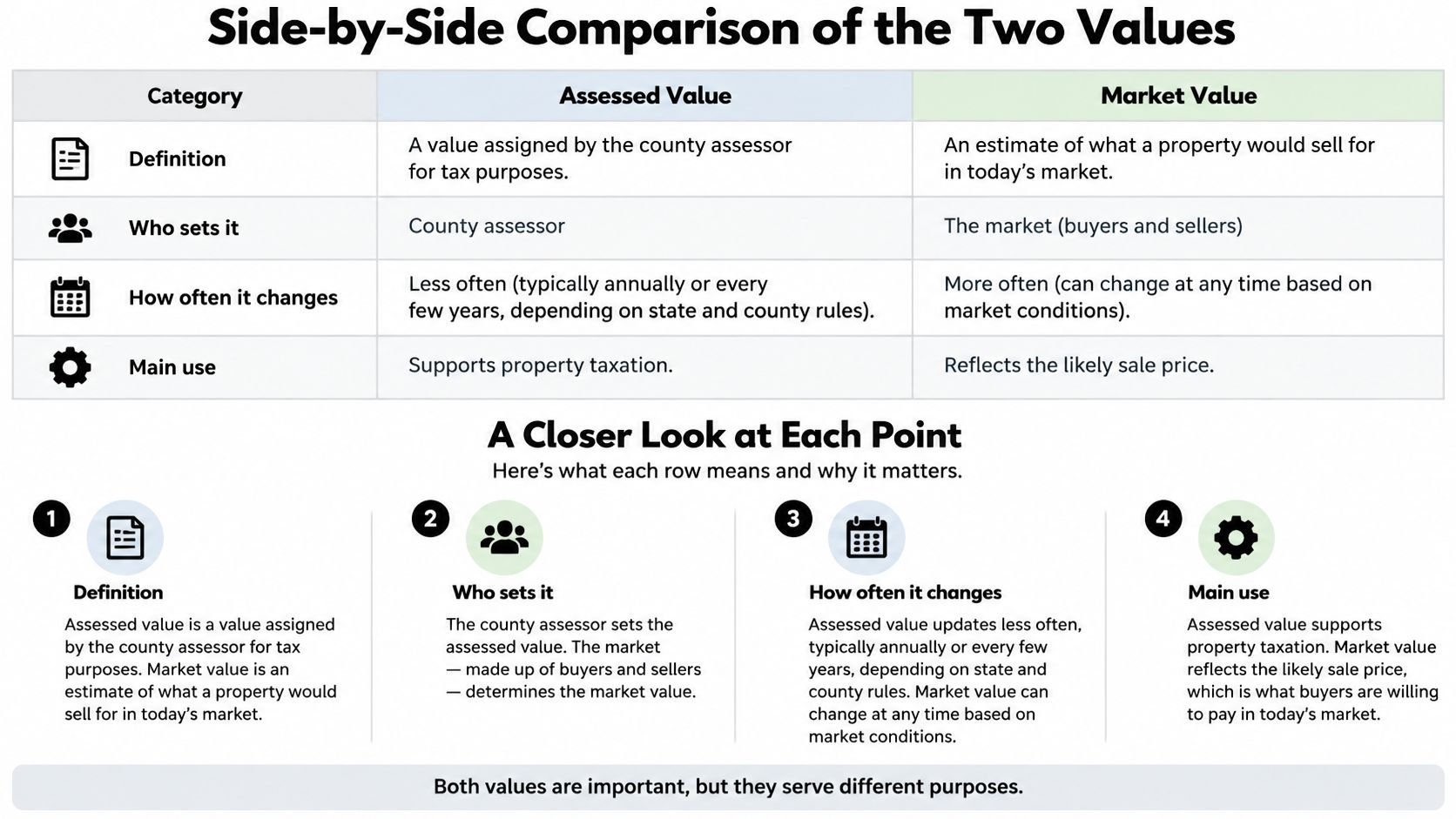
Who sets the figure matters
An assessing office produces an administrative value under local rules. Buyers and sellers establish transaction prices, which analysts use to estimate market value for other properties. Until a transaction occurs, a market-value estimate remains an interpretation of evidence, not an observable sale price.
The basis row deserves particular attention. Assessors can use sales, cost, and income information, but their output must fit the assessment system. An acquisition analyst instead selects comparable properties and adjusts for differences relevant to the subject property.
Timing and use determine the next step
A renovation completed after the assessment's valuation date may be relevant to an offer but absent from the tax figure. Conversely, an investor shouldn't use renovated comparables to value an unrenovated house without accounting for its current condition.
The typical gap isn't a promise that assessed value will always be lower. A stale assessment can also exceed what current buyers would pay.
Finally, challenging an assessment and negotiating a price are different procedures. An appeal requires evidence that addresses the jurisdiction's assessment rules; a seller can evaluate an offer without accepting the tax record as a pricing benchmark.
Use the table to identify the number a document requires. A loan application, appeal form, and purchase analysis don't become interchangeable because each contains a box labeled value.
How the Assessment Ratio Links the Two Values
Implied market value = assessed value ÷ assessment ratio
The assessment ratio expresses assessed value relative to market value or, in a sales-ratio study, relative to sale price. Dividing by that ratio reverses the relationship. The arithmetic is straightforward; deciding whether the ratio applies to your property is the difficult part.
What the calculation can reveal
A historical analysis published by LSE Business Review describes a national average assessment ratio declining from approximately 83% in 1850 to about 40% by the early twentieth century, and illustrates how a $200,000 assessment could correspond to $500,000 in market value at the latter ratio. The point isn't to apply historical ratios today. It's that an assessment has never been synonymous with a sale-price estimate.
The following worked arithmetic uses a hypothetical assessment and the Virginia statewide medians identified in the opening. These are scenario outputs, not property valuations.
Assessed value vs implied market value at different ratios
| Assessment Ratio | Assessed Value | Implied Market Value |
|---|---|---|
| 100% (assessment equals market value) | $200,000 | $200,000 |
| 86.68% (Virginia 2025 statewide median) | $200,000 | Approximately $230,734 |
| 75.17% (Virginia 2024 statewide median) | $200,000 | Approximately $266,064 |
The assessment stays unchanged throughout the illustration. Only the divisor changes, yet the implied market value changes materially. That sensitivity is why a statewide median should prompt investigation rather than dictate an offer.
Build an independent market estimate
Reverse the workflow before relying on the result:
- Select comparable sales. Start in the same competitive neighborhood and favor properties with similar construction, use, and buyer appeal.
- Normalize the evidence. Adjust for living area, condition, lot characteristics, and market movement between sale dates.
- Reconcile the indications. Give better-matched sales more influence instead of mechanically averaging every nearby transaction.
The result is an independently supported estimate against which to test the ratio-derived figure.
Tax-bill arithmetic is a separate calculation. In a simplified system, the taxable base multiplied by the applicable tax rate produces the levy; exemptions, assessment limitations, and separate taxing bodies can alter the actual bill. The assessment ratio isn't the tax rate, and substituting one for the other confuses valuation with taxation.
A local ratio is a diagnostic. It can tell you that a tax figure needs context, but it can't establish the price of an individual house.
Why Assessed Values Lag Behind Market Prices
A 1% change in jurisdiction-wide market values produced less than a 0.30% change in assessed values over the following three years in an analysis of U.S. assessments and transactions covering 2000 through 2020, summarized by the National Bureau of Economic Research. Current and prior two-year market-value changes explained only about 8% of the variation in assessment growth in that analysis.
That finding challenges a common shortcut: assuming last year's assessment, adjusted by recent neighborhood appreciation, must approximate today's assessment or market value. Assessors don't necessarily incorporate price changes immediately or proportionately.
A tax notice can therefore require more interpretation than its precise-looking figure suggests.

Administrative timing isn't transaction timing
A buyer can respond to a competing listing, a price reduction, or newly discovered repair needs during negotiations. An assessing office works within a valuation process and schedule. Those processes needn't incorporate the same information at the same moment.
The distinction works in both directions. During rising prices, an unchanged tax figure may look unusually low. During a decline, an assessment may remain above the price supported by current transactions.
Neither pattern alone proves that the assessor made an error. First determine whether you're comparing today's market with a value intended for an earlier date.
Local fiscal conditions deserve attention
The NBER summary also describes associations between fiscal conditions and assessment behavior, including county finances and school-referendum outcomes. Those findings don't establish that an individual assessment was deliberately inflated, and they aren't a formula for predicting your next tax notice.
For underwriting, the practical response is to investigate the assessment process rather than assign motives:
- Check the reassessment schedule. Establish whether the current figure precedes a broad update.
- Review the next valuation event. Ask which reassessments or property changes could affect the holding-period budget.
- Separate assessed value from tax expense. Read the actual bill and applicable rules instead of treating a valuation increase as an identical increase in taxes.
Date-stamp every tax figure used in an acquisition file. Record the legal valuation date separately from the date you downloaded the record, because a newly retrieved document can still contain an old valuation.
How to Test a Tax Assessment Against Market Value
A jurisdiction can be reasonably accurate overall while treating different price segments unevenly. New York's 2025 assessment-equity analysis found that about 44% of sampled assessing units assessed residential property neutrally, while 55% tended to over-assess lower-value homes relative to higher-value homes.
That makes the central question more precise: is your assessment unusual among comparable properties, or does the whole price segment receive different treatment?
The workflow below separates record checking from valuation judgment.
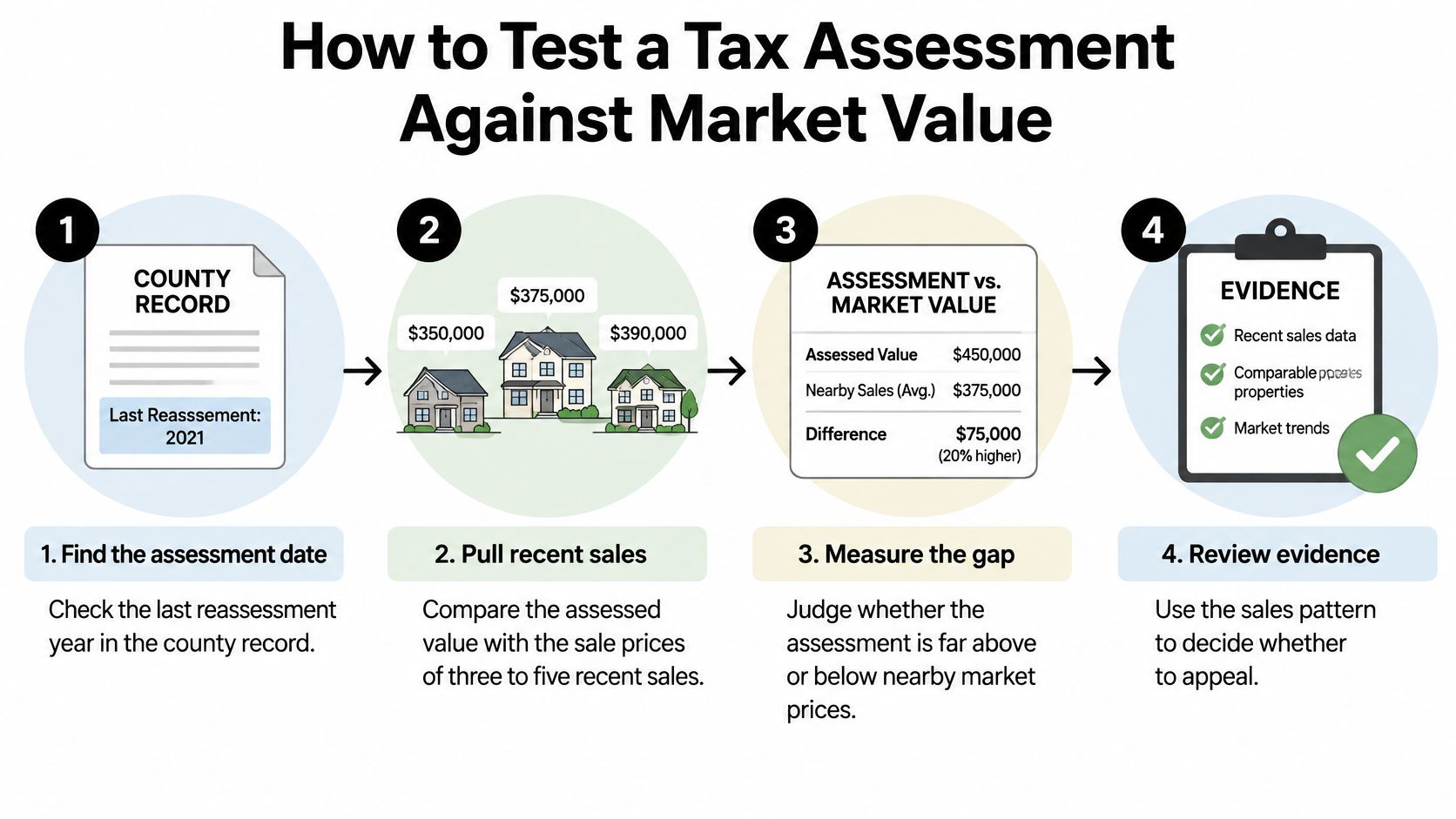
Assemble and normalize the evidence
Find the assessment date and reassessment status. Download the property record, identify its statutory valuation date, and establish when the jurisdiction last reassessed. Don't substitute the notice date or website update date for the date being valued.
Pull comparable transactions and their assessment records. Start with the same subdivision or competitive neighborhood, matching property type and condition rather than merely choosing the nearest addresses. Check whether each transaction involved unusual terms, related parties, or a materially different property configuration.
Calculate each assessed-to-sale ratio. Divide the relevant assessment by the recorded sale price, using assessment records appropriate to that transaction's timing. A common slip is pairing a post-sale reassessment with an earlier sale and treating the resulting ratio as evidence of pre-sale accuracy.
For a systematic approach to selecting and adjusting transactions, use our real estate comparable-sales analysis guide. For readers comparing valuation approaches across countries, the Corinthian Surveyors London property value guide from Corinthian Surveyors London LTD offers UK-specific context, not a substitute for U.S. assessment rules.
Test fairness separately from price
Compare price tiers within similar groups. Examine whether lower-value and higher-value properties consistently have different ratios. A small selection can flag a concern, but it can't establish jurisdiction-wide bias; don't let a county average conceal the pattern relevant to your subject.
Adjust sales before estimating the subject's value. Account for living area, renovation quality, lot utility, and sale timing, documenting the reason for each adjustment. Keep raw ratios available for the equity review, and use adjusted comparable indications for the property-specific valuation rather than mixing the two exercises.
Label the conclusion and its uncertainty. Record assessment and sale dates, reassessment status, condition differences, excluded transactions, and a confidence note. For an appeal, prioritize evidence relevant to the required valuation date; for an acquisition, prioritize evidence relevant to the condition and exit you're underwriting.
Evidence check: If adjusted comparable sales and a ratio-derived estimate disagree substantially, don't average away the disagreement. Investigate the cause and obtain an appraisal before making a commitment that depends on the disputed value.
Which Value to Use in Each Situation
Choose the value that matches the decision, then verify its assumptions. Tax assessed value vs market value isn't a contest in which one number wins every time. A figure can be suitable for administering a tax roll and unsuitable for setting a purchase price.
A homeowner deciding whether to appeal
Consider an owner whose assessment is below the market-value range supported by similar homes. That relationship alone doesn't provide an overvaluation argument. The owner should instead check whether the property record is wrong, the relevant valuation date has been mishandled, or comparable properties receive unequal treatment.
Now consider an owner whose assessment exceeds well-supported comparable indications for the required valuation date. That owner has a reason to investigate an appeal, but a lower online estimate isn't a complete evidence package. Condition photographs, repair documentation, comparable transactions, and assessment records make the argument more specific.
The filing deadline and accepted grounds come from the jurisdiction, not from a general valuation guide. Our explanation of how to challenge property taxes can help organize the evidence, but check the notice and assessing office's procedure before filing.
A buyer comparing a listing with tax records
A listing price above the assessment doesn't establish that the seller is overcharging. Nor does an assessment below the asking price establish that the buyer has found equity.
The buyer needs to determine what comparable purchasers paid for similar homes and whether the subject requires additional work. A recent kitchen renovation, a compromised foundation, or a materially different lot can matter more to negotiations than the difference between the listing and the tax roll.
The governing deadline here is practical: complete the valuation and condition checks before the contractual point at which you lose the relevant right to investigate or withdraw. Don't assume a later appraisal will resolve every pricing concern.
An investor underwriting a rental or flip
For a renovation investment, ARV describes the planned finished property, not the acquisition in its present condition. Our ARV Calculator gives after repair value from comparable sales, while PropLab pulls property information from public records, tax assessments, and market data without requiring MLS access.
The analyst still has to match the proposed finish level to the comparables. A premium renovated sale isn't appropriate support for a basic repair plan because the houses share a floor plan.
A low assessment on a higher-priced property also isn't an acquisition signal by itself. Treat it as a reason to inspect the relevant price tier, then build the offer from supported resale value and the actual work required. Our Max Offer Price calculation uses ARV minus repairs and includes a built-in profit margin; the quality of those inputs remains central to the decision.
Match the deliverable to the situation
Which value to use by situation
| Situation | Value to Rely On | Check Before Using It |
|---|---|---|
| Disputing a property tax bill | Market value supporting the appeal | Assessment date, comparable sales near the valuation date, appeal deadline |
| Buying a home or making an offer | Market value from recent comparable sales | Condition differences and sale timing |
| Refinancing or lender collateral | Appraised market value | Lender requirements; AI estimates are not a licensed appraisal |
| Rehab or flip underwriting | After repair value from adjusted comparable sales | Rehab scope and assessment ratio bias in the price tier |
| Estate or divorce valuation | Market value on the required valuation date | Date set by the court or statute; professional appraisal |
| Budgeting for property tax | Assessed value and local tax rate | Reassessment schedule and pending changes |
For refinancing, confirm the lender's valuation requirements early enough to meet financing conditions. For an estate or divorce, establish the required valuation date and professional-report requirements before commissioning the work. For tax budgeting, identify when new assessments or other applicable changes could enter the holding period rather than copying the seller's bill indefinitely.
AI output, including ARV calculations and valuations, isn't a licensed appraisal, definitive valuation, or guaranteed forecast. Don't assume a lender or court will accept it in place of the professional valuation its process requires.
Before relying on either number, identify the decision, record the relevant dates, and test the comparable-sale evidence. Tax assessed value is the wrong tool for setting an offer or forecasting renovated resale proceeds when it hasn't been reconciled with the property and market you're underwriting.
PropLab brings public records, tax assessments, and market data into a comparable-sales workflow, with an ARV Calculator for evaluating the planned finished property. Visit PropLab to compare the tax figure with relevant sales and build an offer analysis that makes its assumptions visible.
Tags
About the Author
P
PropLab Team
Real Estate Analysis Experts
The PropLab team consists of experienced real estate investors, data scientists, and software engineers dedicated to helping investors make smarter decisions with AI-powered analysis tools.
Free tool
Get the ARV of any property in 30 seconds
Skip the spreadsheet. Enter an address and get an after-repair value backed by real comps.
