General
Foreclosure Listings Tampa: 7 Sources to Check in 2026
November 28, 2026
14 min read
A Tampa duplex shows up on a listing portal at well under the neighborhood median. You request access and get a callback explaining there's no interior showing, no inspection period, and a cashier's check due before bidding opens. The property isn't listed for sale in any conventional sense. It's scheduled for a courthouse auction.
That gap between what a portal displays and what a sale requires is where new investors lose money in this market. A foreclosure listing in Tampa covers at least three different processes: a court-ordered judicial sale run by the Clerk, a bank-owned home marketed through the MLS, and a pre-foreclosure lead where no sale has been scheduled yet. Each answers a different question, and each fails in a different way.
Below are seven sources, sorted by the sale type they represent rather than by popularity. Treat them as a toolkit. Use the Clerk to confirm what's real, the portals to compare marketed inventory, and the paid databases to build a lead pipeline you then verify.
1. Hillsborough County Clerk (Official Foreclosure Sales)
Start with the Clerk when the question is whether a court-ordered sale exists. The Hillsborough County Clerk states that foreclosure sales occur every weekday at 10:00 a.m. through the county's RealAuction platform. Each record carries the case number, legal description, and opening bid. Those fields let you move from a lead to a docket, then confirm the exact case and sale entry.
Timing is set by statute, not by the seller. Under Florida Statutes §45.031, a final judgment directs the clerk to schedule the public sale no fewer than 20 and no more than 35 days after judgment, and the sale notice must be published for at least two consecutive weeks. That window is your diligence clock. Pull the docket, confirm the judgment date, count forward, and check whether the notice, case status, and sale date still align.
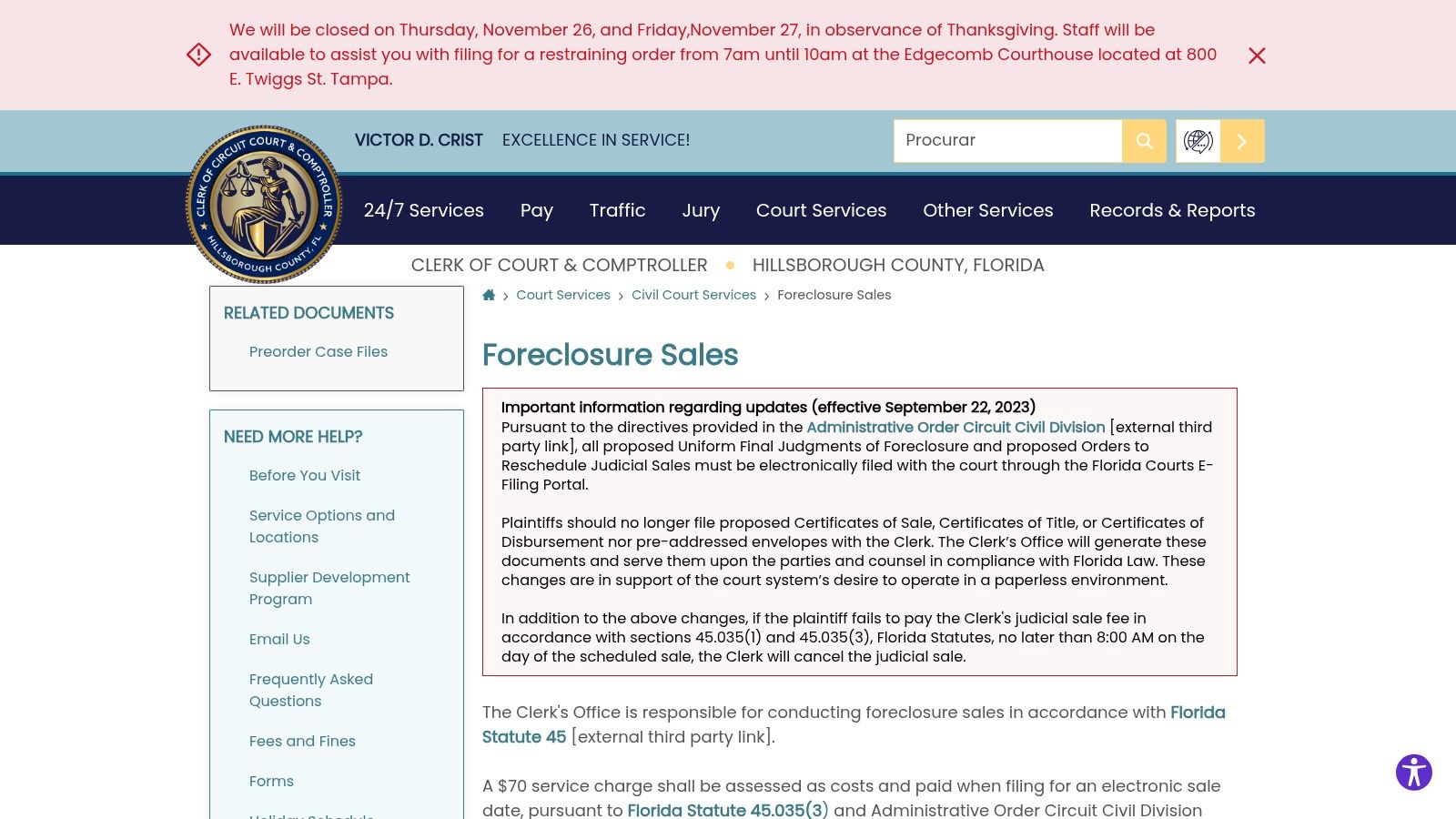
What the Clerk can and cannot tell you
It confirms a sale exists and when it happens. It won't tell you about liens, occupancy, or condition, and it isn't a search engine for bank-owned homes sitting in the MLS. That distinction matters because a courthouse sale, a marketed bank-owned listing, and a pre-foreclosure lead all require different checks.
A third-party feed is a notification. The Clerk's docket is the record.
A single snapshot of county inventory can mix sale types badly. Court foreclosure sales and tax-deed sales can appear together, with different title risks attached to each, so check the case type before you underwrite anything. Use the Clerk for the legal event. Use market sources only to understand property condition, comparable sales, and likely competition.
For a walkthrough of building a list from zero, see how to get foreclosure listings.
2. Auction.com
Auction.com is where bank-owned and trustee-run inventory gets marketed at scale, and it's the first place most investors check for scheduled sales around Tampa Bay. Filters work by city and ZIP, listing pages show sale timing and property details, and some carry an opening bid or estimated value.
The trap is reading an auction count as inventory. Hillsborough County auction statistics show how wide that gap runs: in May 2025 the county logged 152 scheduled auctions, but 128 were cancelled, 12 went to the plaintiff, and only 12 became third-party sales. February 2025 looked similar, with 91 auctions and 68 cancellations.
Screen before you fall for a number
Cancellations, plaintiff take-backs, postponements, and title problems all pull properties out of the actionable pool. A listing that looks live on Monday can be gone by Thursday.
The opening bid is a starting number, not a price. Build your maximum from after-repair value minus repairs, holding costs, and a risk margin, then see whether the bid clears it.
Use Auction.com for two jobs: monitoring sale flow across the metro, and pulling property details for preliminary screening. Don't use it as your authority on whether a sale will happen.
If you're moving from browsing to buying, finding a foreclosed home covers the sequencing that keeps you out of cancelled-sale dead ends.
3. Hubzu
Hubzu sits in the middle ground: an online marketplace where banks and asset managers list properties for auction-style bidding or direct offers. Its Florida foreclosure search surfaces Tampa-area homes, and property pages carry beds, baths, square footage, and sometimes public-record tax detail.
The thing to understand is that Hubzu is usually a marketing channel, not the seller. The entity conducting the sale, the bidding rules, and the buyer's premium change from listing to listing, and some pages are closer to advertising than to a live auction.
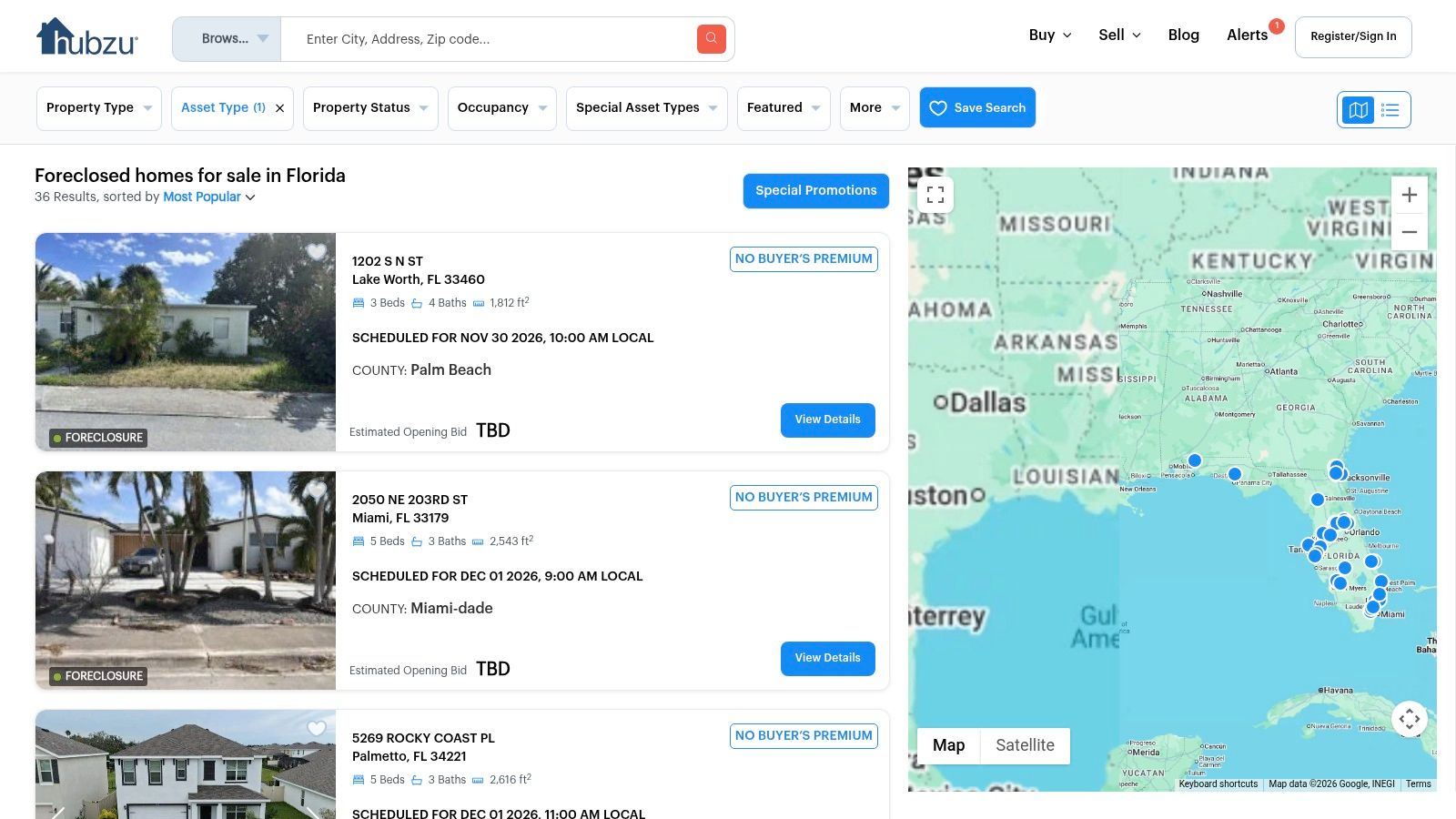
Read the terms before you register
Check three things on every page: who the seller is, whether bidding is live or the property is merely open to offers, and what fees sit on top of the hammer price. A buyer's premium is real money that has to come out of either your repair budget or your margin.
Occupancy is the second issue. Many of these homes are tenant-occupied or owner-occupied with no inspection access, so budget for a cash-for-keys conversation and a timeline you don't fully control.
Price the rehab from a worst-case interior assumption, because you probably won't get inside before you bid.
Hubzu earns a weekly scan because it surfaces bank inventory that never appears as a conventional listing. Treat each page as a lead, confirm the sale operator and fee structure, and then decide whether it belongs on your shortlist.
4. Zillow
Zillow's Tampa foreclosure page collects homes its data partners flag as foreclosures inside the for-sale inventory. You get photos, asking prices, property facts, saved searches, and the listing agent's contact information. It's free, fast, and familiar.
What it isn't is a courthouse calendar. Zillow covers properties already marketed for sale, which in practice means bank-owned homes listed through brokerages. The size of that pool is real: RealtyTrac counted 1,740 foreclosure homes listed for sale in the Tampa area as of September 2024. Those are homes you can inspect, finance, and negotiate on, a very different product from a 10 a.m. auction.
Where Zillow earns its place
Comparables. Once you have a candidate address from any other source, Zillow gives you a quick read on the neighborhood price band, days on market, and recent sold prices before you spend money on title work.
Two cautions. The foreclosure label comes from data vendors and can lag actual status by weeks. And MLS-fed fields go stale, so verify square footage and bed count against the county property appraiser.
Practical rule: If a Zillow listing is tagged as a foreclosure and the price looks too good, check the parcel record and the Clerk before you write an offer.
For address-level data pulls across a batch of candidates, Zillow search by address via RealtyAPI.io is a useful utility when you're checking a list rather than a single home.
5. Realtor.com
Realtor.com runs a Tampa foreclosure search with property cards, filters for price and property type, and links through to the listing brokerage. Its related searches, including fixer-uppers, help when you want to widen beyond the foreclosure flag itself.
The strength here is the brokerage connection. Every listing traces to an agent who can answer whether the bank is reviewing offers, whether the property is winterized, and whether there's an occupancy problem. That conversation is often worth more than the listing page.
What works
- Brokerage traceability: a named agent to call about offer status and access.
- Filter depth: price, property type, and related searches narrow a broad county list fast.
- No paywall: you can review marketed inventory without a subscription.
What doesn't
- No auction calendar: it won't show you what's scheduled at the courthouse next Tuesday.
- Stale labels: the foreclosure tag can lag reality by weeks.
- No lien data: a listing page doesn't establish title or what obligations survive a sale.
Listing status is a snapshot. Confirm the property is still active and not under contract before you schedule a walkthrough.
Treat Realtor.com as the start of a broker call, not the end of your research. Pair it with the Clerk's sale list and you'll catch the overlap: homes both scheduled for auction and being marketed, which usually means a bank trying to sell before the sale date.
6. Redfin
Redfin's Hillsborough County foreclosure search covers Tampa plus Brandon, Riverview, Plant City, and the rest of the county. Property cards show price, beds, baths, and square footage, with sorting that makes it easy to compare a Tampa candidate against cheaper alternatives twenty minutes out.
That wider frame matters. Tampa city limits hold a limited slice of the metro's distress, and the late-2025 filing picture shows how spread out it is: Tampa Bay 28 reported ATTOM data showing 632 foreclosure filings across the metro in November 2025, including 321 in Hillsborough County, 157 in Pinellas, 118 in Pasco, and 36 in Hernando.
Use the county view to price the city
When Tampa inventory is thin, the county search tells you what a comparable distressed house costs in Riverview or Plant City. That's your competition for buyer attention and your fallback if a Tampa deal gets bid past your number.
Redfin's listing data does not substitute for the Clerk's auction record. Prices and labels reflect what a seller is asking, not what a court has ordered or what a property is worth after repairs. Run the same rehab and holding-cost model on every candidate, regardless of how attractive the list price looks.
Use Redfin for market context and alternative inventory, then take the shortlist back to public records before you commit a deposit.
7. Foreclosure.com
Foreclosure.com is a paid research database rather than a marketplace. It aggregates Tampa and Hillsborough County leads across stages, including pre-foreclosure, auction, bank-owned, and some government-owned properties, with estimated values and rent estimates on many records. The site offers a preview period followed by a paid subscription, so confirm the current pricing and cancellation terms on its site before you enter card details.
The pre-foreclosure tier is where the earliest leads live. A lis pendens filing means a suit has started, nothing more: no sale date, no judgment, and sometimes no real distress if the owner cures the default. That makes Foreclosure.com a lead generator, not a source of purchasable inventory, and it answers a different question than the Clerk's auction calendar does.
Read the pipeline, not the headline
Tampa drew national attention in October 2025 when it recorded the highest foreclosure-filing rate among U.S. metros with at least one million residents, at one filing for every 1,373 housing units, according to Fox 13 reporting. Resumed data collection in Hillsborough County and backlogged filings shaped that result, so treat it as a pipeline and measurement signal rather than proof that distressed deals are flooding the market.
The longer series adds the nuance. University of Florida housing data puts Hillsborough County at 2,835 foreclosure filings in 2025, up 22% from 2024 and the highest annual total in the reported 2019 to 2025 series, at 7.61 filings per 1,000 owner households. A rising filing count expands the pre-foreclosure lead pool before it expands auction inventory, which is exactly the gap this database tracks.
Lead, not listing: a pre-foreclosure record tells you a case exists. Confirm the judgment status and sale date in county records before you spend a dollar on outreach.
Before paying for access, verify what a lead record contains: pull the lis pendens from county records, check whether a sale date is set, and confirm the owner and lien details match. A record that fails any of those checks is noise, no matter how fresh the database flags it.
Then underwrite the file properly: equity position, lien stack, occupancy, and repair scope. For the exit side of that math, see the pros and cons of buying a foreclosure house.
How the Seven Tampa Foreclosure Sources Compare
| Item | Listing Type | Free to Browse | Best For |
|---|---|---|---|
| Hillsborough County Clerk, Official Foreclosure Sales | Court-ordered foreclosure auctions | County information available without a paid subscription; bidding requires registration and a deposit | Verifying official local auction details |
| Auction.com | Foreclosure and bank-owned auctions | Searchable listings; terms vary by property | Exploring auction and bank-owned opportunities across Tampa Bay |
| Hubzu | Florida foreclosure and auction-style listings | Browse listings; availability and sale terms vary | Finding auction-style properties and reviewing listing details |
| Zillow | Marketed foreclosure homes | Yes | Comparing for-sale foreclosures across Tampa neighborhoods |
| Realtor.com | Marketed foreclosure homes | Yes | Filtering and reviewing listed properties |
| Redfin | County-wide foreclosure and bank-owned listings | Yes | Comparing Tampa with nearby Hillsborough County markets |
| Foreclosure.com | Foreclosure, auction, pre-foreclosure, and bank-owned leads | Free seven-day preview advertised; ongoing access is paid | Monitoring leads across foreclosure stages |
Turning a Tampa Foreclosure Search Into a Verified Shortlist
Sequence matters more than the subscription. Start with the Clerk: pull the scheduled sale list for Hillsborough County, note the case numbers, and confirm sale dates on the docket. Anything you find on a portal gets checked against that list before it earns a place on your shortlist.
Then cross-check the marketed side. Zillow, Realtor.com, and Redfin tell you what banks are asking and what comparable homes look like block by block. Auction.com and Hubzu tell you what's being bid on, and their auction calendars tell you when. Foreclosure.com tells you what's coming, since its pre-foreclosure and lis pendens leads often surface months before a sale date is set. Each source answers a different question. None of them tells you what a property is worth or which liens survive the sale, and those are the two questions that decide whether you bid.
Verification is the step most investors skip. For every candidate, confirm the case type (judicial foreclosure versus tax deed), the final judgment and scheduled sale date, the opening bid, the tax status, municipal and association liens, occupancy, and any bankruptcy filing. The Clerk won't advise you on encumbrances, and the portals don't know about them. A bankruptcy filing can freeze a sale the morning it's scheduled, so checking the docket the day before bidding is a habit worth building.
The funnel narrows hard between filing and deed transfer. SFR Analytics counted 867 completed foreclosures across the Tampa metro in 2025, a foreclosure rate of 1 in every 1,270 homes, per its Tampa foreclosure research. Compare that completed-sale count with the volume of filings and pre-foreclosure leads you'll see on the portals, and you understand why a shortlist of five candidates is a realistic outcome of a month of searching, not a failure.
Numbers come last, and they come before the bid, not after. Build your maximum offer from ARV minus repairs minus transaction costs minus a risk margin. On an occupied property or one with unclear lien status, widen that margin rather than dropping the deal reflexively; sometimes the discount still justifies the risk. Free calculators such as the ARV Calculator and Rehab Cost Calculator on PropLab require no account, so you can test assumptions on a shortlist before committing a deposit.
That order, Clerk first, portals second, records third, math fourth, is what separates a working pipeline from a folder of screenshots.
PropLab turns a single address or listing link into an offer-ready report with comps, ARV, rehab estimates, a maximum offer price, and red flags, usually in about 60 seconds. Paste in a foreclosure address from any of the sources above and see whether the deal still works once the numbers are on the page. Visit PropLab to run your first analysis on a property address.
Tags
About the Author
P
PropLab Team
Real Estate Analysis Experts
The PropLab team consists of experienced real estate investors, data scientists, and software engineers dedicated to helping investors make smarter decisions with AI-powered analysis tools.
Free account
Underwrite your next deal in under a minute
3 free analyses, no credit card. ARV, rehab, comps and exit strategy in one report.
