General
How to Find Property Tax Records: A Step-by-Step Guide
November 15, 2026
12 min read
You have an address and a question. Is the tax bill current? Did the seller pull permits for the addition? What did the county think this house was worth last year, and does that number still hold?
So you search the address, land on a county portal that returns a figure labeled "assessed value," a lot size, and not much else. It isn't the asking price and it isn't what the owner paid. You close the tab without knowing whether you found the right record at all.
That gap between finding a record and trusting one is where most property research goes wrong. Knowing how to find property tax records is the easy half. The half that protects your money is working out which office owns each field, whether the page is current, and what to do when part of it is missing.
Find the Right County Office First
There is no national property tax database. Records are held by counties and municipalities, and the office that can answer your question depends entirely on which field you need. The Colorado Division of Property Taxation sends anyone seeking a property-specific assessment to the county assessor, and sends tax payments and payment questions to the county treasurer. Those are two different buildings and two different websites.
El Dorado County, California, shows the depth worth expecting from a modern assessor page: a search by assessment number, parcel number, or street address, then land and structure values, net assessed value, lot size, year built, bedroom and bathroom counts, plus history going back several years. None of it includes a balance due. For that you need the treasurer.
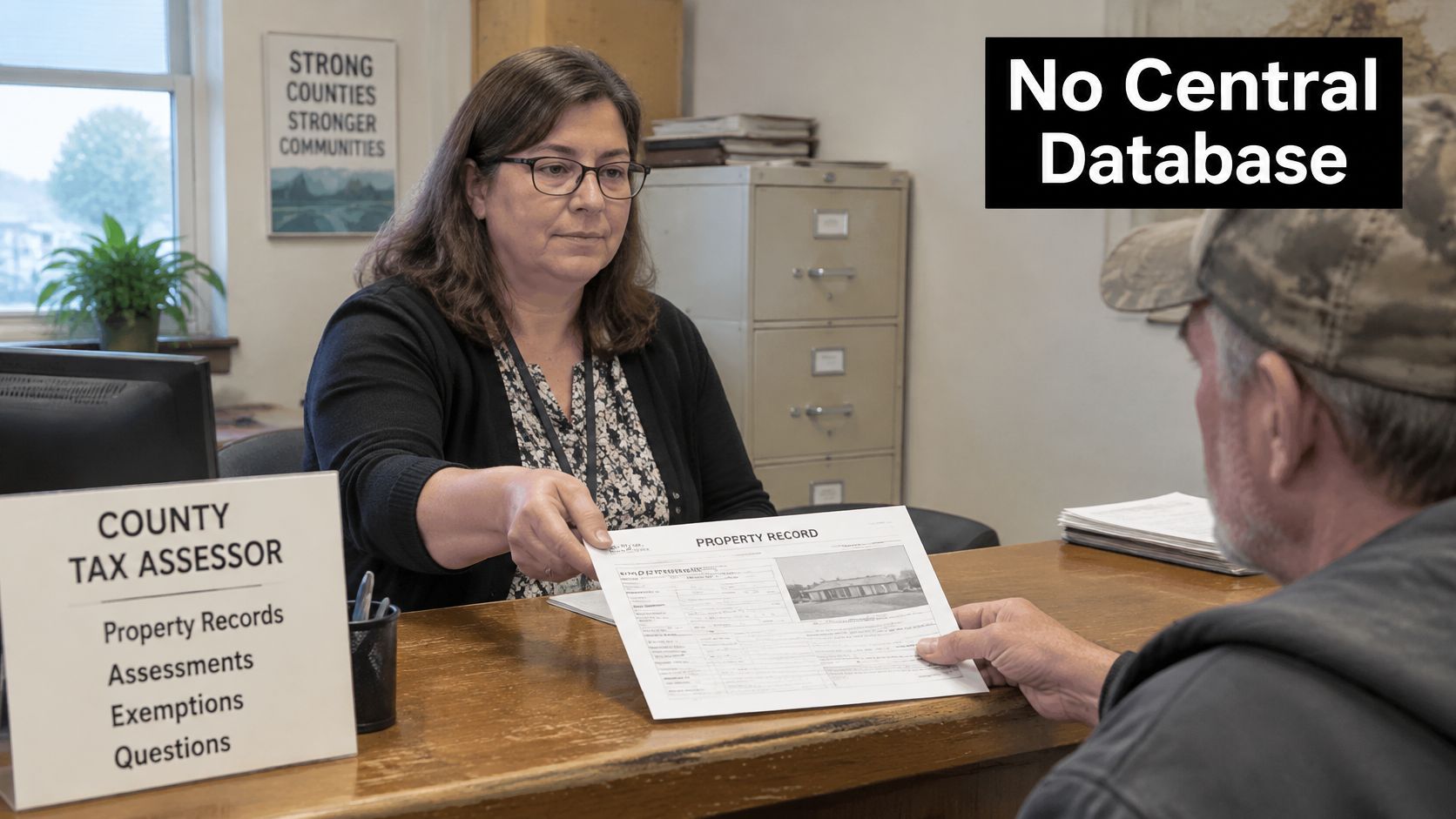
Most of the work still happens across a counter like the one below, even when your search starts online.
Here's the split that matters in practice:
| Record | Office | Typical use |
|---|---|---|
| Parcel number (APN) and legal description | Assessor | Verifying the parcel |
| Assessed value, land and improvement values | Assessor | Tax-basis figures, not market value |
| Exemptions and property characteristics | Assessor | Confirming exemptions, size and rooms |
| Assessment history | Assessor | Tracking value changes over time |
| Current bill, installments and balance | Treasurer or tax collector | Checking payment status |
| Delinquency and payment history | Treasurer or tax collector | Checking unpaid taxes before closing |
| Deed, owner of record and transfer date | Recorder or clerk-recorder | Confirming ownership |
State revenue departments publish statistics, not parcel lookups. Washington's Department of Revenue comparison of county assessor statistics covers 2024 assessed values, parcel counts, taxable and exempt parcels, new construction, and assessment-roll certification dates. Excellent for reading a market. Useless for finding one house.
Say you're sizing up a small rental duplex. The assessor page gives you an assessed value, a lot size and a two-unit property class, but nothing about what's owed. The treasurer's portal answers that in a minute: current installment, prior-year balance, any delinquency. Two offices, one property, and only one of them can tell you whether the seller is behind.
Confirm the county from the property's physical address before you type anything, because mailing cities and county lines regularly disagree. Then use the county's own government site, not an aggregator that scraped it two years ago and stripped the update date.
Search the Assessor Portal in Five Steps
Run the search the same way in every jurisdiction and you stop losing records to your own search terms. Illinois Department of Revenue guidance on property record cards is a useful anchor here: the cards are maintained locally by the chief county assessment office, and county portals generally accept either an address or a parcel number. Local control is the whole story.
Identify the assessor from the property address. County lines and city limits rarely line up, so a house with a mailing city in one town can sit on the next county's roll. Confirm the county first, then find that county's official property search.
Search by street address to start. An address search is the fastest way to confirm you have the right parcel in front of you. When it returns a stack of matches, which happens with new subdivisions, condo buildings and split farm parcels, stop guessing and move to the parcel number.
Capture seven fields, not one. The APN, assessment year, land value, improvement value, exemption value, tax-rate area and last update date. Land plus improvement usually gets you to total assessed value, and none of those three is the same as taxable value or the amount billed.
Open the treasurer or collector portal for the money. Assessor pages typically stop at value. Bills, installments, balances and delinquency sit with the treasurer or tax collector, which is why a property with a hefty assessment can show nothing owed on the assessor's site.
Cross-check the parcel map and the recorded deed. The map confirms you're looking at the right shape of land, and the deed confirms who holds title and when it moved. Two minutes here catches parcel splits that would otherwise wreck a comparable sale set.
The same sequence, in one view:
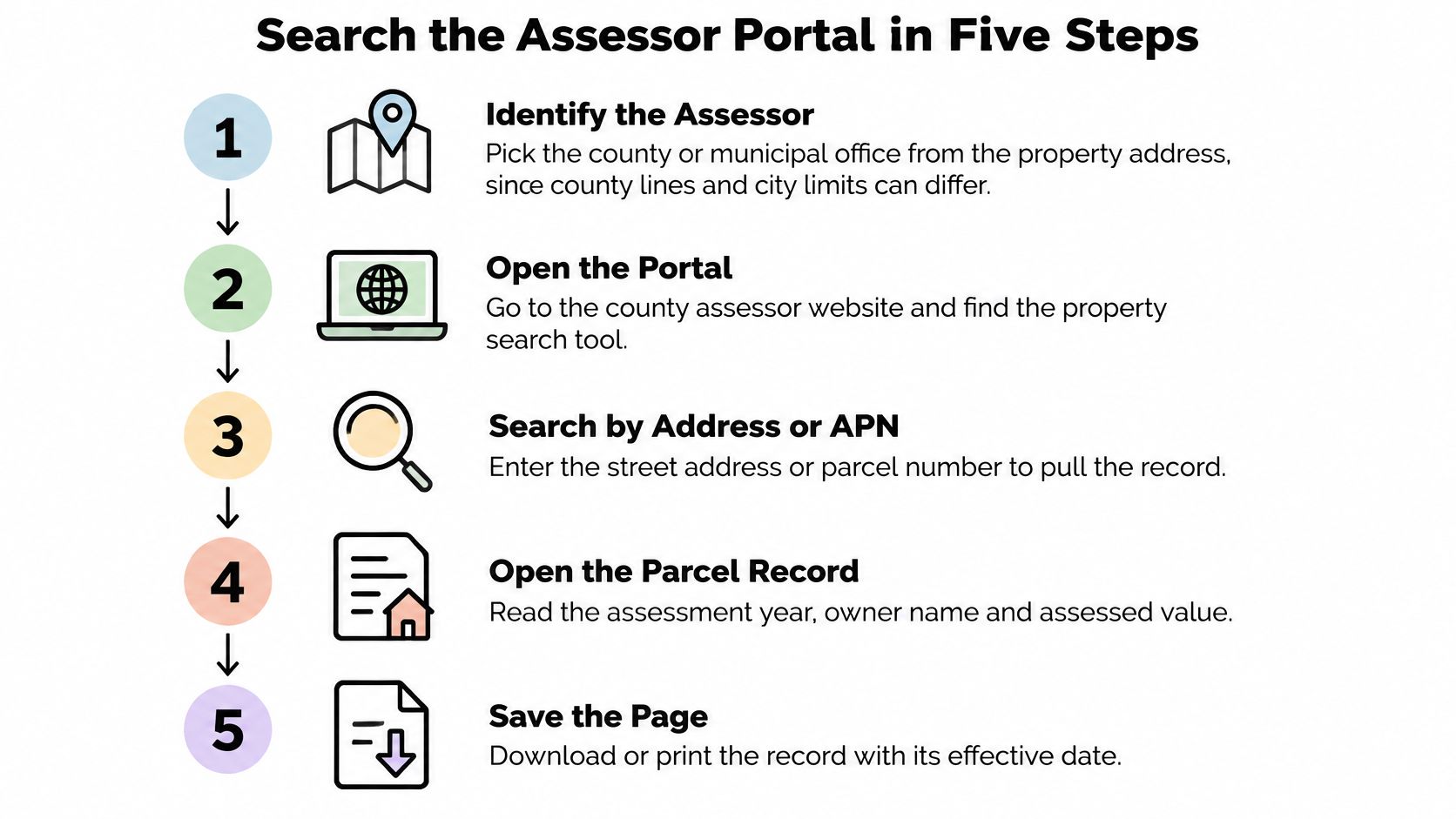
Save the page, not the number. Screenshot or download the record along with its URL and the date you pulled it. A figure with no retrieval date is unusable a month later, and a lender will ask.
Treat the APN as the join key when you stack tax, GIS, deed and sales data together. Address matching fails constantly on abbreviations, unit numbers, situs-versus-mailing addresses, and parcels that were split or merged. One more habit worth building: store whether each figure is assessed, taxable or billed. They're three distinct measures, and substituting one for another is the fastest way to build a model on the wrong number.
Search Tips for Addresses and Parcel Numbers
Most failed searches are formatting problems, not missing records. Try these before you conclude the county has nothing.
- Match the county's abbreviation. Search 123 N Main, not 123 North Main Street, if the first attempt returns nothing. Directional prefixes, St versus Street, and dropped unit numbers all break matching on older systems.
- Search the situs address, not the mailing address. Many portals index the physical location, so an out-of-state owner's mailing address often returns zero results even though the parcel is right there.
- Feed it a parcel number when you have one. An APN from an old deed, closing statement or prior tax bill is more precise than any street address. If you only have an address, this walkthrough on how to find your APN covers the route.
- Expect splits and merges. A lot that was subdivided or combined may carry a brand-new number, and a search on the retired one returns a dead record with stale values.
- Use the owner name only where the county allows it. Plenty of portals restrict owner searches for privacy reasons, and a failed name search tells you nothing about the property.
Here's the pattern behind all five: the county indexes what it assesses, not what the listing site displays. Search terms copied from a marketing page are the most common reason a record looks missing when it isn't.
When the address and the parcel number both come up empty, stop typing and switch approaches. The next moves are offline, and they're covered below.
Fix Missing or Incomplete Records
A blank result is usually a publication decision, not an empty database. The Georgia Department of Revenue names the county tax assessor as the best source for assessment values, tax records and maps, then warns that in most counties you may need to visit the assessor's office because not every county publishes property records online. Privacy rules, document type and historical coverage thin out what's left even where a portal exists.
Sort the failure by symptom and send yourself to the office that holds the field:
| Symptom | Likely cause | Fix |
|---|---|---|
| County search returns nothing | County does not publish records online | Visit the assessor office or submit a public-records request |
| Owner name blank | Privacy rules restrict owner data | Request the owner field from the assessor's office |
| Assessed value looks outdated | Assessor updates lag deeds, sometimes until the next tax year | Check the update date and compare with the deed date |
| Assessed value shown but no balance | Billing is kept by the treasurer or tax collector | Search the treasurer or tax collector portal |
| Building size or bedroom count looks wrong | Mass appraisal data rather than an inspection | Compare with permits and the property itself |
Budget the time carefully. A portal switch or a phone call can cost you a day. A formal public-records request can cost weeks, so file it early rather than the week before closing. Spartanburg County's assessor records guidance is the right frame: when online results omit owner data, historical rolls or bulk fields, the jurisdiction's public-records request process is the answer, not an inferred value.
The other trap is procedural status. Illinois's property tax appeal pages separate the local property record card, the assessor's review, the board-of-review appeal, and later state or court appeals into distinct stages. A valuation you can see on screen doesn't tell you which stage a parcel is sitting in, and that stage changes the risk profile of the deal. Ask the question directly when you call.
Verify the Record Before You Rely On It
A record that loads is not a record you can underwrite. Utah State Tax Commission guidance on property tax tells owners to check acreage, building square footage and unfinished space against the property itself, because factual errors affect both the assessment and the tax calculation. The stakes run wider than one bill: research using 26 million sales across 95% of U.S. counties found that adding property features and publicly available Census data could materially improve assessment accuracy and fairness.
Run this checklist before you treat any figure as current ownership, size or tax due.
- Record the effective date. Query by address and APN, then write down the assessment year, the effective date and the last-update timestamp. Without those three, you don't know what you're looking at.
- Compare that date with the deed. An assessor roll can trail a recorded transfer by months, and some counties don't reflect a sale until the following tax year. The recorder's copy is the authority on who owns it and when it changed hands.
- Respect the seasonal freeze. Several assessors publish characteristics and values frozen at the preceding December 31 through the first four months of the year, so a spring record can describe a house that has since been renovated.
- Pull the collector's bill. Keep delinquency, installments, special assessments and exemptions beside the valuation rather than in a separate note.
- Walk the numbers against the property. Living area, lot size, bedroom and bath counts, and unfinished space all need a look at permits and inspection evidence, because mass appraisal works from models and data rather than a fresh visit.
- Use the parcel map for orientation only. Assessor parcel lines are illustrative and not legal surveys, so order a real survey for any boundary, easement or acreage question.
Comparing the page against the paperwork catches most of this:
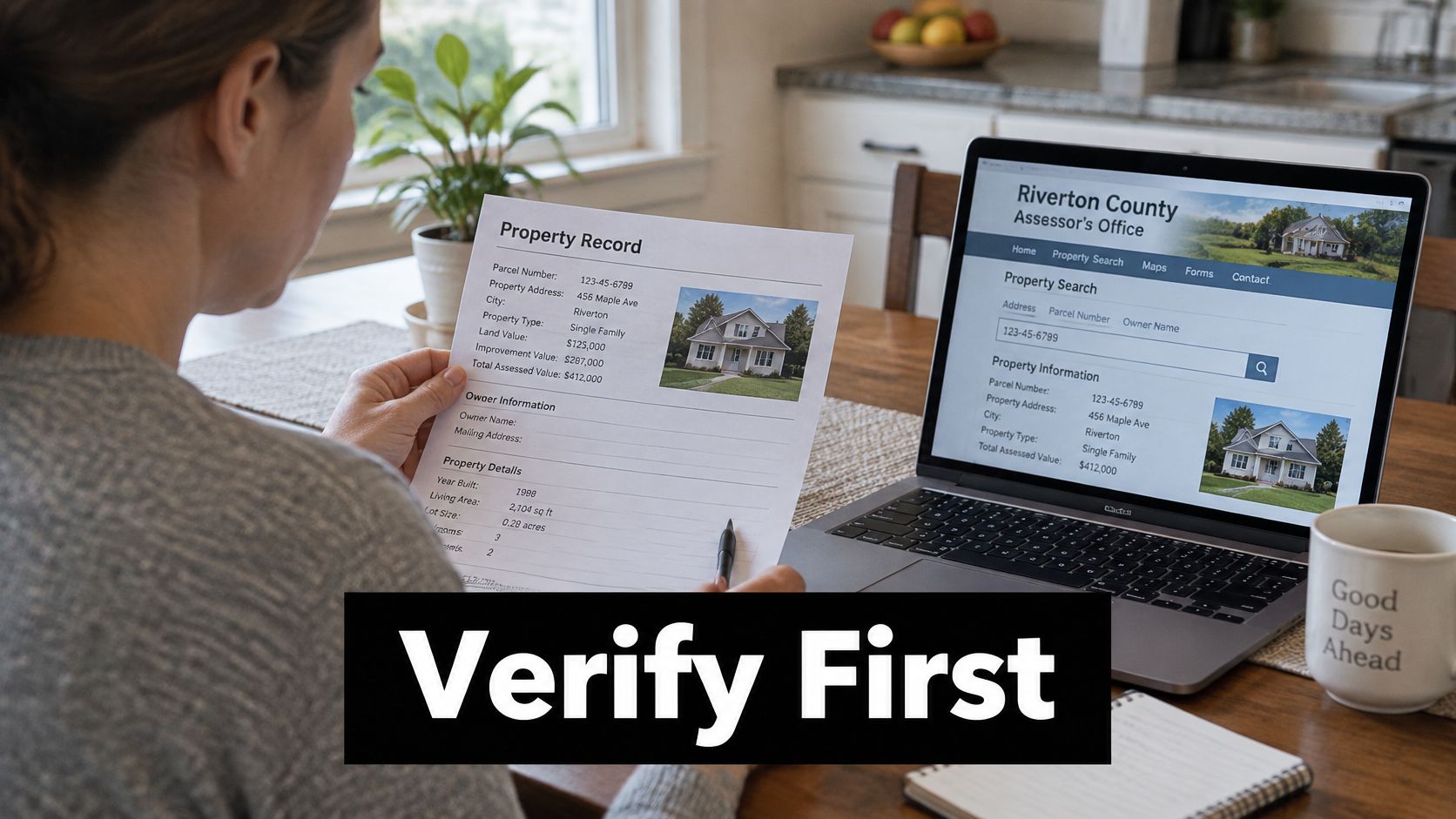
Four numbers, never one line. Assessed value, market value, tax rate and actual tax due are separate figures. Keep each with its source URL and retrieval date, and never let one stand in for another in a spreadsheet.
A worked case makes the cost obvious. The county record shows 1,400 square feet, but a permit file shows a 400 square foot addition finished two years ago. Your comparable selection shifts, the after-repair value shifts, and the holding cost estimate shifts with it. None of that shows up if you take the first page at face value. If the divergence between county value and market value still feels fuzzy, appraisal versus assessment is worth five minutes before you build a model on either number.
Choose Your Next Step on the Property Record
The record is the starting point, and what you do next depends on why you pulled it.
If you're buying, confirm the treasurer balance, the delinquency status and the recorded deed before closing, and keep the printouts with the contract file. A lien or an unpaid installment discovered after closing is your problem, not the seller's.
If you own the property, compare the assessed value against your appeal deadline and check that every exemption you qualify for is applied. Exemptions disappear after a transfer, and the guide to challenging property taxes walks through the filing sequence when the number looks wrong.
If you're underwriting, finish the verification checklist first, then add recent comparable sales before an assessed value touches a model. Assessed value is a tax-administration figure, and the gap between it and market value is often large enough to flip a deal from pass to fail. For investors gathering the same fields across several properties, PropLab pulls property data from public records, tax assessments and market data, and you don't need MLS access to run it.
Keep every verified field in one place with its source and date beside it. The action for today is small: pull the county assessor record for one property you care about, and write down three things, the APN, the last update date, and the bill status from the treasurer.
PropLab takes the parcel data you just verified and turns it into a decision. Paste an address and it builds a report from public records, tax assessments and market data, with comparable sales, an ARV estimate, rehab costs, red flags and a max offer price you can send to a partner or lender as a PDF. Run one property through it at PropLab and see whether the numbers on the county page survive contact with the market.
Tags
About the Author
P
PropLab Team
Real Estate Analysis Experts
The PropLab team consists of experienced real estate investors, data scientists, and software engineers dedicated to helping investors make smarter decisions with AI-powered analysis tools.
Free account
Underwrite your next deal in under a minute
3 free analyses, no credit card. ARV, rehab, comps and exit strategy in one report.
