General
What Is Tax Assessed Value? How It Is Set and Used
November 16, 2026
12 min read
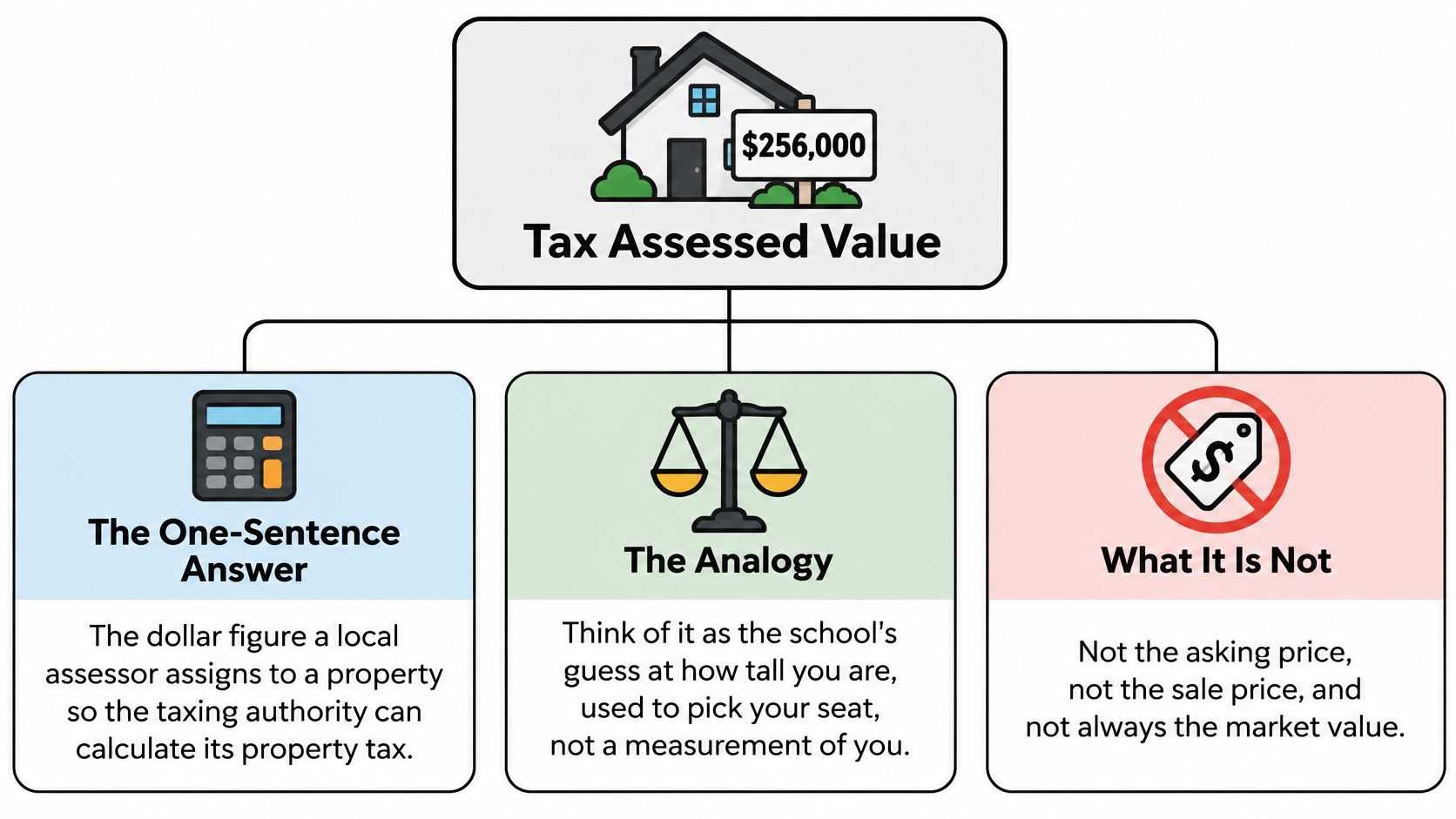
Tax assessed value is the dollar figure a local assessor assigns to a property so the taxing authority can calculate its property tax, and it is not necessarily the price the property would sell for.
If you're buying the house, why assume the seller's tax bill tells you what you'll owe? That's the gap many buyers miss: the assessment describes a property under local tax rules, and those rules can produce a different bill after ownership changes.
For investors, understanding that distinction helps separate a property's tax cost from its resale potential. Both matter to a deal, but they answer different questions.
What Tax Assessed Value Means in Plain Terms
Tax assessed value is a government-assigned value for taxation. Think of it as the price tag the tax office attaches for its calculations, not the price a seller can expect a buyer to pay.
An assessor is the public official or agency responsible for valuing property for taxation. According to the U.S. Census Bureau's explanation of taxable property values, counties perform assessments in most U.S. states, while Maryland and Montana use more centralized systems and Connecticut relies substantially on municipal governments; once property is defined for taxation, its assessed value helps determine the tax owed.
Basic calculation: Property tax = assessed value × tax rate, subject to exemptions, caps, and other adjustments.
The tax rate determines how much tax applies to the value used in that calculation. An exemption removes qualifying value from taxation, while an assessment cap limits increases under local law.
Say you're reviewing a house with a fresh kitchen and a recently repaired roof. The seller may price it using nearby sales, but the assessor's record may reflect a different valuation date or legally restricted tax basis. Neither number automatically proves the other wrong.
The tax roll, the government's official list of taxable properties and their values, serves an administrative purpose. It helps distribute the community's tax burden rather than guarantee an individual property's selling price.
Keep these roles separate:
- Who sets the value: The responsible public assessor or assessment agency.
- What it measures: The property's value under applicable assessment rules.
- Why it matters: It supplies a starting point for calculating the property's tax obligation.
Assessed Value, Market Value and Sale Price Compared
| Value | Who sets it | Main purpose | When it changes |
|---|---|---|---|
| Tax assessed value | Local assessor or taxing authority | Calculating property tax | At periodic reassessment under local rules |
| Fair market value | Hypothetical willing buyer and seller | Reference price for the property | Moves with the local market |
| Appraised value | Licensed appraiser | Lending, estate or transaction decisions | Fixed for a particular report and valuation date |
| Sale price | Buyer and seller | What was actually paid | Established for the completed transaction |
| Taxable value | Assessor or responsible agency, after adjustments | Basis for the tax bill after exemptions and caps | Recalculated for the applicable tax cycle |
Fair market value, often shortened to FMV, means the price informed, willing buyers and sellers would agree to without being compelled to transact. The IRS guide to determining property value defines FMV through those market conditions and explains that assessed values can sometimes help allocate value between land and buildings when FMV is uncertain.
An appraised value is an appraiser's opinion for a stated purpose and effective date. A sale price is an actual transaction result. For a closer look at why the first differs from the tax office's figure, use our guide to appraisal versus assessment.
The value that actually gets taxed
Taxable value is the amount left subject to tax after the applicable assessment rules and adjustments. A homestead deduction, for example, is an owner-occupancy-related reduction available under qualifying local rules. It shouldn't be assumed to apply to an investment property.
A bill may express its rate as millage, a rate quoted in mills rather than as a percentage. Use the taxing authority's stated conversion when calculating the bill.
Underwriting rule: Use assessed value to investigate tax expense, not to establish your expected exit price.
Underwriting means evaluating a deal's income, expenses, value, and risk. For that work, estimate after-repair value, or ARV, the expected market value after planned renovations, using relevant comparable sales, meaning sales of similar properties. A broker opinion, an agent's market-based estimate, also answers a different question from an administrative assessment.
How Assessors Arrive at the Assessed Number
The assessment process combines property facts, valuation methods, and legal adjustments. The sequence and labels differ by jurisdiction, so read the local assessment explanation alongside the property record.
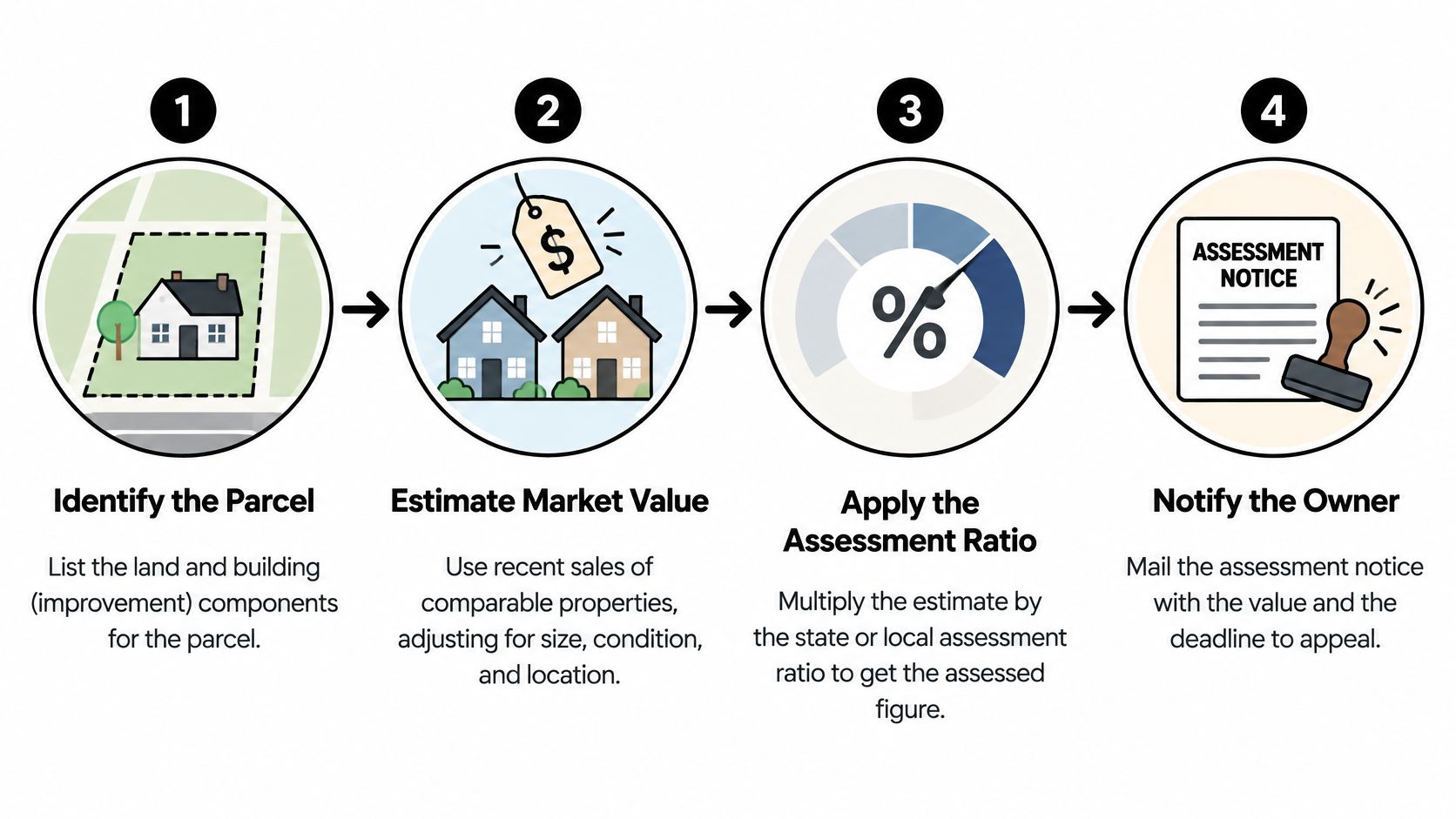
Identify the parcel and its components. A parcel is a separately identified piece of land in the assessment system. The record typically separates land from improvements, meaning buildings and other added structures, so check that the listed house, garage, and site features match the property.
Estimate the property's underlying value. Assessors may use recent comparable sales, adjusting for differences such as size, location, and condition. Where appropriate, a cost approach considers replacement cost and deterioration, while an income approach considers earning potential; outdated sales or inaccurate condition records can distort the estimate.
Record the valuation date and allocation. The effective date identifies when the valuation applies, not necessarily when you opened the website or received the notice. Keep the land and improvement amounts separate so you can identify which component appears inconsistent.
Apply any assessment ratio. An assessment ratio is the share of underlying market value recognized for assessment purposes. Don't assume the ratio is the tax rate: the ratio establishes a value, while the rate turns taxable value into a tax amount.
Account for eligible reductions and limits. Check whether exemptions have been applied and whether a statutory cap restricts growth. A missing exemption can inflate the taxable amount, while a cap can hold it below the assessor's current market estimate.
Issue the notice and provide a review route. The assessment notice communicates the recorded value and information about challenging it. Read the local instructions promptly rather than assuming the payment deadline is also the appeal deadline.
What to verify on the notice
Find the assessment's effective date, the applicable ratio, and the exemption entry. If any is unclear, ask the assessment office which field establishes the taxable base and which field merely reports estimated market value.
That question is more useful than asking whether the assessment is accurate without identifying which number you're discussing.
Turning Assessed Value Into a Property Tax Bill
The following is a hypothetical calculation, not a tax estimate for a particular address. It uses the market-value and assessment-ratio example introduced by the Census Bureau, then adds an invented exemption and rate solely to show the arithmetic.
| Step | Example figure | Result |
|---|---|---|
| Market value, assessor's estimate | $300,000 | Starting point for the assessment |
| Assessment ratio | 33 1/3% | Taxable value before exemptions of $100,000 |
| Exemption, illustrative | $25,000 | $100,000 − $25,000 = $75,000 |
| Tax rate, illustrative | 1.5% of taxable value | $75,000 × 0.015 = $1,125 annually |
First, apply the assessment ratio to the market estimate. In this hypothetical, taking one-third of the starting value produces the pre-exemption taxable amount. That reduction isn't a discount on what the home would sell for.
Next, subtract the illustrative exemption. This creates the amount subject to the illustrative tax rate. The exemption reduces the tax base, not the tax bill dollar for dollar.
Finally, convert the percentage rate to its decimal form and multiply it by the remaining taxable value. The result is an annual tax amount under the example's assumptions, before any additional local charges or adjustments.
What can change the result
Identically priced houses in different towns needn't generate identical bills. Each town's assessment rules and applicable rates must be read together.
- Exemptions reduce the base. Confirm eligibility rather than copying a deduction from another owner's record.
- Caps restrict growth. Check what the limit applies to and whether ownership changes affect it.
- Rate changes alter the calculation. A stable assessment doesn't guarantee a stable bill when the taxing authority changes the rate.
Read the record as a chain: estimated market value, taxable value, then annual tax. Don't skip directly from the first figure to the last.
For an actual purchase, replace every assumption with the jurisdiction's published rules. Confirm whether the stated bill includes the full set of applicable taxing authorities and whether separate charges appear outside the value-based calculation.
Why Assessed Value Drifts From Market Value
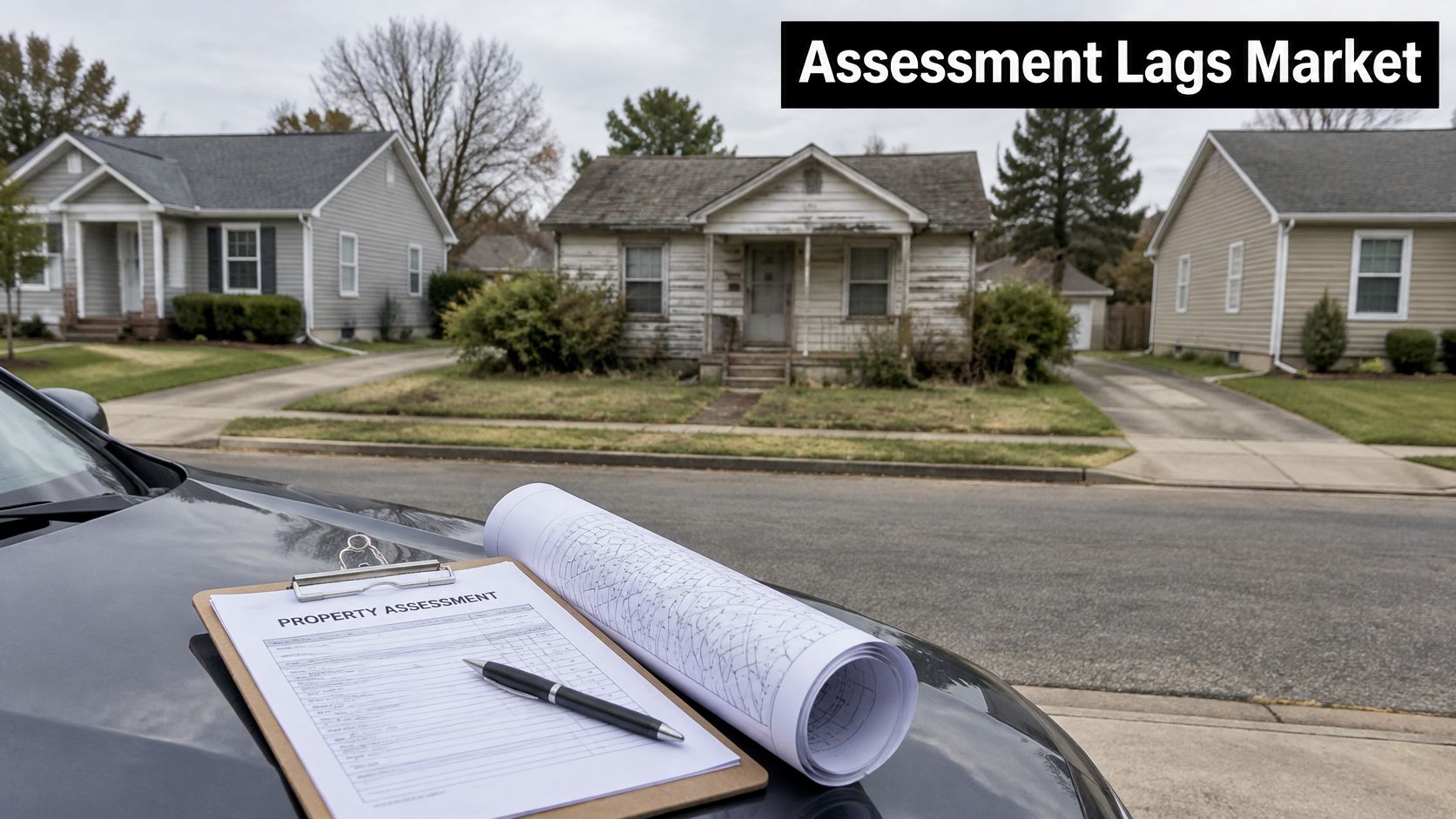
A low assessment doesn't prove you've found an underpriced house. The tax office may be using an older valuation date, a fractional assessment system, or a legally limited value rather than an unrestricted current market estimate.
New York's 2025 market-value survey found that nearly 40% of assessing units had assessments at least 75% of current market value and that 55% of sampled jurisdictions tended to over-assess lower-value homes relative to higher-value homes. Those findings describe New York's surveyed assessment systems, not a conversion formula for every property.
The latter pattern illustrates vertical inequity: lower-priced properties are assessed at a higher proportion of market value than higher-priced properties. A modest house can therefore face a heavier effective burden relative to its value, even when its tax bill is smaller in absolute dollars.
Test the record rather than trusting the gap
Look for these warning signs:
- An older valuation date: Check whether the record reflects the latest scheduled reassessment.
- Newer sales at different price levels: Compare properties with similar physical characteristics, not just nearby addresses.
- A condition mismatch: A renovated home and an uninhabitable home aren't interchangeable comparables, even on the same street.
To test the assessment, develop a market estimate from relevant sales, then apply the locally required assessment treatment. Compare that result with the corresponding field on the tax record, not with a differently labeled amount.
If the difference appears to come from incorrect property facts or unsupported valuation assumptions, assemble the record, photographs, and suitable sales evidence. Our guide to challenging property taxes explains how to approach that review.
Don't turn the assessment into a resale forecast. A higher recorded figure doesn't guarantee that buyers will pay it, just as a lower figure doesn't establish an acquisition discount.
What a Sale Can Do to the Tax Bill
A buyer can acquire the house without inheriting the seller's favorable tax treatment. In jurisdictions with assessment limits, a long-held property may retain a restricted taxable value that changes after a sale.
The Lincoln Institute's analysis of new-buyer property taxes reported that, in its 2025 Miami comparison, a newly purchased median-value home faced a $10,024 bill versus $3,166 for an equally valued home purchased in 2012, a 3.2-times difference. That comparison shows why an existing bill can be a poor forecast for a new owner.
Build a buyer-specific expense estimate
Before accepting the seller's tax expense in your budget:
- Confirm the transfer rule. Ask whether a purchase triggers reassessment, removes a limit, or changes exemption eligibility.
- Estimate the new assessment basis. Use purchase price or updated market value only as the jurisdiction's rules direct.
- Apply buyer-eligible adjustments. Establish the taxable base after the deductions and limits you qualify for.
- Calculate and schedule the expense. Apply the relevant rate, then identify when the changed assessment will affect billing.
The order matters. A value-based exemption generally reduces the taxable base before you apply the rate; don't subtract it directly from the finished tax bill.
For rental investors, cash flow is income remaining after operating expenses and financing costs. Understating taxes can make that remainder look healthier than it will be.
The same concern applies to BRRRR, meaning buy, rehab, rent, refinance, repeat. Renovation and refinancing plans don't excuse using a predecessor's tax treatment in the long-term operating budget.
Keep separate fields for current taxable value, assessed value, taxable value after buyer-eligible exemptions, and expected future tax expense. Local labels may overlap, but your worksheet should make the assumptions explicit. A seller's historical payment is evidence to investigate, not a promise about your ownership costs.
Check the Assessed Value Before You Rely on It
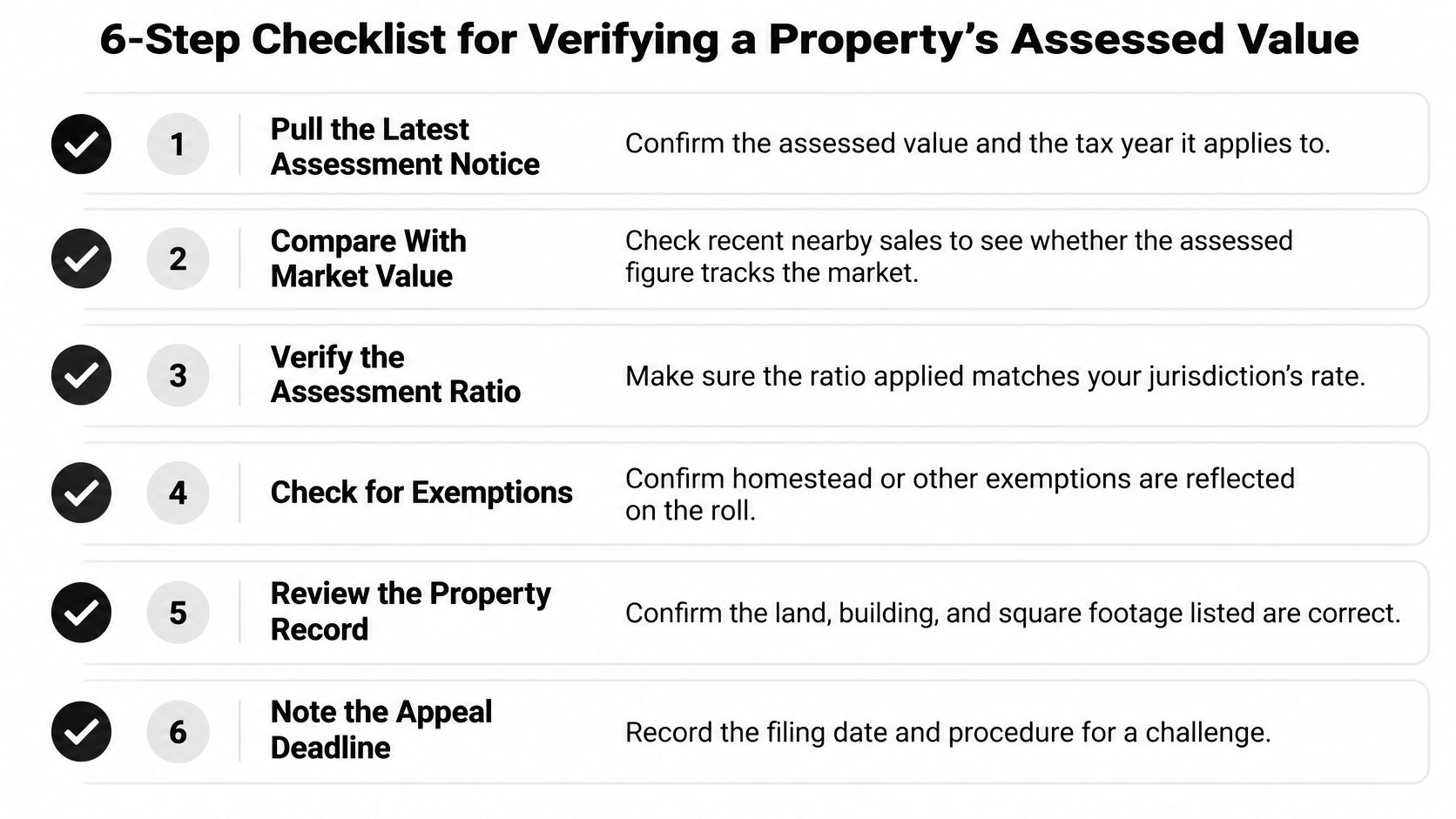
Use this checklist before placing an offer or finalizing an expense budget.
Retrieve the correct record. Match the address to its assessor's parcel number, or APN, the identifier used for the land record. If needed, follow our guide to finding your APN, then confirm the notice's effective date.
Identify each value field. Separate the underlying valuation from the adjusted taxable amount. Check the recorded building details, too.
Investigate transfer treatment. For a purchase, document the rules supporting your expected post-sale bill.
Calendar the appeal deadline. Save the filing instructions and supporting documents before the review window closes.
Check suitable sales. Match location, condition, size, and transaction timing rather than selecting sales solely because they're nearby.
Obtain the required professional valuation. Order a licensed appraisal when the lender, court, or transaction requires one.
For a jurisdiction-specific example, the Unitism® guide to DC assessments provides context for reviewing assessments in the District of Columbia. Use the guidance for the property's actual location rather than importing another jurisdiction's rules.
AI output, including ARV calculations and valuations, isn't a licensed appraisal, definitive valuation, or guaranteed forecast. Use assessed value as the tax input and comparable sales as the market-value input.
We pull public records, tax assessments, and market data without requiring MLS access, helping you examine tax information alongside market evidence. Visit PropLab to analyze a property's comparable sales and ARV, then verify the buyer-specific tax assumptions before setting your offer.
About the Author
P
PropLab Team
Real Estate Analysis Experts
The PropLab team consists of experienced real estate investors, data scientists, and software engineers dedicated to helping investors make smarter decisions with AI-powered analysis tools.
Free account
Underwrite your next deal in under a minute
3 free analyses, no credit card. ARV, rehab, comps and exit strategy in one report.
